She stood on the ledge fourteen floors above a New York City street, the wind moving around her in the silence of a late night she would never fully be able to recall. She was tired, lost, and numb, but unafraid. She was not at all certain she wanted to take her own life, and that uncertainty was the only thing that kept her from stepping forward. She looked down at the pavement, stood there in total silence, and then came back inside.
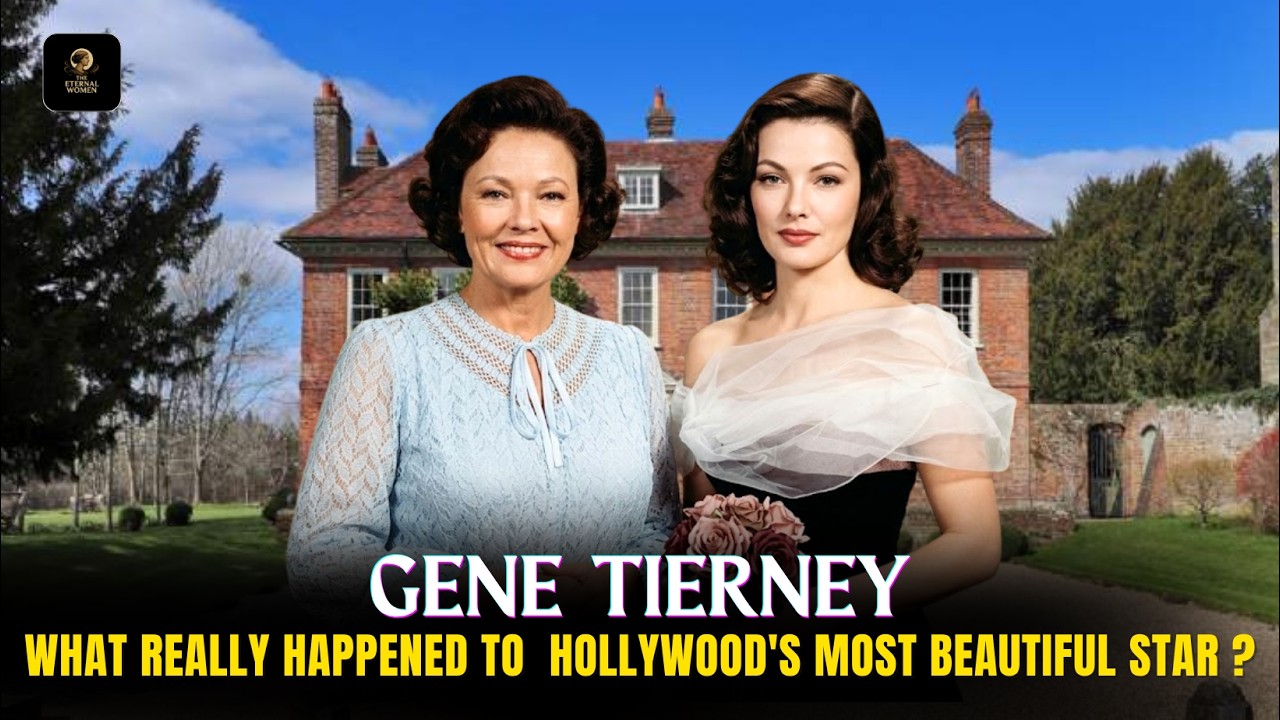
She always came back. The woman on that ledge was Gene Tierney, and by the time she found herself there, in the mid-1950s, she had already been called the most beautiful woman in movie history, romanced a future president, married a count against her family’s fury, lost a daughter to a stranger’s careless act before the child was even born, and submitted to twenty-seven electroshock treatments that erased years of her own memory. Darryl F. Zanuck, the most powerful studio chief in Hollywood, had called her face unquestionably the most beautiful in film.
None of it had protected her. None of it had reached the place where she was breaking. She was born Gene Eliza Tierney on November 19th, 1920, in Brooklyn, New York, the second of three children in a family that already wore success like a tailored coat. Her father, Howard Sherwood Tierney, was a prosperous insurance broker, genuinely wealthy, a man of position and expectation in the upper middle class of New York.
Her mother, Belle Lavina Taylor, had been a physical education instructor before marriage. Together they raised their children in a world of private schools, European finishing academies, and carefully managed social ascent. Gene was named after a beloved uncle who had died young, carrying someone else’s memory from her very first breath. She attended Saint Margaret’s School for Girls in Waterbury, Connecticut, and the Unquowa School in Fairfield, Connecticut, where she published her first poem, titled “Night,” in the school magazine.
Before returning to the United States in 1936, she spent three years studying at the Brillat-Savarin International School in Lausanne, Switzerland, and became fluent in French. She was multilingual, cultured, refined, and impossibly striking even as a teenager. She did not need Hollywood. She was not running from poverty or obscurity.
When she eventually chose acting, she was choosing down in some respects, choosing the uncertain, somewhat disreputable world of performance over the safe comfort of a society marriage to a Yale man. Her own words, years later: “In my circle, you married a Yale boy after school. I wanted to be an actress. ”
Her discovery happened twice, both times to the same face in different rooms.
On a family trip to the West Coast, the Tierneys visited Warner Brothers studios, where Belle’s cousin, Gordon Hollingshead, worked as a producer of short films. Director Anatole Litvak, taken by the seventeen-year-old’s presence, told Gene directly that she should become an actress. Warner Brothers wanted to sign her immediately, but her parents advised against it. The salary was too low, and they had other ambitions for their daughter.
Her society debut occurred on September 24th, 1938. Quickly bored with debutante life, she pushed toward acting, but on her father’s terms. He insisted she begin in the legitimate theater, not film, and set up a corporation specifically to promote her theatrical career. Her first Broadway role, in the 1938 production of What a Life, consisted of carrying a bucket of water across the stage.
A Variety critic, apparently somewhat bewitched, declared, “Miss Tierney is certainly the most beautiful water carrier I’ve ever seen. ”
She appeared as an understudy in The Primrose Path, then took a major role as Molly O’Day in Mrs. O’Brien Entertains, 1939. The New York Times critic Brooks Atkinson wrote, “As an Irish maiden fresh from the old country, Gene Tierney in her first stage performance is very pretty and refreshingly modest.
” After Ring Two, theater critic Richard Watts Jr. of the New York Herald Tribune offered a forecast that proved almost prophetic: “I see no reason why Miss Tierney should not have an interesting theatrical career, that is, if cinema does not kidnap her away. ”
Cinema had every intention of kidnapping her. The mechanism was The Male Animal, a 1940 Broadway hit that made her a genuine sensation.
She was photographed for Life, for Harper’s Bazaar, for Vogue, for Collier’s Weekly. She was the toast of Broadway before her twentieth birthday. One night during the run, Darryl F. Zanuck was reportedly in the audience.
He told his assistant to note the name of the actress he had just watched. Later that same night, at the Stork Club, he spotted a young woman on the dance floor and told his assistant, “Forget the girl from the play. See if you can sign that one. ” The woman on the dance floor was Gene Tierney.
He did not even realize she was the same person. She had, as she later explained, several distinctly different looks. Zanuck signed her to 20th Century Fox. She made her motion picture debut in Fritz Lang’s western The Return of Frank James, 1940, opposite Henry Fonda.
She was twenty years old. What followed was an extraordinary cascade of work: Tobacco Road, directed by John Ford; Hudson’s Bay; The Shanghai Gesture, directed by Josef von Sternberg, in which she played a Eurasian girl in an opium den with such intensity that audiences did not know quite what to make of her; Belle Starr; Son of Fury; China Girl. She worked at a pace that today would be considered exploitative, multiple films per year under a contract system that owned her time, her image, and her professional trajectory. She was shaped by some of the most demanding directors in the industry, Fritz Lang, Ernst Lubitsch, Otto Preminger, men who had no patience for anything less than total commitment.
She broke their tempers. She absorbed their lessons. She grew. By 1943 she had the professional confidence that only comes from surviving difficult rooms.
She was cast opposite Don Ameche in Ernst Lubitsch’s Technicolor comedy Heaven Can Wait, reportedly locking antlers regularly with the brilliant, infuriating Lubitsch while quietly trying to conceal something from her colleagues. She was pregnant, and she was deeply, terrifyingly happy about it. The happiness would not last. In 1940, Gene met Oleg Cassini at a party hosted by their mutual friend Constance Moore.
Cassini was a Russian-Italian fashion designer, charming and dapper, technically a count, and working as a costume designer at Paramount Pictures. Her family was horrified. Her father saw Cassini as unsuitable, divorced, not wealthy enough, not the right kind of man for his carefully cultivated daughter. 20th Century Fox was similarly unenthusiastic.
None of it mattered to Gene. On June 1st, 1941, she eloped with Cassini in Las Vegas, Nevada, in a private ceremony, giving her name as Gene Eliza Taylor Tierney. Her parents essentially disowned her for a time. The couple had to live almost entirely on Gene’s earnings, and her father, who had been managing her finances, had squandered a significant portion of her savings.
She was supporting her husband, estranged from her family, and still expected to show up on set every morning and be radiant. She was twenty years old. For a brief period the marriage was genuinely happy. Cassini genuinely loved her.
He later worked as her personal costumer at Fox, designing clothes specifically for her. When he was posted to Fort Riley, Kansas, during his wartime military service with the United States Army, they maintained a correspondence filled with the particular longing of separated people who were still in love. But the cracks were already forming. What happened in June of 1943 would split the foundation entirely.
In the summer of 1943, Gene was pregnant with her and Oleg’s first child. Unlike many stars of that era, she was doing her patriotic duty, appearing at the Hollywood Canteen, a club on Cahuenga Boulevard where servicemen and women could come on their nights off and mingle with the celebrities who came to entertain them. In June 1943, Gene contracted rubella, German measles, at one of these appearances. Antoinette Daria Cassini was born prematurely in Washington, D.
C. She weighed three pounds and two ounces and required a complete blood transfusion. The rubella had caused catastrophic congenital damage. Daria was born deaf, partially blind due to cataracts, and severely mentally disabled.
She would require institutional care for the remainder of her life. Gene and Oleg tried to bring her home. They tried to raise her, but her needs were beyond what they could provide, and eventually, heartbreakingly, she was institutionalized. Howard Hughes, Gene’s longtime friend, who had pursued her romantically in earlier years and been gently rebuffed but had remained close to her, personally paid for all of Daria’s medical expenses, ensuring she received the best care available.
About a year after Daria’s birth, Gene attended a tennis party. A young woman approached her, smiling, and asked if Gene remembered her. She reminded Gene that they had met at the Hollywood Canteen. Then, with what seems to have been a complete inability to grasp the magnitude of what she was about to say, the woman added, “Did you happen to catch German measles after that night?
You know, I probably shouldn’t tell you this, but almost the whole camp was down with German measles. I broke quarantine to come to the canteen to meet the stars. Everyone told me I shouldn’t, but I just had to go. ”
Gene stood there in the middle of a sun-drenched tennis party and listened to this woman confess, casually and without apparent remorse, that she had broken a medical quarantine, during wartime, to shake hands with a movie star.
Gene later wrote in her 1979 autobiography, Self-Portrait, that she felt a kind of numb, almost dissociative shock. “I wanted to hit her. I wanted to scream. Instead, I turned and walked away.
” She never publicly identified the woman. She wrote about it. She carried it. And she broke under the weight of it in stages over the years that followed.
Agatha Christie read about the incident and was so disturbed by its moral complexity that she wrote The Mirror Crack’d from Side to Side around it. Christie’s official website acknowledges directly that the plot was inspired by this real-life tragedy. In the middle of all this private devastation, Gene made the film that would define her legacy. Laura, 1944, directed by Otto Preminger, is one of the most perfectly constructed films noirs ever made.
Gene plays Laura Hunt, and the genius of her performance is that she had to be more compelling as a memory, as a portrait on a wall, than any living person in the film could be in the flesh. The detective, played by Dana Andrews, had to fall in love with a woman the audience had only heard about. When Laura finally appeared, Tierney had to justify every word of praise and every gesture of longing that had preceded her entrance. The shot of her walking through a doorway, rain-drenched, confused, alive, when everyone thought she was dead, is one of the most iconic frames in Hollywood history.
Laura was a massive commercial and critical success, selected in 2008 by the American Film Institute as one of the ten greatest mystery films ever made. It earned Preminger an Academy Award nomination for Best Director and made Gene definitively a major star. The unbearable irony is that during the production of Laura, she was carrying the grief of Daria’s birth, the stress of her increasingly strained marriage, and the beginning of the interior unraveling that would eventually consume her. She was playing a woman who returns from apparent death while privately wondering if she herself was dying in a way no one could see.
If Laura made her a star, Leave Her to Heaven, 1945, proved she was an actress of genuine fearless depth. In John M. Stahl’s luridly beautiful Technicolor melodrama, Gene plays Ellen Berent, one of the most frighteningly possessive, psychologically complex women in classic Hollywood cinema. She never plays her as a villain.
She plays her as someone who is completely, sincerely convinced that her love is pure, even when she is doing monstrous things to protect it. She was nominated for the Academy Award for Best Actress. She did not win; the Oscar went to Joan Crawford for Mildred Pierce. But the nomination has only grown in stature over the decades.
The films kept coming: A Bell for Adano, The Razor’s Edge opposite Tyrone Power, Dragonwyck directed by Joseph L. Mankiewicz, and The Ghost and Mrs. Muir opposite Rex Harrison, a delicate, romantic ghost story in which Tierney brought a warmth and gentle melancholy that felt deeply personal. By the mid-1940s she was at the absolute peak of her fame, on par, as contemporaries noted, with Rita Hayworth, Lana Turner, and Ava Gardner.
Fox continued her salary without interruption through whatever personal crises arose. Professionally, she was seemingly untouchable. But privately, the machinery was grinding. In 1946, while filming Dragonwyck, Gene met a young man in a Navy lieutenant’s uniform.
She wrote about this moment in Self-Portrait with a clarity that still carries heat decades later. She turned and found herself looking into what she thought were the most perfect blue eyes she had ever seen on a man. “My reaction was right out of a lady’s romance novel. Literally, my heart skipped.
” The man was John F. Kennedy, at that point a young World War II veteran, not yet the Massachusetts senator or the president he would become. Gene was separated from Oleg Cassini at the time, though their divorce proceedings were ongoing. She was technically still married.
Kennedy was a charismatic thirty-year-old Irish Catholic with a family of fearsome ambitions and very clear expectations about who their son could and could not marry. They fell into each other anyway. They met again at the house of Norwegian ice skating star Sonja Henie. Kennedy, Gene wrote, quickly dispatched the man she had arrived with and drew her into an empty room where they danced together.
“At one point he said, ‘I could dance like this the rest of my life. ‘ The words did not sound trite at all. I decided right then it would be very easy to fall in love with him. ”
Their romance continued through late 1946 and into 1947.
Something bound them together beyond attraction, something both tragic and intimate. Kennedy’s sister, Rosemary, had been born with intellectual disabilities and had been institutionalized. Gene had Daria. They shared the particular grief of loving a child or sibling who required a kind of care the world could not quite accommodate.
Kennedy told Gene about Rosemary. Gene understood completely. But the romance was doomed by the very architecture of Kennedy’s ambitions. Even Oleg Cassini, still Gene’s husband and far from an innocent party in their marital collapse, warned her directly.
“Don’t you understand? Jack can’t marry you. No Catholic is going to marry a divorced woman. His family won’t stand for it.
Gene, be sure you know what you’re doing. ”
He was right. In 1947, Kennedy broke it off. His exact words to Gene, as she recorded them, were essentially that she would not fit into the life he was building, that the political path he intended to walk could not accommodate a divorced actress with a disabled daughter.
He was not cruel about it. He was clear. She was devastated. She sent him a congratulatory note in 1960 when he was elected president.
She voted for Richard Nixon in that election, a fact that reflects something complicated and human. One more detail history could not have invented: after the divorce from Gene was finalized and Kennedy became president, it was Oleg Cassini, Gene’s ex-husband, who became Jacqueline Kennedy’s personal fashion designer, creating the iconic look the world came to associate with Camelot. Gene and Oleg divorced in 1952, a full eleven years after their Las Vegas elopement. The divorce had been attempted before.
The proceedings began in the late 1940s, but the two had briefly reconciled, and their second daughter, Christina, was born on November 19th, 1948, Gene’s own birthday. Christina was born healthy. She was everything Daria, in heartbreaking contrast, could not be. After the divorce was finalized, Gene’s life entered a new phase.
She was working consistently: Night and the City, The Mating Season, On the Riviera, Plymouth Adventure. During the filming of Personal Affair in Europe, she met Prince Aly Khan, who was simultaneously going through a divorce from Rita Hayworth. They fell in love. They became engaged.
Then Aly Khan’s father, the Aga Khan III, spiritual leader of millions of Ismaili Muslims, made his feelings known. He opposed the match entirely. The engagement was broken. She had now been told, twice, by two men she loved, that the life she wanted to build with them was architecturally incompatible with their other obligations.
Kennedy’s political family, a prince’s religious dynasty. Both times the message was essentially the same: you are wonderful, but you do not fit. Gene Tierney was diagnosed with what was then called manic depression, the condition now understood as bipolar disorder. The onset, while influenced by the accumulated trauma of Daria’s birth, her marriage’s collapse, Kennedy’s rejection, and the engagement falling apart, was not simply situational grief.
There was a clinical condition. Her brain chemistry was turning against her. The symptoms manifested first as difficulty concentrating. She had always been professional, disciplined, reliable on set.
Now she began forgetting her lines. The mental fog thickened. In 1953 she was slated to star in Mogambo opposite Clark Gable. She had to withdraw.
The role went to an up-and-coming actress named Grace Kelly. Two years later, while filming The Left Hand of God opposite Humphrey Bogart, the situation reached a point that alarmed her co-star enough to take action. Bogart’s younger sister, Frances, had struggled with mental illness. He knew what it looked like up close.
He fed Gene her lines throughout production, quietly and without making a scene. He warned the studio bosses that she was sick and needed help. The studio assured him she was a professional and would deliver. She did deliver.
She always delivered. But the effort it cost her was immense. Gene later described it in harrowing terms: “I was so ill, so far gone, that it became an effort every day not to give up. I knew that if I got through the picture, I had to get myself to a hospital.
”
She entered the Harkness Pavilion in New York. She then spent a year and a half at the Institute of Living in Hartford, Connecticut, and later eight months at the Karl Menninger Clinic in Topeka, Kansas. There, at the Menninger Clinic, as part of her therapy, she took a job as a salesgirl at a local dress shop, anonymously. Nobody knew she was Gene Tierney, the woman Darryl Zanuck had called the most beautiful in movie history.
She folded clothes and helped customers and rang up purchases and tried to remember how to exist as a person rather than a persona. Life magazine later published photographs of this period. They are among the most quietly devastating images in the archive of Hollywood history. In 1957, Gene stepped out onto the ledge of her mother’s apartment building, fourteen floors above a New York City street.
She wrote about it in Self-Portrait with a chilling, dissociated calm. “I felt tired, lost, and numb, but unafraid. I wasn’t at all certain I wanted to take my own life. ” She was talked back inside.
She did not fall. She survived what had come before, the rubella, Daria’s disability, the failed marriages, the heartbreaks, the twenty-seven electroshock treatments that would, by her own account, erase significant portions of her memory. She submitted to them because they were, at the time, a standard and recommended treatment for severe depression. She later spoke out against shock therapy publicly, saying it had destroyed sections of her recollection of her own life.
The ledge was not the end. It was, in a terrible way, the bottom. In September 1958, Life magazine ran a story that was unusual for its time. Gene Tierney, then thirty-seven, had returned to Hollywood after four years of absence.
She spoke with what Life described as easygoing directness about exactly where she had been and what she had been doing. She did not hide her hospitalization. She did not employ the careful euphemisms of the era, exhaustion, nerves, taking time away. She said she had broken down.
She said she had been in a mental sanitarium. She said she had needed help. In 1958, this was extraordinary. 20th Century Fox had, notably, continued paying her salary throughout her entire absence.
Everywhere she went on that return visit to the Fox lot, executives, actors, carpenters, directors, people hurried to shake her hand and hug her and welcome her home. She appeared in Advise and Consent, 1962, directed by Otto Preminger, the director who had made Laura with her eighteen years earlier. Critics noted her acting was as compelling as ever. Her last feature film was The Pleasure Seekers, 1964.
Her final screen appearance was in the CBS miniseries Scruples, 1980, in which she played lesbian magazine publisher Harriet Toppingham. In 1958, during her return to Hollywood, Gene met W. Howard Lee, a Texas oil baron who had, by one of history’s more extraordinary coincidences, recently gone through a divorce from Hedy Lamarr. Lamarr was, like Gene, one of Hollywood’s most celebrated beauties, and both had been described, at various points, as the most beautiful woman in the world.
Gene and Howard Lee married in 1960. She moved to Houston, Texas. Her marriage to Howard Lee was, by all accounts, genuinely happy. She described her life in Houston as preferable to her years of Hollywood stardom.
She traveled with her husband. She participated in civic causes. She became active in helping children with intellectual disabilities, a cause deeply personal to her. Then in 1960, Gene discovered she was pregnant again in the middle of planning a professional comeback and return to Peyton Place.
She withdrew from the film. She suffered a miscarriage. The grief was real and it set her back. But it did not send her to the ledge again.
She had built something in Houston, a life, a marriage, an identity that existed independent of the camera and the spotlight, and she held on to it. Howard Lee died in 1981. Gene remained in Houston, living quietly in the city she had made her home for the next decade. As an actress, Gene appeared in more than thirty feature films.
Two of them, Laura and Leave Her to Heaven, are regarded as masterworks of their respective genres. Laura was selected for preservation in the United States National Film Registry by the Library of Congress in 1999, deemed culturally, historically, or aesthetically significant. In 1979 she published her autobiography, Self-Portrait, written with journalist Mickey Herskowitz. It is one of the earliest accounts by a major Hollywood star of the realities of mental illness, its treatment, and its impact on a career and a life.
In 1986, she received the Donostia Lifetime Achievement Award at the San Sebastian International Film Festival. Her personal papers, letters, and film-related materials were entrusted to the Wesleyan University Cinema Archives. The Agatha Christie novel The Mirror Crack’d from Side to Side, directly inspired by the incident at the Hollywood Canteen, introduced her tragedy to a second generation of readers, and then a third when the novel was adapted for television in 1980 with Elizabeth Taylor playing the thinly veiled Tierney character. Howard Hughes pursued Gene romantically in the early years of her career and was, by all accounts, firmly but gently rebuffed.
They became lifelong friends. When Daria was born, Hughes stepped in immediately and personally covered all of Daria’s medical expenses for the rest of her life. No public announcement. No press release.
Gene’s own assessment of Hughes, delivered with the wry affection of a true friend, was, “I don’t think Howard could love anything that didn’t have a motor in it. ” Humphrey Bogart had no romantic relationship with Gene. What he had was the specific, practical empathy of someone who recognized suffering he understood because he had seen it in his own family. He fed her lines without humiliating her.
He warned the studio that she was unwell. He counseled her privately to seek help, advice she eventually followed. He was not performing compassion. He was extending it.
Gene Eliza Tierney died on November 6th, 1991, in Houston, Texas. She was seventy years old, two weeks short of her seventy-first birthday. The cause was emphysema, developed over decades from a lifelong cigarette habit she had adopted in Hollywood to lower the timbre of her speaking voice after hearing herself for the first time in a playback, convinced she sounded, in her own words, like an angry Minnie Mouse. She left behind her daughter Christina and grandchildren and great-grandchildren.
Daria Cassini, who had spent most of her life in institutional care, died on September 11th, 2010, at the age of sixty-six. Christina Cassini died on March 31st, 2015, also at sixty-six. Both daughters outlived their mother. Both daughters died at the same age.
Gene Tierney’s story sits at a particular crossroads of American life in the mid-twentieth century. She was born into privilege, gained extraordinary fame, suffered losses that would have broken most people outright, received inadequate medical treatment for a real clinical condition, was subjected to procedures she later identified as damaging to her memory and sense of self, and she survived all of it. She found a quiet life. She wrote her book.
She told her truth. She was a woman who said, with characteristic directness, “I had no trouble playing any kind of a role. My problems began when I had to be myself. ”
Darryl F.
Zanuck called her the most beautiful woman in movie history. That assessment, whatever its merits, reduces her to a single dimension. The fuller truth is more interesting and more important. She was a woman of genuine talent who did her finest work in the shadow of real pain, who was open about her mental illness long before openness was fashionable or safe, who survived what should not have been survivable, and who found, in the end, a version of peace that was quieter than the headlines but more lasting than the fame.
She had the beauty, the talent, the fame, the love of one of the most charismatic men of the twentieth century, a prince who wanted to marry her. None of it, not one single ounce of it, protected her from loss, from grief, from the biology of her own brain, from the cruelty of a stranger’s reckless decision on a wartime evening, from standing on a ledge fourteen floors up and not being entirely sure she wanted to come back inside. What saved her was treatment, time, a second marriage to a quiet man in Texas, the slow, unglamorous work of rebuilding an interior life that was not built on a performance, and the willingness to write it all down, honestly, and put her name on it. Gina Eliza Tierney, November 19th, 1920, to November 6th, 1991.
Actress, survivor, witness to her own life.
