The box arrived at Lord Byron’s residence while he was living abroad, and when he opened it, he found a note from Lady Caroline Lamb professing her continued love for him. Beneath the note lay a lock of hair. It was not hair from her head. It had been plucked from lower on her body, and the strands were still bloody.
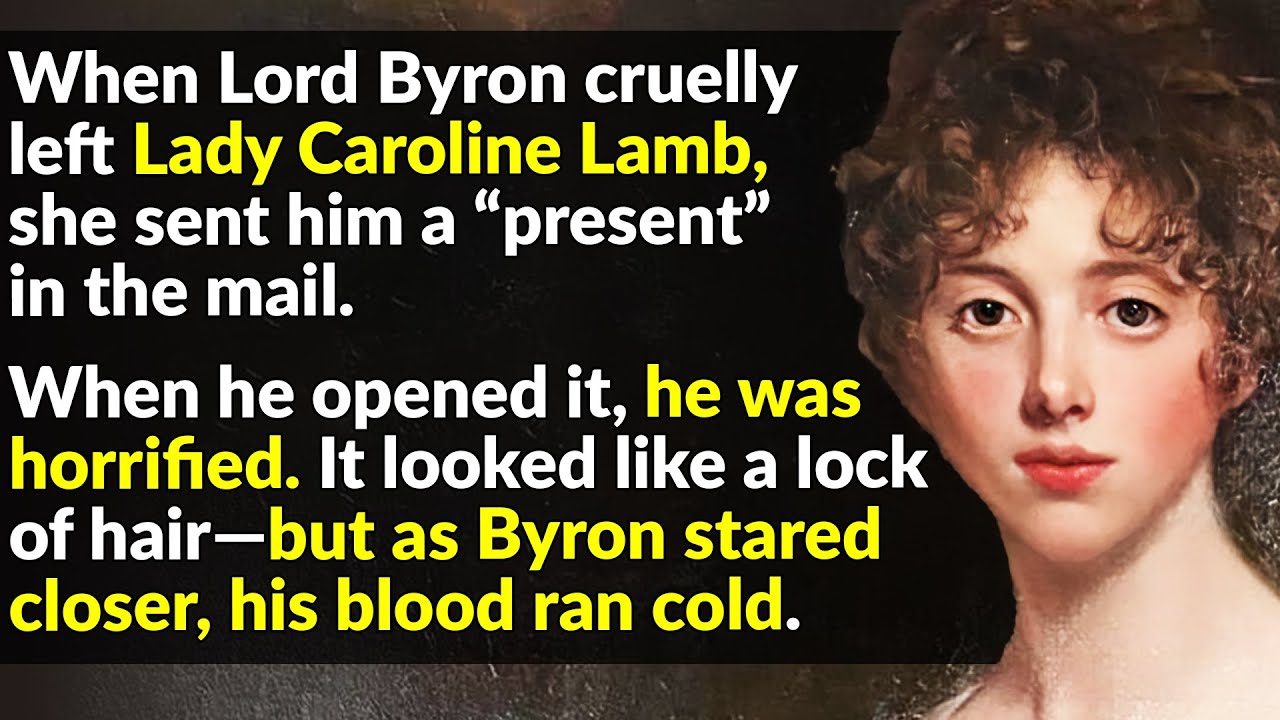
The sight of it horrified him. His blood ran cold. What she had been thinking when she packed that present, no one would ever know, but it was a strange way to declare love to anyone. Before there was Bridgerton, there was Lady Caroline Lamb.
Beautiful, envied, and born into the highest circles of British society, she would end up at the center of one of the most disastrous affairs in history, and she would pay for it with her reputation, her health, and nearly her sanity. She was born Caroline Ponsonby on November 13, 1785, the only daughter of Frederick and Henrietta Ponsonby, the Earl and Countess of Bessborough. As a child, she was frail, so sickly that she nearly died from an illness involving worms. While her upper-class cousins spent their time running and playing, young Caroline struggled with her ailments, and in time she picked up a scandalous habit to cope with them: she took opiates such as laudanum, a remedy that would follow her for the rest of her life.
Despite her frail constitution, she blossomed into an extraordinarily beautiful young woman as she entered her teenage years. Her aristocratic family, with its enormous connections, had no doubt their daughter would land an excellent marriage. At the age of nineteen, she married the Honorable William Lamb, a man from an equally aristocratic family with great political ambitions. The match was a happy one, at least at first, with both partners genuinely liking one another.
What Caroline did not know was that her new mother-in-law despised her from the very beginning. The marriage started well, but that would soon change. Caroline became pregnant shortly after the wedding, but the child was stillborn. The loss was hard on the young couple, yet they tried again.
The pregnancies took a severe toll on Caroline’s weaker constitution, and her body was slow to recover. She gave birth to a son named George in 1807, and then a premature daughter in 1809 who died very quickly. The pregnancies left her severely weakened. Then came more difficult news: their son George had mental disabilities.
In an era when it was common practice to send such children to institutions, Caroline insisted on caring for her son at home, a decision that put considerable strain on her marriage. The stresses in Caroline’s life weighed on her heavily. Her ailing health, her son’s challenges, and her husband’s ambition for political power were a great deal for a young woman to handle. Her mother-in-law made her life difficult at every turn, and her husband’s siblings followed their mother’s lead, cruelly calling Caroline “the Little Beast.
”
With all these troubles piling up, it was no surprise that she soon found herself embroiled in an affair. In 1812, at the age of twenty-six, she met the dashing and infamous poet Lord Byron, a man with a reputation for seducing women wherever he went. His attention soon fell on Lady Caroline herself. Byron was immediately smitten, but at first she ignored his advances, calling him “mad, bad, and dangerous to know.
” Her attitude changed after she read some of his poetry. She reached out to him with a letter, and Byron responded by visiting her in person. Within days, their affair was in full swing. The relationship was tumultuous from the very beginning.
They played games with each other, criticizing one another publicly and then sneaking off together in private. Both were infatuated. Byron gave her the pet name “Caro,” and he famously called her “the cleverest, most agreeable, absurd, amiable, perplexing, dangerous, fascinating little being that lives now, or ought to have lived 2,000 years ago. ” Their intense obsession nearly propelled them into the realm of bigamy.
Caroline’s desperation reached such heights that she implored Byron to marry her, despite the inconvenient fact that she was already married to William. The reckless proposition showed just how infatuated she was. Had they actually gone through with it, the consequences would have been nothing short of scandalous. Oddly enough, Lord Byron was very good friends with Caroline’s mother-in-law, the very woman who hated her so much.
When the mother-in-law found out about the affair, she put all her efforts into ruining it, making sure her son William was promptly informed. Despite the strained relationship between William and Caroline, and this new revelation of her extramarital affair, William was not incredibly bothered. He did not divorce her. Unfortunately for Caroline, Byron soon tired of her.
He broke things off in August 1812, after only half a year together. What Caroline did not know was that one of the reasons Byron ended the affair was that he was deeply in debt and was searching for a rich woman to marry to solve his financial troubles. After Byron left her, Caroline was seen as a social pariah in the eyes of high society, something of damaged goods. Byron’s reputation, for what it was worth, did not suffer at all.
To help her as best he could, William sent Caroline off to Ireland so she might recuperate in peace and quiet. Alone and cooped up in Ireland, she could not get over her former lover. She ended up writing letters to Byron, and he replied, starting a correspondence between them. But when Caroline returned to London in 1813 and sought Byron out, he let her know in no uncertain terms that they were done.
She also soon realized that Byron was already in a relationship with someone else: Lady Oxford. To add insult to injury, Byron cruelly began to insult Caroline publicly and privately. He complained that he was haunted by a skeleton, a cruel reference to Caroline’s weight loss and diminished appearance. In a particularly dramatic incident, during a ball held to honor the Duke of Wellington, Byron had the audacity to insult Caroline in front of all her peers.
In response, Caroline hugely overreacted and caused a major scene. The incident did not help her image at all, with many unfairly assuming she had done it only for attention. The situation then took a darker turn. Caroline’s obsession with Byron escalated to the point where she began to stalk him.
Her relentless pursuit led her to dress up in various disguises in an attempt to gain entry to his residence. The behavior highlighted the lengths to which she was willing to go to maintain some connection with him. In 1815, still unable to move past her relationship with Byron, Caroline was devastated to hear that he had married a wealthy heiress named Annabella Milbanke. The news was a painful blow, deepening her feelings of loss and rejection.
The marriage marked the end of any lingering hopes she might have harbored and intensified the sense of betrayal and heartbreak that had long plagued her. Byron’s new marriage, though, did not go smoothly either. Barely a year into it, Annabella left him, taking their newborn daughter with her. Byron had not exactly been a very good husband.
Combined with his excessive debts and rumors that he had even slept with his own half-sister, he became a social pariah, just as Caroline had been. In disgrace, he fled the country in 1816. In an act of revenge, Caroline published a novel titled Glenarvon. Although it was presented as a work of fiction, the novel very transparently revealed many secrets from her tumultuous affair with Lord Byron.
The bold move shocked society. Though the book was published anonymously, the writing was so thinly disguised that it was clear Caroline had written it. One of the aristocratic women ridiculed in the novel, the Countess of Jersey, made sure all of Caroline’s memberships to exclusive clubs were revoked upon finding out what had been written. This time, Caroline was truly out.
Yet it was not all bad for her. Her book was a huge success, and shortly afterward she struck up another affair, this time with the famous Duke of Wellington, fresh off his victory over Napoleon at the Battle of Waterloo. Over the following years, Caroline and Byron engaged in a toxic pattern of behavior, frequently alluding to each other in their writings. These references were far from friendly, often laden with bitterness and resentment.
In 1824, Lord Byron fell ill and tragically passed away while in Greece. The news of his death was devastating for Caroline, and she reportedly fell ill herself upon learning of his demise. During Byron’s funeral procession, her distress overwhelmed her, and she collapsed dramatically in public. Byron’s death seemed to be the final straw for Caroline’s well-being.
Her behavior became erratic. She would have fits of rage and break things, or ride her horse crazily around town. She even stopped caring about her appearance, showing up to engagements entirely messy and unkempt. Throughout all of this drama, her husband William remained by her side, refusing his family’s wishes that he divorce his wife and leave her for good.
In the end, it was Caroline herself who finally suggested a divorce. After leaving William, things only went downhill. She took up residence at a place called Brocket Hall, and it was during this time that she became an alcoholic, as well as addicted to laudanum, the opiate she had used as a child for her health issues. By 1827, at the age of forty-one, Caroline’s health was very poor, and she was under the full-time supervision of a doctor, suffering from edema, a buildup of fluid in the tissues.
Near the end of her life, it appeared that Caroline was finally able to let go of her obsessive attachment to Lord Byron. Instead, her thoughts turned to her ex-husband. Reflecting on their relationship, she remarked: “He is the only person who has never failed me. ” In a final gesture of reconciliation, Caroline requested that William visit her one last time.
Demonstrating his beautiful character and sense of duty, William traveled all the way from his post in Ireland just to be by her side. Their reunion was brief and bittersweet. Lady Caroline passed away just a few days after William’s arrival, at the age of forty-two. William’s presence in her final days provided her with a sense of comfort and solace.
Caroline’s ex-husband went on to have an immensely successful political career, ultimately rising to the position of Prime Minister of the United Kingdom in 1835. It was a significant milestone in British politics, but Caroline would never witness his accomplishment, or what their life together could have been had things turned out differently. Lady Caroline had lived a tumultuous life. She struggled with many difficulties and had many flaws, with her erratic and scandalous behavior.
She was rather unfairly maligned for her struggles with mental health, something that was not well understood in the nineteenth century. Despite how her behavior was judged then, and how we may judge her today, none of it can excuse the creepiest thing she ever did. Shortly after Byron left her, Caroline got a very strange idea. She decided to give Byron a present to remember her by, but the present she gave him was utterly disturbing.
When Byron, living abroad, opened the box, he found the note professing her love, and beneath it the lock of hair, plucked from below and still bloody. What she was thinking when she did this, we will never know. But it was a very strange way to declare your love for someone.
