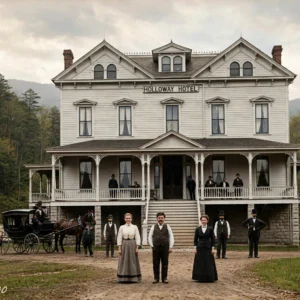
Idaho Press-Tribune, October 17, 1907—that was the date stamped on the clipping, but the story itself was older, and stranger, and it began long before the newspaper ever touched it. It began, as so many things do, in the dark of a Missouri autumn. In the autumn of 1909, when the leaves turned copper and gold in the Ozark Mountains of Shannon County, local authorities made a peculiar discovery at the Warren homestead, approximately seven miles east of the small logging town of Eminence. What began as a routine welfare check following the sudden cessation of the family’s regular appearances in town gradually transformed into one of the most disturbing and least understood cases in the region’s history.
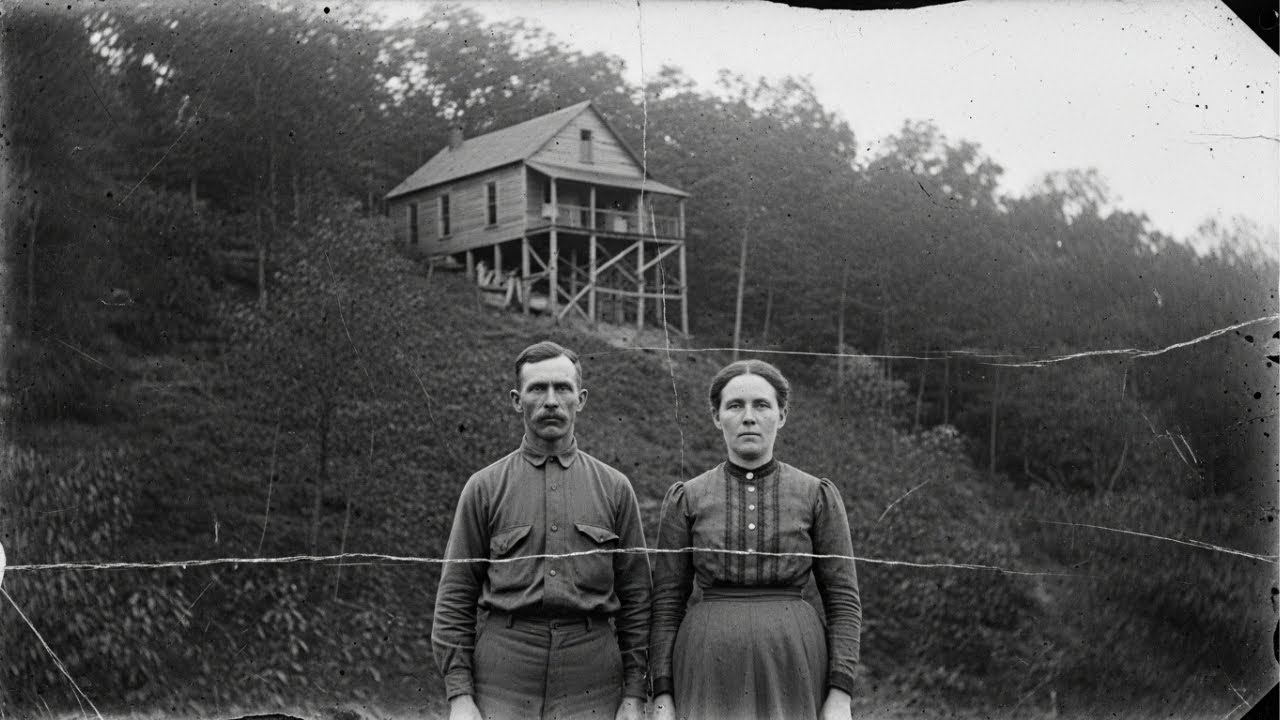
The Warren family had moved to the remote homestead in 1903, purchasing nearly eighty acres of densely forested land that bordered what is now part of the Mark Twain National Forest. Thomas Warren, a stern-faced man in his early forties with a military background from the Spanish-American War, was known in Eminence primarily for his infrequent supply runs and his insistence on handling all family business personally. His wife Margaret, described in county records as reserved and particular, was rarely seen in town after their first year of residence. The couple had no children, though Thomas occasionally mentioned distant relatives who might join them someday.
According to town records, the Warrens paid for their property entirely in gold coins of Spanish origin—a detail that raised eyebrows but was not entirely uncommon in a region where banking institutions were still developing. The homestead they purchased had previously belonged to the Garrettson family, who had abandoned it following a series of crop failures in the drought years of 1901 and 1902. Local memory suggested that the Garrisons had also experienced unusual difficulties during their tenure, though specifics were never documented in official records. The Warren property sat in a narrow valley between two ridgelines, with a year-round spring feeding a small creek that ran along its eastern boundary.
The house itself was positioned unusually—not in the fertile bottomland near the water source, as logic would dictate, but halfway up the western slope, built into a natural depression in the hillside that local geography would later reveal to be the collapsed entrance to a small cave system. This positioning meant that the rear wall of the house’s cellar was in fact the natural limestone of the hill itself. Thomas Warren made significant modifications to the existing structure during their first year of residence. He hired local men for the heaviest work but insisted on performing certain aspects himself, particularly anything involving the cellar and foundation.
Jeremiah Daws, one of the laborers who assisted briefly, later told Sheriff McIntyre that Warren had sealed off a portion of the cellar with a new brick wall, offering no explanation for this modification. “He worked at night on whatever was behind that wall,” Daws reported. “We’d arrive in the morning and find fresh mortar and brick dust, though he claimed he’d been sleeping. ”
What made the Warren case particularly unusual was not what authorities found inside the home during that fateful visit in November 1909, but rather what they didn’t find—and the inexplicable condition of the property itself.
The house stood in perfect order. Meals appeared to have been prepared, but not consumed. Personal belongings remained undisturbed. The only evidence that something was amiss was a peculiar collection of sealed jars in the root cellar, each meticulously labeled with dates and strange markings, and a series of journals written in what one deputy described as a language that resembled English, but wasn’t quite right.
The Warrens themselves had vanished without a trace. Most disturbing of all was the testimony of Elijah Cranford, the nearest neighbor living three miles away, who reported hearing voices in conversation coming from the direction of the Warren property for weeks after the couple was reported missing. “Not shouting,” he clarified in his sworn statement, “just talking like people do at supper. But there wasn’t nobody there to be doing the talking.
” When pressed about whether he had investigated, Cranford stated firmly, “No man with sense walks toward voices with no bodies. ”
Cranford’s testimony was initially dismissed as the imagination of an isolated man known for his fondness for moonshine. However, subsequent statements from hunters and trappers who occasionally passed through the area corroborated his account. Tobias Wheeler, a fur trapper with an established reputation for reliability, reported camping approximately one mile from the Warren property in late November 1909.
“I heard them plain as day,” he told the county clerk in a documented interview from December of that year. “A man and woman talking like they were standing just beyond the firelight. The voices moved when I moved. They stayed the same distance away no matter which direction I walked.
I packed up before dawn and didn’t stop until I reached Winona. ”
The initial investigation was led by Sheriff Josiah McIntyre, whose preliminary report described the scene as unsettling in its ordinariness. The beds were made. The pantry was stocked.
A half-written letter sat on Thomas Warren’s desk, ending mid-sentence: “Margaret believes we finally understood the method by which the remainder was never found. ” What the official report failed to mention, but was later revealed in McIntyre’s personal journals, was the condition of the mirrors in the Warren home. Every reflective surface—from the beveled glass mirror in the bedroom to the polished metal serving tray in the dining room—had been meticulously covered with cloth. When these coverings were removed during the investigation, deputies discovered that the reflective backing of the glass mirror had been scratched with the same curious geometric pattern found beneath the rug.
The metal surfaces showed similar modifications: not random scratches, but precise, intentional alterations to the reflective properties. Deputy James Hullbrook described finding a peculiar design carved into the wooden floor of the Warren bedroom, hidden beneath a heavy rug. “Geometric in nature, with a precision that seemed almost machined rather than hand-carved,” he wrote. The center of the design showed significant wear, as though someone had stood in that exact spot repeatedly.
Hullbrook included a rough sketch of the pattern in his notes, but the original document was damaged in a courthouse fire in 1921, leaving only fragments of the drawing intact. These fragments, when compared to similar designs documented in a certain collector’s possession, show striking similarities to what anthropologists now classify as entoptic phenomena—geometric patterns that appear universally in the visual hallucinations associated with altered states of consciousness across cultures. During their research, investigators uncovered records of a curious incident that occurred shortly before the Warrens’ arrival in the Ozarks. Thomas Warren had previously worked as an acquisition specialist for a private collector in Boston, a man named Thaddeus Blackwood.
According to employment records from Blackwood’s estate, Warren was dispatched to various locations to obtain items of historical and anthropological significance. His final assignment before resigning his position was to the Oklahoma territory in 1902, where he was tasked with acquiring Native American artifacts from the region. Blackwood was a man obsessed with what he called “threshold artifacts”—objects purportedly capable of bridging different states of reality. His collection included items from various indigenous cultures around the world, all sharing similar geometric motifs and all associated with local legends involving transitions, passages, or doorways.
His academic credentials were questionable, but his wealth allowed him to pursue his interests without institutional oversight. His correspondence with various scholars of the period reveals a man gradually moving from legitimate antiquarian interest to increasingly esoteric and fringe beliefs. What Warren found in Oklahoma territory was never officially documented, but correspondence between Blackwood and Warren suggests a significant disagreement about a particular object. In the last letter from Blackwood to Warren, dated January 1903, the collector wrote: “Your refusal to surrender the artifact constitutes theft.
Your claims about its properties are the ravings of an unsound mind. Return what is mine or face the consequences. ” Three months later, Thomas and Margaret Warren purchased their isolated property in the Ozarks, paying in gold coins. Banking records show that Thomas Warren withdrew his entire savings from a Boston bank in February 1903.
The withdrawal was made in person but was flagged in the bank’s records as unusual due to Warren’s agitated state and insistence on gold rather than banknotes. The teller’s notation indicated that Warren claimed to be departing on an extended journey and expressed concern about being followed. What made the case even more troubling was how methodically all traces of the Warrens’ specific activities had been removed from the property. Sheriff McIntyre noted that while personal items remained, anything that might indicate their daily routines or interests had been systematically eliminated.
No books remained on their shelves, though the shelves themselves showed evidence of having been full. No photographs were found, despite an expensive camera among their possessions. The root cellar contained preserved foods, but also dozens of those strange sealed jars filled with what the initial report described only as “unidentifiable organic material suspended in clear fluid. ”
Following the initial investigation, Sheriff McIntyre established a regular schedule of visits to the homestead, carefully noting any alterations.
His records indicate a property in a state of unnatural transition: certain areas decaying rapidly, while others remained perfectly preserved regardless of exposure to the elements. Most notable was his observation that the geometric pattern in the bedroom floor appeared to be slowly expanding, with new lines appearing between his visits, despite the house being supposedly empty. In 1912, three years after the disappearance, a hunting party reported finding what they believed might be human remains approximately one mile from the Warren property, in a small cave system that honeycombed that part of the Ozarks. However, when authorities arrived to investigate, they found the cave entrance had collapsed.
Attempts to excavate were abandoned after workers reported hearing what they described as whispering from inside the rock itself. This incident was officially attributed to superstitious anxiety among the workers, according to county records. One of the workers, Samuel Ledbetter, later provided a more detailed account to a local preacher, Reverend Isaiah Thompson. In Thompson’s personal journal, preserved by his descendants, he recorded Ledbetter’s experience.
The man insisted that as they cleared debris from the cave entrance, they uncovered not bones as expected, but a series of glass jars similar to those found at the Warren place. These jars were arranged in a circle and appeared to have been deliberately placed there. As the workers removed the surrounding stone and soil, Ledbetter claimed the contents of the jars became agitated, moving of their own accord within the sealed containers. Shortly thereafter, the whispering began—not from the cave interior, as reported to authorities, but from the jars themselves.
The cave collapse that halted the excavation occurred when Ledbetter, in a panic, struck one of the jars with his pick, shattering it. He described the released contents as “like smoke, but moving with purpose. ” The other workers corroborated this account but agreed to a simpler explanation for official records, fearing ridicule or worse. Margaret Warren’s sister, Elizabeth Holloway, traveled from Philadelphia to claim the property in 1910 but departed the region less than a week after her arrival.
Before leaving, she authorized the immediate sale of the land at a fraction of its value and reportedly told the station master at the Winona Rail Depot, “I would sooner sleep in a charnel house than spend another night in this country. ” The property failed to sell and eventually reverted to county ownership due to unpaid taxes in 1917. In a letter dated May 17, 1910, to her attorney in Philadelphia, Holloway wrote: “I am now convinced that my sister and her husband have met with foul play, though of a nature I cannot explain. The local authorities are either incompetent or complicit.
During my stay in that dreadful house, I experienced things that strained credibility. Objects moved without cause. Voices carried on still air, and most disturbing, glimpses of figures in my peripheral vision that vanished when directly observed. In the root cellar, I discovered Margaret’s journal hidden behind a loose stone.
Its contents so disturbed me that I destroyed it immediately. I will not repeat what she described, but I will say that if even half of it represented reality rather than madness, Thomas brought something back from his travels that should have remained buried. Sell the property for whatever it will fetch. I want no part of it or anything it contains.
”
A curious footnote to this case emerged in 1935 when a University of Arkansas anthropologist named Dr. Robert Keller published a limited academic paper on indigenous beliefs in the broader Ozark region. In it, he made brief reference to a collection of sealed containers discovered in Shannon County, Missouri, that contained substances consistent with those used in certain Native American purification rituals. Keller noted that such materials were traditionally used to trap malevolent influences and were typically buried at the boundaries of tribal lands.
His paper speculated that the jars found in the Warren cellar might represent a misguided attempt to adopt these practices. The paper was poorly received by his colleagues and was never formally published. Dr. Keller took a leave of absence shortly thereafter and did not return to academia.
Before his academic career, Keller had spent time as a missionary among various tribal communities in Oklahoma territory between 1900 and 1905, potentially overlapping with Thomas Warren’s time there. Keller’s personal papers, donated to the university archive after his death in 1942, include fragmentary notes about what he termed “threshold entities”—beings that supposedly existed at the boundaries between different states of reality. He described them as fundamentally neutral but dangerous in their indifference to human existence. Keller’s notes suggest that certain indigenous practices were designed not to communicate with these entities, but to establish and maintain boundaries against them.
Most significantly, Keller’s papers included a sealed envelope containing a single photograph labeled simply “Warren specimen, 1910. ” The image shows one of the jars recovered from the Warren cellar, the contents clearly visible as a cloudy substance with distinct organized structures floating within. A handwritten note on the back reads: “This is not preserved tissue. This is not a plant.
This is not a fungus. I believe this is a fragment. ”
Between 1909 and 1945, at least seven individuals or families attempted to occupy the former Warren property. None remained longer than four months.
Reasons for departure varied from unusual sounds to persistent feelings of being observed to more prosaic explanations such as poor soil quality or inconvenient location. What remains consistent in their accounts is a description of increasing unease or discomfort that many attributed to the isolation of the property. The Miller family, who attempted residence in 1922, provided the most detailed account of their experience. Jackson Miller, his wife Ellaner, and their two adult brothers purchased the property without knowledge of its history, intending to establish a small tobacco farm.
Within weeks, Ellaner began complaining of insomnia due to what she described as conversations in the walls. Jackson initially dismissed her concerns but soon reported similar experiences himself. Most troubling was their account of frequently finding themselves in rooms without remembering having entered them—particularly the bedroom, where the geometric pattern had been discovered. In a letter to his sister in St.
Louis dated June 1922, Jackson wrote: “There is something fundamentally wrong with the angles in this house. I know how that sounds, but I can find no better way to express it. Rooms seem larger or smaller depending on where one stands. Doorways don’t quite lead where they should.
Ellaner insists that the hallway to the bedroom grows longer each night. Yesterday I measured it carefully: 16 feet 7 inches. This morning, the same careful measurement showed 17 feet 3 inches. Either we are suffering some shared delusion or this house defies the basic principles of physical space.
”
The Millers abandoned the property in July 1922, leaving most of their possessions behind. Jackson’s final letter to his sister, never previously published, contains a disturbing account of their final night in the house: “We have seen them—the previous occupants. They stand in corners, in doorways, always at the periphery of vision. When directly observed, they seem to fold somehow, not vanishing, but receding into spaces that shouldn’t exist.
They are trying to show us something—a method, a process. Ellaner believes they want us to follow them. We are leaving at first light. Whatever the Warrens discovered, whatever transformed them, we want no part of it.
Burn this letter after reading. ”
The last family to attempt residence was the Peterson family in the summer of 1945. Harold Peterson, his wife Ruth, and Ruth’s elderly father purchased the property at auction, unaware of its history. Within weeks, Ruth began complaining of someone “moving things when we’re not looking.
” Harold reported waking to find his father-in-law standing motionless in corners of rooms at night, though the elderly man had no history of sleepwalking or confusion. In September of that year, Harold Peterson arrived in Eminence alone, appearing disoriented and unable to clearly explain where his family members were. When authorities accompanied him back to the homestead, they found it empty. Ruth and her father were never located.
Harold Peterson was briefly held on suspicion of foul play but was released due to lack of evidence. Before leaving the region, he gave a statement to local newspaper editor Franklin Mosley that was never printed but was preserved in Mosley’s personal papers: “They’re still there in the house. Not Ruth and her father—the others. The Warrens.
I heard them talking through the walls. They found a way to step sideways somehow. They’re watching from somewhere just next to where we are. ”
Peterson was committed to the state hospital in Farmington the following year, where records indicate he refused to sleep in a room with closed doors until his death in 1957.
His primary physician, Dr. Emerson Clark, noted: “Patient exhibits consistent confusion regarding physical relationships between objects and spaces. He insists on maintaining visual contact with doorways at all times and becomes severely agitated when his view is obstructed. Most notably, he demonstrates an unusual form of prosopagnosia—the inability to recognize faces—but in a highly specific manner.
He recognizes individuals perfectly well from the front, but becomes terrified when viewing the same individuals in profile, insisting they are someone else looking through from the other side. ”
The property was subsequently condemned by county authorities and left to deteriorate naturally. In 1962, a forest fire swept through portions of Shannon County but inexplicably circled around the Warren homestead, leaving it untouched while burning forests on all sides. Local fire officials attributed this to a change in wind direction, though meteorological records for the day indicate steady winds from the southwest.
Aerial photographs taken during the fire control efforts show a perfect circle of unburned forest surrounding the Warren property, approximately half a mile in diameter. Fire scientists could offer no conventional explanation for this pattern, particularly given the uniform fuel load of the forest and the consistent wind conditions reported throughout the event. The most significant development in understanding the Warren case came in 1968, when a team of researchers from the University of Missouri, led by Dr. Caroline Shepard, initiated a project to document historical homesteads in the Ozarks.
Upon examining county records related to the Warren property, Dr. Shepard became intrigued by the unusual nature of the case and obtained permission to visit the site. A respected anthropologist with a particular interest in folk beliefs and practices, she assembled a team that included two graduate students, a photographer, and a local guide familiar with the terrain. Their expedition was planned as a three-day examination of the site with comprehensive documentation of any remaining structures and artifacts.
They departed Columbia on October 3, 1968. What her team discovered has never been fully disclosed. Their preliminary report, filed with the university on October 9, 1968, noted that despite nearly sixty years of abandonment, portions of the structure remained standing and the root cellar was largely intact. Among the artifacts recovered were fragments of the journals mentioned in the original 1909 investigation.
Dr. Shepard noted that the writing was indeed English, but written in a peculiar reverse style that required a mirror to read properly. The few deciphered passages made reference to “the thinning” and “visitors from the adjacent place. ”
The report includes transcriptions of several journal fragments, including one particularly disturbing entry attributed to Margaret Warren, dated August 1908: “Thomas insists the process is controllable, that with sufficient preparation, we can step through and return safely.
I remain unconvinced. What we have glimpsed watching us through the mirrors seems neither malevolent nor benevolent, merely curious in a way that makes me deeply uneasy. The jars continue to fill, though I cannot say how. We sealed the last one this morning—15 now in total.
Thomas says we need at least 24 to complete the circle. I have begun to dream of spaces between spaces. ”
Most significantly, the team discovered a hidden compartment beneath the floor of what had been the Warren bedroom, containing a small metal box of unusual composition. The box held a single item: a smooth stone object approximately six inches in length, cylindrical, covered in markings that Dr.
Shepard preliminarily identified as possibly related to certain Siouan linguistic groups. The report indicated that the object would be transported to university facilities for further analysis. The report also detailed an unusual phenomenon experienced by the team during their stay. On their second night at the site, all five members reported hearing what sounded like conversations coming from the ruins of the house, though no one was there when investigated.
The team’s photographer, David Kellerman, reported that his equipment malfunctioned in specific areas of the property: film exposures showing inexplicable distortions, audio recordings containing sections of silence punctuated by what he described as “whispering too faint to decipher. ” Most disturbing was Dr. Shepard’s account of finding one of her graduate students, Michael Collins, standing motionless in the remains of the Warren bedroom at approximately 3:30 a. m.
, facing the corner where the geometric pattern had been documented. When approached, Collins reportedly turned to Dr. Shepard and asked, “Do you see how the angle opens if you look at it correctly? ” He had no recollection of the incident the following morning.
Three weeks after filing this report, Dr. Shepard requested an immediate leave of absence from the university. Her team’s materials were placed in storage pending her return, but she never resumed her position. Attempts to locate her by university officials were unsuccessful.
The artifacts recovered from the Warren property, including the stone object, were listed in the university’s inventory but were reported missing during a routine audit in 1969. The remaining documentation was archived, and the investigation was effectively abandoned. When researchers later located Michael Collins, now a retired English professor living in Portland, Oregon, his recollection of the expedition remained vivid despite the intervening decades. “We should never have stayed overnight,” he said in a recorded interview.
“The place had a wrongness to it that’s difficult to articulate. Distances seemed inconsistent. Sounds didn’t travel normally, and there was a persistent sense of being observed from just outside your field of vision. ” When asked about the incident Dr.
Shepard reported, Collins became visibly uncomfortable. “I have no memory of standing in that room. What I do remember is the dreams that started that night. Dreams of a place that was almost but not quite the clearing where we were camped.
In this place, everything was slightly wrong. Trees bent at impossible angles, colors that had no names, and there were figures there watching. They looked human until they turned sideways. Then they weren’t.
”
Collins confirmed that the team had indeed found the stone artifact described in the report. “It was warm to the touch,” he recalled, “even though it had been buried in cold earth for who knows how long. And the markings—they seemed to shift slightly when viewed from different angles, revealing new patterns. Dr.
Shepard became obsessed with it immediately. She would stay up late making drawings of it from different perspectives, claiming that the full pattern could only be understood when all possible views were compiled. The last time I saw her, she showed me her composite drawing—a geometric structure that seemed to fold in on itself impossibly. She claimed it was a map of sorts, though to where I couldn’t say.
”
In a curious postscript to this phase of the story, a librarian at the university recorded receiving a package from Dr. Shepard in December 1968 containing only a handwritten note that read: “Some doors once opened cannot be closed. The Warrens understood too late. I understand now.
” The note was filed and forgotten until researchers uncovered it while examining records related to the case. Further investigation revealed that Dr. Shepard’s vehicle was discovered abandoned on Forest Service Road 317, approximately four miles from the Warren homestead site, on November 12, 1968. Her personal effects remained in her university office, including several notebooks containing her research on the Warren case.
These notebooks contained detailed drawings of the geometric patterns found at the Warren homestead alongside similar designs documented from various indigenous cultures worldwide. Dr. Shepard had annotated these comparisons extensively, developing what appeared to be a theoretical framework for understanding them as representations of non-Euclidean spatial relationships—essentially maps of ways to transition between different states of space. Her final notebook entry, dated November 10, 1968, reads: “The Warrens were attempting to create a controlled gateway using the object as a key and the pattern as a lock.
The jars contained fragments of the boundary itself—pieces of the membrane between here and elsewhere, harvested through the initial partial openings they achieved. Thomas believed that with a sufficient quantity of this substance properly arranged, they could stabilize a transition point indefinitely. What they failed to understand was that the boundary, once breached, begins to erode naturally. They didn’t need to complete their ritual.
They only needed to wait. ”
In the aftermath of Shepard’s disappearance, a descendant of Sheriff McIntyre came forward with a collection of his great-grandfather’s personal effects, including a journal kept separate from official records. In an entry dated December 1909, McIntyre wrote: “I return to the Warren place when duty permits. Something about the quality of silence there disturbs me deeply.
Yet I find myself drawn back. Yesterday I would swear I heard a woman humming a tune from within the empty house. When I entered to investigate, the sound moved to the yard behind me. When I returned outside, it seemed to come from inside once more.
I have told no one. They would think me unfit for office. ”
A later entry from April 1910 is more troubling: “Found another of those damnable jars, this one hidden in the well. The contents were still preserved, still moving slightly when agitated.
Against my better judgment, I opened it. The odor was not unpleasant, reminiscent of honey and copper. I have been dreaming of the Warrens since. In these dreams, they stand just behind me, speaking urgently, but I cannot turn quickly enough to see them.
They insist they are trying to warn me about something they call the thinning between. ”
McIntyre’s final entry regarding the Warren case, dated July 1910, reads simply: “I will not return to that place again. What watches from the windows is no longer even pretending to be human. ” The journal continues with mundane accounts of county business for several months with no further mention of the Warren case, until a curious entry from November 1912: “Margaret Warren came into town today.
I saw her clearly, standing outside the general store, wearing the same blue dress she wore the last time I saw her in 1909. When I approached, she smiled in a way that did not reach her eyes and turned away. I followed her around the corner of the building, but she was gone. No one else reported seeing her.
I must accept the possibility that the strain of office is affecting my reason. ”
A final reference appears in an entry from February 1915, shortly before McIntyre’s retirement: “Thomas Warren stood at the end of my bed last night. I was fully awake, had risen to get a glass of water. He looked as he always did, proper and stern, but his eyes were wrong somehow—too deep, as though looking at him was like looking down a well.
He spoke a single sentence. ‘The circle is almost complete. ‘ I did not respond. When I blinked, he was gone.
I am now convinced that whatever happened to the Warrens has happened to me as well, though in lesser degree. I find myself wondering if I’ve been carrying something back from that property all these years. Some fragment of whatever they discovered, clinging to me like dust. ”
Perhaps the most disturbing aspect of the Warren disappearance is how thoroughly they seem to have been forgotten.
Despite the unusual circumstances, no national newspapers ever reported the case. No family members aside from Margaret’s sister ever came forward. Employment records for Thomas Warren prior to his work with Blackwood are strangely absent. Thomas Warren appears in Boston city directories from 1897 to 1902, listed as an antiquities procurement specialist with an address in the Back Bay area.
Before 1897, there is no record of him in the city. Margaret Warren, née Holloway, is mentioned in Philadelphia social registers until her marriage in 1896, after which she disappears from those records completely. The marriage itself is documented in a church register in Baltimore, Maryland—a city with which neither family had any apparent connection. While Thomas claimed to have served in the Spanish-American War, no military record matches his name and approximate age.
His employment with Blackwood is confirmed only through Blackwood’s private records, not through any business registration or tax documentation. It is as if the Warrens were systematically removing themselves from official existence even before their physical disappearance. In the archives of the Oklahoma Historical Society, researchers found a correspondence between a tribal elder of the Osage Nation and a federal Indian Agency representative dated 1902—the same year Thomas Warren was in the territory on behalf of Blackwood. The letter warns of a white man asking questions about “the speaking stones of the thin places” and expresses grave concern that this individual might locate such an artifact.
The letter states: “These objects were buried by our ancestors for good reason. They are not tools, but doors, and what waits on the other side has patience beyond human understanding. If this man finds what he seeks, he must be made to understand. Such a thing can never be owned.
It can only be survived. ”
The letter goes on to describe the nature of the thin places in terms that align remarkably with both the Warrens’ journal fragments and Dr. Shepard’s later theoretical framework: “They exist where the boundary between this world and the adjacent world weakens naturally. Our ancestors recognized these locations by the behavior of animals, which would not enter them, and by the strange quality of silence that prevailed there.
They marked such places with stones carved with specific patterns, not to help others find them, but to warn them away. The stones themselves absorbed something of the thinness over time, becoming conduits. This is why they were buried in secret, separated from each other. ”
In 1965, shortly before her death, a woman named Clara Jenkins, who had been a young girl in Eminence at the time of the Warren disappearance, gave an interview to a local historical society.
When asked about the case, she became noticeably distressed. “The trouble with the Warrens wasn’t that they disappeared,” she said. “The trouble was that they didn’t stay disappeared. For years afterward, people would see them at a distance, standing at the edge of their property, or glimpse them through the trees, always watching, never speaking.
My father saw Thomas Warren in town one night in 1915, standing under the lamp post outside the general store. He said he called out to him, but Warren just smiled in a way that made my father’s blood run cold, then turned and walked away. When my father followed, there was no one there. ”
Jenkins went on to describe a childhood experience that had never been formally documented.
“In the summer of 1912, my friend Mary and I were picking blackberries near the old logging road that ran about a mile from the Warren place. We came across a woman sitting on a fallen log wearing an old-fashioned blue dress. She was humming to herself and seemed to be writing in a small book. We thought nothing of it until she looked up at us.
Her face, it wasn’t right. It was like looking at a reflection in troubled water, almost but not quite as it should be. She smiled and asked if we would like to see the other side of the hill. Something in her voice made us both turn and run.
Later, when I described the woman to my mother, she turned white as a sheet and forbade me from ever going near that part of the woods again. It wasn’t until years later that I saw a photograph of Margaret Warren and recognized her as the woman we’d encountered three years after she had supposedly vanished. ”
Jenkins’s account is corroborated by a letter from Mary Hollister Anderson, her childhood friend, discovered in the historical society’s archives, written in 1967 in response to Jenkins’s interview. Hollister confirmed the encounter but added a detail Jenkins had apparently omitted: “What Clara didn’t mention was what happened as we ran away.
I looked back once and saw the woman standing—not sitting, as she had been—watching us leave. As I watched, she turned sideways, and this sounds insane, but she seemed to become impossibly thin, like a piece of paper seen on edge, and then she was simply gone. I’ve told no one but my husband about this in all these years. Even now, I can’t think about it without feeling that same terror I felt as a child.
”
The Warren homestead site is now indistinguishable from the surrounding forest. No structure remains visible, and its precise location is known to few. In 2001, a geological survey of Shannon County included soil and water testing in the vicinity of the former Warren property. The results, while not widely publicized, showed several anomalies.
The water from the spring that had supplied the Warren homestead contained trace elements not typically found in the region’s groundwater, including unusual concentrations of rare earth metals. More significantly, magnetic resonance imaging of the hillside into which the house had been partially built revealed what the report described as “structural inconsistencies”—essentially, spaces within the limestone that did not register properly on the equipment, appearing as neither solid nor void, but something indefinable in between. When researchers attempted to locate the exact site using historical maps and GPS coordinates, their equipment experienced unexplained failures on the second day of searching. As they prepared to continue with traditional compass navigation, their guide, a lifelong resident of Shannon County, refused to proceed further, claiming that they had already crossed into what locals still quietly refer to as “Warren ground.
” “The trees grow too close together here,” he explained, gesturing to the seemingly normal forest around them. “And haven’t you noticed? No birds, no insects. Nothing makes a sound here but us.
” He was right. The natural chorus of the forest had fallen silent around them. Reviewing their photography from that day, they discovered that images taken in that area showed curious distortions—not lens flares or equipment malfunctions, but what appeared to be elongated shadows with no apparent source standing at the periphery of several frames. One image in particular, taken near what they believed might be the remains of the Warren homestead foundation, showed a partial figure at its edge: a woman’s hand and the fold of what might be a blue dress, just visible behind a tree.
When examined at higher magnification, the hand appeared somewhat distorted, as though photographed in motion or through water. None of the team recalled seeing anyone in the area at the time. In a final effort to understand the Warren case, researchers shared the historical documentation with Dr. Eleanor Voss, a theoretical physicist at Princeton University whose work involves the concept of brane theory—the idea that our universe might be one of many existing in parallel, potentially separated by only minute differences in fundamental physical properties.
Without providing any context regarding the source of Dr. Shepard’s notes, Voss’s response was unexpectedly candid: “These equations are remarkably sophisticated for what appears to be work from the late 1960s. The underlying theory anticipates several concepts that wouldn’t be formally proposed in physics literature until decades later. If I were to interpret this model literally, it suggests a method for creating a controlled intersection between different states of spacetime—essentially, a doorway.
However, the mathematics also indicate such a transition would be fundamentally unstable, creating a progressive weakening of the boundary in both directions. Whatever your anonymous researcher was investigating, I would strongly advise caution. In theoretical terms, this describes not just a door, but one that cannot be closed once opened and would continue to open wider over time. ”
When researchers revealed the source of the equations, Dr.
Voss declined further comment except to say that she found it disturbing that someone with no apparent formal training in higher physics could have developed such a model independently, particularly given the era. She suggested that either Dr. Shepard had collaborated with an unknown mathematician or physicist, or she had somehow derived these concepts through some other method entirely. The last known reference to the Warren appears in the personal journal of Dr.
Caroline Shepard, recovered from her abandoned office at the University of Missouri. The final entry, dated November 10, 1968, reads: “I understand now why the jars were sealed. They were trying to contain it piece by piece, but some things cannot be contained once recognized. I hear the Warrens at night now, whispering just behind me.
They’ve been trying to get back for sixty years. They say I can help them. They say it’s too late to close what they opened, but perhaps not too late to cross over ourselves. Tomorrow I go back to the homestead one last time.
May God forgive what I’m about to do. ”
Dr. Shepard’s car was found abandoned on a Forest Service road approximately four miles from the presumed location of the Warren homestead. No trace of her has ever been found.
In the decades since, the Warren case has faded into local legend—a ghost story told around campfires, a whispered warning to avoid certain parts of the forest after dark. Yet the pattern continues. Between 1968 and the present, Shannon County records show at least seven unexplained disappearances within a five-mile radius of the Warren property’s presumed location. In each case, extensive searches yielded no results.
In three instances, personal belongings were found neatly arranged, as though the missing individuals had simply stepped away momentarily and never returned. Local residents still report occasional sightings of a well-dressed couple walking at the forest’s edge in the late evening light—a stern-faced man and a woman in blue, visible for a moment and gone the next. Some claim to hear distant conversations carried on the wind from uninhabited sections of the forest, or glimpse lights among the trees where no structures stand. In the spring of 2023, a hiker reported finding an antique glass jar at the base of a tree in what might have been the vicinity of the Warren property.
The jar was sealed with wax and contained what appeared to be cloudy water. Before authorities could retrieve it, the hiker claimed to have heard whispers coming from the jar itself. Frightened, they left it where they found it and departed the area. By the time a forest ranger investigated the following day, the jar was gone.
The ranger noted in his report that while searching the area, he briefly observed what appeared to be a woman in outdated clothing standing among distant trees, watching him. When he called out to her, she turned sideways and vanished from view. The ranger attributed the sighting to a trick of light through the forest canopy. He did, however, make one unusual notation in his official report: “Unusual silence in the area.
No wildlife observed or heard. Recommend routine monitoring, but no cause for concern. ”
The Warren case remains officially unsolved—one of many mysteries lost to time in the remote corners of the American wilderness. Yet in those densely forested hills, where cell phone signals fade and GPS coordinates sometimes contradict themselves, locals still give certain areas a wide berth.
They have no need for scientific theories about branes or membranes between realities. They simply know that some places belong more to the other side than to this one. And that the Warrens, wherever and whatever they have become, are still watching from just beyond the edge of perception, waiting for someone else to understand what they discovered—and perhaps in understanding, to join them on the other side of the thinning.