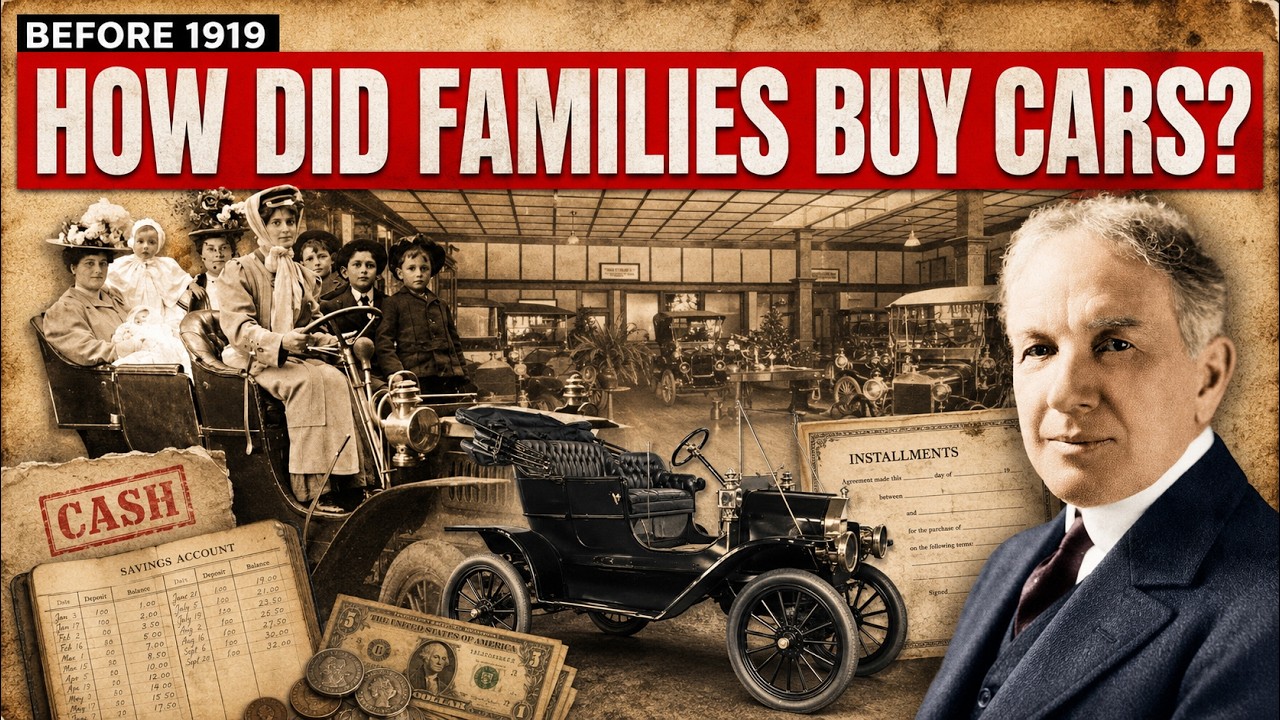
Before 1919, the system that now dominates American life did not exist. There were no formal car loans, no mass-market financing, no monthly payments stretching across six years. For the first two decades of the automobile age, borrowing money to buy a car was considered reckless by bankers, immoral by religious leaders, and financially suicidal by most ordinary Americans. If you wanted a car, you paid cash, all of it, up front, or you simply did not get one.
In the year 1900, there were fewer than 8,000 automobiles in the entire United States, a nation of 76 million people. There were roughly 21 million horses pulling wagons, carriages, and streetcars. The horse was infrastructure, and entire industries existed to feed, shoe, stable, and clean up after them. Cities like New York dealt with thousands of tons of horse manure daily, a genuine public health crisis.
When a horse died in the street, it could take days to remove the carcass. The first automobiles were not seen as replacements for the horse. They were toys, loud and unreliable, for rich men with more money than sense. The earliest cars were hand-crafted by small workshops, each one essentially a custom job.
In 1903, the average price of an automobile was around $2,500, roughly $80,000 in today’s money. The average American worker earned between $400 and $600 a year. A car cost five to six years of wages. It was a product for doctors, lawyers, and bankers, not for working families.
Then Henry Ford changed the equation. Ford was obsessed with building a car for the great multitude, one so low in price that no man making a good salary would be unable to own one. In 1908, the Ford Model T went on sale for $850, still roughly 18 months of wages for the average worker, but half the price of most competing automobiles. In 1913, Ford introduced the moving assembly line at his Highland Park plant.
Before the line, it took over 12 hours to build a single Model T. After, that time dropped to 93 minutes. Production exploded and costs plummeted. By 1925, you could buy a base Model T for just $260, the equivalent of roughly $4,000 today, about two and a half months of wages.
But Ford expected you to pay cash, all of it, in one lump sum. And for years, that is exactly what people did. Working families saved for years, setting aside a few dollars a week in coffee tins, savings accounts, or under the mattress. Rural families traded in horses, wagons, and farm equipment as partial payment.
Neighbors pooled resources to buy a shared car. Immigrant communities used rotating credit associations, where each member contributed a fixed amount monthly and one member received the full pot in turn. The most common method was simply patience. This system put a hard ceiling on sales.
If customers have to save for years before buying, your market is limited to those who have already finished saving. By the mid-1910s, the automobile industry was producing cars faster than Americans could save up to buy them. Inventory piled up, and the seasonal nature of car buying made it worse. Dealerships sat idle all winter with capital tied up in unsold stock.
The idea of buying on credit was not entirely new. Installment plans had existed since the Civil War era for sewing machines, pianos, encyclopedias, and furniture. But cars were different. They were far more expensive, and they depreciated rapidly.
A sewing machine retained its value; a car broke down, wore out, and lost value the moment it was driven. Bankers saw a terrible investment. If a borrower defaulted on a sewing machine loan, the bank could repossess and resell it. If a borrower defaulted on a car loan, the bank got back a used, possibly damaged vehicle worth a fraction of the debt.
So most banks flatly refused to make automobile loans. There was a moral dimension too. In the prevailing Protestant ethic of the era, debt was associated with weakness, improvidence, and moral failure. Newspapers warned against installment buying.
Ministers preached about the sin of living on borrowed money. Families who did buy on informal credit kept it a secret. Yet beneath the surface, a quiet revolution was underway. Some dealers figured out that to sell more cars, they needed to help customers finance them.
These were informal handshake deals, a down payment of about a third of the purchase price, with the rest paid in weekly or monthly installments. If the buyer missed a payment, the dealer took the car back. By the mid-1910s, a handful of specialized auto finance companies had emerged, including the Guaranty Securities Company, the Commercial Credit Company, and the Commercial Investment Trust. They were small and localized, the seed of something much larger.
Then came the First World War, which introduced millions of young American men to trucks and motorized equipment for the first time. Soldiers returned home wanting cars, and they were impatient. The war also changed attitudes about debt. The government had sold Liberty Bonds to finance the war effort, asking ordinary citizens to lend money to their country, often on installment plans.
The government itself had normalized borrowing and lending as patriotic acts. In 1919, General Motors created the General Motors Acceptance Corporation, known as GMAC. The man behind it was John J. Raskob, chairman of GM’s finance committee.
Raskob understood something Ford stubbornly refused to accept: the future of the automobile industry depended not on making cars cheaper, but on making it easier for people to buy expensive ones. Ford’s strategy had been to strip the car down and sell it for the lowest possible price, and it had worked brilliantly. By 1918, half of all cars on American roads were Fords. But Raskob saw an opening.
What if, instead of building the cheapest possible car, they built better, more comfortable cars and gave customers a way to afford them? GMAC initially helped dealers finance their inventory, but it quickly expanded into consumer lending. Early auto loans required a 35% down payment, with the remaining balance due in installments over roughly 12 months. The terms were strict by today’s standards, but revolutionary at the time.
A family that had been saving for three years to buy a $500 car could walk into a dealership, put down $175, and drive home that day. This is where Alfred P. Sloan enters the story. Sloan became president of General Motors in 1923 and brought a vision fundamentally different from Ford’s.
Where Ford believed in one car for everyone, Sloan believed in a car for every purse and purpose. He structured GM as a ladder of brands: Chevrolet at the bottom competing with Ford, then Pontiac, Oldsmobile, Buick, and at the top, Cadillac. A young man might start with a Chevrolet, then trade up as his income grew, each step up the ladder a visible marker of status and progress. And each step was facilitated by GMAC.
Ford was selling transportation. Sloan was selling aspiration, and aspiration proved a far more powerful engine of commerce than utility. Henry Ford watched with contempt. He believed debt was corrosive and bought into older views about whether Americans should use debt to buy cars.
Instead of installment plans, Ford created his weekly payment plan, a layaway system where customers made deposits of five or ten dollars until they had accumulated enough to cover the full purchase price. It was responsible and old-fashioned, and it was a catastrophic failure. Given the choice between saving for two years and putting 35% down today, families chose the second option almost every time. General Motors began outselling Ford.
By 1927, the situation had become so dire that Ford shut down his entire operation for months to retool and design the Model A. By 1928, even Ford Motor Company had capitulated and established its own financing subsidiary. By 1930, three out of four cars and trucks in America were being bought on installment plans. In one decade, the country had gone from a cash-only culture to a credit culture, and the automobile had been the battering ram.
The rise of auto credit was part of a larger shift. The Roaring Twenties were a decade of unprecedented consumer spending. Radios, phonographs, vacuum cleaners, refrigerators, and washing machines were all being sold on installment plans. Advertising fed Americans a steady diet of aspiration: Buy now, pay later.
You deserve it. This was the birth of modern consumer capitalism, and it had a darker side. The expansion of consumer credit created real vulnerabilities. Families stretched thin, juggling multiple installment payments.
As long as wages rose, the system held. But when the stock market crashed in 1929 and the Great Depression descended, millions of families were crushed under debts they could no longer pay. Car loans defaulted at staggering rates. Repossessions surged.
Dealerships collapsed. More than 7,000 banks failed during the Depression, and the consumer credit boom of the ’20s was a significant contributing factor. The credit economy contracted during the Depression, but it did not disappear. When World War II ended and the post-war boom began, consumer credit came roaring back.
By the 1950s, the auto loan was a permanent fixture of American life. Loan terms stretched from 12 months to 24, then 36, then 48. Down payment requirements shrank. The automobile evolved from a utilitarian machine into a symbol of the American dream.
You weren’t just buying a car; you were buying freedom, status, independence. The genius of the auto loan was that it made people think in terms of monthly payments rather than total costs. A $40,000 car sounds expensive. A $550 monthly payment sounds manageable.
Financed over 72 months at 6% interest, that $40,000 car ends up costing closer to $46,000 or $47,000. The extra thousands evaporate into the financial system, invisible to buyers focused only on the monthly number. This is exactly what Sloan and Raskob understood in the 1920s. The monthly payment reframes the buyer’s psychology, shifting attention from the total cost to the short-term impact.
The car loan made the automobile accessible to millions of families who could never have saved the full purchase price. It accelerated the adoption of the automobile, transformed the American landscape, built the suburbs, created the highway system, and fueled an economic boom that defined the 20th century. But it also normalized debt. It taught generations of Americans that borrowing money to buy depreciating assets was not just acceptable, but expected.
The question became not whether you could afford something, but whether you could afford the monthly payment. Today, the average American car buyer finances their vehicle for 68 months. The average monthly payment on a new car is around $730. Total auto debt in the United States stands at $1.
6 trillion. Delinquency rates are climbing. Negative equity, owing more on a car loan than the car is worth, affects millions of borrowers. Rolling negative equity from one car loan into the next, carrying debt forward from vehicle to vehicle in a never-ending cycle, has become alarmingly common.
The system created to help working families buy cars has evolved into a system that traps many of them in perpetual debt. The monthly payment, once a bridge to ownership, has become a treadmill. The car, once a symbol of freedom, has become for many Americans the single largest source of financial stress in their lives. When General Motors created GMAC in 1919, they were creating a new relationship between Americans and money, built on convenience, aspiration, and the seductive promise that the future would always be prosperous enough to cover today’s debts.
For many, that promise has held true. For many others, it hasn’t. And the distance between those two outcomes is the distance between the American dream and the American debt trap.
