In the early morning of November 20, 1943, a nineteen-year-old Marine sat in a landing craft moving through the waters of Tarawa Atoll. He did not know the tide was running low. He did not know the maps used by intelligence officers three miles offshore had misled him. All he knew was that his boat had stopped moving, stuck on a coral reef five hundred yards from the beach.
He stepped off the ramp into chest-deep water. The Japanese had spent eight months preparing for this moment. Machine guns opened fire from concrete bunkers. Men fell beside him before they took their first steps.
Others drowned, weighed down by equipment, with no one left to pull them up. He kept moving forward because there was nothing behind him but more men in the water and more boats grounded on the reef. By sunset, more than five hundred Marines were dead. By the time the island was secured seventy-six hours later, the total reached 1,090.
Most did not die on the sand. They died in the water, in a five-hundred-yard stretch of open ocean, exposed and slow, under the aim of an enemy sheltered behind steel and concrete. The man who had made the decision that led to this slaughter was not on the beach. He was aboard a command ship miles away, reading reports as they arrived.
His name was Richmond Kelly Turner, a vice admiral in the United States Navy. His own men called him Terrible Turner. They did not mean it as a compliment, and neither did he understand it as one. This is the story of what he did after Tarawa, not what he did at Tarawa.
Turner was born in Portland, Oregon, in 1885. His father was a schoolteacher. There were no admirals in his family, no naval tradition. He entered the Naval Academy in 1904 and graduated fifth in his class of 1908.
He was not popular. His fitness reports called him competent, but never likable. For the next twenty years he moved among cruisers and destroyers, steadily building a career that looked strong from a distance and ordinary up close. In 1927, at the age of forty-two and already a commander, he went to Pensacola, Florida, to learn to fly.
The other naval aviators were boys in their twenties. Turner was a man in the second half of his career, with no promotion waiting at the end of flight school. He went anyway. He would never fly as a career, but he became something rarer: an officer who understood with his own hands and body how the coming war at sea would be fought.
Eight years later, the navy sent him to teach at the Naval War College in Newport, Rhode Island. In 1935 he stood before his students and told them something almost no one in the American military dared say publicly. The coming war in the Pacific would not be decided by battleships firing in deep water. It would be decided on beaches, on strips of sand and coral where thousands of young Americans would have to leave their boats and walk into machine-gun fire with nothing to hide behind.
The navy had no doctrine for this, no manual, no plan. Turner began writing one, studying what the British had done at Gallipoli and what the Japanese were doing in China. In October 1940, he went to Washington as director of the War Plans Division. The following November, Admiral Harold Stark sent a memorandum to the president recommending that Germany be defeated first, while the United States held in the Pacific.
The memo, known as Plan Dog, shaped every major American strategic decision for the next five years. Stark signed his name at the bottom. The thinking and the framework came from studies Turner had carried from Newport. In June 1942, Admiral Chester Nimitz gave Turner command of all amphibious forces in the Pacific.
On paper it was one of the most important jobs in the war. In reality it was a title without substance. The navy had no effective amphibious doctrine and no trained landing force. What it had was Turner, and all the knowledge he had spent twenty years building.
The men who served under him did not use warm words to describe him. He shouted. He interrupted. He insulted junior officers in front of their peers when they fell short.
He drank openly and often. One officer who worked beside him before the war said Turner was the hardest man he had ever seen, then added, without pause or irony, that he was also the most competent officer in the navy he had served with. In the summer of 1942, Turner stood on the bridge of USS McCawley, watching a fleet of transports take position in the waters off Guadalcanal. On August 7, the Marines of the First Marine Division landed.
The airfield, the objective that the entire operation had been designed to seize, was captured on the first day. Then, on the evening of August 8, Admiral Frank Jack Fletcher, commanding the aircraft carriers, announced he was withdrawing. His destroyers were low on fuel. He had lost planes.
He was pulling his carriers south, out of range. The transports now lay in the water with no air cover and only half their cargo unloaded. That night, Turner called a meeting aboard the McCawley, bringing together Marine General Alexander Vandegrift and British Admiral Victor Crutchley. As they argued over what to do, the question became irrelevant.
In the darkness, Japanese Vice Admiral Gunichi Mikawa had slipped his force of cruisers and destroyers through the channel undetected. At 1:36 a. m. his ships opened fire.
In thirty-seven minutes, four Allied cruisers were lost and more than a thousand sailors were dead. It was the worst surface defeat in the history of the United States Navy. The place became known as Ironbottom Sound. Turner did what he always did.
He thought. He calculated what the Marines on the island had and what they would need. He calculated what would happen to the men if he withdrew the transports, and what would happen to the transports if he did not. Then he gave the order no one would talk about afterward.
He kept unloading. He kept the ships in those waters through the entire day of August 9, without air cover and without cruiser protection, in waters Japanese planes could reach at any moment. Vandegrift wrote of it later. Turner, whom Vandegrift had clashed with throughout the planning and never pretended to like, was given credit by Vandegrift for saving the campaign.
If Turner had pulled the transports immediately after Savo Island, the Marines on Guadalcanal would have been left with barely four days of ammunition. The campaign, the first American offensive of the Pacific war, would have collapsed before it truly began. Over the next fourteen months, Turner kept working, moving through the Solomon Islands, each operation refining the amphibious doctrine he had been building since Newport. But one problem kept reappearing.
Every landing depended on what lay under the water. The charts were old. The tide tables were guesses. Aerial photographs could not see through the reef.
Turner read the after-action reports from every operation and saw the same phrase again and again: landing craft grounded on coral. Boats stopped short of the beach. Marines waded the last two hundred yards under enemy fire. He knew what was coming.
Somewhere, on some island, the reef, the tide, and the enemy would combine in the worst possible way. In November 1943, it happened. The island was Betio, the main defensive position of Tarawa Atoll. The Japanese had spent a year fortifying it, with concrete strongpoints and interlocking fields of fire covering every approach.
On November 20, the first wave hit the reef. The tide was lower than predicted, just enough to stop the boats five hundred yards from shore. Seventy-five percent of the first wave fell killed or wounded before reaching the sand. By the time the island was secured, 1,096 Marines were dead and more than 2,100 wounded.
For the first time in the war, the government allowed newspapers to publish photographs of dead Americans. The images reached home in the last week of November. Bodies in the water. Bodies on the sand.
The country was stunned. General Douglas MacArthur called Tarawa a tragic and unnecessary massacre. Members of Congress demanded an investigation. Turner looked at the same photographs and asked a different question.
Not whose fault it was. Not whether the operation should have been attempted. He asked: How do you know what is under the water before you send men across it? He did not blame the charts.
He did not blame the intelligence officers. He did not blame the tide tables. When he wrote about it later, he used eight words, in his own direct way, accepting the responsibility. Then he began building the solution.
Before any landing, someone had to go into the water first. Not in a boat. Not with sonar. In the water, with his own body, swimming close enough to touch the bottom, to feel the coral heads, to see the slope of the beach with his own eyes, then swimming back to report exactly what he had found.
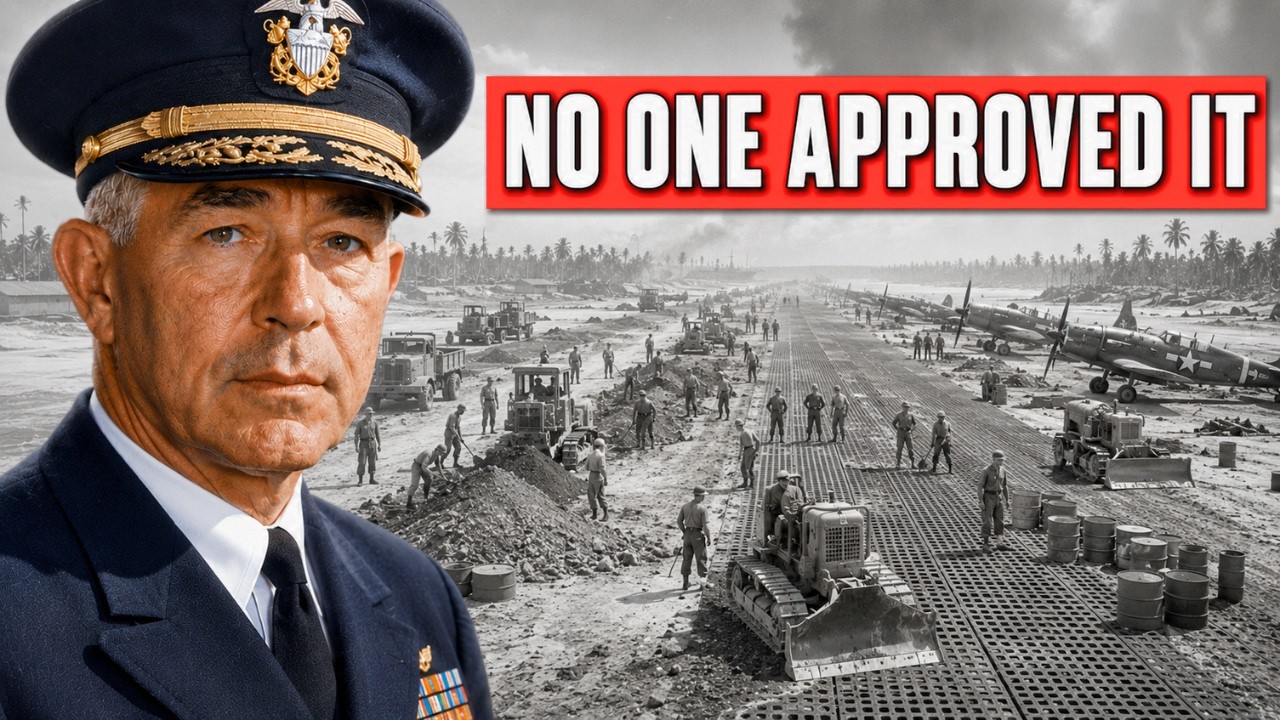
By the end of 1943, Turner had gathered 180 men at a training camp at Waimanalo on Oahu. No directive from Washington authorized the unit. No budget was approved for it. Turner looked at the Tarawa photographs, identified the problem, found the solution, and began building the organization to carry it out.
The unit was called the Underwater Demolition Teams, the UDT. If you have heard of the Navy SEALs, this is their origin. Not from a congressional hearing or a formal military review, but from a furious, hard-drinking, unpopular vice admiral who looked at photos of dead Marines floating in shallow water and asked the one question no one else had asked. On January 31, 1944, the first real test came.
Two officers stripped to their swim trunks and goggles, jumped from their rubber boat with no weapons, swam toward a defended beach, counted the coral heads, measured the depths, noted the gun positions, and swam back. The Japanese never saw them. Turner listened to their report and gave the order that changed the course of the Pacific war. From now on, before every landing, the men went into the water first, with nothing but their bodies.
The naked warriors were born. Not from a plan on a desk, but from two men who saw a problem and solved it without asking permission, and from an admiral who was willing to look at what they had done and understand what it meant. Five months later, at the landings on Saipan, the UDT swimmers went out under heavier fire than they had faced at Kwajalein. The Japanese defenders were alert, entrenched, expecting them.
The swimmers went anyway and returned with what Turner needed. The landing craft approached the beaches on paths the divers had measured. The casualties during the approach were a fraction of what they had been at Tarawa, not because the Japanese were weaker, but because the men leaving the boats knew where to put their feet. By early 1945, Turner knew the next challenge would be the hardest of all.
The island of Iwo Jima, eight square miles of volcanic rock and black sand, was defended by General Tadamichi Kuribayashi, a 53-year-old cavalry officer who had spent two years in America in the late 1920s. He understood the Americans. He had given his men one order: kill ten Americans each before you die. For eight months he had carved a fortress into the rock, eleven miles of tunnels, command bunkers with twelve-foot-thick walls, gun positions dug at angles that protected them from both air and sea fire.
He would not try to stop the Americans on the beach. He would let them come, then kill them one by one from underground. On February 17, 1945, two days before the landing, Turner gave the order. UDT teams 12, 13, 14, and 15 went into the water at first light.
Young men in swim trunks and goggles, grease pencils between their teeth, small waterproof boards tied to their wrists, swimming unarmed toward the beaches in daylight to measure the bottom. To cover them, Turner sent twelve LCI gunboats moving in a line toward the shore, their 40mm guns and rocket launchers aimed at the beach, meant to draw fire and convince the Japanese this was the landing. From his tunnels, Kuribayashi watched them approach. He had ordered his men to hold fire until the actual invasion, but twelve gunboats moving in line was not something he could ignore.
If this was the landing, he had to stop it here. He gave the order. Every gun opened up. The line of gunboats disappeared behind a wall of water and steel.
All twelve LCIs were hit. Roughly fifty American sailors died in the water off Iwo Jima that morning, and more than 150 were wounded. The swimmers watched the boats burn above them and kept swimming, measuring the depths, mapping the coral heads, testing the sand that would have to bear the weight of tanks. They returned with data no aerial photograph could have provided.
Two days later, buoys were placed in the water. Every landing craft heading for the beach on February 19 would follow the marks those swimmers had placed, at the cost of about fifty American lives. But something else had happened. Kuribayashi, by opening fire on the boats, had revealed the positions of the guns he had spent eight months hiding.
The American bombardment on the morning of February 19 did not fire on guesses. It fired on precise coordinates. Thirty thousand Marines landed on the first day. They were alive when they reached the sand.
What happened after they reached the sand is another story, the thirty-six days of the worst fighting the Marine Corps would ever know. But the Marines reached the beach. That part was Turner’s doing. By the time Iwo Jima was secured, the planning for the invasion of Japan had already begun.
Turner was assigned to lead the landing on Kyushu, with 2,700 ships under his command. Japan surrendered on August 15, 1945. Turner never led that invasion. He retired from the navy in 1947 and moved to Monterey, California, to a small house near the water.
He wrote no memoirs, gave no interviews, accepted no speaking invitations. His wife died in 1953, and he lived eight more years alone. He had no children. He died on February 12, 1961, at the age of seventy-five.
There were no crowds at the funeral, no news reports, only a small notice in the local paper. He was buried at Golden Gate National Cemetery south of San Francisco. Ten months and twenty days later, on January 1, 1962, the United States Navy established SEAL Team One and SEAL Team Two, the direct institutional heirs of the Underwater Demolition Teams. Every Navy SEAL who has served since then traces his lineage to a hard-drinking, unpopular vice admiral who admitted his mistake and built the answer in secret without waiting for permission.
Three years after Turner’s death, in June 1964, the navy commissioned a guided-missile frigate and named it USS Richmond K. Turner. At the launching ceremony, an officer stood on the platform and said what should have been said about the man the ship was named for. He said Turner hated the incompetent and despised the lazy.
He said Turner had great faith in his country and his navy. He said Turner gave everything he had to both. That was the truest thing anyone ever said publicly about him, spoken at a ship’s launching three years after he was buried. There are no beaches named Turner.
No parks, no restored battleships anchored in foreign ports. There is only the quiet of a cemetery in northern California, the historical record, and the men who left the boats and reached the sand.
