The door of the harem closes and the sound is final, like a stone rolled across a tomb. The girl from the Ethiopian Highlands, taken from a burning village, walked through days of desert heat and weeks of salt water to stand on the auction block in Zanzibar. She was inspected like livestock, priced in Maria Theresa thalers, and bought to serve in the imperial household of the Ottoman Sultan. She is 15, perhaps 16.
Her name is gone. The system gave her a new one. The process of erasing her from the world has begun. The trade that brought her north was ancient and enormous.
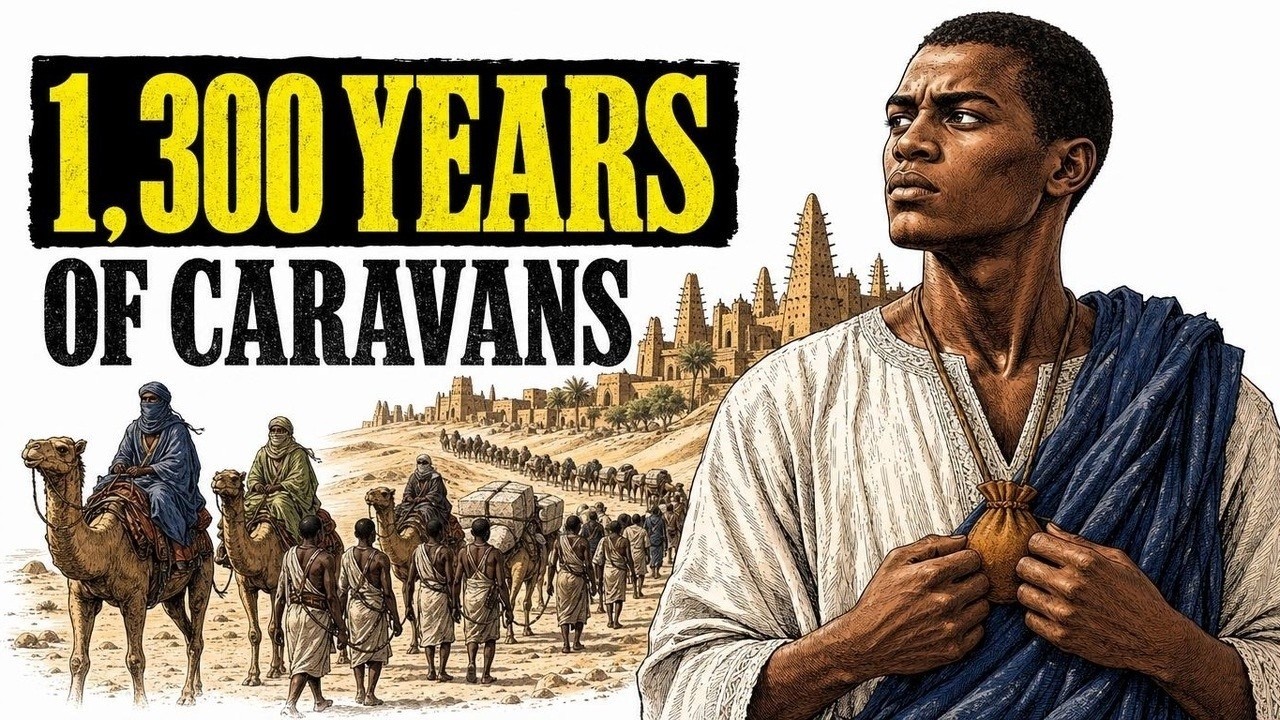
Between the 7th and the 20th centuries, an estimated 14 million people were taken from sub-Saharan Africa into the Ottoman Empire and the broader Arab world. This trade predated the Atlantic slave trade and outlasted it. It moved captives across the Sahara by caravan and across the Indian Ocean in wooden dhows. The desert routes ran from the Sahel to the markets of Cairo, Tripoli, and Murzuk.
The sea routes linked the Swahili coast to Zanzibar, Oman, Persia, and the Red Sea. The conditions killed a fixed percentage before arrival, a loss already calculated into the profit margins. The British explorer James Richardson walked one of these desert tracks in 1845. He recorded in his journal that the trail was paved with skeletons, so many that travelers no longer counted them.
He noted the small bones of children lying beside the larger bones of women he assumed were their mothers. On a single day’s march, he counted more than 100 corpses before noon. The German explorer Gustav Nachtigal, crossing the same desert in 1869, described caravans where the dead were unhitched from the chain and left sitting upright, because the slavers did not want to slow the column to dig graves. The sea route was no kinder.
Captives were packed into the holds of dhows bound for Zanzibar, Oman, and Persia. The British naval officer Captain Colomb, patrolling the Indian Ocean in the 1860s aboard HMS Dryad, boarded captured dhows and found children stacked in tiers, bodies still chained to the dead. Sharks followed the vessels closely, and corpses went over the side without a word. A dhow that arrived with half its human cargo still breathing was logged as a successful voyage.
The trade was not random. It was a targeted hunt shaped by buyer demand. Women from the Ethiopian Highlands and the Horn of Africa, called Habesha in Arab sources, were priced three to four times higher than women taken from other populations. The 9th-century writer Al-Jahiz ranked the perceived qualities of enslaved peoples in a treatise, and an 11th-century Baghdad guide by Ibn Butlan advised buyers on how to read an enslaved woman’s temperament by the shape of her eyes and neck.
The price differential rewired the violence. Raids were launched into specific valleys to seize those particular women. The demand for a luxury good produced a hunt for a luxury good. The destruction of family was the opening move.
At inland collection points in the southern Sudan, families were broken apart with method. The Austrian missionary Father Daniel Comboni, working along the Upper Nile in the 1860s, watched mothers tear at their own hair as their children were dragged away in separate directions. Sisters were separated. Husbands and wives were split.
The Sudanese historian Naoum Shukair, writing in 1903, listed the separation of mothers and children as a formal step in the caravan journey, noted alongside the rationing of grain. An isolated person is easier to control than a family. The destination for survivors was often Zanzibar. By the middle of the 19th century, under Sultan Said Said, the island had become the central node of the East African slave trade.
David Livingstone walked through it in 1866. He did not describe chaos. He described routine and paperwork. He estimated that for every captive who reached the coast alive, four or five had died on the inland march from the Great Lakes.
The slave market stood in the heart of Stone Town, in the shadow of the Sultan’s Palace. Captives were held in underground cells cut into coral rock, ceilings so low that an adult could not stand. Those chambers still exist beneath the Anglican Cathedral built in 1879 on the orders of Bishop Edward Steere, the altar placed where the whipping post had stood. On the auction platform, the last shred of personhood was stripped away.
Buyers ran fingers along teeth and gums to estimate age. They pinched arms and calves for muscle tone. They ordered women to walk, to turn, to lift their arms. A scarred back lowered the price, because it suggested a will that had fought back.
For the highest-priced women, young Ethiopian girls sold as virgins, an older enslaved woman performed a crude examination to confirm virginity. A confirmed virgin could double or triple in price. Once bought, the captive was led through narrow alleys to a high stone wall and a heavy wooden door. She entered the harem, the inner chamber of the Ottoman imperial palace.
The harem of Topkapi Palace, built after Mehmed II conquered Constantinople in 1453, was not the place of silk pillows and forbidden romance painted by European artists who had never seen it. It was a sealed vault of roughly 400 rooms, a political snake pit, and a slow machine for taking a human being apart and reassembling her into an instrument of the state. Identity was destroyed on the first day. The name given by her mother was taken and replaced with a sweet-sounding Ottoman name like Gulnar, pomegranate flower, or Lalizar, tulip garden.
Her language was forbidden. Speaking it drew a beating from eunuch overseers with a thin rod across the soles of the feet. She was pushed to convert to Islam by force or by the slower force of social exclusion. In a matter of weeks, her name, her tongue, and her god were gone.
The harem ran on a strict pyramid. At the top stood the Valide Sultan, the mother of the reigning Sultan, who controlled vast estates and shaped imperial policy. Kösem Sultan, born a Greek girl named Anastasia on the island of Tinos, became the favorite of Ahmed I, then valide to two sultans, and effectively ruled the empire through the regency of her grandson. On the night of September 2, 1651, she was hunted through the corridors by eunuchs aligned with a rival faction, found hiding in a cupboard, and strangled with the curtain cord of her own bedchamber.
That is what the top of the pyramid looked like. The only path upward ran through the Sultan’s bedchamber. A concubine who bore a son was promoted to umm walad, mother of a child. She could no longer be sold.
She received her own apartments, servants, and a stipend. The competition for that promotion was a quiet battlefield of training, alliance, and poison. Women learned music, dance, and verse to catch a single glance. The Sultan would drop a handkerchief at the feet of the woman he chose for the night.
That gesture could change everything. Accounts from the 16th and 17th centuries describe substances slipped into sherbets to force miscarriages, and food destined for a favored woman was tasted first by enslaved girls who sometimes died for the chance of an attempted poisoning. Even winning was a defeat. The freeborn son of an African concubine was raised entirely in his father’s world.
He learned Arabic for theology, Persian for poetry, and Ottoman Turkish for statecraft. He learned the names of his Ottoman ancestors back to Osman Ghazi. He never learned the name of his African grandmother. His mother became a beloved figure of childhood, not a source of identity.
Her bloodline poured into the imperial river, and the river carried no trace of where it originated. Outside the palace walls, a second mechanism ran in parallel. Enslaved men, especially boys taken between the ages of 7 and 12, were often made into eunuchs. Castration was not a side practice.
It was a core feature of the trade. The procedure was performed at staging points chosen because the local population had reasons to perform an act Islamic law prohibited. The Coptic monastery at Abu Gerg in Upper Egypt was one of the most notorious centers. The town of Bagirmi, southeast of Lake Chad, was another.
The wounds were cauterized with boiling oil, or the boys were buried up to the waist in hot desert sand. The mortality rate was catastrophic. Nachtigal reported that out of every ten boys subjected to the procedure, only one or two survived the infection. The survivors were worth enormous sums.
A trained palace eunuch could command a price equal to several hundred ordinary captives. Every castration was a genetic full stop, a closed line on a ledger. The third mechanism was the absorption of children. Across the Islamic world, when an enslaved woman bore a child by her free master, the child was born free.
At first glance, this seems more humane than the chattel systems of the Americas, where a child inherited the mother’s bondage. In demographic terms, it was the opposite. The American system preserved a community by walling it off. The Islamic system dissolved a community by absorbing it.
The child took the father’s name, faith, and identity. The African mother could not pass on her language, her religion, or her stories. Within a single generation, her ancestry was reduced to a biological fact without cultural meaning. The final result was a demographic ghost.
Generational intermarriage diluted the remaining traces until the descendants vanished into the general population. Today, there is no large Afro-Turkish community in Istanbul, no Afro-Egyptian neighborhood in Cairo with its own institutions, no Afro-Arab literary movement comparable to the literature of the Atlantic diaspora. The small communities that do exist are the exceptions that confirm the pattern. The Afro-Iraqis around Basra, who call themselves the Zanj, descend from East African captives brought to work the date plantations, some from the survivors of the great Zanj rebellion against the Abbasid Caliphate that lasted from 869 to 883 AD.
The Afro-Turks of the Aegean coast number a few thousand and hold a small annual festival. The Afro-Iranians of the southern coast preserve a healing ceremony called the Zar, traceable to Ethiopian roots. The slave market of Zanzibar was abolished in 1873 under British pressure. Slavery in Saudi Arabia was officially abolished in 1962, in Oman in 1970, in Mauritania in 1981.
The dates are recent enough to be living memory. But the communities of descendants who should be present today are not. The system was not only cruel, it was effective. It was designed to turn human beings into a temporary resource, used and then removed from the demographic record.
The legacy of this trade is not a culture or a people. It is an empty space on the map, a silence in the record, a ghost made out of arithmetic. The names of the millions were never written down in the first place.
