The assassin’s bomb went off under the rear wheel of an open-topped Mercedes-Benz at a hairpin bend in a Prague suburb on the morning of May 27th, 1942. Reinhard Heydrich, the Reich Protector of Bohemia and Moravia, the man Adolf Hitler himself called the man with the iron heart, staggered into the road with his pistol in hand, tried to chase his attackers, and collapsed from blood loss. He was rushed to Bulovka Hospital in Prague. For eight days he hovered between life and death.
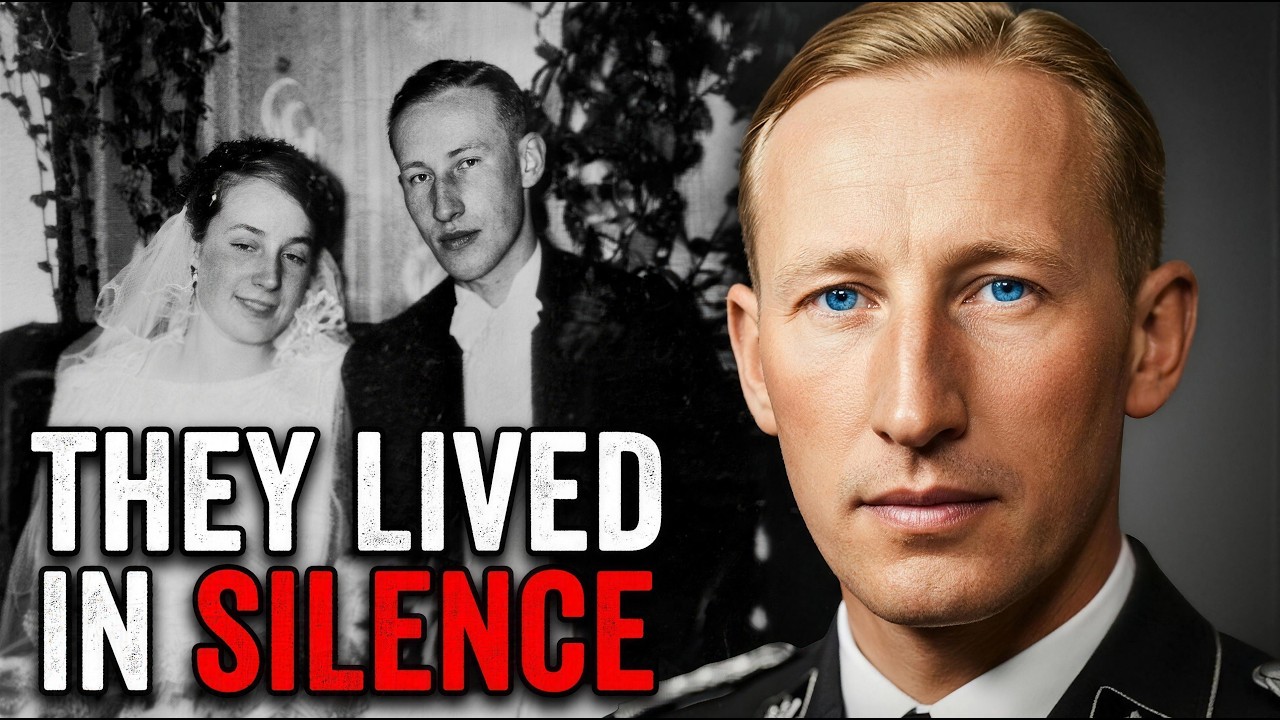
On June 4th, 1942, he died, at the age of 38, of sepsis, almost certainly aggravated by horsehair from the car’s upholstery driven deep into his body cavity, which the surgeons could not fully remove. That single death set everything in motion for the family he left behind. At the Panenské Břežany estate north of Prague, his heavily pregnant wife, Lina, received the news that would reshape every remaining day of her life. She had known for eight days that her husband was fighting for his life.
When the news came that he had died, she was thirty years old, pregnant with her fourth child, and a widow. To understand what became of those who bore his name, it is necessary to understand who Reinhard Heydrich was and why his death sent shockwaves not only through the Nazi high command but through the lives of everyone connected to him. He was born on March 7th, 1904, in Halle, in what was then the German Empire, into a cultured bourgeois family. His father, Bruno Richard Heydrich, was a composer and founder of the Halle Conservatory of Music.
His mother, Elisabeth Maria Anna Amalia Krantz, was an accomplished pianist. The family was steeped in the arts, and Reinhard himself was an extraordinarily gifted violinist, a fact that struck many observers as grotesquely incongruous given the monstrous career that awaited him. He was also athletic, fiercely competitive, and possessed of an almost predatory intelligence, speaking fluent French and showing aptitude as a fencer. His path to the upper echelons of Nazi power was not straightforward.
After serving in the German Navy during the Weimar Republic years, he was dismissed in 1931 following a personal scandal involving a young woman and allegations of dishonorable conduct. It was a humiliation that could have ended his ambitions entirely. Instead, it redirected them. Heinrich Himmler, then building up the SS, gave the young disgraced naval officer an interview in 1931 and was immediately impressed.
Heydrich, drawing on his naval intelligence background, outlined his vision for a security and intelligence apparatus, and within months he headed the SD, the intelligence service of the SS. By the time World War II began, he headed the RSHA, the Reich Main Security Office, an organization that brought together the Gestapo, the SD, and the criminal police under one terrible umbrella. He was Himmler’s direct deputy, one of the most powerful men in Germany, and widely regarded as the primary architect of the Holocaust. It was Heydrich who chaired the Wannsee Conference on January 20th, 1942, the meeting at which senior Nazi officials coordinated the systematic murder of eleven million Jews across Europe.
The conference lasted only ninety minutes. The decisions made in that room resulted in the murder of six million Jewish people. The minutes of the meeting, recorded by Adolf Eichmann, survived the war because copies were preserved in the German foreign ministry files. They record Heydrich’s opening statement, in which he identified himself as having been authorized to make the preparations for carrying out the final solution, then presented, in bureaucratic language of extraordinary coldness, the scope of the task: roughly eleven million Jews of Europe, listed by country, to be subjected to evacuation, the Nazi euphemism for deportation and murder.
But before the assassination, before Operation Anthropoid and the bomb on that Prague street, there was also a private man. A husband, a father, a son. And it is the fate of those bound to him by blood that remains one of the most complex sagas of postwar Germany. Because for all the enormity of what Heydrich did, the people who shared his name were left to answer for it in ways they never chose and could never fully escape.
By the spring of 1942, Heydrich had added another title to his collection. In September 1941, Hitler appointed him acting Reich Protector of Bohemia and Moravia. He arrived in Prague with a reputation that preceded him like a thundercloud, known as the butcher of Prague, the blonde beast, the hangman. His methods were swift and savage.
He executed resistance leaders, deported Jews to the death camps, crushed dissent with exemplary terror. But he also used a combination of economic incentives and fear to stabilize Czech industrial production for the German war machine. Hitler was delighted. So perfect was Heydrich in his master’s view that there was growing talk within the Nazi high command that he was being groomed for even greater responsibilities after the war, potentially to replace Himmler entirely or to be given responsibility for the occupation of France.
It was precisely this combination of importance and terror that made him a target for the Czechoslovak government in exile, operating from London under President Edvard Beneš. In the autumn of 1941, with the approval and logistical support of the British Special Operations Executive, they began planning the most audacious assassination operation of the entire war. The mission, codenamed Operation Anthropoid, involved parachuting a small team of specially trained soldiers into occupied Czechoslovakia. The men chosen for the actual assassination attempt were Jozef Gabčík, a Slovak, and Jan Kubiš, a Czech.
They parachuted in on December 29th, 1941, and spent months hiding with local resistance families in Prague, waiting for the right opportunity. That opportunity came on the morning of May 27th, 1942, as Heydrich traveled through Prague in his open-topped Mercedes-Benz, a deliberate demonstration that he feared no one. He commuted daily between the Panenské Břežany estate and Prague Castle. On the morning in question, his car slowed to negotiate the hairpin bend on a street called Kirchmayerova in the Prague suburb of Libeň.
Gabčík stepped forward and raised his Sten submachine gun. It jammed. Heydrich, who might have simply ordered his driver to accelerate away, instead stood up in the car and drew his pistol. In that moment of pride or arrogance, Kubiš threw a modified anti-tank grenade.
It exploded under the rear wheel, sending fragments of metal and horsehair from the upholstery tearing into Heydrich’s body. His spleen was ruptured. His injuries were treated by German doctors flown in from Berlin, and for a time it seemed he might survive. Himmler visited the hospital.
But on June 4th, Heydrich died. The reaction in Berlin was shock and fury. Hitler ordered a massive reprisal operation. The scale and savagery of the response exceeded even the usual standards of Nazi terror in occupied Europe.
On June 10th, 1942, six days after Heydrich’s death, the entire village of Lidice, near Kladno in Bohemia, was destroyed. The SS and German police surrounded the village before dawn, acting on false and fabricated intelligence that the village had connections to the British agents. Every man and boy over the age of fifteen, 173 people in total, was taken out and shot against the walls of a local farm that same morning. The women, 184 in total, were loaded onto trucks and transported to Ravensbrück concentration camp, where many subsequently died.
Ninety children were taken into German custody. Most were deemed unsuitable for Germanization and killed by carbon monoxide poisoning at the Chełmno extermination camp. The village itself was burned to the ground, the ash bulldozed into the earth, the wells filled in with rubble. The Nazis attempted to erase Lidice from the face of the earth.
A second village, Ležáky, where a radio transmitter had been discovered, was similarly destroyed on June 24th, 1942. In all, the reprisals resulted in the deaths of approximately five thousand Czech people. The assassins were eventually tracked down to the Church of Saints Cyril and Methodius in Prague’s New Town, where they had been hiding with several other paratroopers. On June 18th, 1942, betrayed by a fellow paratrooper named Karel Čurda, motivated by the enormous reward and by fear, the church was surrounded by hundreds of SS troops supported by armored vehicles.
The battle lasted several hours. The paratroopers in the nave held out with extraordinary courage before being killed or choosing to die. The three in the crypt, including Gabčík and Kubiš, fought until their ammunition was exhausted. Water was pumped into the crypt to flood them out.
They took their own lives rather than surrender. Lina Heydrich, née von Osten, had been born on June 14th, 1911, on Fehmarn, a small island in the Baltic Sea. She came from a family with conservative nationalist leanings. Her encounter with Reinhard Heydrich at a naval dance in Kiel in December 1930 was immediate and intense.
Their courtship was swift, though complicated by the fact that Heydrich was at the time involved with another woman. That earlier relationship and his failure to handle it honorably contributed directly to his dismissal from the Navy in April 1931 after a naval honor court ruled his conduct improper. Lina, far from distancing herself, stood by him. She had been introduced to national socialism by her brother and was already a convinced believer.
They married on December 26th, 1931, in a ceremony attended by Heinrich Himmler. Over the years that followed, as Heydrich’s power grew, Lina moved within the highest circles of the Third Reich, meeting Hitler, Himmler, Göring, Goebbels, and virtually every other senior figure in the Nazi hierarchy. She was a formidable personality in her own right, strong-willed, opinionated, and not easily intimidated, known to argue with her husband in ways most people would not have dared argue with one of the most dangerous men in Germany. She was genuinely devoted to him, and he to her, in the complicated way possible between two people who shared a ruthless ideology and a taste for power.
They had four children. The eldest, Klaus, was born on July 17th, 1933. The second, Heider, arrived on December 23rd, 1934. A daughter, Silke, was born on April 9th, 1939, months before the outbreak of war.
The youngest, another daughter named Marte, came into the world on July 23rd, 1942, more than six weeks after her father had already died. She was in the most literal sense a child born into the aftermath of her father’s death, a child who would never know him except through the accounts of others. The Nazi state gave Heydrich a state funeral of enormous pomp. His coffin lay in state in Prague Castle, and tens of thousands of Czechs, many compelled to attend, filed past it.
The cortege then moved to Berlin by special train, where another ceremony was held at the Reich Chancellery. Hitler himself delivered a lengthy and emotional eulogy, praising Heydrich as one of the finest men the German race had produced, a man who had lived and died as a true national socialist hero. Heydrich was buried with full military honors in Berlin’s Invalidenfriedhof, the resting place of some of Germany’s greatest military figures. Lina stood at the graveside, widowed, pregnant, surrounded by the most powerful men in Germany.
Following her husband’s death, Lina remained at Panenské Břežany, the grand estate that Heydrich had essentially requisitioned from a Jewish family, the Bloch-Bauers, prominent Jewish industrialists who had been forced to flee or deported. Lina managed the property with characteristic efficiency and determination, organizing the agricultural work and overseeing the household. She gave birth to Marte in July 1942. In the strange bubble of the occupied protectorate, she maintained the estate with the same iron determination she brought to everything else.
But tragedy struck with devastating force. On October 24th, 1943, while riding his bicycle near the estate, Klaus Heydrich, the eldest son, just ten years old, rode into the path of a German military truck. He was killed instantly. He had been just nine years old when his father was assassinated, old enough perhaps to dimly understand that something terrible and irreversible had happened, young enough that the full meaning was beyond his comprehension.
His death was a grief upon grief for Lina, who had now lost both her husband and her firstborn son within seventeen months. She had two surviving sons, Heider, who was eight, and the daughters, Silke, who was four, and the infant Marte, just over a year old. The collapse of the Third Reich in the spring of 1945 shattered the world that had sustained Lina and her children. As Soviet and Allied forces closed in, Lina faced a suddenly terrifyingly uncertain future.
When the war ended and the Czechs reasserted control over their country, the consequences were immediate. She was expelled from Czechoslovakia along with millions of Sudeten Germans and Reich Germans. The Panenské Břežany estate was returned to the Czech state. She and her children were pushed westward with whatever they could carry, leaving behind Klaus’s grave, the agricultural enterprise she had built, and the last physical connection to the years of her husband’s greatest power.
They ended up in Bavaria, in a ruined, occupied country. Lina was interrogated extensively by Allied investigators and called to testify in various proceedings. She faced denazification proceedings under the Allied Control Council’s directives. The evidence available was insufficient to support specific criminal charges against her personally, and the focus of major prosecutions was on those who had directly participated in specific crimes rather than family members.
She was ultimately classified at a level that carried financial penalties and restrictions but did not involve imprisonment. The proceedings made clear that she was considered an active participant in the Nazi world rather than a passive bystander. What happened next for Lina is perhaps one of the most extraordinary sagas of postwar Germany. Rather than retreating into obscurity, rather than adopting a posture of shame or silence, she spent the decades after the war fighting back.
She fought for her widow’s pension with relentless determination. She fought to recover assets. She fought against what she described as the unfair historical treatment of her husband and herself. She maintained contact with networks of former SS members and their families.
And ultimately she wrote a book that encapsulated her worldview and defiance in the most public way possible. The pension battle was the most prolonged and significant of her postwar legal struggles. Heydrich had held some of the most senior positions in the Nazi state, and in purely formal terms this should have entitled his widow to a substantial pension. The fundamental legal question was whether the criminality of the activities conducted in those official positions should disqualify the entitlement.
If Heydrich’s role as head of the RSHA constituted participation in criminal organizations, which the Nuremberg tribunals had definitively established, should the widow of such a man be able to claim a pension based on that role? Different courts gave different answers at different times. Her case went through multiple rounds of the German court system over more than two decades, from the late 1940s into the 1970s. At various points she received partial awards; at other points those awards were challenged.
The proceedings generated substantial press coverage, which Lina found both useful and maddening, useful because publicity kept her cause in the public eye, maddening because the coverage invariably framed the issue in terms of her husband’s crimes. The eventual outcome, in the early 1970s, was a compromise that satisfied no one entirely. The proceedings contributed to subsequent changes in German law that made it harder for the families of Nazi perpetrators to claim pension benefits based on criminal official roles. Throughout all this, Lina was engaged in what might be called the cultural battle for her husband’s memory.
She gave interviews to journalists with remarkable candor, speaking of her refusal to accept the historical consensus on her husband’s role. She maintained her network of contacts with former SS members and their families, participating in the social world of the unrepentant Nazi survivor community that existed below the surface of respectable West German society. Published in 1976, her memoir was titled in German Leben mit einem Kriegsverbrecher, which translates as Life with a War Criminal. The title was not her choice; it had been imposed by the publisher, Grabert Verlag, a publisher with a long history of producing books that challenged the accepted historical account of the Third Reich.
Lina was furious about the title and said so openly in interviews. In her view, the title was a lie against her husband, because she did not accept that he had been a war criminal in any meaningful sense. The contents of the book were a vigorous and essentially unapologetic defense of Reinhard Heydrich. Historians were outraged by its revisionism.
Reviews in major German newspapers were withering. Survivor organizations condemned it. But it found its audience among those who wanted to believe the accepted historical account was distorted, and it sold well enough to provide Lina with some financial benefit. In the 1960s, Lina was identified as one of the participants in a network that provided financial and logistical support to former SS members facing legal proceedings in West Germany, a network that overlapped with but was not identical to Stille Hilfe.
Her involvement was documented by investigative journalists and government agencies. The activities did not result in criminal charges, but they added to the picture of a woman who was not simply a widow trying to live a quiet life, but an active participant in an ongoing ideological and social community that had not relinquished its commitments. The children grew up within this environment. For Heider, the oldest surviving child, the consequences were profound and lasting.
He was seven and a half when his father was assassinated, nine when his older brother Klaus was killed, and ten when Germany collapsed. He attended school in a country beginning to confront what had happened. He bore a name associated not just with the general horror of Nazism but with specific documented catastrophic crimes: the Wannsee Conference, the RSHA, the Protectorate, the Einsatzgruppen, the coordination of the Holocaust. Every book that mentioned these events, every history class that covered the final solution, was in some sense a description of what his father had built and run.
Heider Heydrich became, by all available accounts, a man who tried to lead an ordinary life while carrying an extraordinary burden. He went into business as an entrepreneur, spending much of his working life in the food industry in Germany. He settled in the Federal Republic, married, had children of his own, built what appears to have been a private and relatively unremarkable bourgeois existence. But the question of his father was never far from the surface.
His name appeared in books and newspaper articles. He was contacted by journalists, historians, and filmmakers. His position was ambivalent. In some interviews, he spoke with apparent sincerity about the difficulty of reconciling the father he remembered as a small child with the historical figure the records revealed.
He acknowledged the historical reality of the Holocaust and did not attempt to minimize it in the way his mother had. But he was also protective of certain aspects of his personal memory, and his relationship with his father’s legacy was never one of clean, uncomplicated condemnation. He maintained a certain distance from the most damning historical assessments. Heider lived to a remarkably advanced age.
He was eighty-six years old when he died on December 24th, 2020, on Christmas Eve, just one day after his birthday. He had outlived his mother by thirty-five years, his brother Klaus by seventy-seven years, and had lived long enough to see Reinhard Heydrich become one of the most studied and written about figures of the entire Nazi era. When he died during the extraordinary isolation of the COVID-19 pandemic, a final thread connecting living personal memory to one of the darkest chapters of the twentieth century was severed. The news was noted in the German press with brief factual reports.
There was no great outpouring of public grief. A man who had spent his life trying to find a way to be simply himself rather than merely his father’s son died and was remembered primarily as his father’s son. Of all Heydrich’s children, Silke is the one about whom the public record is sparsest, because she made the choice, more consistently than her brother, to live entirely outside the public eye. Born April 9th, 1939, she was just three years old when her father was assassinated.
She grew up in the Federal Republic and largely disappeared from the public record. She gave virtually no interviews, made no public statements, and structured her life around keeping as great a distance as possible from the notoriety attached to her surname. Whether she changed her name at any point, whether she married and acquired a different surname, the public record cannot definitively answer. Marte Heydrich, the youngest, born July 23rd, 1942, never saw her father.
She came into the world after the man was already gone. For her, the word father was from the very beginning a category populated not by memory or experience but only by story and history. Her relationship to his legacy was mediated entirely through other people’s accounts. Like Silke, she largely avoided the public eye in her adult life.
Both daughters made the consistent choice of privacy over public engagement, of retreat over confrontation. Beyond the nuclear family stood the broader circle. Heydrich’s mother, Elisabeth, born in 1879, died in 1943 while the war was still ongoing, before the liberation, before the trials, before the full public reckoning. She had lived long enough to see her son rise to the pinnacle of power, to know he was one of the most feared men in Europe, and to grieve his assassination.
His brother, Heinz Siegfried Heydrich, born in 1905, served in the Wehrmacht, the regular German army, and was deployed to the Eastern Front. He died in action in 1944, one of the millions of Germans consumed by the catastrophe Nazi Germany had unleashed on the Soviet Union. His sister, Marita, led an obscure existence and left even less of a trace in the historical record. There had been, throughout Reinhard Heydrich’s lifetime, persistent rumors that the Heydrich family had Jewish ancestry, centered on his father’s birth name and the circumstances of the family’s origins.
The rumors circulated widely within the Nazi party and caused Heydrich considerable anxiety, because in the insane logic of the Third Reich, even an unsubstantiated allegation could be politically catastrophic for a senior SS leader. He commissioned extensive genealogical research to disprove the claims, and the official record was eventually certified as showing no Jewish heritage. Himmler personally vouched for his Aryan credentials. But the rumors never entirely died away, adding a particularly cruel dimension to the family’s situation: a man who devoted his professional life to persecuting and murdering Jewish people lived with the permanent possibility that history might record him as having been among those he was destroying.
For the Czechs, Heydrich remains one of the most hated figures in their modern history. The church where the paratroopers made their last stand was restored and made into a memorial, the bullet marks preserved in the walls. A museum in the crypt commemorates both the paratroopers and the Czech civilians who helped them. The rebuilt village of Lidice rose from the ashes through a combination of national determination and international solidarity.
The original village site was preserved as a memorial garden with a rose garden containing roses donated from around the world and a haunting bronze sculpture depicting the eighty-two Lidice children who were taken and killed. Lidice Lives became the village’s postwar motto. For the children of Reinhard Heydrich, growing up in postwar Germany learning about the war, the connection between their father’s death and the destruction of Lidice was direct, documented, and inescapable. Even Lina, prepared to minimize or deny virtually everything else associated with her husband’s record, never appears to have attempted to challenge the historical account of the Lidice massacre.
The Heydrich family’s story must be understood against the broader evolution of Germany’s relationship with its Nazi past. In the 1950s, West Germany was a society in which the instinct to look forward rather than backward dominated. Denazification was wound down with considerable incompleteness. Former Nazis served in the judiciary, the civil service, academia, business, and politics.
The dominant social convention was a kind of collective amnesia. For the Heydrich family, this culture was in some respects convenient, creating social space in which a widow of a Nazi war criminal could live without constant public stigma. But it also meant the reckoning that eventually came arrived with greater force precisely because it had been so long delayed. When the German student movements of the late 1960s erupted, partly in protest against the incompleteness of the reckoning; when the Frankfurt Auschwitz trials of 1963 to 1965 brought the horror of the death camps into German consciousness; when the prosecution of Adolf Eichmann in Jerusalem in 1961 created a global media event, the Heydrich children were middle-aged adults.
Eichmann had been one of Heydrich’s most important subordinates, the man responsible for coordinating the logistics of deportations, present at the Wannsee Conference. His capture in Argentina by Israeli Mossad agents in May 1960, his trial, and his execution in 1962 were major international events that brought Heydrich’s name back into prominent public discussion. The publication of Günther Deschner’s 1977 biography, Heydrich: The Pursuit of Total Power, and other major historical works systematically demolished any remaining claim that he had been merely a professional functionary. He had actively sought, created, and expanded his role as a killer, drawn to the SS and to the work of persecution and murder eagerly, a willing and enthusiastic perpetrator.
Lina Heydrich died in August 1985, still denying, still fighting, still the most conspicuous embodiment of a particular failure of moral reckoning. In the years since Heider’s death in December 2020, the living link between the Heydrich family and anyone who could claim direct personal memory of Reinhard Heydrich has been effectively severed. The grandchildren and great-grandchildren, whoever and wherever they are, belong to a generation for whom he is as much a historical figure as a family ancestor. The personal memory, always fragmentary and always contested, has given way entirely to the historical record.
That record is overwhelming, thoroughly documented, and irrefutable. It tells the story of a man who was one of the primary architects of the most systematic program of murder in human history. The memorial at Lidice, the Wannsee Conference House in Berlin, the bullet-marked walls of the church in Prague, these are the truest legacy of what the Heydrich story means. They exist to remember his victims and those who resisted him, standing as permanent refutations of the denial and revisionism that Lina Heydrich spent her life promoting.
The family he left behind, the widow who refused to repent, the brother consumed by the war, the mother who died before the full reckoning, and the children who tried to live their lives in the shadow of the man who was their father, carried that name through the decades, finding different ways to manage the weight of it, none of them finding a way that was fully satisfactory. All of them in the end simply doing what human beings do in impossible situations, surviving, adapting, and carrying on.
