The summons reached Francis of Teck in London on the morning of 7 March 1866, a single day after his arrival from Vienna. He had come at the invitation of the Prince of Wales, who had met him at the imperial court the previous year and been struck by the young officer’s bearing. Now, at St James’s Palace, the Prince of Wales introduced him to his cousin, Princess Mary Adelaide of Cambridge. The meeting was brief.
The chemistry was immediate. Mary Adelaide would later recall the course of their courtship with characteristic candor. “Francis arrived in England on the 6th of March, and we met on the 7th,” she wrote. “A month’s acquaintance settled the matter, and on the 6th of April he proposed to me during a walk among the rhododendrons in Kew Gardens, and I accepted.
” In four weeks, the princess who had long feared she would die unmarried had found a husband. To understand what that proposal meant, one has to go back to the beginning of her life, and to the peculiar position she occupied within the British royal family. Mary Adelaide Wilhelmina Elizabeth of Cambridge was born on 27 November 1833 in the city of Hanover, then part of the German Confederation. Her father, Prince Adolphus, Duke of Cambridge, was the youngest son of King George III, and he served as viceroy of Hanover on behalf of his elder brothers, King George IV and King William IV.
Her mother, Princess Augusta of Hesse-Cassel, was of German origin, and so the young princess grew up at a cultural crossroads between Britain and Germany. She shared her childhood with two elder siblings: Prince George, later the second Duke of Cambridge, and Princess Augusta of Cambridge. When Mary Adelaide was four years old, the death of King William IV and the accession of her cousin Victoria to the British throne brought profound changes. Because of the Salic law, which barred women from inheriting the German kingdom, Victoria could not succeed in Hanover.
The crown passed instead to another of Mary Adelaide’s uncles, ending the personal union between the British and Hanoverian crowns. The Duke of Cambridge was no longer needed as viceroy, and in 1843 the family returned to England, settling in Kensington Palace, where Mary Adelaide spent the remainder of her childhood. She was raised in a privileged but austere environment, tutored privately in languages, history, and music. Music was her particular gift, and she excelled at it with enthusiasm.
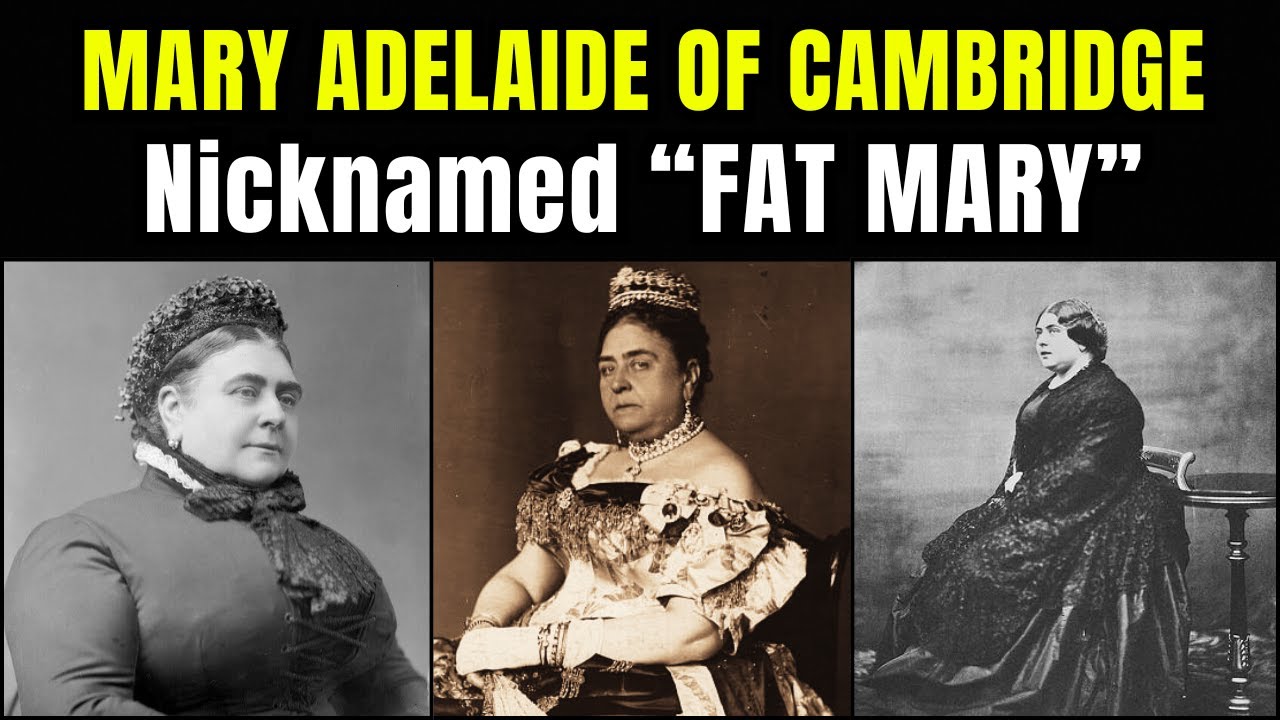
By temperament she was cheerful and lively, often the center of attention at family gatherings, admired for her infectious laughter and sharp wit. One royal historian would later describe her as a young woman “spirited and imperious, with somewhat rough manners, but a great sense of humor,” one who occasionally shocked Victorian high society. But alongside her virtues, Mary Adelaide developed from an early age an excessive fondness for food. Her tendency to overeat led to weight gain, an uncommon trait among the refined courts of Europe.
In the rigid society of Victorian England, her fuller figure did not go unnoticed, and the public unkindly nicknamed her “Fat Mary. ” Far from being offended, the princess took the unflattering moniker in good humor. Reports from the time affirm that jokes about her weight never troubled her; she even laughed at them herself. That light-hearted attitude and her warm disposition earned her the affection of many subjects, though her appearance, combined with her royal status, would present real obstacles in her personal life, especially when it came to marriage.
Upon reaching adulthood, Mary Adelaide found herself in a complicated position. As a princess of the United Kingdom and a member of the House of Hanover, she was expected to wed someone of royal blood or high aristocratic rank. But by the mid-nineteenth century, suitable matches were scarce for a woman who, despite her kind heart and impeccable lineage, was considered physically unattractive by the standards of the time and lacked a substantial personal fortune. Furthermore, the fact that she had been born and spent her childhood in Germany led some courtiers to view her with suspicion in an increasingly anglophile environment.
To make matters worse, she was already in her twenties with no engagement on the horizon, something that was beginning to raise eyebrows in the rigid circles of Victorian society. Several suitors were considered during the 1850s, but none came to fruition. In 1856, Prince Oscar of Sweden, son of King Oscar I, visited Mary Adelaide in London on several occasions, sparking rumors of a possible courtship. But those attentions did not culminate in a formal proposal.
Shortly afterwards, an even more ambitious match was contemplated: King Victor Emmanuel II of Sardinia, the future first king of a unified Italy, who had recently been widowed, expressed interest in her hand. For the young British princess, however, the idea of marrying a foreign Catholic monarch was unacceptable. A devout Protestant like the rest of her family, Mary Adelaide refused to consider converting to Catholicism to become queen consort of Sardinia. Distressed by the prospect, she declared with resolve, “My heart is truly Protestant,” making clear that her religious convictions outweighed any crown.
By her mid-twenties, Mary Adelaide began to fear she might never find a husband worthy of her rank. At the age of twenty-five, she privately confessed that she saw herself ending her days unmarried, a sort of royal spinster’s fate. Queen Victoria, her cousin, watched the situation with concern. The monarch held deep affection for Mary, as she was known within the family, and is said to have remarked sorrowfully, “Poor Princess Mary, I pity her.
”
Determined to help, Victoria resolved to find her a suitable husband. It was not merely a personal matter; a favorable marriage for Mary Adelaide would also avert the embarrassment of having an unmarried princess without a defined role at court. The task was far from simple. At last, in 1865, hope emerged through the intervention of the Queen’s eldest son, the Prince of Wales, the future Edward VII.
During a visit to the imperial court in Vienna, the Prince of Wales and his wife Alexandra of Denmark met an attractive and well-connected officer: Prince Francis of Teck. Francis was a member of the royal house of Württemberg, a small German state, although by birth he held a lower rank. His father, Duke Alexander of Württemberg, had contracted a morganatic marriage with a Hungarian noblewoman, Countess Claudine Rhédey von Kis-Rhéde, which meant that Francis had no succession rights to the throne of Württemberg despite his royal blood. He was, in a sense, a prince without a realm and without significant fortune.
Yet his aristocratic lineage and personal reputation made him an intriguing prospect. Within Viennese court circles, Francis had earned a reputation as “the handsome hussar,” regarded as one of the most strikingly good-looking men in the Austrian army. The Prince of Wales, impressed by Francis’s qualities, considered him a suitable match for his cousin. He invited the young officer to visit England in early 1866 with the clear intention of facilitating an introduction.
Francis arrived in London on 6 March 1866. The next day, the two royals were introduced at St James’s Palace. The courtship was brief. In a letter to a childhood friend, Mary Adelaide expressed her joy in heartfelt words: “I long to tell you how happy I am, and with what confident hope I can look forward to a future full of bright promise.
He is not only all I could wish for, but completely fulfills the desires of my heart. ”
The princess’s family shared in her happiness. Her mother, the Duchess of Cambridge, wrote with relief shortly before the wedding: “I am glad to say I feel quite assured of dear Mary’s future happiness. Prince Teck appears to be an excellent young man, of good principles, very religious, and of perfect manners.
In short, I should say Mary is a very fortunate creature to have found such a husband. ”
With the enthusiastic blessing of Queen Victoria, the marriage was celebrated on 12 June 1866. The wedding took place in the relative intimacy of the Church of St Anne in Kew, Surrey, and was marked by simplicity and warmth. Mary Adelaide herself wished her marriage to be free of excessive state pomp; she desired, as she put it, “a country wedding in the truest sense of the word.
” And so, without great fanfare, but with the presence of the royal family and close friends, the Princess of Cambridge was wedded to Prince Francis of Teck at the age of thirty-two. From then on she would be officially known as Her Royal Highness Princess Mary Adelaide, Duchess of Teck, for in 1871 Francis was elevated by the King of Württemberg to the title of Duke of Teck, a noble title which Mary Adelaide held as his consort. It is worth noting that Queen Victoria initially refused to grant Francis the style of Royal Highness reserved for princes of the first rank owing to his lower status. Years later, in 1887, she bestowed upon him the rank of Serene Highness on the occasion of the monarch’s golden jubilee.
Once established as husband and wife, Mary Adelaide and Francis formed a happy and solid marriage despite the initial gossip. The couple settled in London, as the princess wished to remain close to her family and continue her duties at the British court. They resided in apartments provided by Queen Victoria at Kensington Palace, and for a country retreat they were granted White Lodge, a residence within Richmond Park on the outskirts of the capital. There, in privileged yet relatively discreet surroundings, the Duke and Duchess of Teck began to raise the family that would soon grow.
Over the course of seven years, they had four children, to whom Mary Adelaide devoted herself with care. On 26 May 1867, their first daughter was born: Princess Victoria Mary of Teck, affectionately known as May. This child would decades later become Queen Mary, consort of King George V of the United Kingdom. From birth, May was the focus of her mother’s attention and also that of Queen Victoria, who served as her godmother.
The little girl grew up very close to Mary Adelaide, absorbing from an early age the lessons of responsibility and duty that her mother instilled in her. The second child, Prince Adolphus of Teck, was born on 13 August 1868. Years later, as an adult, he would renounce his German titles in the context of the First World War and be created Marquess of Cambridge by his cousin, King George V, thus adopting the surname Cambridge in honor of his mother’s family branch. The third child was Prince Francis of Teck, born on 9 January 1870.
Francis, sometimes known as Frank, led a quiet life, distant from dynastic duties, as he held no titles beyond that of Prince of Teck. He died unmarried in 1910, leaving behind fond memories within the family but no descendants. Finally, on 14 April 1874, the youngest was born: Prince Alexander of Teck. This youngest son would go on to have a distinguished career in the service of the British Empire.
Decades later, like his brother, he renounced his German titles during the Great War and adopted the name Alexander Cambridge, being created Earl of Athlone. Alexander married Princess Alice of Albany, niece of Queen Victoria, in 1904, thereby strengthening the ties between the Teck family and the British royal family. Mary Adelaide strove to provide her children with an excellent education while also instilling in them humility and a sense of service. Family accounts describe her as an affectionate mother, warm and approachable in character, who organized musical evenings at White Lodge and delighted in playing with her little ones.
Of course, they also had governesses and tutors, but the Duchess of Teck was personally involved in their upbringing. Her daughter May in particular grew up under Mary Adelaide’s close supervision, accompanying her to charitable events and learning firsthand the importance of philanthropy and royal courtesy. This maternal relationship would prove instrumental in shaping the character of the future Queen Mary. However, while domestic life was happy, the financial situation of the Tecks began to grow increasingly concerning.
Although a member of the royal family, Mary Adelaide was not immensely wealthy. She received an annual allowance of £5,000 from the British Parliament for her official duties, a respectable but modest sum by the aristocratic standards of the time, and she had some financial support from her mother, the elderly Dowager Duchess of Cambridge. Francis of Teck, for his part, did not contribute a significant personal fortune. Indeed, he was often privately referred to as “the poor prince” due to the precarious state of his finances.
Despite these limited means, Mary Adelaide’s tastes leaned towards extravagance. Accustomed to the luxury of court life, she did not hesitate to spend on elegant gowns, jewels, and lavish banquets. The Duke and Duchess of Teck became known in London for the splendid parties they hosted and for leading a cheerful lifestyle, though it certainly exceeded their financial reality. This inclination toward excess contrasted with the more restrained atmosphere Queen Victoria sought to impose on the royal family after the death of her husband, Prince Albert.
By the 1870s, Victoria was promoting the image of an honest, family-centered, and austere monarchy, while the display at the Teck household was beginning to cause discomfort at court. As the 1870s progressed and the early 1880s unfolded, the debts of the Duke and Duchess of Teck mounted alarmingly. Their lavish lifestyle, travels abroad, receptions, costly renovations of their residences, and continual purchases to uphold their social status caused their expenditures to far exceed their income. On multiple occasions, Mary Adelaide was compelled to appeal to Queen Victoria for additional financial support, but the prudent monarch typically refused such requests.
Though affectionate towards her cousin, Victoria believed that bailing her out would set a poor precedent and that it was the Tecks who ought to moderate their way of life. With no financial rescue in sight, the situation became untenable. In 1883, overwhelmed by debt and besieged by creditors, Mary Adelaide and Francis made the difficult decision to leave England temporarily to escape the financial pressure. This self-imposed exile was a drastic but necessary measure.
Accompanied by their four children, the Duke and Duchess of Teck departed for the European continent, where life could be both more affordable and more anonymous. They initially traveled incognito under the modest titles of Count and Countess of Hohenstein, in an effort to avoid media attention and recognition by those familiar with their financial difficulties. They settled for a time in Florence, Italy, a cosmopolitan city inhabited by other European aristocrats and where living costs were lower than in London. Later, the family found refuge with relatives at various German courts, spending time in Germany and Austria, hosted by maternal and paternal family members who extended their hospitality.
However, maintaining a low profile did not sit well with Mary Adelaide. Accustomed to the deference and honors of her rank, the Duchess soon grew weary of life in the shadows. According to anecdotes recorded in memoirs, she found it frustrating to travel as a noblewoman of secondary rank. She longed for the preferential treatment she had enjoyed when using her royal title.
Eventually, she chose to abandon the incognito. During her travels across Europe, she resumed presenting herself openly as the British princess she truly was. This, of course, attracted greater attention, but it also allowed her to be treated in a manner befitting her dignity at hotels and social events, something she appreciated despite their circumstances. This period of exile proved bittersweet for the Teck family.
On the one hand, they endured hardship, living on a strict budget and far from home. On the other, they spent more time together as a family than ever before, free from the rigid protocol of the English court. Mary Adelaide’s children, particularly the elder ones entering adolescence, would later remember those years as a peculiar adventure: visiting museums in Italy, meeting distant cousins in German castles, but also learning firsthand the consequences of poor financial management. The Duchess, despite everything, never lost her love of splendor.
Even in relative austerity, she found ways to appear in her finest attire at gatherings and to maintain a certain image of rank, though she also began to show genuine concern for those suffering from deprivation. After two years on the continent, and having alleviated some of their debts through negotiations or discreet assistance from family, the Duke and Duchess of Teck received Queen Victoria’s permission to return to England. In 1885, Mary Adelaide, Francis, and their children resumed residence at White Lodge in Richmond Park. Their return was low-key but welcomed at court.
After all, the extravagant yet endearing “Fat Mary” was popular both among the people and the nobility, and her absence had certainly been noticed. Back in London, Princess Mary Adelaide entered a new phase of her life, marked by a profound commitment to charity and public service. Though her financial means remained limited, the Duchess of Teck had transformed her outlook on wealth and luxury after the hard lesson of exile. Rather than focusing on social extravagance, she channeled her energy into charitable causes, becoming a pioneer of royal philanthropy at a time when such involvement was not customary for members of the royal family.
As early as the late 1880s, Princess Mary Adelaide was seen visiting orphanages, hospitals, and modest schools, offering comfort and assistance to those in need. She accepted official patronages from various charitable organizations, most notably Dr Barnardo’s, a children’s charity that provided shelter and care for orphans and impoverished youngsters in London. But her work went far beyond lending her name. The Duchess would roll up her own sleeves and take part in fundraising events and social initiatives.
She attended charity bazaars and even stood behind the stalls as a vendor to help raise money, an act almost unheard of among the nobility of the time. She also organized groups of well-to-do volunteers to sew clothing for the poor, using her influence to inspire others to contribute. These charitable activities, although now seen as an inherent part of royal duties, were then met with some suspicion. Certain members of the royal family and aristocracy felt embarrassed that a princess of royal blood should behave in such an unseemly manner, mingling with common folk at fairs or directly managing charitable affairs.
Yet Mary Adelaide was deeply convinced of her mission. She had discovered a true calling in alleviating the suffering of others and using her position to draw attention to social issues. In fact, the London press began to portray her in a highly positive light. One newspaper of the time described her as possibly “the hardest working member of the royal family” due to her tireless charitable agenda.
During those years, Mary Adelaide also involved her daughter, Princess May, in these efforts, unknowingly preparing the young princess for the role she would soon assume within the royal family. Mother and daughter worked as a team. It is known that each morning they would go through the correspondence that arrived at White Lodge requesting aid or patronage. The Duchess personally opened the letters sent by subjects in need, selected the most urgent cases, drafted handwritten replies, and with May’s assistance recorded every petition in detailed charity ledgers.
This meticulous dedication left a strong impression on observers and biographers. Years later, royal historian James Pope-Hennessy would write of Mary Adelaide: “When she gave her name to a cause, she gave also her time, her energy, and her thought,” highlighting how she laid the foundations for active royal involvement in social work. While the Duchess of Teck devoted herself to philanthropic work, she also remained attentive to the future of her children, especially her eldest daughter. Princess Victoria Mary of Teck, now a young adult, had grown into a cultured, disciplined woman with a strong sense of duty inherited from her mother.
Mary Adelaide held great hopes for May. By the early 1890s, the Duchess dreamed of seeing her daughter married to an heir to the British throne, a prospect that would not only bring great honor to the Teck family but would also secure her daughter’s place at the forefront of the monarchy. That ambition coincided with the intentions of Queen Victoria herself, who was seeking a suitable bride for her eldest grandson, Prince Albert Victor, Duke of Clarence and Avondale. Albert Victor, familiarly known as Eddy, was the eldest son of the then Prince of Wales, Edward, later King Edward VII, and thus second in line to the throne.
With Queen Victoria’s express approval, the official engagement between Princess May of Teck, aged twenty-four, and Prince Albert Victor was announced in late 1891. For Mary Adelaide, it was the fulfillment of her aspirations. Her only daughter was poised to become queen of the United Kingdom one day. Mother and daughter took part together in the preparations for the wedding scheduled for 1892, and the Duchess of Teck proudly presented this family achievement to British society as one that elevated the standing of the Tecks.
Sadly, fate had other plans. Barely six weeks after the engagement, in January 1892, Prince Albert Victor died suddenly of pneumonia, believed to have been worsened by an influenza epidemic. The tragic death of the young Duke of Clarence was a devastating blow to the royal family and personally to Princess May and her mother. Mary Adelaide consoled her daughter in mourning while sharing with her the resignation that came with the apparent loss of a unique opportunity.
However, Queen Victoria, both pragmatic and affectionate, was not willing to let go of such a promising granddaughter-in-law. After a period of mourning, the elderly monarch maneuvered to keep May close to the line of succession. Thus, she encouraged Albert Victor’s younger brother, Prince George, Duke of York, who after Eddy’s death became the new direct heir following his father, to court May. The Duke of York already knew Princess Teck, and with the Queen’s encouragement, a mutual understanding soon blossomed between them.
In 1893, little more than a year after the tragedy, Princess May married Prince George at the Chapel Royal in St James’s Palace. Mary Adelaide thus witnessed her daughter’s marriage into the royal family itself. May became Her Royal Highness the Duchess of York, now positioned to become the future Princess of Wales and Queen Consort in the years ahead. This marriage marked a tremendous rise in fortune for the Teck family.
Mary Adelaide’s daughter was now destined to become queen of the United Kingdom, a destiny fulfilled in 1910 when George ascended the throne as King George V and May became Queen Mary. For the Duchess of Teck, the knowledge that her daughter would occupy such an exalted position must have been a source of immense pride and reassurance. Mary Adelaide had exerted significant influence over May’s upbringing, instilling in her the strength and sense of responsibility needed for such a role. Indeed, many observers noted that the future Queen Mary exhibited the same serenity, charity, and firmness of character that she had learned from her mother.
Although surrounded by family joys in her final years, including the birth of her first grandchildren — Prince Edward, the future Edward VIII, born in 1894, and Prince Albert, the future George VI, born in 1895 — the health of Mary Adelaide began to decline in the late 1890s. Her struggles with excess weight, which she always bore with humor, eventually took their toll in the form of heart-related ailments. Nevertheless, the Duchess of Teck remained active to the end, attending charity functions and family events whenever her strength allowed. In October 1897, Mary Adelaide suffered a serious bout of illness.
She underwent an emergency operation in an attempt to save her life, according to some sources related to abdominal or cardiac complications, but sadly little could be done. She passed away on 27 October 1897 at the age of sixty-three, at her beloved residence of White Lodge in Richmond. News of her death caused deep sorrow within the royal family and among the many citizens who held her in high regard for her warmth and kind nature. Her body was taken to Windsor Castle, where she received honors befitting her rank.
She was laid to rest in the royal vault of St George’s Chapel at Windsor, the historic resting place of monarchs and their relatives, where she lies alongside other members of the family. The Duchess of Teck would not live to see her daughter become Princess of Wales, a title May would receive in 1901, nor to witness her coronation as Queen Consort in 1911. But her legacy was already secure. In recognition of her life, Queen Victoria expressed profound sorrow at the loss of “my dear cousin Mary, whose kindness brightened so many hearts.
” Friends and acquaintances highlighted in obituaries and memoirs her liveliness, her generosity, and the unconventional yet beneficial role she played within the royal household.
