Somewhere in what is now eastern Turkey, about five thousand years ago, a person holding a carefully chipped stone blade came face to face with something never seen before. It was long, thin, metallic, and reflected light in a way stone never could. The man holding it had an undeniable advantage. His weapon had greater reach, would not shatter on impact, and was made of a material that could be shaped in ways the old tools never allowed.
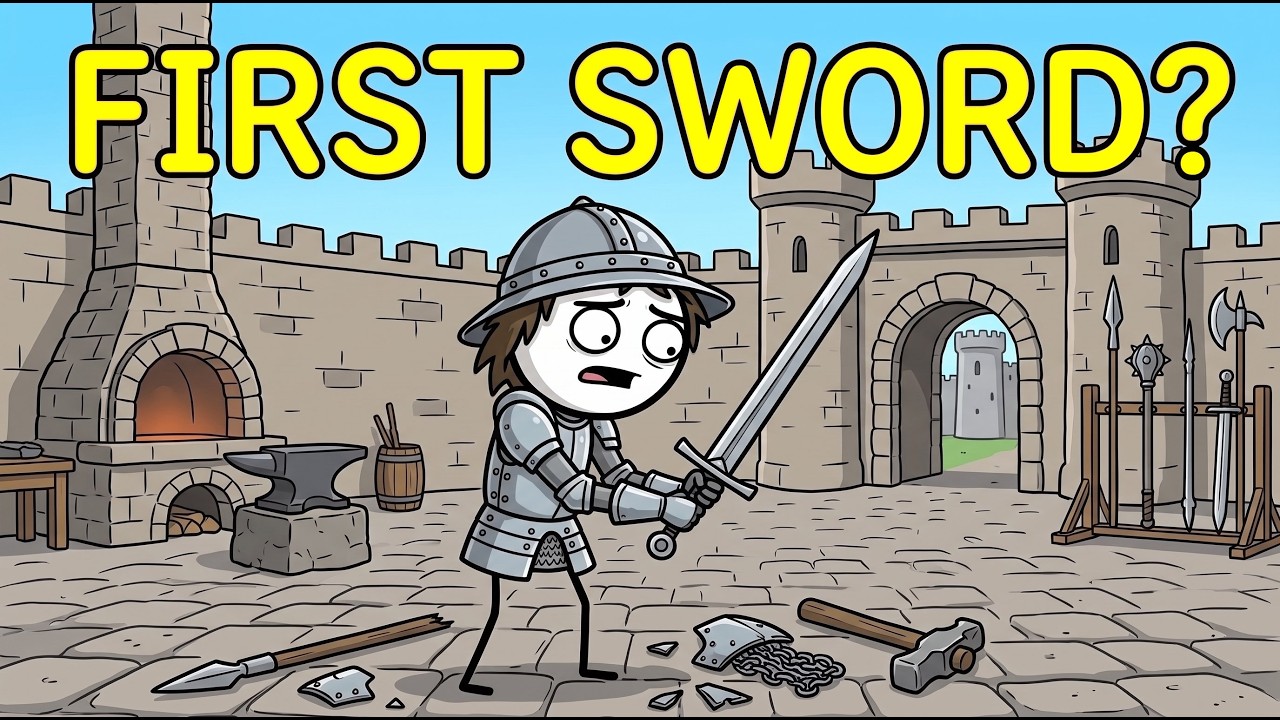
That single encounter, the first meeting between stone and metal, marked one of the most profound technological shifts in the history of human violence. It began not because someone wanted a better weapon, but because someone figured out how to melt rock. For roughly two and a half million years, every cutting tool humans made came from stone. Flint and obsidian were remarkably effective.
Obsidian, a volcanic glass, fractures into edges as thin as three nanometers. A modern steel surgical scalpel, by comparison, has an edge around 25,000 nanometers thick. Under an electron microscope, a steel blade looks jagged and irregular, while obsidian appears as a single unbroken line. Modern experimental surgeries have even used obsidian scalpels because they can cut between individual cells rather than tearing them.
But stone had a fatal weakness. It was brittle. A flint dagger worked fine, but a flint sword was physically impossible. The longer the blade, the more likely it snapped.
In combat, reach meant everything. The person with the longer weapon controlled the distance, and the person who controlled the distance controlled the fight. For millions of years, no one could solve that problem because the material itself refused to cooperate. Metal said yes.
Around nine thousand years ago, people in different parts of the Near East began picking up pieces of raw copper that appeared naturally near the surface and hammering them into shape. It was soft, too soft to hold a real edge, and bent easily. Not the material you would trust with your life in a fight. But it had one property stone lacked.
Copper could be heated, melted, and poured into molds, forming shapes stone could never hold. Then someone, likely by accident, mixed copper with arsenic. The resulting alloy was harder, held an edge longer, and could be cast into longer, thinner blades than pure copper allowed. In the early 1980s, Professor Marcella Frangipane of Sapienza University in Rome was excavating a site called Arslantepe in Malatya Province, eastern Turkey.
Inside the remains of a palace complex, her team found a cache of nine weapons. Three short swords and six long daggers, made of copper-arsenic alloy, with blades between 45 and 60 centimeters long. They had fullers, guards, handles, and pommels. Every element we recognize as sword design was already present.
Three were inlaid with silver. These were not crude experimental prototypes. They were polished, carefully crafted weapons that clearly belonged to high-status individuals. They are approximately 5,300 years old.
Before Arslantepe, most historians dated the appearance of the first swords to around 1600 or 1500 BC. Frangipane’s discovery pushed that date back more than 1,500 years, proving that an advanced metalworking tradition in Anatolia or the Caucasus was producing true swords while most of the world still fought with stone. But early metal blades had their own problems. Copper and copper-arsenic were soft.
A long blade would bend in the middle of a fight, the kind of problem that could get you killed. This is where tin changed everything. Mix copper with about ten percent tin and you get bronze. Bronze is harder than pure copper, holds a better edge, and is strong enough for long blades that do not bend on first impact.
Bronze turned the sword from a status symbol into a real weapon. The Egyptian khopesh is probably the most famous bronze sword in history. It evolved from Mesopotamian sickle swords and, before that, from crescent-shaped battle axes. Its earliest depictions appear on the Stele of the Vultures around 2500 BC, but it reached its peak during Egypt’s New Kingdom, roughly between 1570 and 1070 BC.
The forward-curving blade was not decorative. The hook could catch an opponent’s shield and pull it away, opening a gap for a killing stroke. It was devastatingly effective in chariot warfare, where speed and the ability to strike while passing made a curved hook far more useful than a straight blade. Two khopesh swords were found in Tutankhamun’s tomb, buried not as ornaments but as symbols of pharaonic power.
Bronze had its own fatal dependency. Making it required tin. Copper was relatively available, especially from Cyprus, but tin was geologically rare and unevenly distributed. The nearest major sources for the ancient Near East were in Afghanistan, Central Asia, Cornwall in Britain, and parts of the Iberian Peninsula.
Modern geochemical studies using trace element and isotope analysis have confirmed that tin from Cornwall reached the Mediterranean as early as the second millennium BC. British tin was found in shipwrecks dating to 1300 BC off the coast of Israel. Three thousand years ago, a supply chain stretched from the mines of southwestern England to the forges of the eastern Mediterranean just so people could make swords. In 1982, a shipwreck was discovered off the coast of Turkey.
The Uluburun, a Late Bronze Age merchant vessel, sank in the late fourteenth century BC. It carried copper and tin ingots, glass, luxury goods, and two bronze swords of Mycenaean type. One ship, sitting on the Mediterranean floor for over three thousand years, contained both the raw materials and finished products of the Bronze Age weapons industry. It told archaeologists more about how interconnected the ancient world was than decades of land excavation had.
Then that entire system collapsed. Around 1200 BC, a cascade of disasters struck the eastern Mediterranean. Climate change, drought, trade disruption, internal revolts, and the mysterious Sea Peoples, a coalition of maritime raiders whose identity historians still debate. The city of Ugarit, a vital node in the international tin trade, was destroyed around 1180 to 1190 BC.
When tin trade routes collapsed, so did the ability to produce bronze weapons. And without bronze weapons, the military power that depended on them fell like dominoes across an entire civilization. Here is what most people get wrong about what came next. Iron did not replace bronze because iron was better.
Early iron was often worse than high-quality bronze. It was softer, harder to work, and more prone to rust. Iron replaced bronze because iron ore is everywhere. It is one of the most abundant elements in the Earth’s crust.
You did not need a trade route stretching from Cornwall to the Levant. You could find it in your backyard. That changed everything because you no longer needed to be wealthy to arm yourself. Iron democratized the sword the way the printing press later democratized the book.
During the Bronze Age, swords were expensive, owned by an elite warrior class. Most people, farmers and laborers who made up the vast majority of any ancient population, still fought with stone tools or simple wooden weapons. War belonged to the rich. Iron changed that permanently.
When the raw material was in the hill behind your village, everyone could be armed. Armies grew larger. Wars became bloodier. The individual warrior with his expensive bronze sword and personal reputation mattered less than massive infantry formations of ordinary men with ordinary iron swords.
In 1925, Howard Carter was carefully unwrapping Tutankhamun’s mummy when he found two daggers inside the wrappings, one of gold and one of iron. In 2016, researchers using X-ray fluorescence spectroscopy analyzed the iron blade and found it contained about eleven percent nickel and 0. 6 percent cobalt. That is the chemical fingerprint of meteoric iron.
The blade was matched to a meteorite found near Mersa Matruh. The ancient Egyptians had a name for this material. They called it iron from the sky. They literally took a rock fallen from space and turned it into a dagger for a dead king.
Iron alone was still not good enough for swords. It was too soft. But adding a small amount of carbon, between 0. 5 and 1.
5 percent, transforms iron into steel. Steel is harder than bronze, flexible enough not to shatter, and holds an edge through sustained combat. In India, metalworkers first solved this. Around the mid-first millennium BC, artisans in southern India developed a process known as crucible steel.
They packed iron ore with carbonaceous materials, wood chips, certain leaves, and sealed the mixture inside clay crucibles. Then they heated them to temperatures exceeding 1,200 degrees Celsius. The result was steel with unusually high carbon content and an internal crystal structure that, when properly forged, produced visible patterns on the blade’s surface. The Indian words for this steel, uraku in Tamil, ukku in Kannada, were Arabized by Europeans into wootz.
Wootz steel ingots were exported along ancient trade routes to Persia and Syria, where Persian and Arab swordsmiths forged them into weapons the Western world called Damascus swords. The name came from the markets where Europeans first encountered them, not where the steel actually originated. The flowing watery patterns on a genuine Damascus blade are not applied or etched onto the surface. They are inherent to the steel’s internal carbide structure, only revealed after careful acid etching.
The secret of wootz steel production was largely lost by around 1750, disrupted during the colonial period. But before it vanished, it left a mark. Alexander the Great reportedly brought ten kilograms of Indian wootz steel back from his campaigns, said to be amazed by its quality. Centuries later, physicist Michael Faraday studied Indian steel alloys in his laboratory, and his research helped lay the foundations of modern materials science.
A failed attempt to reverse-engineer an ancient sword ended up establishing an entire scientific discipline. On the other side of the world, Chinese metallurgists solved the same problem differently. In 1965, archaeologists excavating a tomb in Hubei Province opened a nearly airtight wooden box and found a bronze sword. It belonged to Goujian, King of Yue, who reigned from 496 to 465 BC.
The sword was over 2,500 years old. It had not rusted, and when tested, it cut through twenty sheets of paper cleanly. The secret was a bimetallic design. The blade’s core was copper-rich bronze, flexible enough not to break.
The cutting edges had a higher tin content, making them harder and sharper. Two different metal alloys in one weapon, each performing a different function. That level of metallurgical sophistication 2,500 years ago, in a culture also independently developing cast iron and steel, demonstrates that the story of the sword is not one story. It is many stories happening simultaneously across different continents with different materials and solutions, all converging on the same fundamental problem.
Back in Europe, the Romans answered this question not with metallurgical innovation but with design philosophy. The Roman gladius was short, roughly 60 to 68 centimeters. By the standards of Celtic and Germanic swords, it was almost laughably small. Celtic La Tène swords, with broad iron blades of 70 to 90 centimeters, were designed for wide, powerful slashes by warriors fighting in loose formations.
They were flashy weapons for flashy fighters. Yet the Romans defeated them repeatedly with a sword that resembled an overgrown kitchen knife. The gladius was not designed for duels. It was designed for formations, tight disciplined shield-wall formations where the soldier in front of you was close enough to smell your breath.
In that environment, a long slashing sword was useless. You could not swing it. There was no room. What you needed was a short, quick thrusting weapon you could drive from behind your shield edge into the man directly in front of you.
The gladius was that weapon. An industrial tool for organized killing, designed not for heroic duels but for the unglamorous grind of close-order infantry combat. The Romans originally adopted the design from Celtiberian warriors in the Iberian Peninsula, who used a similar short sword called the gladius hispanus. The irony is considerable.
Rome took the sword concept from one people and used it to conquer most of the known world, including the descendants of its inventors. By the third century AD, Roman armies fought differently. More cavalry, more mobile engagements, enemies fighting in looser formations at greater distances. The short gladius was losing its edge, literally and figuratively.
So the Romans adopted the spatha, a longer sword of 75 to 100 centimeters, directly influenced by the long Celtic and Germanic swords they had fought for centuries. The spatha gave cavalry the reach they needed and infantry versatility against enemies who did not stand in neat ranks waiting to be stabbed. The spatha became the direct ancestor of every subsequent European medieval sword. Viking swords, Norman swords, Crusader swords.
Each traces its origin back to a Roman weapon that was itself borrowed from Celtic enemies. In Japan, swordsmiths answered the hardness-versus-flexibility dilemma with perhaps the most labor-intensive blade-making process ever devised. The katana is made from tamahagane, steel produced in clay furnaces called tatara from iron sand and charcoal. The raw material had wildly varying carbon levels and many impurities.
The famous folding technique was not magic. It was a necessary metallurgical solution. Folding homogenized the carbon distribution, preventing brittle weak points. It removed slag and impurities and created a layered grain structure visible on the finished blade.
Then came differential hardening. The smith coated the blade with clay, thicker on the spine and thinner at the edge, then quenched it in water. The thin-coated edge cooled rapidly, becoming extremely hard. The thick-coated spine cooled slowly, remaining flexible.
The result was a blade that was hard where it needed to cut and flexible where it needed to absorb shock. The visible line where the two zones meet, the hamon, became one of the most celebrated aesthetic features in the history of weapon design. In the meantime, Vikings were carrying swords inscribed with the word VLFBT. Produced between the ninth and eleventh centuries, these swords were made of crucible steel with very low slag content, steel that European furnaces of the time could not produce.
The metal almost certainly came from Central Asia or the Islamic world, imported along the Volga trade route connecting Scandinavia to the Caspian Sea. Ulfberht was not a single blacksmith. It was a brand, a prestigious workshop name stamped on blades for over 200 years. Because the name carried such value, forgers made counterfeits using poor local iron, brittle enough to shatter in combat and kill the man who paid good money for a sword he thought he could trust.
Medieval swords were not heavy. A standard one-handed sword weighed between 2. 5 and 3. 5 pounds, roughly the weight of a laptop computer.
These were precision instruments, not crude clubs, and the people who used them were not swinging randomly. Medieval combat manuals written by masters like Johannes Liechtenauer in Germany and Fiore dei Liberi in Italy describe sophisticated martial arts systems with named techniques. Precise footwork, counter-strikes, the half-sword technique where the blade was gripped with a gauntleted hand to direct the point toward gaps in armor, the Mordstreich technique where the sword was reversed and the crossguard used as a hammer against a fully armored opponent. The groove running along many medieval blades, the fuller, is not a blood groove.
It has nothing to do with blood. It is a structural feature that reduces the blade’s weight while maintaining its stiffness, the same engineering principle used in steel beams for skyscrapers. Then the sword’s era ended. Not suddenly, but slowly, the way most dominant technologies end, not because something directly replaced them, but because the world changed around them.
By the late Middle Ages, plate steel armor became so effective that traditional cutting swords were almost useless against it. Swordsmiths responded with thrusting swords like the estoc, which had no cutting edge at all, just a stiff, narrow blade designed to pierce gaps in armor. Techniques like the Mordstreich, using your sword as a hammer, were an admission that the weapon’s original purpose no longer worked. Then came organized pike formations, dense blocks of infantry carrying pikes often 15 to 18 feet long, presenting a wall of points.
The sword in this context was a liability. It had become a secondary weapon long before firearms arrived. Then came the bayonet in the late seventeenth century, converting every musket into both a ranged weapon and a spear. In one stroke, it eliminated the need for dedicated pikemen and made the sword unnecessary in infantry combat.
The sword survived as a cavalry weapon and an officer’s personal sidearm for two more centuries, but its days as a decisive battlefield tool were over. George S. Patton, before he became famous for commanding tanks across Europe, designed what may have been the last serious military sword ever made. The 1913 cavalry saber, sometimes called the Patton saber, was designed specifically for thrusting rather than cutting, because Patton believed this was the only way the sword could remain effective against modern opponents.
It was a serious last attempt to modernize a weapon already rendered obsolete. The fact that the man who designed it later abandoned horses entirely for armored vehicles tells you everything about where the sword stood by the twentieth century. The last major cavalry charge with drawn sabers took place on August 23, 1942. The Italian Savoia Cavalleria regiment, about 600 men, attacked Soviet infantry positions at the Battle of Isbushensky on the Eastern Front.
Using sabers and hand grenades, they overran 2,000 Soviet soldiers armed with machine guns and mortars, and they won. In 1942, a saber charge against automatic weapons. It worked one final time in a world that had already moved beyond it. As a coda to 5,000 years of history, archaeologists working in Nördlingen, Bavaria, in June 2023 unearthed a bronze sword from a burial site containing three skeletons.
It was about 3,000 years old. It had an octagonal bronze handle cast directly over the blade using a technique called overlay casting, requiring exceptional skill. Officials said the weapon still gleamed almost as if new. Despite being buried for three millennia, the blade showed no signs of combat use, but center-of-gravity analysis confirmed it was a functional weapon, not ceremonial.
Three thousand years underground, and it was still, in a fundamental sense, ready to fight. There is a sword hanging on a wall. Perhaps in a museum behind glass. Perhaps in a collector’s home.
Perhaps as part of a military officer’s ceremonial uniform. Polished and formal. Carried for tradition, not for threat. It no longer cuts anything.
It does not need to. But the problems it solved, how to project lethal force farther than your arm reaches, how to concentrate cutting energy on a fine edge, how to combine hardness and flexibility in a single object, those problems shaped metallurgy, chemistry, global trade networks, martial arts, architecture, and the political structure of nearly every civilization that ever carried a sword. A sword is just a piece of curved metal. It is also 5,000 years of human ingenuity compressed into something you can hold in one hand.
The people who made the first swords in that palace workshop in eastern Turkey could not have known what they were starting. They only knew that stone breaks and metal bends, and the one with the longer blade wins.
