In the summer of 1949, a biologist working in the Great Smoky Mountains counted the flashes of a single firefly and recorded a number he himself could barely believe. The fireflies on that hillside were blinking together. All of them, across acres of dark forest, in perfect unison, for two weeks every year. He wrote down the observation, and almost no one listened to him for four decades.
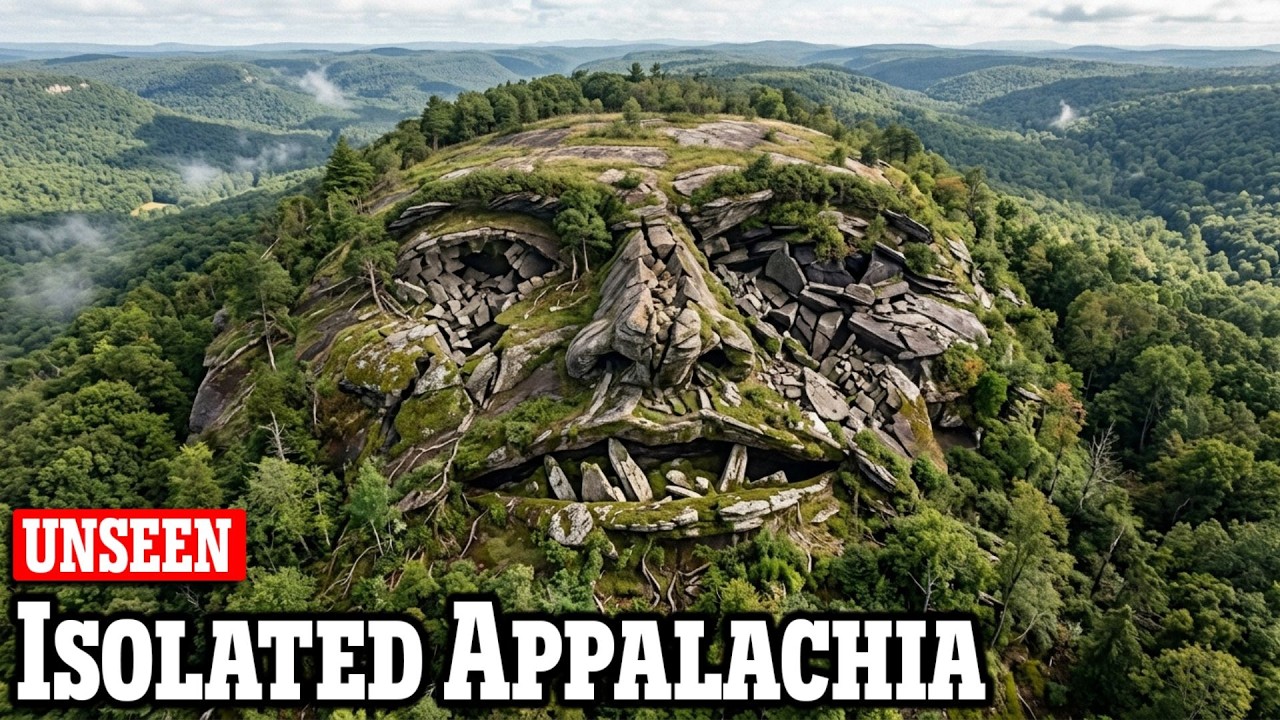
That was not the only rule broken in these mountains. Eleven times, nature here did what nature was not supposed to do. A river older than the mountain range it cuts through. A summit where trees refuse to grow.
Today the climb begins, and all eleven rules stand waiting. Rule eleven: the fireflies that flash in synchrony, in Elkmont, Tennessee. For most of the year, the old logging settlement of Elkmont is an empty clearing in a forest that is growing back. A few chimneys and a creek are all that remain of the town.
But for two weeks in early June, it becomes one of the strangest places on the continent. Fireflies flash to be found. Every male blinks in his own rhythm, alone, out of step with every other male on the hillside. That is the rule on every continent where fireflies exist.
The species Photinus carolinus does not follow it. Here, thousands of insects across acres of dark forest flash at the same instant. Six pulses, then silence for about eight seconds in total darkness, then six more pulses. Records show the behavior was described in the 1930s and largely ignored for roughly fifty years.
No one has ever fully explained why they do it. Synchrony is costly. It hides the individual inside the crowd, which is the opposite of what a mating signal is supposed to do. The forest is performing a calculation, and no one knows who taught it the math.
That light lasts two weeks. The next one has been burning for centuries. Rule ten: dead wood that glows in the dark, in the Nantahala National Forest, North Carolina. Split open a rotting oak log in these mountains on a humid night and you may see it glowing.
Pale green, cold, and steady. Soldiers in the eighteenth century used it to mark trails in the darkness. The glow comes from the fungus Armillaria and its relatives, which penetrate dead wood as black threads called rhizomorphs, producing light through a chemical reaction that continues as long as the wood lasts. The rule is that light requires energy, and an organism that wastes energy loses.
Researchers have suggested the glow attracts insects that carry spores away. The evidence is thin. Some of these fungi glow in places no insect ever reaches. The glow is also disappearing, and not for any mysterious reason.
Foxfire needs standing dead hardwood and true darkness. Records show both have been declining across the range for a century. A light that lasted a thousand years is now being switched off by porch lamps and chainsaws. Both of these give off light.
The next one does not even breathe. Rule nine: salamanders that breathe without lungs, in Great Smoky Mountains National Park. Studies have found that the southern Appalachians hold the greatest diversity of salamanders on Earth. Not just in North America.
Anywhere. Dozens of species, some confined to a single mountain, some to a single gorge. Some exist on one slope and nowhere else. In certain forests here, biologists estimate the total weight of salamanders beneath the leaf litter exceeds the weight of all the birds and mammals above it.
The most abundant vertebrate in the forest is a creature you have probably never seen. Most of them have no lungs. The family Plethodontidae lost theirs in the deep past and never regained them. They breathe through their skin, which works only if the skin stays moist and the air stays cool.
That is the only reason they exist here. These mountains are old, shaded, and soaked with water, and they have stayed that way while the rest of the continent dried out. One researcher marked individuals on a single slope in North Carolina and returned to the same site for more than thirty years. Some of the salamanders he recaptured were older than his study itself.
An animal without lungs outliving the man counting it. Those three rules were broken by living creatures. The next one was broken by the mountain itself. Rule eight: the peak that refuses to grow trees, Roan Mountain, Tennessee and North Carolina.
Climb Roan Mountain or Gregory Bald and you step out of dense forest into open grass. No trees. Just a meadow, spreading across summits above 1,500 meters, with spruce and hardwood standing in a ring below like a tide line. Some of these clearings stretch for hundreds of hectares.
The rule is simple. The tree line at these latitudes sits far higher than any peak in the Appalachians. Nothing here is too cold, too dry, or too high for forest. The soil is deep.
The rain is heavy. Seeds fall every autumn and nothing sprouts. For as long as people have watched, these summits have stayed bald. No evidence of fire explains it.
No shallow bedrock. No scientific consensus. The common local explanation has always involved livestock. Settlers drove their herds up every summer, and the story says grazing created the clearings.
Records show the summits were already bald when the first Europeans arrived. Cherokee tradition explains one of them with a tale about a monster and a council of animals, older than any cow. The prevailing idea now is that they are relics of the ice ages, kept open first by cold, then by herds of grazers that no longer exist. Mammoths, elk, and bison, animals that vanished from these mountains centuries ago.
The bald meadows are harvested by ghosts. Rule seven: the hillside that breathes ice in July, Ice Mountain, Hampshire County, West Virginia. On certain steep slopes in these mountains, cold air comes out of the ground in July. Not just fresh air.
Cold air, near freezing, flowing from gaps between broken rocks while the forest above sits in full summer heat. The cold pockets can approach zero degrees while the air a few steps up the hill is above 30. The mechanism is ice. Water seeps into the fractured rock in winter, freezes deep inside the slope, and stays underground through the warm months.
The hillside breathes out what it stored. The rule being broken is not temperature. It is time. On those few square meters of cold ground grow plants that belong a thousand kilometers to the north, stranded since the last ice age and kept alive by a refrigerator made of stone.
Land snails found nowhere else on Earth. Ferns that should be in Labrador. These sites are small, often no larger than the footprint of a house. Records show that a road cut, a quarry, or a single blocked opening can end one permanently.
An ice age surviving in a hole on a hillside, and a bulldozer finishing it in a single afternoon. That slope holds a few square meters of the north. The next entry holds an entire ecosystem. Rule six: the arctic bog stranded in the south, Cranberry Glades, Pocahontas County, West Virginia.
At about 1,000 meters elevation in the West Virginia highlands sits a bog. Sphagnum moss, acidic black water, sundews, and pitcher plants that eat insects because the soil has no nitrogen to give them. That ecosystem belongs in Canada. It sits here, about 800 kilometers south of where the rule says it should stop, in a shallow basin where cold air drains down the hill every night and pools in the valley bottom.
Frost has been recorded there in every month of the year. The peat runs several meters deep. Pollen cores pulled from it read like a stack of climates, layer upon layer, going back more than 10,000 years. Nothing here is merely a curiosity.
It is a relic. Records show the surrounding highlands were nearly completely logged between 1880 and 1920. The wet ground was too soft to work. A Canadian bog survived the loggers because it was too poor to be worth cutting.
That bog hides in a hollow. The next rule is broken in broad daylight across the entire range. Rule five: the forest that makes its own sky, along the Blue Ridge Parkway, Virginia and North Carolina. The mountains are named for a color they make themselves.
On still summer days the ridges turn blue, hazier the deeper you look toward the horizon. It is not water vapor. The forest exhales isoprene and terpenes, hydrocarbons released by oaks, hickories, and pines in the heat, which react with sunlight to form fine particles that scatter blue light toward you. A single mature oak can release these compounds by the kilogram in one summer.
The rule is that nature does not make its own weather. But this forest does, on a massive scale, every warm afternoon, and it has done so long before anyone came to name it. Records show the haze grew whiter and denser through the twentieth century as industrial sulfates joined it, and visibility at some southern peaks fell to a fraction of its natural range. The color in the name has become part of the record of what we added.
Five rules broken so far. Fireflies keeping time. Wood that glows. An animal without lungs.
A summit with no trees. An ice age in a rock pile, an arctic insect in West Virginia, a forest painting the sky. None of this is accident. These are survivors, left over from colder worlds and older continents, still here because these mountains never changed radically.
The next rule is bigger, and it has been watched for two centuries without an answer. Rule four: the lights no one has found a source for, Brown Mountain, Burke County, North Carolina. Something has appeared above a low ridge in western North Carolina for at least 200 years. Points of light rising above the tree line, holding still, drifting sideways, then going out.
Records show the reports were common enough by 1913 that the U. S. Geological Survey sent an investigator. He concluded the lights were locomotive headlamps from the distant valley.
Then the flood of 1916 destroyed the railroad, the bridges, and the roads, and the lights were reported again while the entire valley sat in darkness. The Survey returned in 1922 and attributed the lights to cars, trains, and grass fires. The reports did not stop. They have not stopped since.
Cameras have been placed on the ridge. Spectrometers have been pointed at it. Hikers still report them from a roadside overlook. No confirmed source.
No repeatable mechanism. No accepted explanation, after two centuries and two federal investigations. Rule three: the ice age forest stranded on a summit, Clingmans Dome, Great Smoky Mountains. Above about 1,700 meters in the southern mountains, the hardwood forest ends and something else begins.
Red spruce and Fraser fir, dark, dense, and cold, standing inside the clouds. They smell like Maine. In a sense, they are Maine. When the glaciers advanced south, these forests came ahead of them, covering the lowlands as far as Georgia.
When the ice retreated, the forests climbed the mountains to stay in the cold air, and then there were no more mountains. What remains sits on a few dozen peaks, separated by warm valleys the trees cannot cross. Islands in the sky. Animals were stranded with them.
The Carolina northern flying squirrel. The spruce-fir moss spider, a tarantula the size of a grain of rice, found only in the damp moss mats of a few summits and nowhere else on Earth. Then in the 1950s, an insect arrived from Europe. The balsam woolly adelgid feeds on the bark of the Fraser fir, and the fir has no defense against it.
Records show it killed more than 90 percent of the mature trees on some peaks within 30 years. Stand on Clingmans Dome today and the gray trunks are still standing. The species survives commercially in Christmas tree farms. In the mountains where it grows wild, it is a remnant guarded by a few thousand hectares and a warming line creeping up the slope.
A forest that survived an ice age is being killed by an insect from a hemlock. That forest is dying slowly, and in front of us. The next one disappears entirely and returns on a fixed schedule. Rule two: the insects that count in prime numbers, on the Cumberland Plateau, Tennessee.
For 13 or 17 years, nothing happens. The nymphs sit underground in the dark, drinking sap from tree roots and counting something. Then, within a single week, they all emerge together. Densities in some areas have been recorded at over a million insects per hectare.
Their noise has been measured at more than 90 decibels, enough to drown out a chainsaw. After six weeks, every adult dies. The forest falls silent for another generation. Records show the broods of these insects were mapped and numbered in the 1890s.
The map still works today. The rule is that an animal reproduces when conditions are favorable. But these do not. They reproduce according to a fixed number.
And that number is prime. Thirteen and seventeen are divisible only by themselves. The likely explanation is that a prime-number cycle is nearly impossible for any predator to track. Anything that sets its rhythm by two, three, or five years will miss them for centuries.
It is a defense built on arithmetic. There is an insect in the soil beneath your feet keeping time more precisely than most clocks, and it has never seen a single year. Every entry so far has broken one rule. The last one breaks the limits of time itself.
Rule one: a mountain range older than bones and flowers, from Alabama to Newfoundland. The Appalachians are old in a way that is hard for the mind to hold. They began rising about 480 million years ago and finished about 270 million years ago, when Africa and North America collided, pushing up a range geologists estimate once rivaled the Himalayas. That was before flowers.
Before birds. Before dinosaurs. These hills were already ancient when the first trees learned to make wood. Then the continents split apart and the range tore with the same rocks, the same folds, the same ages appearing on the shores of Scotland, Ireland, Greenland, and Morocco.
Everything else on this list follows from that age. The bald peaks, the bogs, the ice slopes, the salamanders, the sky islands. None of them were scraped away because the ice sheet stopped short of the southern chain. This refuge is being dismantled within a single human lifetime.
Invasive insects have killed the first trees, then the hemlocks, and have begun attacking the elms. Warming pushes the sky islands upward, off the tops of their mountains, toward an elevation that does not exist. This was supposed to be the end. But it is not.
The elk were hunted to extinction in these mountains by the nineteenth century, then reintroduced in 2001. They are now calving in Cataloochee Valley, the first births here in more than a century. Hellbender salamanders, giant river salamanders that vanished from vast stretches of their waterways, are being raised in tanks and returned to the streams. None of this is a museum.
The adelgid is killing spruce trees at this moment. The night sky over the range grows brighter every year, and the fireflies flash in a glow they never evolved for. In nearly every case, someone measured it and wrote it down, and then was ignored. The Appalachians do not look like a place where rules are broken.
They look like hills, trees, water, and blue blocks in the summer haze, until you understand what they are. And only then do they look like everything.
