In 1935, a businessman named Howard Anthony walked into a bankruptcy auction in Michigan and bought a dead airplane company for $300, reportedly using his wife Helen’s life savings. The company had no products, no customers, and no obvious future. Within two decades, it would become the largest electronics kit manufacturer in the world. By the mid-1970s, its catalogs listed more than 400 products in kit form across 11 product lines, and more than 1,800 workers filled a factory in St.
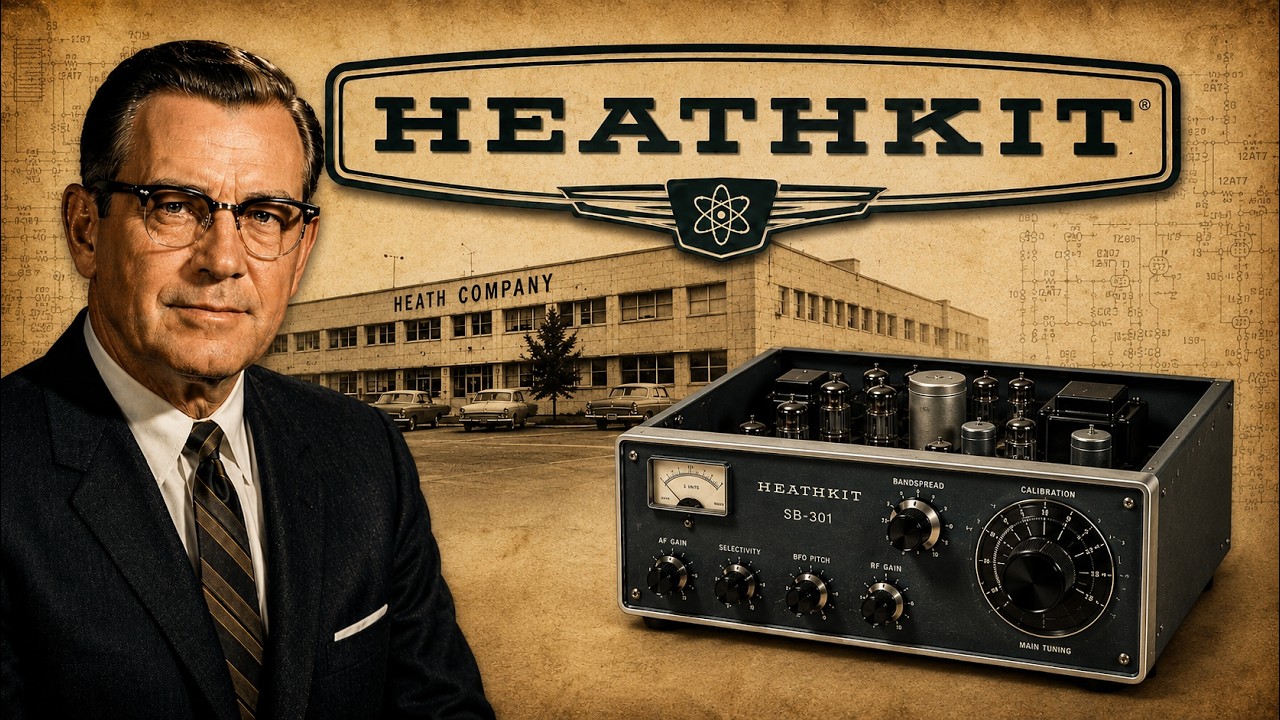
Joseph, Michigan, designed in the shape of the letter H. Over four decades, the company sold tens of millions of kits, trained a generation of American engineers, and put working oscilloscopes, ham radios, color televisions, and personal computers into the hands of people who built every one of them at their own kitchen tables with nothing more than a soldering iron and a set of instructions so clear that a teenager could follow them. In March 1992, the company announced it would stop making kits. When the last remnant of the business finally closed its doors in 2012, it employed fewer than six people.
The distance between those two numbers, 1,800 and six, is the story of Heathkit. And it begins with five railroad boxcars full of government surplus that nobody expected to arrive. The company that became Heathkit did not start in electronics. It started in the air.
Edward Bayard Heath was an aviation pioneer who bought a small company called Bates Airplane Co. in Chicago in 1911 and renamed it the E. B. Heath Aerial Vehicle Company.
After the First World War, he sold surplus aircraft and parts and offered flying instruction. He was a successful light plane racing pilot who won at the National Air Races in a plane he called the Baby Bullet. By 1926, Heath was selling something unusual for the era: an airplane in kit form. The Heath Parasol was a single-seat monoplane named for the way its wing sat above the pilot like a parasol.
For a few hundred dollars and a lot of nerve, you could build one yourself. You could order just the blueprints, or you could order every part and piece. Heath believed that if the instructions were detailed enough and the parts were available, ordinary people could build extraordinary machines. The parasol became a favorite in the flying fraternity, and Heath’s small company built an excellent reputation in the kit aviation world.
That belief, that any skill could be taught through clear instructions and honest engineering, would define the company for the next 70 years, long after the man who held it was gone. On February 1, 1931, Edward Heath was killed during a test flight of a new aircraft design. He was 42 years old. A pilot named Walter Clinin took over the company, moved it from Chicago to Niles, Michigan, and renamed it the International Aircraft Corporation.
Clinin made poor investments, including a bet on the 1933 Chicago World’s Fair, and by the end of 1934, the company was bankrupt. It sat dead for months. Then Howard Anthony showed up with $300 and an eye for wreckage that still had value. Anthony was no aircraft designer.
He was a pragmatic, opportunistic businessman who could see potential in things other people had given up on. He bought the Heath Company’s name and what remained of its tooling, moved operations first to Niles and then to Benton Harbor, Michigan, and tried to make a living selling accessories for small aircraft. He had limited success. Then the Second World War arrived, and the word airplane in the company name brought the United States military to his door.
The government was buying aircraft parts from anyone who could make them. The Heath Company grew from five employees to 125. Anthony was finally making money. And then, in 1945, the war ended.
The contracts were canceled overnight, and the Heath Company shrank back to five employees. Anthony needed a new business, and he needed it fast. In 1946, the federal government began auctioning off enormous quantities of surplus military electronics. Anthony placed a bid.
He won. And then the station master in Benton Harbor called him. As told by people who were at the company in those years, Anthony had nearly forgotten he had placed the bid. The station master informed him that five railroad boxcars filled with surplus electronic parts had arrived and that he had roughly 10 days to unload them before the demurrage fees started.
Anthony went into scramble mode. He called friends, borrowed barns, garages, attics, any storage space he could find across Benton Harbor, and emptied those boxcars into every available corner of town. Inside one of those shipments were hundreds of 5BP1 cathode ray tubes, five-inch tubes used in military radar equipment, exactly the kind of component you could build an oscilloscope around. Anthony found a magazine article published shortly after the war that described how to build an oscilloscope using the 5BP1 tube, and he used it as a reference design.
In late 1947, the Heath Company introduced the O-1 oscilloscope kit. It sold for $39. 50. A comparable factory-built oscilloscope at the time cost several times that amount.
The premise was simple and radical: anyone, regardless of technical knowledge, could assemble a working oscilloscope from a kit using nothing more than a few hand tools, some solder, and a set of instructions. Anthony sent out 500 advertising flyers. 350 orders came back. The Heathkit business was born, and the real product was never the oscilloscope.
The real product was the instruction manual. This is what separated Heathkit from every competitor that would follow. The manuals were legendary. They contained step-by-step instructions written in plain language, accompanied by large exploded diagrams that showed the builder exactly where every component went.
Nothing was assumed. Nothing was skipped. Every resistor, every capacitor, every wire was identified, located, and explained. The company developed a business relationship with electronics correspondence schools like the National Radio Institute and Bell & Howell, which supplied Heathkit products to their students and based entire courses around the assembly process.
For builders who wanted to understand the circuits they were assembling, each manual included a detailed theory of operation chapter, explaining how the device actually worked. You were not just building a piece of equipment. You were getting an education in electronics. As surplus parts ran out, Anthony substituted new components and updated model numbers.
The O-1 became the O-2, then the O-3, then the O-4 in rapid succession. A vacuum tube voltmeter kit followed, then audio equipment. By the early 1950s, the first amateur radio transmitter, the A-1, appeared in the catalog. By 1954, the Heath Company had $10 million in annual revenue.
Nearly 100,000 oscilloscope kits had been sold. Howard Anthony had turned five boxcars of surplus into a company that was changing how Americans related to the technology in their lives. On July 23, 1954, Howard Anthony boarded a de Havilland Dove on a demonstration flight to Florida. The twin-engine aircraft, a purchase he was considering for the growing company, carried a professional pilot, Anthony, and four other passengers.
Over Tennessee, they encountered severe weather. The plane crashed. There were no survivors. Howard Anthony was the second head of the Heath Company to die in an airplane crash.
His wife, Helen, who had handled the finances and understood the business intimately, was devastated. But she was also determined. She would sell the Heath Company, but only to a buyer who would keep the employees and keep the operation in Benton Harbor. On February 1, 1955, exactly 24 years to the day after Edward Heath’s fatal crash, Helen Anthony signed the company over to Daystrom, a holding company that manufactured diversified electronics and military technology.
Helen Anthony went back to work the next morning. Under Daystrom, the Heath Company built a new factory in nearby St. Joseph in 1958. The plant was designed in the shape of the letter H, an architectural nod to the company name, and it covered 150,000 square feet.
It was later expanded multiple times in 1962, 1967, 1968, 1969, 1972, and 1974. In 1962, Daystrom was acquired by Schlumberger, the French oil field services giant. It was a strange corporate marriage: an oil exploration company now owned the largest electronics kit maker in America. But Schlumberger largely left Heathkit alone.
The Daystrom and Schlumberger years, from the mid-1950s through the late 1970s, were Heathkit’s most productive and most profitable. Heathkit stopped being a company that sold test equipment to hobbyists and became a company that put consumer electronics into the American home, one kit at a time. Hi-fi amplifiers, stereo tuners, shortwave receivers, color televisions, ham radio transceivers, metal detectors, electronic ignition kits for automobiles, microwave ovens, weather stations, digital clocks. The catalog grew from 48 kits in 1954 to over 300 by the late 1960s and past 400 by the mid-70s.
Heathkit opened more than 60 retail stores across the country, where customers could see the finished products, pick up kits, and get advice. These were not ordinary electronic shops. They were places where the staff could walk you through the build because many of them had built the same kits themselves. The model worked because electronic components were big enough for human hands to place and expensive enough that building your own saved real money.
Neither of those conditions was permanent. Thousands of veterans came home from the Second World War with training in military electronics and an appetite to keep building. The GI Bill sent many of them to engineering schools, but just as many taught themselves at their kitchen tables. And Heathkit was the curriculum.
The company’s low-cost test equipment meant that anyone with a soldering iron and a garage could open a television repair shop. In the 1950s and 60s, thousands did. TV and radio repair shops bloomed across the country, and the equipment inside most of them had been assembled by the owner from Heathkit boxes. Amateur radio exploded in the same period, and Heathkit became its dominant supplier.
Over the company’s lifetime, Heathkit produced more than 150 amateur radio kits, the largest ham radio product line ever assembled by a single manufacturer. The HW-101 transceiver alone sold nearly 40,000 units, more than any single amateur radio product anyone had ever sold. The test equipment numbers were staggering. Over the course of 40-plus years, Heathkit sold more than 2 million vacuum tube voltmeters and more than 2 million oscilloscopes across more than 60 different models.
The transistor and then the integrated circuit arrived, and Heathkit adapted, moving from tube-based kits to solid-state designs without losing the builder. In the early 1970s, Heathkit introduced the GR-2000, a 25-inch solid-state color television kit. It was the most ambitious consumer electronics kit ever offered to the American public. The GR-2000 was the first television anywhere, at any price, from any manufacturer to display the channel number and time on the screen.
Not RCA, not Zenith, not Sony. Heathkit. Elementary Electronics magazine wrote in 1974 that the Heathkit GR-2000 was the color TV the rest of the industry would be making tomorrow. In a single year, Heathkit sold 47,000 of them.
The Heath Company held 27 patents on improvements to color television technology. The manual for the GR-2000 was enormous. The build took weeks, and the result was a television that the builder understood from the power supply to the picture tube, because they had placed every component with their own hands. For amateur radio operators, the SB series transceivers and the DX-100 transmitter were objects of reverence.
The DX-100, which appeared in 1956, weighed nearly 100 pounds, cost $190, covered all the high-frequency bands with over 100 watts of output, and included a built-in power supply and variable frequency oscillator. Hams who assembled these rigs in the 1960s are still operating them today, six decades later, because the engineering was that sound and the construction, guided by those manuals, was that careful. In 1982, Heathkit introduced the Hero 1, the Heathkit Educational Robot. It was a self-contained mobile robot with a Motorola 6808 processor, 4 KB of RAM, light and sound detectors, a sonar ranging sensor, and an optional speech synthesizer.
The kit cost $1,500. Byte magazine called it a product of extraordinary flexibility and function. 14,000 Hero 1 units were sold over eight years. It was featured on the children’s television program Mr.
Wizard’s World. But inside the GR-2000 and the Hero 1, the seeds of the end were already visible. Integrated circuits were getting smaller. Surface mount components were replacing the through-hole parts that human fingers could grip and a soldering iron could reach.
Factory automation was driving the cost of assembled electronics down so fast that building your own no longer saved 50%. It might save 10%. It might save nothing. The thing that had made Heathkit possible, components large enough to place by hand and expensive enough to justify the labor, was disappearing.
In 1977, Heathkit introduced the H8, its first personal computer kit. It used an Intel 8080 processor running at 2 MHz, came with 4 KB of RAM, and sold for $379 for the base unit. Heathkit had considered building a computer as early as 1974 but had concluded it was not a good fit for their traditional market. The successful launch of the Altair changed the calculation.
The H8 ran Heathkit’s own operating system, HDOS, and was compatible with CP/M. In 1979, Heathkit followed with the H89, an all-in-one computer that combined a terminal, a processor, and a built-in floppy disk drive in a single enclosure. Within two years of the H8’s introduction, Heathkit’s computer business exceeded $30 million in annual sales, with two-thirds in kits and one-third in assembled product. These were the most successful products the company had ever made.
They were also the products that would bring the company to the attention of a buyer who wanted the computers and had no particular interest in the kits. The irony ran deeper than the sale price. The same hobbyists who had spent 20 years building Heathkit oscilloscopes, amplifiers, and ham radios were now buying Heathkit computers. But once the computer was built, the hobby changed.
The workbench gave way to the keyboard. The soldering iron went back in the drawer. The act of building hardware was being replaced by the act of writing software. And software required no kit, no manual, and no Heathkit.
In October 1979, the Zenith Radio Company purchased the Heath Company from Schlumberger for $64. 5 million. Zenith’s television business was struggling, and the company wanted into the booming personal computer market. Zenith carved out the computer products and created Zenith Data Systems, headquartered initially at Heath’s own facilities in St.
Joseph. ZDS grew fast. By 1983, just four years after the acquisition, ZDS was doing $225 million in annual sales. By 1988, it peaked at $1.
4 billion in revenue with 3,800 employees. The kit business, meanwhile, was an afterthought. No new kits were developed after 1986. The retail stores were reorganized under a separate entity.
The engineering talent that had designed those legendary kits was redirected or dispersed. The ham radio kits that had been the backbone of the company for 30 years were discontinued one by one. The 1990 holiday catalog listed just 79 kits, and some of the newer ones were small novelty items. In 1989, Zenith sold ZDS and Heathkit along with it to Group Bull, a French state-owned computer manufacturer.
The kit business was by then a rounding error inside a billion-dollar computer operation. In March 1992, the Heath Company formally announced the discontinuation of electronic kits after 45 years of production. The last amateur radio product Heathkit ever made, the SS-9000 transceiver, was so complex that it had to come assembled. A Heathkit that could not be built as a kit.
Only 375 were produced. Heathkit Educational Systems carried on, selling courseware and training materials to schools and vocational programs. The factory on Hilltop Road in St. Joseph was divided up.
Today it houses a Whirlpool facility and a scattering of small businesses. In 2012, Heathkit Educational Systems defaulted on its lease and filed for bankruptcy. At its peak, the Heath Company employed more than 1,800 people. When the doors closed for the last time, there were fewer than six.
But the machines outlived the company. The oscilloscopes built from kits in the 1950s are still on workbenches. The ham radio transceivers assembled in the 1960s are still on the air. The DX-100 transmitters, the SB series rigs, the HW-101s are still pulling signals out of the ether six decades after someone soldered their last connection and turned the dial for the first time.
The Hero 1 robots are in collectors’ basements, still booting, still running their Motorola 6808 processors. The instruction manuals are traded online, archived by preservationists, and studied as models of technical writing decades after the last kit shipped. In 2013, new owners attempted a revival. In 2023, a North Dakota company called Kirkwall acquired the Heath Company.
The headquarters moved from Benton Harbor to Fargo. A website offers a handful of new kits and vintage replacement parts. The name survives, but the empire, the 400 products, the 60 stores, the 1,800 workers, the factory shaped like the letter H, is gone. Five railroad boxcars of surplus electronic parts arrived at a station in Benton Harbor, Michigan, in 1946.
Howard Anthony, who had bought a dead airplane company for $300 eleven years earlier, borrowed every barn and attic in town to store what was inside them. From those boxcars and from the hundreds of 5BP1 cathode ray tubes packed among the resistors and transformers and surplus military wiring, he built a $39 oscilloscope kit and attached to it a set of instructions so clear that a high school student could follow them on a Saturday afternoon. That decision to trust the customer with the components and teach them how to build created a company that trained more American engineers than most universities. Heathkit was sold for its computers.
It was remembered for its manuals. And it was mourned for everything in between.
