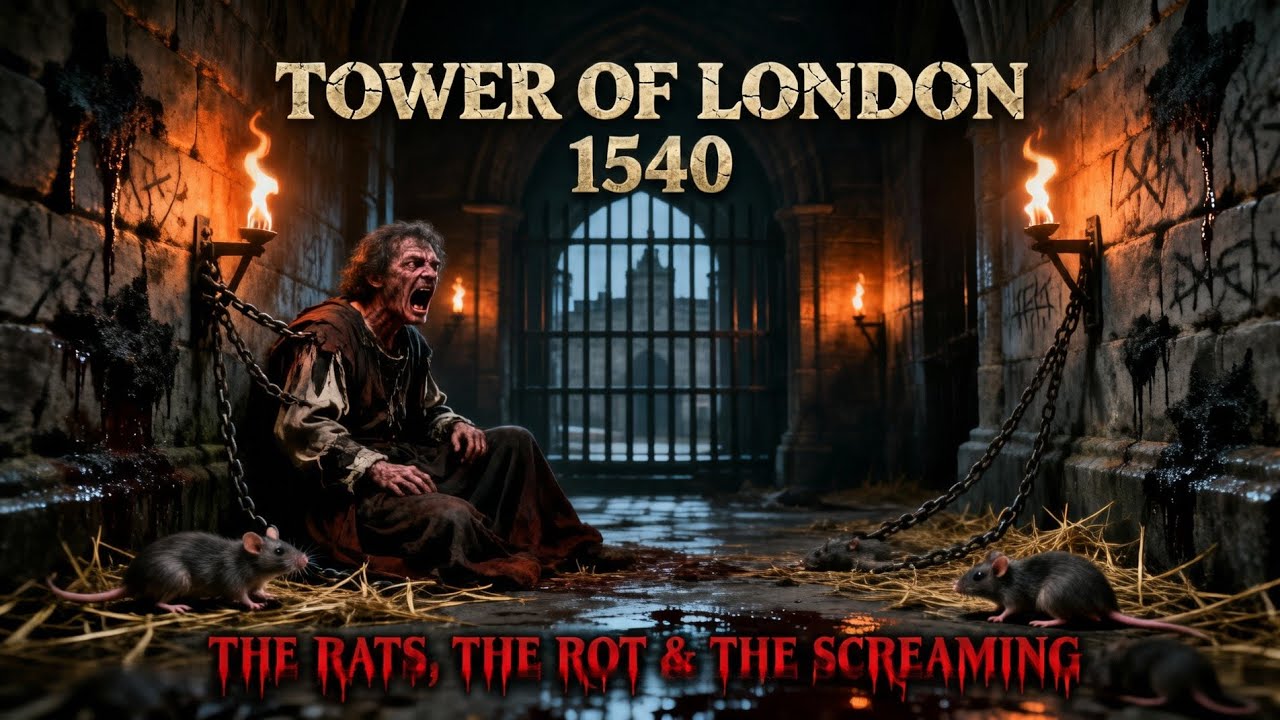
In 1540, a prisoner stepped off a barge at Traitor’s Gate and onto wet stone. The iron gate ground shut behind him, water streaming off the bars as he was led down into the Tower of London’s lower chambers, below the medieval water table, where cells flooded twice daily with Thames river water. He had been arrested three days earlier. He did not know the charges.
He did not know when he would be tried. He knew only that the building itself had begun to dismantle him. The cell was in Beauchamp Tower, built in the 1280s as part of the inner defensive wall. The ground level sat below the high-tide mark.
The floor was coated in a thin film of moisture that never fully drained. The walls glistened black with mold. A vertical slit eight inches wide and two feet tall cut through three feet of stone admitted a blade of daylight that told him nothing useful about time. There was no fireplace in the lower cells; those cost extra and existed only in the premium accommodations above.
He had a straw pallet laid on stone and a wool blanket that stayed permanently damp. Twice a day the tide came in, raising groundwater pressure and forcing seepage up through the floor joints, through the mortar, through microscopic fractures in the stone. The air was saturated. Nothing dried.
Within weeks, the respiratory infections began: a raw throat, a dry cough that turned wet, shallow breathing because deep breaths hurt. His skin macerated in the constant damp. Small cuts stayed open and weeping. Sores spread across his feet and ankles.
His hands cracked and bled at the knuckles. Joint pain inflamed everything, knees, hips, shoulders, fingers, worsened by cold and moisture that never relented. He could hear other prisoners coughing through the walls, but he could not see them. Isolation was total except for sound.
The Tower did not need to torture him. The building did it automatically, through moisture, cold, darkness, and time. Prisoners were moved downward as their money ran out. The Lieutenant of the Tower was not paid by the Crown to house prisoners; he was paid by the prisoners themselves, with the bill calculated daily.
Rental fees for cells, daily charges for food, firewood sold by the bundle, candles by the dozen, paper and ink for letters, servant attendance: every human need had a price. A prisoner with resources got a room in the Lieutenant’s lodgings with a fireplace and a servant. A prisoner with moderate funds got a cell in Beauchamp Tower like his, damp but bearable. A prisoner whose money ran out was moved to smaller, darker, colder cells below the waterline, where the air was thick and the lungs filled with fluid.
He had arrived with funds. His family had mobilized immediately, sold grain stores, called in debts, scraped together enough to secure him a mid-tier cell. But the arithmetic was simple and terrible. Each week in the Tower drained resources they did not have.
His wife wrote that the estate was struggling, the harvest had been poor, she was borrowing from relatives. His brother wrote that he had sold land to cover the costs but it would not last beyond Easter. His daughter wrote nothing; she was twelve, and they were shielding her from the financial collapse. The letters from adults began discussing which possessions to sell next.
If he stayed six months, the family lost the house. If he stayed a year, they lost everything. The moves came without warning. One morning the door opened and a guard told him to gather his possessions.
The last payment had been short. The new cell was smaller, no table, no window, just a slot in the door for food. The walls were wetter, the smell worse, the candle ration dropped to one every three days. He sat on damp straw and counted the hours by listening to guard rotations in the corridor.
Three months in, he was moved again. This cell had no light except what leaked under the door. The walls streamed water. The pallet, blanket, and clothes were soaked.
The food ration had been reduced to bread and water, which was not enough to sustain him in the cold. He developed sores that would not heal, a cough that deepened, weight loss that would not stop. He wrote to his wife, “Stop paying. Let me be moved down.
Don’t destroy yourselves for this. ” She wrote back, “We will not abandon you. ” But he read between the lines: they had sold everything movable, they were living on charity, his son had left school to work. His imprisonment was a financial catastrophe radiating outward, destroying everyone connected to him.
The Tower’s records showed this pattern repeatedly. Prisoners who entered with wealth moved progressively downward as family resources collapsed. Men who began in furnished rooms ended in lightless cells with straw and rats. Not because their crimes were reassessed, not because they were formally punished, but because the money ran out and the Tower adjusted their accommodations to match their ability to pay.
Some families bankrupted themselves maintaining comfort for years. Some gave up after months, and the prisoner dropped to the bottom cells where survival rates were catastrophic. Some prisoners begged their families to stop paying. Some families kept paying long after the prisoner wanted them to, unable to accept that stopping meant condemning a loved one to the wet darkness below.
He was in that darkness now. He had lost track of days. No light meant no marking of time except meals, and meals had become irregular because he was low priority now, and sometimes the guards forgot. His body was failing in measurable ways: constant cough, bleeding gums, joint pain so severe he could barely stand.
He was cold all the time. The damp had penetrated so deeply he could not remember what dry felt like. Then the cell door opened. He was being moved again.
He gathered nothing because he had nothing left. The new space was smaller than he had thought possible. He could not stand fully upright. There was no pallet.
He slept on bare stone. During high tide, the water on the floor was ankle-deep, and he stood in Thames water twice a day. His feet were rotting. This was the bottom.
The Tower did not execute him. It simply withdrew all services and waited for his body to fail. Some men lasted months. Some lasted weeks.
The recorded cause of death would be fever or flux or consumption. The actual cause was economic. Then the Privy Council issued a warrant. It was signed by multiple council members, dated, sealed, and filed in the Tower’s records.
It authorized the Lieutenant of the Tower to apply interrogation under duress for matters touching the King’s security. This was legal torture, official, bureaucratic, processed through proper channels. The warrant arrived at midday. He heard footsteps, multiple guards, the scrape of keys.
The lieutenant stood in the doorway with two wardens and read the warrant aloud. He was to be brought to examination. The walk from his cell to the White Tower basement took minutes that stretched into something measureless. He crossed the inner courtyard, felt daylight and open air for the first time in months, and was taken down circular stone stairs into foundation-level chambers that stayed cold even in summer.
In the center of the examination room stood the rack: a wooden frame six feet long, slightly elevated, with two rollers operated by long wooden levers, iron chains ending in manacles. The device was simple, mechanical, effective. He was positioned on the frame. His wrists were locked into the upper manacles, arms extended above his head.
His ankles were locked into the lower manacles, legs straight. The chains were drawn taut, not pulling yet, just eliminating slack. The questions began. Who else was involved?
What was discussed? Where did you meet? The lieutenant asked from beside the frame, voice level, while the clerk’s pen scratched on paper. He answered.
The answers were not satisfactory. The lever turned. One click. The chains tightened.
His shoulders registered the pull. Not pain yet, but pressure. More questions, rephrased. His answers did not change because there was nothing else to say.
Another click. Now his shoulders hurt, a deep ache as ligaments stretched. Another click. The pain intensified.
His shoulder joints were dislocating, the ball of the humerus pulling against the socket rim. His hips screamed. He screamed too. The clerk noted that the subject cried out.
Anne Askew had endured this in 1546, a Protestant reformer accused of heresy. The Lord Chancellor himself turned the lever. She was racked so severely both shoulders dislocated, then her hips. The session lasted hours.
When it ended she could not walk or stand. At her execution three days later she was carried to Smithfield in a chair and chained to the stake sitting down because her body no longer functioned as a skeleton. She was burned alive while unable to stand. The rack did that, not the fire.
He was still on the frame. Time had stopped meaning anything except the space between clicks. His joints had separated. His shoulders hung loose.
Something in his knee joint tore and he felt it pop. The pain whited out thought. The clerk recorded his words, everything he said, everything he screamed. His agony was part of the official record now.
The session ended because the warrant specified a time limit, and the limit was reached. He had confessed nothing new. The leathers were reversed, the chains slackened, the manacles removed. He could not stand.
Two guards lifted him and carried him back to his cell, his arms hanging at wrong angles, his legs dragging. He was left on the floor. No physician, no treatment. His body would either repair itself or it would not.
Most rack victims retained permanent damage: shoulders that never raised fully, hips that could not bear weight properly, spines that never straightened again. Some died within days from shock or infection. Some lived for months crippled. The warrant could be reissued.
This could happen again tomorrow or next week. He did not know. That was part of the design: the uncertainty, the waiting to heal just enough that they could damage him again. Sir Thomas More waited fifteen months between arrest and execution.
No trial date, no formal charges delivered, just days accumulating while he sat in dampness and listened to the Tower’s bells mark hours that meant nothing. Each morning he woke to the same question: Is this the day? Trial, release, execution, or nothing? The door stayed closed.
Breakfast arrived, bread and water, another day alive, another day waiting. The sentence arrived: beheading. He felt relief, not joy, not resignation. Relief because the legal penalty for treason was hanging, drawing, and quartering, dragged through streets, hanged until nearly dead, cut down conscious, castrated, disemboweled while watching, heart torn out, body quartered, parts spiked across London for birds to eat.
Beheading was mercy, an aristocratic privilege. One stroke, instant death. He wrote to thank the Crown for this kindness. On Tower Hill, he knelt.
The block was smooth wood worn by necks before his. The executioner tested his axe. He heard the blade cut air.
His last thought was not fear; it was gratitude that the waiting finally ended.
