The sheriff’s lantern caught two small figures on the path, and Robert Crane stopped walking. His instincts, honed by six years of overseeing men and managing the machinery of Hutchkins Fields, told him something was wrong. The figures were too still, too silent, and they were far from the kitchen quarters where they belonged. “Sarah?
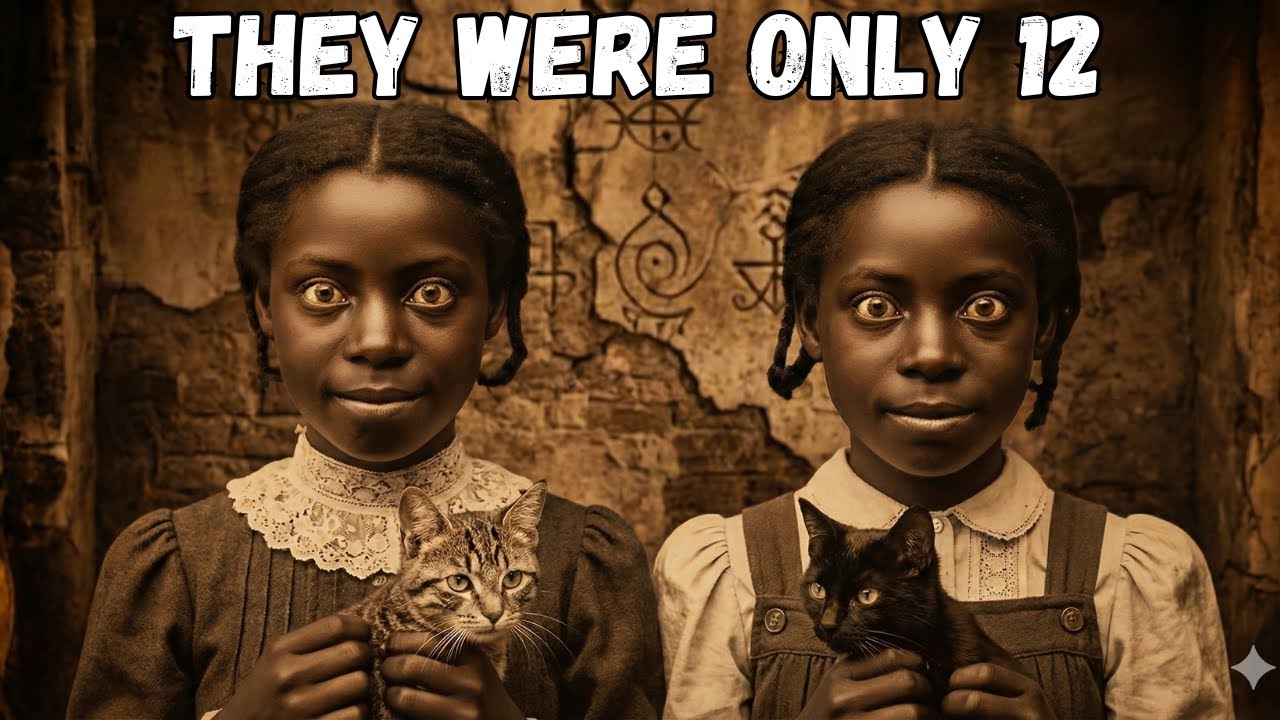
Margaret? ” he called, his voice cutting through the hum of the cicadas. “You are far from your quarters. ”
There was no panic, no trembling.
The two girls simply stood side by side, their hands empty, their faces illuminated by the flickering oil lamp. Crane took a step forward, and in the shifting light he saw it. He saw the travel clothes beneath their aprons. He saw the tension in their posture.
And finally, looking into their eyes, he saw the abyss. “It was you,” Crane whispered, the pieces of two years of tragedy locking together in his mind. “All of them. Vernon, Douglas…
it was you. ”
He reached for the knife at his belt, not out of aggression but out of sudden primal fear. The twins were already moving. They did not flee.
They attacked. Crane was a large man, strong and experienced in violence, but he was fighting shadows that didn’t follow the rules of combat. Sarah lunged low, aiming for his knees, throwing him off balance. As he stumbled, Margaret brought a heavy riverstone down on his lantern hand with bone-shattering force.
The lantern fell, glass shattering, oil spilling and igniting instantly in the dry grass. In the confusion, Crane tried to regain his footing, but the twins were a whirlwind of coordinated strikes. They tripped him, and he fell hard, his temple striking stone. He went limp, blood pooling on the path.
The fire from the lantern was growing, licking at the dry scrub. The twins stood over the unconscious overseer, their chests heaving, illuminated by the growing inferno. They did not speak. They simply grabbed Crane by his coat collar and boots, dragged him three feet, and positioned his body directly in the path of the spreading flames.
It would look like another accident. A man who tripped, hit his head, and was consumed by his own lantern fire. It was the signature they had perfected: death that looked like misfortune. As the fire caught Crane’s clothing, the twins turned their backs on Hutchkins Fields for the last time.
They melted into the forest, leaving behind the blaze that would serve as both their exit signal and the funeral pyre for the last man standing in their way. To understand how two thirteen-year-old girls had reached this point, one must return to the beginning, to the humid, clay-dusted expanse of Burke County, Georgia, in the spring of 1851. Over a span of nearly four years, seventeen men would meet their ends on three distinct cotton plantations. They were overseers, drivers, and supervisors, men who wielded whips and authority with equal weight.
The local medical examiners, baffled by the statistical anomaly of so many accidental deaths, signed death certificates citing drowning, falls, kicks from horses, and sudden illness. Sheriff Clayton Morgan consistently closed the files, unable to find a single shred of physical evidence linking the deaths to human agency. He never suspected that two identical faces were watching from the periphery, tallying the dead on a silent internal ledger. Hutchkins Fields was not merely a farm.
It was a sprawling 800-acre industrial engine of the antebellum South, located a dozen miles south of Waynesboro. In 1851, it was in the throes of its most lucrative season in a decade, a white ocean of cotton managed by William Hutchkins. Hutchkins was a man of ledgers and ink, a deacon who believed that godliness was found in order and profit. He tracked every variable of his estate with obsessive precision: the weight of the harvest, the cost of grain, the depreciation of tools, and the vital statistics of the 347 enslaved souls he claimed as property.
His study was lined with leather-bound volumes, a library of human misery reduced to arithmetic. His wife, Elleena, mirrored his cold efficiency in the domestic sphere, ruling the household staff with a quiet, terrifying rigor. It was into this world that Sarah and Margaret arrived, purchased in January of that year from a passing trader in Augusta. They were listed simply as “twin females, approximately 12, domestic,” with no surname and no recorded kin.
The twins entered Hutchkins Fields on a gray Tuesday afternoon, huddled in the back of a transport wagon alongside seven other strangers. Even then, amidst the confusion and trauma of arrival, they possessed a disquieting stillness. Robert Thaddius Crane, the plantation’s head overseer, processed them with the bureaucratic indifference of a man who had spent six years turning humans into labor units. He assigned the girls to the kitchen and laundry details under the supervision of his wife, Martha.
In those initial weeks, the twins were nothing short of phantoms. They spoke only when a direct question required an answer, and even then their voices were flat, uncolored by the fear that usually defined new arrivals. They moved with a synchronization that unnerved the older women in the laundry. If Sarah reached for a basket, Margaret was already opening the door.
They were two halves of a single consciousness, observing the plantation’s machinery with eyes that seemed to be deconstructing the very physics of their prison. While the other enslaved workers kept their heads down to avoid the lash, Sarah and Margaret watched the overseers with the focus of predators studying migration patterns. They memorized the rotation of the guards, the blind spots behind the stables, the specific times when men were isolated. They did not look for escape routes.
They looked for leverage. Their attention eventually settled on Vernon Cushing, the overseer of the East Cottonfields. Cushing was a twenty-eight-year-old sadist who viewed pain not as a tool for discipline but as a recreational pastime. He targeted the vulnerable—the elderly, the children—with a glee that even Robert Crane found distasteful.
The twins observed Cushing for three weeks, cataloging his movements with scientific detachment. They noted that every morning, fifteen minutes after the dawn bell, Cushing rode his stallion along a narrow, muddy track through a pine thicket to reach the fields. He always rode alone, and he always rode fast. The morning of March 28th, 1851 brought a torrential downpour that turned the Georgia clay into a slick, treacherous paste.
It was the variable the twins had been waiting for. Under the cover of a pre-dawn sky still bruised with storm clouds, Sarah and Margaret slipped from the kitchen quarters carrying a length of hemp rope stolen from the stables days prior. They moved to a section of the pine path where two ancient trees created a natural choke point, and where the rain had pulled the ground into a deep muddy depression. Working with practiced efficiency, they tied the rope between the trees at shin height, too low for a rider to see in the gloom but perfectly placed to intercept the galloping legs of a horse.
They retreated twenty yards into the brush and waited. When Cushing came thundering down the path, his horse hit the trip wire and pitched forward. The violence of the stop ejected the overseer face-first into the mud. The impact was catastrophic.
Cushing landed with such force that the wind was driven instantly from his lungs, leaving him gasping in a slurry of water and earth. Before he could recover, his panicked horse, thrashing to regain its footing, rolled partially over him, pinning him into the muck. By the time the field hands discovered him an hour later, Vernon Cushing had drowned in eight inches of dirty water, his mouth and nose packed with the soil he had once ruled over. The twins had retrieved their rope and were back in the kitchen, their hands dusted with flour, long before the alarm was raised.
The sheriff from Waynesboro conducted a perfunctory examination and concluded that the horse had slipped in the treacherous mud. A simple misadventure. No one questioned the narrative. Why would they?
Men died on plantations all the time. With Cushing gone, the plantation’s ecosystem shifted. William Hutchkins promoted Douglas Pritchard, a forty-year-old career supervisor, to fill the vacancy. Pritchard was a man of average cruelty, a bureaucrat of violence who did what was necessary to maintain quotas.
He might have survived his tenure if not for a single afternoon in April. The twins watched as Pritchard beat an elderly man named Samuel with a shovel handle because the old man, delirious with fever, moved too slowly. Pritchard didn’t just strike him. He kicked the collapsed man with a casual disregard that sealed his fate.
That night, lying in the darkness of the kitchen quarters, Sarah and Margaret silently added Pritchard to their ledger. Pritchard’s routine was different. He commuted from town and kept his saddle in the plantation tack room. The twins, who had access to the stables to feed kitchen scraps to the pigs, began to study his equipment.
They ignored the obvious weapons—knives, pitchforks—and focused instead on the structural integrity of his leather gear. On the evening of April 29th, the twins infiltrated the tack room while the stable hand was distracted. Sarah used a shard of glass sharpened on a riverstone to perform a delicate surgery on the girth strap, the thick band that holds the saddle to the horse. She made a series of deep longitudinal scores on the underside of the leather, hidden from casual inspection.
The cuts were designed to hold against a steady pull but to shear completely under the sudden, violent stress of a horse bolting. The next morning, Pritchard saddled his horse and rode out to the fields. For hours the leather held, groaning under the microscopic expansion of the cuts. It wasn’t until mid-morning, when his horse shied violently at a snake, that the trap sprang.
The sudden lateral force snapped the compromised leather with the sound of a pistol shot. Pritchard was thrown sideways, his left foot hopelessly snarled in the stirrup iron. The horse, terrified by the saddle slipping under its belly, bolted blindly through the cotton rows. Pritchard was dragged for forty yards, his body battering against the hardened earth until laborers managed to intercept the animal.
He was carried to the infirmary with a fractured skull and crushed ribs, lingering in agony for three hours before dying. The official verdict was equipment failure, a tragedy caused by old, dry, rotted leather. William Hutchkins inspected the strap himself, shaking his head at the frayed edges, never seeing the precise glass cuts hidden within the tear. That night, as the plantation whispered news of the second death in two months, Sarah leaned over to Margaret in the dark and whispered a single word.
Three. The summer of 1851 descended upon Burke County like a heavy woolen blanket. It was in this atmosphere of sweat and mechanical noise that the twins turned their gaze toward their third target. Harold Simmons was the supervisor of the cotton gin operation, a thirty-four-year-old technocrat who valued the efficiency of the machine over the safety of the men who fed it.
He spent his days inside the gin house, a cavernous wooden building where the air was perpetually thick with white lint. The heart of the building was the main drive belt, a massive slapping loop of leather that transferred power from the external waterwheel to the internal gears. It moved at eight feet per second. On June 14th, during the afternoon shift change, when the great wheel was briefly disengaged, Sarah and Margaret entered the silent building.
While Margaret distracted Simmons with a question about the grading of fiber—a calculated anomaly, as the twins never spoke—Sarah moved toward the main drive shaft. She retrieved a length of thin, high-tensile cord she had submerged in her water bucket, tied one end to a structural support beam, and left the other end dangling, forming a subtle loop mere inches from where the drive belt would traverse. When the shift whistle blew and the external wheel groaned into motion, the drive belt began its rapid cycle. The loose end of the cord, caught by the friction of the racing belt, was snatched up instantly.
The slack snapped tight in a millisecond. The tension didn’t break the rope. It shattered the wooden support beam Sarah had anchored it to. A jagged splinter of timber, three feet long and heavy as iron, whipped around with the momentum of the belt and struck Simmons in the temple.
The blow was so severe it lifted him off his feet and threw him into the sorting mechanism. By the time workers disengaged the wheel, Simmons was dead, his neck broken by the impact. The official investigation cited a catastrophic structural failure caused by the machine’s vibration. That evening, as the twins cleared the dinner plates in the main house, they listened to William Hutchkins lament his misfortune.
“Three men in three months,” he murmured to his wife, staring into his wine glass. “It feels as if the land itself has turned against us. ”
Three deaths in rapid succession had created a localized atmosphere of dread. To continue at such a pace would invite scrutiny.
Sarah and Margaret initiated a summer of silence. For the next several months, they killed no one. They simply watched, served, and let the paranoia on the plantation fester. During this hiatus, they expanded their surveillance network.
On Sundays, accompanying Martha Crane to services in Waynesboro, they observed the broader tapestry of Burke County’s slaveholding society. They cataloged faces, memorized names, and noted which men carried themselves with the swagger of cruelty. By September 1851, the harvest was in full swing. George Whitfield, the new gin house supervisor, was not a physically violent man, but his negligence was lethal.
He forced sick workers to man the machines, resulting in two severed fingers among the crew in his first month. Sarah discovered a loose joint in the ventilation ducting and, over the course of a week, subtly manipulated the damper, reversing the air flow so that the heaviest particulate matter concentrated directly in the small office enclosure where Whitfield tallied the bales. Whitfield began to cough in mid-September. By October he was hacking up blood.
He died on November 3rd, his lungs solidified by what the local doctor called acute respiratory congestion. It was a murder committed with dust and patience. Charles Drummond followed shortly after in late November. Drummond was a brute of the old school, a man who believed fear was the only currency the enslaved understood.
He was inspecting a wagon loaded with cotton bales near the storage barn when it rolled backward, crushing him against the wall. Margaret had located the iron pin that secured the brake assembly and applied a corrosive acid mixture derived from cleaning supplies, weakening the steel just enough to fail under vibration. The verdict was mechanical failure due to rust. By the winter of 1852, the death toll stood at five men in eight months.
William Hutchkins was deeply unsettled. He stood in his study, staring at the names in his ledger, trying to find a pattern in the chaos. There were no knife wounds, no poisons, no strangulation marks. Just mud, gravity, dust, and rust.
Hutchkins began to wonder if the slaves were right, if there was a curse on his land. This superstition worked in the twins’ favor. The surviving overseers became jumpy, less prone to random acts of violence, terrified that the bad luck would target them next. The sixth name on their list was Arnold Fletcher, a field supervisor who hated the cold.
The winter of 1852 was exceptionally wet and frigid. Fletcher had a habit of crossing a small tributary creek at a specific ford to save twenty minutes on his rounds. The creek was usually shallow, but the February rains had swollen it to the banks. Fletcher was a harsh man, known for using the lash on women who stopped to tend to their children in the rows.
The twins decided he would not see the spring. Working in the freezing water during a heavy rainstorm, Sarah and Margaret located the submerged ridge of rock that horses used for footing and pried a large stone loose, creating a sudden steep drop-off in the center of the ford—a hidden pothole three feet deep, masked by the rushing muddy water. On the morning of February 18th, Fletcher rode his mare into the swollen creek. The horse, trusting the footing it had used a hundred times, stepped into the void.
The animal panicked, plunging shoulder-deep into the current and bucking violently. Fletcher, encumbered by his heavy wool coat, was thrown into the churning water. The coat soaked up water instantly, acting like an anchor. He was swept downstream and drowned three hundred yards from where the twins had watched him enter the water.
The horse swam to shore and survived. As the first anniversary of their campaign approached, Sarah and Margaret turned thirteen. They had eliminated six men. They knew the easy kills were done.
The plantation was on high alert. But they also knew that a new overseer was arriving: a man named James Pritchard, the brother of the second man they had killed. He was coming not just to work, but to ask questions. James Pritchard arrived in May of 1852.
He was a lean, hawk-faced man with eyes that constantly scanned the perimeter. He openly questioned the official narratives. He examined the site where Cushing had drowned, probing the mud with a cane. He inspected the cotton gin where Simmons had been crushed, asking pointed questions about belt tension and structural rot.
Most dangerously, he began to notice the twins. He observed that Sarah and Margaret were often present in the background of these locations, silent and industrious, like fixtures of the landscape that had witnessed every tragedy. Pritchard began to document his findings. He wrote letters to his wife in South Carolina detailing a theory that was slowly crystallizing in his mind: that the string of fatalities was the work of a saboteur.
He had not yet identified the twins, but he was narrowing the field. The twins, through their network of eavesdropping in the main house, realized that Pritchard was becoming an existential threat. They could not use a simple accident this time. They needed an event so destructive that it would consume not just the man, but the evidence of his investigation.
On the night of May 9th, 1852, just after midnight, the twins slipped into the stable block. They located the tack room where barrels of neat’s-foot oil and turpentine were stored. Sarah saturated a pile of burlap sacks and positioned them at the base of the wooden partition that separated the storage area from Pritchard’s sleeping quarters. Margaret constructed a candle clock: a simple wax candle set in a bed of dry straw and oil-soaked rags, lit to burn down to the flash point in twenty minutes.
When the candle flame finally touched the oil, the air in the tack room ignited with a whoosh that shook the rafters. James Pritchard died of smoke inhalation before the flames touched his skin. But the twins had made a miscalculation. Pritchard’s letters, the documentation of his suspicions, had not been in the stable.
They had been mailed two days prior. When Pritchard’s widow received the news of the fire, she brought the letters to the authorities demanding justice. This accusation forced the hand of Sheriff Clayton Morgan. He could no longer dismiss the events at Hutchkins Fields as bad luck.
Morgan arrived on May 24th with a mandate to turn the plantation upside down. He interviewed every soul on the property. When he questioned Sarah and Margaret, he did so in the presence of Martha Crane. The twins were the picture of terrified obedience.
They spoke in soft, deferential tones, admitting they had been near the accident sites because their duties required them to carry water and food across the entire property. Morgan looked at them: thirteen years old, barely five feet tall, hands calloused from scrubbing floors. His imagination failed him. He noted their presence in his files but marked them as witnesses rather than suspects.
The investigation scared William Hutchkins into action. He implemented a rotation of supervisors, bringing in strangers from other counties. The plantation became a fortress of scrutiny. Sarah and Margaret realized that killing at home was no longer viable.
However, the crisis created a new opportunity. Elleena Hutchkins threw herself into a campaign of aggressive philanthropy, organizing charitable visits to other plantations, delivering blankets, medicine, and Bibles. She took the twins with her as assistants. For Sarah and Margaret, this was reconnaissance.
Between October 1852 and March 1853, the twins expanded their kill zone, accompanying Elleena to five different plantations. During a visit to the Red Creek estate, they noticed an overseer who drank heavily during his lunch hour near an irrigation pond. On their next visit, a well-timed shove while he was stuporous sent him into the water. He was too intoxicated to swim.
At another property, they weakened the support strut of a tool shed roof that was already sagging under the weight of winter debris. It collapsed two days later, crushing a driver who had taken shelter from the rain. These deaths were scattered, geographically distinct, and attributed to the general hazards of plantation life. But the twins were becoming overconfident.
In April 1853, they targeted Richard Blackwell at the Fair View Plantation, eight miles from Hutchkins Fields. Blackwell was a monster of a man infamous for branding runaways. The twins, during a charity visit, had located his office and planned a delayed fire, intending to establish an ironclad alibi. On the night of April 3rd, they snuck away and ran the eight miles to Fair View.
They set the fire, but they had made a fatal error in intelligence gathering. Blackwell had argued with the plantation owner that evening and had been banished to sleep in his office. The crackle of the flames woke him instantly. He burst out of the burning building, coughing and singed, but alive.
As he stumbled into the yard, he looked toward the treeline. The moon was full, casting a stark blue-white illumination across the clearing. There, for a split second before they vanished into the woods, Blackwell saw them. He did not see faces, but he saw the silhouette: two small figures identical in height, moving with a strange synchronized gait, running side by side as if tethered together.
He told the sheriff the next morning that it looked like two children, or perhaps spirits, running as one. When Sheriff Morgan heard the description—two small figures—the tumblers in his mind finally clicked into place. He looked at his map of accidents. He looked at the schedule of Elleena Hutchkins’s charity visits.
He looked at the file on the stable fire that killed James Pritchard. The impossibility of it began to dissolve. The bad luck wasn’t a cloud hanging over the county. It was a contagion, and the carriers were Sarah and Margaret.
Morgan realized with a sickening jolt that he had looked into the eyes of the killers months ago and let them walk away. Sheriff Clayton Morgan rode back onto the grounds of Hutchkins Fields on May 15th, 1853. He met with William Hutchkins in the plantation study. Morgan laid out the timeline, the correlation between the twins’ presence and the accidents, and the damning testimony from Fair View.
“I am not suggesting your property is cursed, Mr. Hutchkins,” Morgan said. “I am suggesting that you have been harboring a nest of vipers. ” They agreed to a formal interrogation scheduled for May 22nd, a delay necessitated by the legal complexities of accusing enslaved minors of capital crimes against white citizens.
The twins did not need to be told that the end had arrived. They understood that the protective veil of their childhood had finally shredded. They spent the week preparing. They cached food supplies in a hollow tree near the northern boundary.
They sharpened a kitchen knife. They studied the patrol schedules of the county slave catchers. They decided on the night of May 20th, two days before the interrogation, as their departure date. Sheriff Morgan found Crane’s body at dawn.
The fire had been contained by the field hands, but Robert Crane was unrecognizable. Yet Morgan knew. He stood over the charred remains and felt a cold admiration for the absolute ruthlessness of the escape. “They are gone,” he told the search party, “and they have a twelve-hour lead.
”
Morgan organized the pursuit with frantic energy, assuming the twins would head east toward the Savannah River to cross into South Carolina, the traditional route for runaways. He deployed dogs and men along the riverbanks, sealing the border. But the twins had anticipated this. In a damp cave ten miles north, they held a council of war.
“They expect us to run to the water,” Sarah whispered. “We go north to Augusta. We hide in the crowd. ”
The journey to Augusta was a three-day ordeal of hunger and evasion.
They moved only at night, navigating by the stars, sleeping in drainage ditches and dense thickets during the day. They ate raw corn stolen from fields and drank from muddy creeks. On May 24th, they reached the outskirts of the city. Augusta was a chaotic hub of commerce filled with wagons, riverboats, and a transient population that offered anonymity.
But the twins knew that two identical faces were a liability. Together, they were a spectacle. Apart, they were just invisible servant girls. In a small grove of oak trees south of the city, they made the pact that would sever the bond they had shared since the womb.
They would separate. They would assume new names. They would never contact each other again until it was safe. There were no tears.
They embraced once, a fierce, silent clutching of hands, and then walked away in opposite directions. Sarah toward the textile mills, Margaret toward the domestic quarters of the city. Sheriff Morgan tracked them to the city limits but found the trail cold. He spent weeks interviewing dock workers and merchants, chasing phantom sightings of twin girls, but they had vanished.
The investigation at Hutchkins Fields was formally closed in August 1853. The final report was a document of failure, admitting that Sarah and Margaret, property of William Hutchkins, were the likely perpetrators of eleven murders, but were currently fugitives from justice. The plantation never recovered. William Hutchkins, broken by the scandal and financial ruin, sold the land in 1854.
The story of the murdering twins became a dark legend in Burke County, a bedtime story told to scare overseers. Morgan remained sheriff until the Civil War, haunted by the case, keeping a file on his desk that he opened on sleepless nights. Fourteen years later, in 1867, a letter arrived at the sheriff’s office in Waynesboro. It was postmarked from Philadelphia, written in an elegant, practiced hand that Morgan did not recognize.
It was unsigned. The text was brief:
“We survived. We built new lives. We never killed again, for it was never about the killing.
It was about the balance. We were not evil, Sheriff. We were the consequences of your world. Do not look for us.
We are gone. ”
Morgan read the letter until the paper wore thin. He never showed it to anyone. He died in 1872, taking the secret of the letter to his grave.
Historians would later find a Sarah Hutchinson listed as a seamstress in Philadelphia records and a Margaret Hutchinson in Boston. Both women living quiet, solitary lives, dying of old age in the early twentieth century. The truth of what happened in Burke County remains suspended in the amber of history, a narrative constructed from court records, grave markers, and whispered folklore. Did two thirteen-year-old girls truly possess the capacity to wage a guerrilla war against an entire plantation system?
Or were they simply convenient scapegoats for a series of tragedies that a superstitious community couldn’t explain? The evidence suggests the former—that for twenty-six months, the impossible happened. Sarah and Margaret proved that the powerless are only powerless until they refuse to be. They stand in the shadows of American history, not as victims, but as the architects of their own terrifying justice.
The ledgers are closed, the cotton fields are overgrown, but the question they posed remains: what are you capable of when survival is the only law that matters?
