At three in the morning on 16 February 1945, the order reached Major Robert Haynes. It was direct and simple: attack at dawn, take the hill, hold it. Haynes read it, looked at the map, then looked at the hill itself. He had been there before.
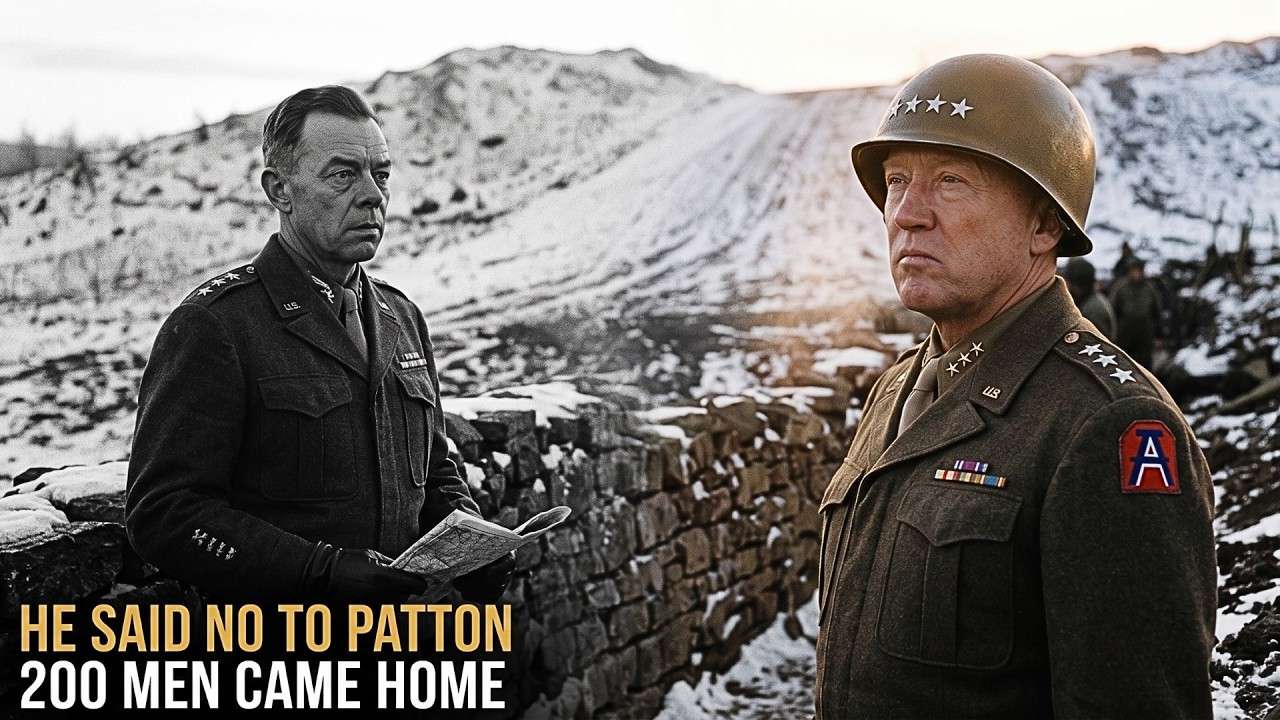
He had walked that ground himself the previous afternoon. What the order demanded of his men—two hundred soldiers climbing an exposed slope in the dark against a fortified position—was not an attack. It was a slaughter. He picked up the radio.
“Sir, I cannot carry out this order. ” Four seconds of silence stretched from the other end. Then the reply: “Major, you have your orders. ” “Sir, I walked that ground.
If I send my men up that slope at dawn, we will lose half of them before they reach the wire. The position cannot be taken from the front. I request permission to hold and find another approach. ” Another silence, longer this time.
“Stay in position, Major. I will take this to Patton. ” The request reached Patton within twenty minutes. He read it.
Then he stood up and drove himself to Haynes—not to relieve him, not to court-martial him, but to see the hill. The Third Army was pressing hard through western Germany, and every day of advance mattered. Ground taken today meant ground that would not have to be retaken tomorrow. The hill outside the town of Echtedingen had been identified as a key position commanding the main road east.
Taking it was a tactical necessity. The advance could not go around it, and holding it would protect the flank of the next phase of the attack. The order had come down the chain of command in the usual manner: objective identified, unit assigned, timing set, attack at 05:30. Haynes was thirty-four years old, from Boston.
He had been in Europe since the previous summer, leading his battalion through France and into Germany, and he had the kind of experience that comes from commanding men in enough bad situations to recognize a bad one coming before it happened. He had climbed the hill himself at noon before the order arrived. He took two of his officers and moved across the terrain slowly and carefully, examining every angle of approach the way you look at ground when your men are going to fight on it. It took two hours, and he needed every minute of them.
What he saw—the slope leading up to the defensive position at the crest—was completely exposed. No natural cover, no trees, no terrain, nothing a man could use to break the line of sight from above. Two hundred men crossing that slope at dawn, even in low light, would be visible to the defenders for the entire length of the approach. The wire at the top stood 150 yards across open ground from the nearest cover.
One hundred fifty yards of clear field of fire. He came back and sat with what he had seen all night. He turned the order over in his mind from every angle he could imagine, looking for the thing he was missing, the element that might make the order sound. He did not find it.
When the attack order arrived at three in the morning, he thought about it for ten minutes. Then he picked up the radio. He was prepared for many reactions—anger, a direct order to execute, even his immediate relief from command. What he was not prepared for, and what no one in his battalion was prepared for, because nothing in the chain of command had hinted at such a possibility, was the single vehicle that stopped at his forward position at four-thirty, forty-five minutes before the scheduled attack.
Patton got out of the vehicle, without much of a guard, followed by Reed and the driver. That was all. He looked at Haynes and said, “Show me. ”
They walked together toward the slope of the crest.
Patton, Haynes, Reed, and one of Haynes’s officers who knew the ground. They moved through the pre-dawn darkness with careful steps, keeping below the line of sight of the crest above. Patton did not speak during the walk. He moved cautiously, watching.
He looked at the slope and the angle of approach, the position of the wire, where the defenders would need to be positioned to cover the area effectively. He stopped twice at two specific spots and stood absolutely still, doing nothing but reading the ground the way you read it when lives depend on what you understand about it. They reached the edge of the last cover, a stone wall at the bottom of the exposed slope, 150 yards of bare ground to the wire. Patton stood at the wall and looked up.
The sky was beginning to lighten, barely, enough to see the shape of the crest above. Enough to see what two hundred men crossing this ground at dawn would look like from up there. He stood there for a long time. So long that Reed, standing behind him, began to wonder whether this silence preceded something very good or very bad.
Then Patton turned to Haynes. “Tell me what you see. All of it. ” Haynes answered: not just the slope.
Everything. The angle of the German positions, the flanks, the approach from the north that would require passing through a stretch of woods that had not been in the original plan—but he had looked at it, and he thought it could work. It would take longer to move two companies through the trees in the dark. The attack would not happen at dawn.
Patton listened without interrupting. When Haynes finished, Patton turned back to look at the slope. He looked at it for a long time—the slope, the open ground, the wire at the top that two hundred men would have crossed in full view. He said, “The northern approach.
Explain to me what you need. ”
Standing at the stone wall in the pre-dawn darkness, the two men bent over Haynes’s marked map. They went through it unit by unit. Which companies would take the northern route?
How long would it take to cross the woods at night with full equipment? What would communications be between the northern force and the decoy company on the front slope? What was the fallback plan if defenders were found on the northern path? When they finished, Patton said, “48 hours.
” The northern route would be ready to move in 48 hours. Not dawn today. He looked at Haynes. Haynes waited.
Patton said, “You were right about the slope. I would have seen it if I had been here yesterday. I wasn’t here. You were here.
” He paused. “Never stop telling me what you see. Don’t let rank persuade you to be silent about something you have actually seen with your own eyes. ” He looked at the hill again.
“Prepare the approach plan. 48 hours. ” He walked back to the vehicle without looking back. The modified attack began 47 hours later.
On the night of 18 February, two companies moved through the northern woods in the dark. The trees slowed them down. The advance was hard—branches, ice, the difficulty of moving two hundred men quietly through dense forest at night—but they reached the northern flank of the hill without being detected. The third company made the decoy from the front slope, moving with enough visibility to draw the defenders’ attention south while the northern force came around from behind.
The hill was secured by 02:00. Casualties were 11 dead and 19 wounded. Not a light price. There were still 11 dead.
But it was a fraction of what that slope would have cost. Haynes wrote his after-action report that morning, sitting in an advanced position while the sounds of operations echoed on the horizon. He described the operation with realism and full detail. And he attached a note at the end, separate from the official report, addressed to Patton’s headquarters.
It read: “The modified approach was the right one. The original order would have cost this battalion nearly half its strength. I am grateful for the opportunity to present my point of view in person. ” Patton read the report and the note.
He wrote two words in the margin and sent the whole report back to Haynes. Nothing else. No official recognition. No words of praise.
Just two words. Haynes kept them for the rest of his life. The after-action report and the note bearing Patton’s two words, in his handwriting, folded together in an envelope inside his desk. After the war, Haynes became a lawyer.
He practiced in Boston for thirty years. He was reticent about the war—not secretive, but quiet, as some men are, quiet about things that were more than could be described or too serious to fit into ordinary conversation. He was asked about it once, at a veterans’ dinner in 1968, by a young man who had served in Vietnam and wanted to know what it felt like to refuse an order from Patton. Haynes thought about it.
You don’t refuse an order, he said. You tell the truth about what you saw. Those are two different things. Refusing an order is about authority and who holds it.
Telling the truth about the field is about the men who will cross it. I didn’t refuse the order. I told the truth about what I saw with my own eyes in the noon of the previous day. He paused for a moment, then said: you have to be right, because if you’re wrong, you have no defense at all.
Nothing. Colonel Reed, who had stood at that stone wall and watched the two men bend over the map in the pre-dawn darkness, spoke about it many years later. He said: he drove 45 minutes in the dark to look at a hill, because a major got on the radio at three in the morning and told him the order would cost half a battalion, and Patton wanted to see the field himself before he decided what to do. He paused.
He believed it. He changed the plan. 48 hours later, two hundred men crossed that hill from an angle the Germans never expected, and most of them came back. Eleven did not.
But most of them did.
