The dried brown paper of the manila envelope flaked at the corners as Professor Sonia Abernathy lifted it from the archival box. Inside, pressed between protective sheets, lay a photograph of three young girls. The image, stamped on its reverse with the date March 1924 and the location Gastonia, North Carolina, showed three Black children standing outside a brick building, their cotton work dresses stained and worn. Through the long windows behind them, the dark interior of what appeared to be a textile mill was faintly visible.
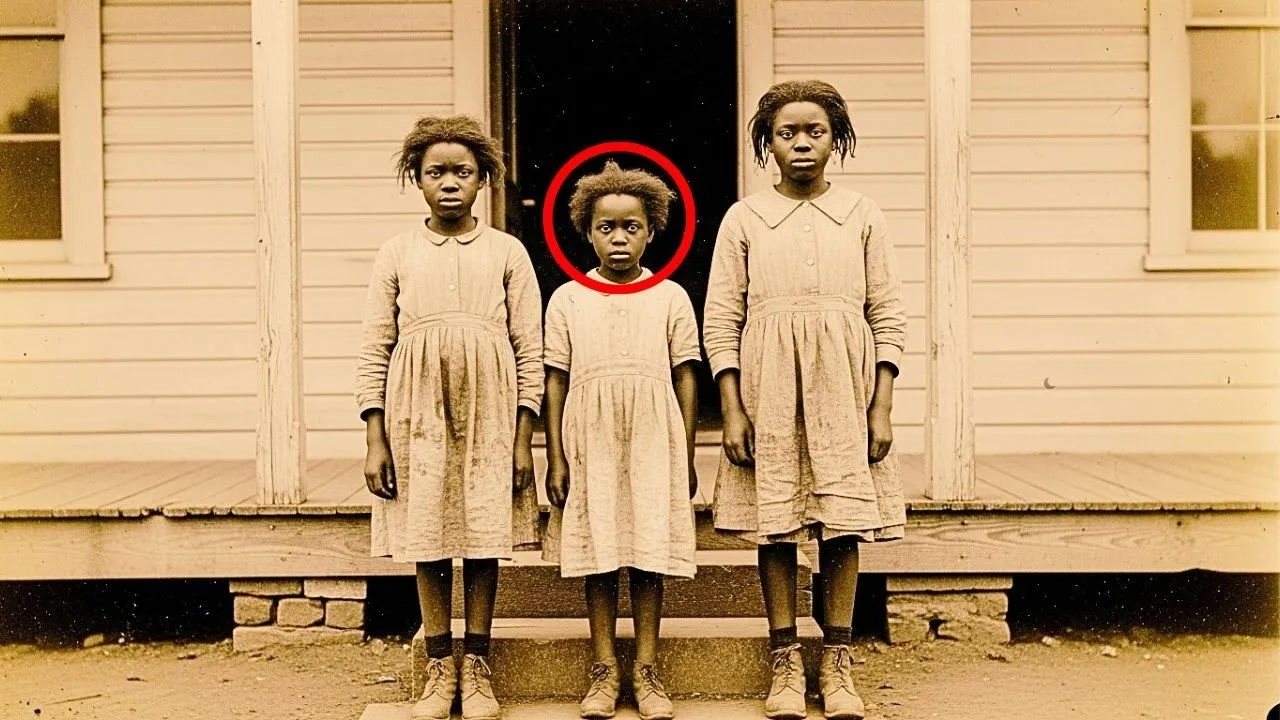
Sonia adjusted her glasses and studied the faces. The girls stood in a row, from shortest to tallest. The youngest could not have been more than nine, her eyes carrying a weariness no child should know. Beside her stood an older girl, perhaps fourteen, with similar features suggesting they were sisters.
The third girl, about the same age as the middle one, stood slightly apart, her expression cautious but defiant. “Another forgotten story,” Sonia murmured, her voice echoing in the quiet archive room. She had dedicated her career to recovering the lost narratives of the American South, particularly those of Black workers whose contributions had been systematically erased from official history. This photograph, she suspected, held such a story.
What she did not yet know was that it would reveal something far more extraordinary than either she or her research assistant could have imagined. Marcus entered the room carrying two cups of coffee. A graduate student from Charlotte, he was passionate about labor history and social justice. “Is this the new addition from the Gastonia collection?
” he asked, setting a cup beside her. “Yes. Three mill workers. All children.
”
“Look at their hands. See the stains? ”
“Cotton dust, probably. ”
“And look at their posture.
They’re exhausted. ”
Marcus leaned in, his expression darkening. “How old is the youngest? She can’t be more than nine or ten.
”
“That was common at the time. Families needed every penny to survive. ”
“It breaks your heart,” Marcus said quietly. “They should have been in school, playing, living their childhood.
Instead, they were breathing cotton fibers for twelve-hour shifts. ”
Sonia nodded, her throat tightening. This was exactly why they did this work. Someone had to remember.
Someone had to tell their stories. Gastonia, North Carolina, 1924. The town pulsed with the mechanical rhythm of its textile mills, their brick smokestacks pumping gray smoke into the morning sky. The air itself seemed to shimmer with cotton dust, a fine white powder that settled on everything—windows, streets, clothing, and most dangerously, the lungs of those who worked inside.
Loray Mill dominated the landscape, its massive structure sprawling across several residential blocks. One of the largest textile mills in the South, it employed more than two thousand workers, many of them children. Mill owners justified this as light work, suitable for small hands that could quickly feed bobbins and tie broken threads. Pearl Turner walked toward the mill entrance beside her older sister Ruth, their feet crunching the gravel still damp with morning dew.
At nine years old, Pearl had been working at the mill for nearly a year. Her hand, once soft and small, now carried small scars from the machinery. Ruth, fourteen, had been working since she was eight; her childhood had become a distant memory. “Are you feeling okay today?
” Ruth asked, glancing at her younger sister with concern. Pearl had been coughing more lately, a dry cough that seemed to echo in her chest. “I’m fine,” Pearl said, though her voice sounded weak. “Just tired.
”
Their neighbor Dorothy caught up with them, her face pale from exhaustion. At thirteen, she looked older than her years, constant labor having carved early lines around her eyes. The three girls joined the stream of workers flowing through the mill gates—men, women, children, sometimes entire families, all heading toward another day of grueling labor. The supervisor stood at the entrance, stopwatch in hand, recording anyone who arrived even a minute late.
Tardy workers faced fines deducted from their already meager wages. Inside, the mill was a cathedral of noise. Hundreds of looms clattered simultaneously, creating a deafening din that made conversation impossible. The air was heavy and hot, deliberately kept humid to prevent cotton threads from breaking.
But this humidity, combined with the ubiquitous cotton dust, created a suffocating atmosphere workers breathed with every intake. Pearl took her place before her assigned machine, a spinning frame that converted raw cotton into yarn. Her job was to watch for broken threads and tie them quickly before too much was lost. It required constant attention, the monotony broken only by the looming danger of the machinery.
In a moment of inattention, fingers could be caught, crushed, or amputated. Throughout the morning, Pearl felt a familiar tightness in her chest, but she continued working. There was no other option. Stopping meant losing wages, and her family depended on every cent she earned.
Around her, other children worked tirelessly, their small bodies moving with practiced efficiency. That evening, a stranger arrived at Loray Mill. Lewis Hine, a photographer from New York, was documenting child labor conditions in the South for the National Child Labor Committee. He carried a large-format camera, its wooden frame and brass fittings marking it as professional equipment.
The mill supervisors regarded him with suspicion, but his credentials and polite persistence gained him reluctant entry. Hine had seen countless mills, factories, and mines where children worked in hazardous conditions. Each photograph he took was testimony, evidence that might one day help change the laws permitting such exploitation. But photographing child workers was delicate work.
Supervisors often hid the youngest children when cameras appeared, and the children themselves had been trained to lie about their ages. During the midday break, Hine spotted Pearl, Ruth, and Dorothy standing outside the mill, grateful for a few minutes of fresh air. The three girls squinted against the bright March sunlight, their eyes accustomed to the dim interior of the mill. Hine approached them carefully, with a gentle, unintimidating manner.
“Excuse me, young ladies,” he said, removing his hat respectfully. “My name is Lewis Hine. I’m a photographer documenting the lives of workers. Would you mind if I took your picture?
”
The girls exchanged uneasy glances. Ruth spoke first, as the eldest. “Why do you want to photograph us? ”
“Because your story matters,” Hine replied simply.
“People in the North don’t understand what life is like in these mills. They don’t see the children working here. I want to show them the truth. ”
Dorothy crossed her arms defensively.
“Will we get in trouble? ”
“No,” Hine assured her. “I have permission to be here, and I won’t use your full names without your consent. I just want to document that you exist, that you work here.
”
Pearl studied the photographer’s face. There was something kind in his eyes, a sadness suggesting he understood their suffering. “Okay,” she said quietly. Hine positioned the girls against the brick wall of the mill, making the building itself part of the testimony.
He asked them to stand naturally, to assume no particular pose and not to smile. “Just be yourselves,” he instructed. “Let people see who you really are. ”
The girls stood together, Pearl in front with Ruth and Dorothy behind her.
Their faces showed exhaustion and resignation, but also quiet dignity. Hine adjusted his camera, checked the light, and took the photograph, a moment frozen in time that would outlast them all. “Thank you,” he said afterward, noting something in his journal. “Your courage in allowing this photograph means more than you can imagine.
”
As Hine packed his equipment, he felt a familiar weight in his chest. These children deserved far better than this life of hard labor, but at least there would now be evidence. At least someone would remember them. The cough began as a minor irritation but worsened steadily over the following months.
Pearl was not alone. Many mill workers suffered from what they called cotton lung or mill fever, a range of respiratory problems caused by constantly inhaling cotton dust and fibers. The fine particles settled deep in the lungs, causing inflammation and scarring, and eventually fatal respiratory failure. Ruth noticed that Pearl’s coughing fits were becoming more frequent, especially at night.
The sound of Pearl struggling to breathe echoed through their small home, which they shared with their mother and three younger siblings. Their mother, Martha, worked the night shift at the same mill, trying to earn enough to feed the family. Their father had died two years earlier of pneumonia, likely worsened by years of mill work. “Pearl needs to see a doctor,” Ruth told her mother one morning, her voice filled with worry.
Martha’s face showed helplessness. “With what money, Ruth? We can barely afford food. The mill doesn’t provide medical care, and the company doctor charges more than we earn in a week.
”
This was the harsh reality of mill life. The same companies that profited from child labor offered no protection, no healthcare, no safety net when workers fell ill or were injured. Children like Pearl were disposable, easily replaced by the steady stream of desperate families coming from rural areas. Dorothy’s situation was worse.
At fifteen, she developed severe respiratory problems, her breathing becoming labored and painful. One morning, she did not come to work. Ruth went to check on her and found her feverish and delirious, her lips tinged blue from lack of oxygen. “Someone get help!
” Ruth screamed, but Dorothy’s family had no resources either. The girl died that evening, drowning in the fluid that filled her lungs, surrounded by helpless family members who could only watch. The mill did not stop for Dorothy’s death. There was no memorial service, no acknowledgment of her passing.
Her position was filled the next day by another child, equally desperate and vulnerable. The machines never stopped turning. Pearl attended Dorothy’s funeral in the colored section of the city cemetery, a small plot marked by a simple wooden cross. She stood beside Ruth, holding her sister’s hand tightly, understanding with terrible clarity that this could be her fate too.
The cotton dust that covered everything—their clothes, their hair, their skin—was slowly killing them all. Yet what choice did they have? Without mill wages, the family would starve. The economic system had trapped them completely, leaving no escape except death or miraculous intervention.
That night, Pearl lay awake listening to her own breathing, wondering how much time she had left. Ninety-six years later, in 2020, Professor Sonia Abernathy sat in her laboratory at Duke University, surrounded by screens displaying the digitally enhanced scan of the photograph. Her team had spent weeks working on the image using advanced restoration technology to recover details invisible to the naked eye. Marcus stood beside her, pointing at the screen.
“Look at the resolution we have now,” he said. “You can see individual threads in their clothing, the texture of the bricks behind them. ”
Sonia leaned forward, adjusting the zoom. “The detail is remarkable.
Hine’s photographs were high quality for their time, but this digital enhancement reveals things he himself might not have seen through his camera lens. ”
The university had recently acquired an AI-powered facial recognition and analysis system, originally designed for medical imaging. It could detect subtle differences in bone structure, skin patterns, and even minor physiological markers. Sonia was using it to identify unknown people in historical photographs, hoping to reconnect descendants with their ancestors.
She ran the analysis program on Pearl’s face, expecting nothing more than basic measurements that might aid identification. But as the data appeared on her screen, something unusual emerged. “That’s strange,” she murmured, frowning at the numbers. “What is it?
” Marcus asked. “The bone structure analysis is showing some unusual markers. Look at the distance between the eye sockets and the cheekbone ratios. There’s something atypical here.
”
Marcus examined the data. “Could it just be individual variation? Every human face is unique. ”
“Yes, but this is different.
These markers sometimes correspond to specific genetic mutations. ”
Sonia opened another screen to compare the measurements against a database of known genetic patterns. “I want to run this through the genomic association program. ”
“Can we do that from just a photograph?
” Marcus asked skeptically. “Not with certainty, but the AI can identify physical markers associated with certain genetic traits. It’s not a diagnosis, but it might suggest possibilities worth further investigation. ”
The analysis began, and they waited as the computer processed thousands of data points, comparing Pearl’s facial structure against genetic databases.
The program had been trained on millions of images linked to known genetic information, allowing it to make probabilistic predictions. When the results appeared, Sonia leaned back in her chair, stunned. “This can’t be right. ”
The screen showed a high-probability match for a rare genetic mutation in the MC1R gene.
What made it exceptional was not just its rarity but the implications of this particular variant. “MC1R,” Marcus read aloud. “Isn’t that associated with red hair and light skin? ”
“Usually, yes, but there are variants of MC1R mutations, and they don’t all produce the same phenotype.
Some are much rarer and have different effects. ”
Sonia’s hands trembled as she opened scientific papers on her other screen. “According to this study from 2018, there’s a specific MC1R variant found mainly in West African populations that has been linked to enhanced tissue repair and cellular regeneration. ”
“Wait,” Marcus’s eyes widened.
“You’re saying this little girl might have had a genetic mutation that could have protected her lungs? ”
“Possibly. The research is still preliminary, but this variant has shown an association with reduced inflammatory response to particulate matter and improved lung tissue regeneration in exposed individuals. ”
They exchanged glances, the implications beginning to dawn on them.
Sonia knew that identifying a genetic marker from a photograph was far from conclusive evidence. She would need to find out what happened to Pearl Turner, if that was even her real name. Most of Hine’s photographs had minimal documentation, sometimes only location and date. Names, when recorded, were often incomplete or changed to protect the children from retaliation.
She began with Gastonia mill records, many of which had been digitized and archived. Loray Mill kept employment records, though they were notoriously incomplete and often falsified to hide violations of the minimal child labor laws that existed at the time. After days of searching, Marcus found a promising lead. “Look at this,” he said, displaying a scanned ledger page.
“March 1924, Loray Mill, spinning room. There’s a name ‘P. Turner’ listed, with the stated age of 14. ”
“Fourteen?
” Sonia said. “That girl in the photo is no more than nine or ten. ”
“Exactly. They routinely lied about ages to avoid fines.
If this is our Pearl, her real age was about nine, just as we estimated. ”
Sonia ran her finger down the record. “There’s an address listed. 512 Cedar Street, West Gastonia.
That was in the Black neighborhood of the city. ”
They searched census records next, finding the Turner family in the 1920 census. Martha Turner, widow, with six children listed. Pearl was recorded as five years old in 1920, making her nine in 1924.
A perfect match. But what happened after that? Mill workers, especially Black workers, often left sparse records. Many died young from workplace accidents or disease, their deaths barely noted in official documents.
Sonia expanded her search, requesting death records, marriage licenses, and city directories. Weeks passed without finding a clear trace. It seemed Pearl Turner had simply vanished from historical records after 1924, as so many workers did. Then, late one evening, Sonia found something unexpected.
In a 1964 issue of the Gastonia Gazette, buried in the obituary section, was a short notice. Pearl Turner, 70 years old, died peacefully at her home on November 3, 1964. A longtime Gastonia resident, she was survived by three sons and eight grandchildren. Sonia stared at the screen, her heart pounding.
“Marcus, come look at this. ”
He read over her shoulder. “She lived to be seventy? That’s… that’s unbelievable.
”
“More than unbelievable. It’s practically impossible. ”
Sonia pulled up her research on mill worker mortality rates. The average life expectancy for child mill workers in the 1920s, especially those working in spinning rooms with high cotton dust exposure, was under thirty-five.
Most died of respiratory disease before age twenty-five. Marcus nodded slowly. “But Pearl lived to seventy. Forty years longer than expected.
And she was supposedly exposed to cotton dust during her most critical childhood growth years. ”
“Which means,” Sonia said, her voice filled with growing excitement, “something protected her. Something allowed her lungs to survive damage that killed almost everyone else. ”
They exchanged glances, the pieces forming a picture neither had expected when they first scanned that old photograph.
Finding Pearl’s descendants proved difficult. The obituary mentioned sons and grandchildren but provided no names. Gastonia had changed dramatically since 1964. The textile mills had mostly closed, the Black neighborhoods had been dispersed by urban renewal projects, and many families had moved away seeking better opportunities.
Sonia contacted the Gastonia Historical Society and local Black churches, explaining her research and asking if anyone knew the Turner family. For weeks, she received no response. Then a woman named Reverend Lisa Mitchell from Mount Zion Baptist Church called. “I think I might know who you’re looking for,” Reverend Mitchell said.
“There’s a woman in our congregation named Evelyn Washington. Her grandmother’s name was Pearl. She talks about her sometimes, how she lived through the mill years and survived when so many didn’t. ”
Sonia could barely contain her excitement.
“Would Mrs. Washington be willing to speak with me? ”
“I’ll ask, but you should know she’s protective of her family’s story. The mill years were painful and traumatic.
Many families don’t like to talk about that time. ”
A week later, Sonia and Marcus drove to Gastonia to meet Evelyn Washington. She lived in a modest brick house on the edge of town, with a well-tended garden full of roses and hydrangeas. A woman in her early seventies with sharp, intelligent eyes greeted them at the door.
“Come in,” she said, guiding them to a living room filled with family photographs. “Reverend Mitchell told me you’re researching my grandmother’s history. I have to admit, I’m curious why. ”
Sonia explained their project carefully, showing Evelyn the enhanced photograph on her laptop.
“We believe this is your grandmother Pearl with her sister Ruth and a neighbor girl. ”
Evelyn studied the image, her eyes filling with tears. “I’ve never seen this photograph before. My grandmother rarely spoke about her childhood in the mills.
She said remembering was too painful. ”
“What did she tell you about those years? ” Sonia asked gently. Evelyn leaned back, gathering her memories.
“She said she started working at nine, twelve-hour shifts in the spinning room. The dust was so thick you could barely see across the floor. Most of the children she worked with died young, mostly from respiratory diseases. She said she watched her friends cough themselves to death, drowning in their own lungs.
”
“But your grandmother survived,” Marcus said. “She did, and she never understood why. She used to say, ‘I breathe the same air, work the same hours, but somehow I stayed alive while everyone else died. ’ She called it her mystery.
”
Sonia leaned forward. “Mrs. Washington, would you be willing to participate in a genetic study? We have reason to believe your grandmother may have carried a rare genetic mutation that protected her lungs from cotton dust damage.
”
Evelyn looked skeptical. “A genetic mutation? What kind? ”
Sonia explained the MC1R mutation and its potential effects, careful to emphasize that the research was still preliminary.
Three weeks later, the genetic test results arrived. Evelyn Washington carried the same rare MC1R mutation Sonia had predicted from Pearl’s photograph. More significantly, she agreed to let the research team contact her relatives, and five of them also tested positive for the mutation. Dr.
James Chen, a molecular genetics scientist at Duke Medical Center, joined Sonia’s research team to help interpret the results. He spread the genetic reports on the conference table, his expression barely contained excitement. “This is extraordinary,” he said. “The MC1R mutation you’ve identified is extremely rare.
We’re talking about less than 0. 1% of the population. But what makes it striking is its functional impact. ”
“Explain that in simple terms,” Sonia requested.
Dr. Chen pulled up a presentation on the large screen. “The MC1R gene is primarily known for its role in pigmentation, but it has other functions we’re just beginning to understand. This particular mutation produces a protein that enhances cellular repair mechanisms, especially in epithelial tissues—the type that lines the lungs.
”
He displayed microscopic images of lung tissue. “When lung cells are damaged by irritants like cotton dust, they typically trigger an inflammatory response. Over time, this inflammation causes scarring and permanent damage—what we call pulmonary fibrosis. But this MC1R mutation modifies that inflammatory response, reducing scarring and enhancing the lungs’ ability to repair themselves.
”
“So Pearl’s lungs could recover from damage that would have been permanent in other workers? ” Marcus asked. “Essentially, yes. Not completely.
She would have suffered some damage, but her recovery rate would have been significantly faster, and permanent scarring would have been greatly reduced. Think of it this way: where an average person’s lungs would scar and stiffen after continuous exposure, hers could partially regenerate. ”
Sonia felt a chill run down her spine. “So this nine-year-old girl, working in one of the deadliest environments imaginable, had a genetic advantage none of her coworkers possessed.
It’s the only reason she survived. ”
“Not just survived,” Dr. Chen corrected. “Thrived, relatively speaking.
According to the records you showed me, she worked in the mills for over a decade, married, had children, and lived to seventy. That’s not just survival—that’s resilience at the cellular level. ”
Evelyn Washington, who had been listening, spoke up. “My grandmother used to say she was lucky.
She lost so many friends, so many family members. Her sister Ruth died at nineteen from lung disease. Grandma Pearl always felt guilty that she lived while others didn’t. ”
Silence filled the room, the weight of survivor’s guilt hanging in the air.
“There’s another aspect of this mutation that’s particularly interesting,” Dr. Chen continued. “The MC1R variant also appears to affect pain perception and physical resilience. Studies have shown that individuals with this variant have higher pain thresholds and faster recovery from physical stress.
”
“That explains how she endured twelve-hour shifts as a child,” Marcus said quietly. “She was biologically different, genetically equipped to withstand hardships that broke others. ”
The research team’s findings caused a stir across multiple scientific fields. Their paper, titled “Rare MC1R Variant Conferring Protective Effects Against Occupational Pulmonary Disease in Early 20th Century Textile Workers: A Case Study,” was published in the Journal of Medical Genetics and immediately covered by major media outlets.
But Sonia felt conflicted about the attention. Yes, the genetic discovery was scientifically significant, but she worried the narrative might overshadow the real tragedy—that children like Pearl had been forced to work in conditions so deadly that only a rare genetic mutation could save them. She insisted that every interview, every presentation, every article begin with the context of child labor and industrial exploitation. “Pearl Turner’s survival was a miracle,” she told journalists, “but it should never have been necessary.
She and thousands of other children were sacrificed for an economic system that prioritized profit over human lives. ”
Evelyn Washington became an unexpected spokesperson for the research, connecting the scientific findings to her grandmother’s lived experience and that of countless others. She spoke at universities and labor history conferences, even testifying before a congressional committee studying occupational health disparities. “My grandmother was one of the lucky ones,” Evelyn said at a symposium at Duke University.
“But luck should never determine who lives and who dies. Ruth, Pearl’s sister, didn’t have this genetic variant. She died at nineteen, coughing blood, unable to breathe. Dorothy, their neighbor, died at fifteen.
These were children—smart, loving children with potential that was snuffed out by cotton dust and corporate greed. ”
The research also revealed painful truths about racial disparities in industrial health. Black workers, already marginalized into the most dangerous jobs with the lowest pay, also received less medical care than white workers. Pearl’s survival was a double miracle.
She had overcome both a biological threat and systematic healthcare deprivation. Dr. Chen’s team expanded their research to test descendants of other Black mill workers from Gastonia. They found that the MC1R mutation, though rare, appeared at slightly higher frequencies in this community compared to the general population, possibly as a result of selective survival.
Those who carried the mutation were more likely to survive long enough to have children, passing on the protective gene. But this raised uncomfortable questions. Had the mills inadvertently created a selection pressure? A kind of unnatural selection where only the genetically fortunate survived?
The implications were disturbing, echoing the brutal logic that had justified slavery and segregation. Sonia refused to let the science become separated from ethics. She worked with Evelyn and community leaders to establish the Pearl Turner Memorial Fund, providing scholarships for descendants of textile workers and funding research on occupational health disparities. The photograph itself, taken by Lewis Hine ninety-six years earlier, became an icon.
It appeared in textbooks, documentaries, and museum exhibits, no longer merely an artifact but a testament to both human cruelty and human resilience. On a warm spring morning in 2021, a historical marker was unveiled at the site of the former Loray Mill in Gastonia. The building itself had long since been converted to apartments and artists’ studios; the machinery and dust were long gone. But the memory remained.
Evelyn Washington stood before a crowd of over two hundred people—descendants of mill workers, historians, scientists, and community members. Behind her, the new bronze marker gleamed in the sunlight, displaying the famous photograph of Pearl, Ruth, and Dorothy alongside text explaining their story and the genetic discovery that followed. “My grandmother, Pearl Turner, stood on this spot nearly a century ago,” Evelyn said, her voice strong and clear. “She was nine years old, working twelve-hour shifts, breathing air thick with cotton dust.
She survived through a combination of genetic luck and remarkable willpower. But we must remember that she should never have needed that luck. No child should ever need it. ”
The inscription on the marker read: “In memory of Pearl Turner, 1915–1964, her sister Ruth Turner, 1910–1929, Dorothy Miller, 1911–1926, and the thousands of child laborers who toiled in Gastonia’s textile mills.
Their sacrifices built this region’s prosperity, but at a human cost beyond measure. Pearl’s survival, made possible by a rare genetic mutation, reminds us that luck should never determine who lives and who dies. May their story inspire us to build a world where no child must endure what they endured. ”
Sonia Abernathy, standing among the crowd, felt tears streaming down her face.
What had begun as a routine archival project had become something far greater—a recovery of forgotten lives, a scientific breakthrough, and a moral reckoning with history. Marcus stood beside her, equally moved. “Do you think it mattered? ” he asked quietly.
“All this research, all this work—does it change anything? ”
Sonia considered the question. “It doesn’t bring Ruth back, or Dorothy. It doesn’t give Pearl back her stolen childhood.
But it does something important. It ensures their memories won’t be forgotten. Their lives meant something. Their suffering wasn’t invisible.
And maybe, just maybe, understanding what happened to them helps us build a better future. ”
After the ceremony, Sonia returned to Duke University with the original photograph, now designated for the university’s permanent collection. She held it carefully, looking once more at the three young faces frozen in time. Pearl’s eyes, which she had studied with such intense focus for months, seemed to look back at her with quiet dignity.
The genetic mutation had saved Pearl’s life, but it was Lewis Hine’s photograph that had saved her story. Without that image, without his testimony, Pearl would have remained nameless, forgotten like so many others. The camera had captured more than light and shadow. It had preserved a piece of evidence that would speak across a century.
Sonia placed the photograph carefully in its archival box, but she knew its power was no longer confined to that fragile paper. It now lived in databases and DNA, in historical markers and scientific papers, in the memories of Pearl’s descendants and the consciousness of everyone who read her story. The photograph had given Pearl a kind of immortality she could never have imagined as she stood outside that mill in 1924. She had been just a girl trying to survive another day of brutal labor, but she had become a symbol of endurance, a scientific marvel, and a reminder of the human cost of progress built on the backs of children.
As Sonia turned off the lights in the archive that evening, she whispered a quiet thank you to the girl in the photograph—to Pearl, to Ruth, to Dorothy, and to all the forgotten workers whose stories still wait to be told. Their lives mattered. Their suffering was not in vain.
And now, through the convergence of history and science and one powerful photograph, the world would remember.






