The hammer came down on Clayton’s wrist with a sound that cut through the barn’s silence. A bone broke. The whip dropped from his hand. Tobias struck again, once to the shoulder, once to the side of the head, not enough to kill, enough to stop.
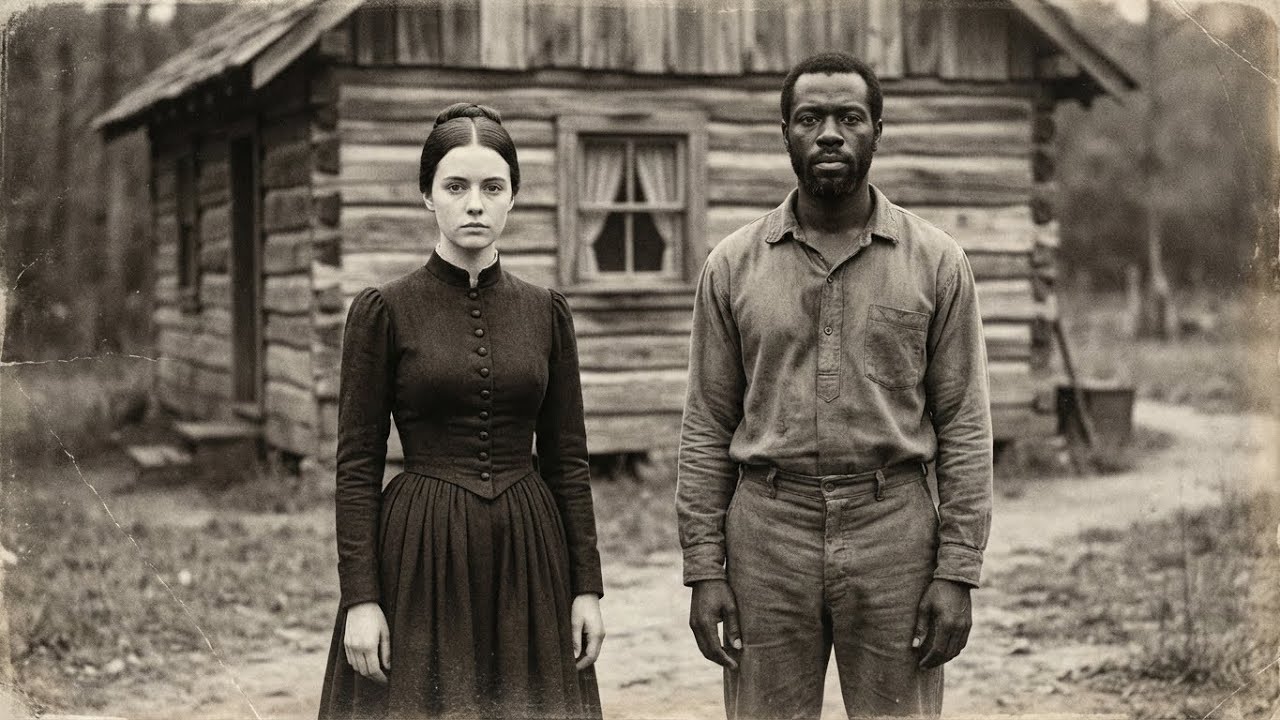
The overseer crumpled to the ground, unconscious but still breathing. Then a foreman stepped through the door, saw the body, saw the bloody hammer, saw the razor in Margarite’s hand. For a moment he did nothing. Then he turned and ran toward the main house, yelling.
The bells began to ring. Margarite could not hear them, but she saw the torches flare to life beyond the barn’s open door, and she understood. She and Tobias ran west into the fields, away from the road, away from every plan they had made. Two miles of open ground lay between them and the woods.
Behind them, the plantation became a swarm of angry lights. Dogs barked somewhere in the dark. They reached the trees at 5:15, forty minutes before sunrise, and kept running until Margarite stopped and vomited from fear and exhaustion. Tobias listened.
The dogs were far away and moving in the wrong direction. Maron had guessed north, toward the free states. They were heading south, to the Mississippi River. Not what anyone would expect.
Maybe that would be enough. It had been three months since Augustine Bowmont sold them both. Three months since Margarite discovered her mother’s letters in the attic of the mansion in Natchez, Mississippi, and learned that the family she belonged to had been poisoning itself for four generations. Three months since she learned that the mute coachman who drove her away was her half-brother, the son of her father and an enslaved woman named Sarah, and that her mother had taught him to read and write in secret before she died.
Three months since she opened the sealed envelope her mother had left for her, the one that read, “For Margarite, open only if you are reading this away from this house,” and found a plan of revenge that had been waiting eighteen years to detonate. Now the fuse was lit. What she and Tobias did not know, as they fled through the winter woods with a waterproof bag of letters, receipts, birth records, and a dead woman’s diary, was that the explosion had already begun. Margarite Bowmont was born deaf.
She never heard her mother’s voice and never learned to speak. By the time she was twenty-one, she had turned down fifteen suitors, though the suitors did most of the turning down. A wife in Natchez had to command house slaves, host parties, move through salons with a sharp tongue and a sharper wit. A deaf mute, however beautiful and well educated, was decorative furniture.
The men who came to the Bowmont mansion with proposals left with diplomatic regrets. Nobody said the real reason out loud, but everyone understood it. A wife needed a voice. Margarite had developed a different instrument.
At age seven she began reading lips by watching mouths move. By twelve she knew simple phrases. By twenty-one she could follow entire conversations, and nobody knew. People spoke freely around her, certain the pretty deaf girl was simple, invisible, safe to ignore.
She kept every secret she learned and said nothing. Her mind was sharp, and it was silent, and it belonged entirely to herself. Her father, Augustine Bowmont, moved through high society in imported clothes, a varnished carriage, and enslaved workers who were always dressed perfectly. The mansion rose three floors above the Mississippi, all Neoclassical columns and immaculate gardens, one of the grandest houses in a city that had more millionaires per person than anywhere else in America.
The fortunes came from cotton fields worked by enslaved people, and the facade of polish and grace hid the trade in flaws that sustained it all. In Natchez, problems were solved quietly. Imperfections were not accepted. They were traded.
Augustine had debts. Twelve thousand dollars had been lost in Arkansas land speculation, and the judicial foreclosure was coming in January 1852. Bankruptcy or private asset liquidation was four months away. He needed money, and he needed to dispose of two liabilities in a way that did not embarrass the family name.
The first liability was his daughter. The second was Tobias, the coachman who had not spoken a word in fifteen years. Tobias had been born into slavery on the Bowmont property. He saw something when he was twelve years old that made him promise never to speak again, and he had kept that promise ever since.
Some people said he was mute from birth. Others said he was mentally slow. Nobody knew the truth, which was that he had chosen silence as a punishment for himself, because words had killed his mother. When Tobias was twelve, his mother Sarah was accused of stealing a silver brooch.
Augustine told the boy to testify against her. If Tobias spoke out against his mother, she would be whipped. If he stayed silent to defend her, Augustine would sell him to Louisiana, a death sentence. Tobias chose a third option.
He said nothing at all. Augustine took his silence as a confession of Sarah’s guilt. Within a day she was sold. Tobias never saw her again.
He never spoke again either. Silence was his self-imposed penance, a constant reminder that words could hurt, that words had destroyed the only person he loved. By September 1851, Augustine had decided to sell them both. One package, two broken items, closed for eighteen hundred dollars.
Henri Maron came to the mansion in late September. A widower of fifty-eight with three thousand acres, he had a reputation that made people lower their voices. People said he conducted agricultural experiments, which was a polite way of saying he was deliberately cruel. But he was very rich, and in Natchez money bought silence about anything.
Augustine closed the office doors and dropped the shutters. Margarite happened to be passing through the hallway with an armful of books. She positioned herself so that a crack in the door gave her a clear view of both men’s lips, and she read everything they said. Maron offered eighteen hundred dollars for Tobias, three times the market price.
Augustine asked why. Maron said that loyalty, discretion, physical strength, and a calm temper were all good traits for certain jobs. But there was a condition. Margarite would come with him, not as a wife or a hired servant, but as part of the deal.
She would live on Maron’s plantation as Tobias’s companion, a governess of sorts. Augustine would get the money, pay off fifteen percent of his debt, and solve two problems at once. How to explain sending his daughter to a bachelor’s house? Maron had an answer.
Margarite needed a controlled environment because of her condition. Tobias had been part of her life since childhood and would provide continuity. Society would accept it. Defectives needed special care, and everyone would pretend they did not know what was really going on.
Margarite watched her father agree. She watched the handshake. She watched eighteen hundred dollars in bills and gold coins change hands over the mahogany desk. And she saw something else: a smaller envelope that Augustine passed quietly to Maron.
A second deal. Payment for silence about something other than the sale. That night at dinner Augustine told the family the decision. A temporary arrangement, he said, to help with money problems.
When things calmed down, she would come back. Lies wrapped in fatherly words. Margarite wrote one question in her notebook and pushed it toward him. Are you selling me?
Augustine read it. For the first time in years, she saw something break in his mask. It was not regret. It was weariness.
He said nothing. He nodded and left the room. Two days before the transfer, Margarite found Tobias alone in the garden. She wrote quickly: Did you know about this?
Tobias stood still for a moment, then reached out and asked for the pencil. His handwriting was beautiful, cursive, perfectly spelled, the work of an educated hand. An illiterate prisoner could not have done it. He wrote: No, but I promise to keep you safe.
Margarite could not move. He could write. He could write very well. With shaking hands she wrote another question: How?
Tobias looked around, uncertain, then wrote slowly: Your mother taught me when I was 8 years old, before you were born. Isabelle had secretly taught an enslaved boy to read and write in 1832, a crime and a danger, when Tobias was eight and she had been married only a few months. Why him? Why teach a slave child?
The letters Margarite had found in the attic flashed through her mind. Her mother had written of a guardian, a person who would teach her the truth when the time came. Tobias was the one. Isabelle had trained him eighteen years ago to protect the daughter she was about to bear, to tell her the truth when Augustine finally did what Isabelle knew he would do.
And he had done it. Augustine had sold them both, exactly as Isabelle had predicted. On the morning of the trip, the carriage waited at the gate. Tobias already sat in the driver’s seat.
Margarite came down the stairs with a small bag of clothes, books, writing materials, and at the bottom, hidden beneath everything, the letters and the sealed envelope. Augustine gave her a quick, mechanical hug. His lips moved. She read: I’m sorry.
She said nothing. She got into the carriage and did not look back at him again until they were far down the road, and he was just a small figure on the porch, speaking to no one, mouthing words that might have been meant for a woman dead eighteen years. The ride took two hours, ten miles south. Tobias stayed quiet.
Margarite stared at his broad back and wondered if he would really protect her or if he was just following orders. The mood changed when they passed through Maron’s gate. Fields stretched to the horizon, but the workers moved strangely. They did not talk.
They did not sing. They worked in silence, like ghosts. Henri Maron stood at the door, smiling, but his eyes did not smile. He ignored Margarite completely and spoke only to Tobias, giving short orders and pointing away from the house.
Then he looked at Margarite like a man inspecting new furniture and gestured for them to follow. Their cabin stood three hundred yards behind the main house, two small rooms with basic furniture, set apart from all the others. Maron explained the rules with gestures and commands, certain Margarite would not fully understand. She understood everything.
Tobias would work from five in the morning until seven at night. Margarite would stay in the cabin and could not speak to other enslaved people without permission. Total isolation. A prison disguised as a dwelling.
After Maron left, they went inside. The place smelled of mold and old wood. A torn curtain separated the two rooms. There was an outside bathroom and a simple kitchen.
That first night, Margarite sat at the old table and pushed the notebook toward Tobias. She had written a question and waited. He read it. For the first time, she saw a look of real recognition cross his face.
The question was: Why did you stop talking? He picked up the pencil and wrote slowly, stopping often: Because words killed my mother. He said nothing else. The sentence hung between them like a warning and a confession.
The first weeks settled into a brutal routine. Tobias rose before dawn and worked fourteen hours, carrying two-hundred-pound cotton bales, fixing fences under the hot sun, doing ironwork that burned his hands even through thick gloves. He came back after dark exhausted. Margarite stayed locked in the cabin.
But she noticed things. Maron came to the fields twice a week just to watch Tobias. He was not supervising work. He was studying him the way a breeder studies stock.
And Clayton, the cruel overseer, kept a strange distance from Tobias. Overseers did not care about enslaved people. They were afraid of them. Why?
In the second week, Margarite began exploring the cabin. Under the loose floorboards there were scratch marks, signs that someone had hidden something there before. On the walls, dark stains formed patterns that were not mold. Wedged between the beams she found a torn piece of fabric, a scrap of what looked like an old bloodstained dress.
At night, a routine formed. Tobias washed, ate in silence, then Margarite pushed the notebook across the table. Their written conversations lasted for hours, and then they burned the pages in the fireplace, leaving no trace but ashes. This was how she drew his story out of him.
He wrote about Sarah. When Sarah was twelve, someone said she stole a silver brooch. Augustine told the boy to testify. He chose silence instead, and silence condemned her.
Tobias never saw his mother again. Margarite made her decision in the second week. When Tobias came back tired, she did not push an empty notebook. She pushed all the letters, including the sealed one marked with her mother’s warning.
Tobias saw the papers and stopped. He knew at once who had written them. He read each letter slowly, his hands shaking slightly. After he finished, he sat still for a long time.
Margarite gave him the sealed envelope and a small knife. Do you know what’s in here? she wrote. He nodded.
Yes. He did not open it. He took the pencil and began to write, and what he wrote changed everything. Isabelle had summoned him to the barn in 1832, went on like a prayer, a confession, a testimony given at last.
He was eight years old. She had just married Augustine and was pregnant with her first child. She told him she had to teach him something secret because he would be important in the future. For eight months, while Augustine was away, she taught him to read and write.
She told him he needed to learn because he would have a very important job: to protect and teach the child she was carrying, in case she did not survive. He did not fully understand at eight. He just did as he was told. The mistress was kind, and lessons were better than hard work.
But Isabelle made him promise that when the child grew up, he would tell the truth, protect the documents she was hiding, and not let Augustine bury secrets. Then came the bloody birth. Isabelle died a few hours later. But first, she called Tobias into the room and gave him a sealed envelope.
It was for Margarite, she said. He could open it only when she was away from the house. Tobias, eight years old, did as he was told and hid the envelope in the barn. He kept it there for eighteen years, waiting for a sign.
When Augustine announced the sale, Tobias knew the time had come. He took the envelope from its hiding place and brought it with him, hiding it in his clothes. He wanted Margarite to find the letters first. Isabelle had told him she needed to discover the truth gradually.
First consanguinity, then the connection between them, and finally the complete plan. Margarite absorbed all of it, then pointed to the envelope. Tobias opened it with care. Inside was a long letter, several pages, in Isabelle’s handwriting, clearer and firmer than the others.
It had been written before she gave birth, while she was still strong. They read it together, one page at a time, and as they read they felt both horror and admiration. Isabelle was not an innocent victim. She was part of the plan.
She had learned before her wedding that Augustine was a monster who raped enslaved women. She learned that the Bowmont family had grown rich through cruelty. And she learned that the consanguineous marriages were deliberate, a way to concentrate wealth even at the cost of their children’s health. For four generations, grandparents married first cousins, great-grandparents married nieces.
The family tree twisted in on itself until every branch rotted. Isabelle had decided to destroy the whole thing. Not through scandal she could not prove, but through revenge. She would marry anyway, knowing the risks.
She would have a child anyway, knowing it would likely be born with problems. That child would be living proof that Bowmont genetics were corrupt. And when Augustine tried to hide the problem, as he always did, she would make sure Tobias told the truth. The next revelation cut deeper.
Isabelle had discovered that Augustine raped Sarah, Tobias’s mother, in 1823. Tobias was born in 1824: the illegitimate son of a master. Bowmont blood ran in the veins of an enslaved man. Isabelle chose Tobias for that reason.
He was Margarite’s half-brother, and he was perfect for the plan. Learn to read and write. Guard the hidden papers, certificates, letters, and financial records she had gathered. Then wait for Augustine to sell both problems when the debts finally forced him.
When that happened, use the papers to destroy the Bowmont legacy. Show the whole system, the incest, the rapes, everything. She ended the letter with words that Margarite read three times: “I know it seems cruel to use my own daughter as a weapon, but the system is crueler. If I just said Augustine was guilty, no one would believe me.
Woman against husband, impossible. But a defective child, an enslaved bastard son, and proof of his guilt. A bomb that no one can defuse. Margarite, I’m sorry for bringing you into the world like this, but if you’re reading this, it means you survived, and survival is already victory.
Now finish what I started. ”
Margarite finished reading with shaking hands. She was not a helpless orphan. She was a weapon made eighteen years ago.
Tobias wrote: She made us for this. Margarite replied: She used me. Tobias wrote back: Yes, but she gave us a choice she never had. We can let the papers die or blow them up.
During their investigation, Margarite found something else Isabelle had not planned. Behind a loose panel in the cabin wall was a leather-bound diary. It belonged to a woman named Ruth, who had been enslaved in that cabin years before. The entries dated from 1847 to 1849.
Ruth wrote about Maron’s breeding program. She had been forced to have four children in three years, and all of them were sold. The last entry, from March 1849, was barely legible. She wrote that she could not take it anymore and would rather die.
There were no more entries. Margarite showed the diary to Tobias. He ran his fingers over the stains on the walls. He wrote: How many more?
How many Ruths? How many Sarahs? Maron came to the cabin in the fourth week at dusk. He entered without knocking, ignored Margarite, and spoke only to Tobias.
He looked at him the way a veterinarian examines a valuable animal. He told him to raise his arms, checked his muscles, looked at his teeth. Clayton, standing behind him, laughed. Margarite read every word on Maron’s lips: Better genetics, strong build, calm temperament.
Six months. If it works, I’ll triple the investment. After they left, Tobias sat down heavily. He stared at his hands.
Finally he wrote what Margarite had already feared. Maron planned to use him in a forced breeding program, to cross him with selected enslaved women to produce stronger workers and sell them for profit. This was not an aberration. It was standard practice on large southern plantations, where owners kept records of enslaved family trees like breeders kept stud books.
What terrified Margarite was not that it was illegal. It was how normal it was. She asked: Will he do it? His answer was bleak.
He had no choice. If he refused, he would be sold to the coal mines of Kentucky, where he would live eighteen months. And if he was sold, Margarite would be alone on the property. Maron knew that.
That was why she was there. Not as a governess, but as a guarantee of obedience. In the sixth week Margarite saw proof. Clayton brought three women to a clearing near the cabin and lined them up.
Maron walked around them, inspecting. One was clearly pregnant. Margarite read his lips: That one is already breeding, but the other two are at the right time. Bring Tobias tomorrow at dawn.
I want to start the tests. One of the women looked at the cabin as they were led away. She met Margarite’s eyes. There was no plea in them, just a blank recognition.
Both of them were property. That night, as they wrote, Margarite noticed something. Tobias did not say escape was impossible. He said that trying to escape without being ready was suicide.
It was a small but essential difference. He was already mapping routes, resources, and windows of opportunity. Fifteen years of silence had not made him passive. It had made him patient.
During a supervision visit the next week, Margarite read a conversation between Maron and Clayton on the porch. Maron said Augustine had paid him five hundred dollars more than the sale price. For silence. Augustine knew Tobias was his bastard son.
He knew Tobias and Margarite were half-siblings. He had paid Maron to keep that secret forever, as long as Maron could profit from both of them. Augustine had not only sold his children. He had paid to make sure the truth died with them.
Maron had agreed. Scandal was worthless in business, but a captive with Bowmont genetics was valuable. People would pay three times as much for Tobias’s children with European features, because they would be branded as quality domestic servants. That night Margarite wrote in her notebook that they were not people.
They were goods with enduring value. The only way to stop being property was to destroy the chains completely. That meant escape, but it also meant making sure the truth survived: documentation, testimony, revelation. Tobias wrote back with one word: How?
Margarite smiled for the first time since they arrived. It was not a happy smile. It was the smile of someone who had found her purpose. She could not hear, but she had learned to hear things no one else could.
He could not speak, but he had learned to scream without a voice. Together, perhaps they could become human. And people who had been thrown away had nothing left to lose. The deadline approached.
Six months became four, then three. Clayton came by more often to remind Tobias of the schedule. The breeding program would begin on the new moon in December with three chosen women. Tobias would be brought to them.
Margarite would be sold to the mines if she resisted. The system was a perfect force. They talked for two nights about the papers. Margarite said revenge against the dead was pointless.
Augustine would lose everything to creditors anyway. Tobias answered that it was not about Augustine. It was about the system. If they could publish papers proving an aristocratic family practiced deliberate incest, that eugenics programs operated on plantations, that enslaved men were used as studs by their own fathers, they would arm the abolitionists.
It would not change the world overnight, but it would make noise the system could not ignore. She finally agreed, not from nobility but because it made sense. The documents were their only bargaining chip if they were caught. They could threaten to publish if Maron killed them, which made the papers a kind of life insurance.
They would decide later what to do after a successful escape. First, they had to live. They planned for the new moon, three days away. Tobias had studied the patterns.
Clayton arrived at five in the morning. Maron had breakfast at seven. Between five and seven lay the window of vulnerability. The tool shed was unlocked.
The path through the fields reached the road without passing the main house, two miles of open ground that was safe before dawn. Margarite added details. Clayton kept about eighty dollars in a metal box in the barn for the weekly payments to the overseers. He did not lock it because he believed enslaved people would not steal.
The money was not much, but it would buy passage on a barge, food, and perhaps forged papers. The night before the escape, they packed everything into a waterproof bag: Ruth’s diary, Isabelle’s letters, the financial records, Tobias’s birth certificate, and Isabelle’s final letter, the complete confession. Evidence strong enough to bring down a dynasty. Tobias wrote one last message before they destroyed the notebook: If we are caught, documents survive.
If we die, truth survives. Either way, Isabelle wins. Margarite nodded. It was not about them anymore.
It was about revenge for a woman dead eighteen years who had planned this with inhuman patience. She had turned her own womb into a weapon. Made Margarite knowing the child would be sick. Made sure Tobias was educated.
Planted the papers. Then let time and Augustine’s greed do the rest. And it had worked perfectly. They were exactly what Isabelle had intended: human weapons that would explode when sold, exactly as she had predicted.
The only thing left was to light the fuse. The last thing they did was look at Ruth’s razor, its blade rusty but still sharp. Margarite held it and felt its weight, the weight that had ended Ruth’s life. But it could serve a different purpose: not to destroy oneself, but to set oneself free.
She put the razor in her pocket. Tobias took a heavy hammer from the shed. Tools of labor became tools of escape. They did not sleep.
They waited until the dark was absolute. New moon. No stars. December 1851.
Three months after the sale. Eighteen years after Isabelle died. Four generations since the first Bowmont marriage between cousins. They left the cabin at 4:30 in the morning.
They did not look back. They carried the bag of papers, the tools, and the weight of generations. But for the first time in their lives they also carried choice. And choice, even if it cost everything, was a luxury no master could buy or sell.
The first stop was the tool shed. Tobias knew how every board creaked. He went in and came back with a hammer and a metal chisel. Ruth’s razor was in Margarite’s hand.
Poor weapons, but better than nothing. The barn was two hundred yards across an open field. They crawled between the rows of already-picked cotton. Only the mad or the fleeing were awake at 4:40.
The barn door was open. Clayton had put too much faith in his control. Inside it smelled of hay and dung. The metal box sat under a workbench beneath a tarp.
Tobias opened it and found eighty-three dollars in cash and coins. A fortune for fugitives. Death if caught. They took it all.
They were about to leave when they heard a voice. Clayton. He had arrived early and was talking to someone outside. They froze behind a pile of hay.
Clayton came in carrying a lantern, and the yellow light flooded the space. He walked straight to the workbench, bent down, opened the box. He saw the empty interior and went still. Then he shouted through the door, calling for the young overseer outside.
There was a thief, he said. Wake everyone. Lock the gates. A quick choice.
They could not be trapped. Tobias stood with the hammer in his hand. Clayton turned, and for a split second froze at the sight of a captive who had never disobeyed now holding a weapon. Then he grabbed the whip at his belt.
Tobias was faster. The hammer came down on his wrist, and a bone broke. Clayton yelled and stumbled backward. A second blow to the shoulder.
He dropped to his knees. Tobias hit the side of his head, not hard enough to kill. Clayton fell unconscious but breathing. Enough violence.
No more. The young overseer had heard the scream and stepped through the door. He saw Clayton on the ground, Tobias with the bloody hammer, Margarite with the razor. He was in his twenties, not a violent man, just a man doing a job that paid.
He stopped. Tobias and Margarite ran past him. He did not try to stop them. He watched them go, then ran toward the main house, yelling.
They fled through the fields, but not along the planned route. That was compromised. They improvised, heading west into the woods. Two miles of open ground, and behind them torches multiplied, voices shouted, dogs barked.
They reached the trees at 5:15. In forty minutes the sun would rise, but the forest gave them cover. Tobias knew from his work that hunting trails were not normal escape routes, and that was exactly why they were safe. They ran for twenty minutes, then stopped to catch their breath.
Margarite vomited from fear and exhaustion. Tobias listened. The dogs were far away, and the sounds were coming from the wrong direction. Maron had assumed north, toward the free states.
They were going south, toward the river. Unpredictable. Maybe that was enough. Three days through forests, swamps, and abandoned land.
They ate roots, drank from streams, slept in two-hour shifts. They kept the money untouched. Using it would draw attention. A white woman and an enslaved man with money was an immediate alarm.
On the fourth day they reached a fishing village on the river. Makeshift buildings, transients, little authority, a place where questions were not asked if the price was right. Margarite negotiated with hand signals while Tobias stood back. A barge owner was taking goods to Memphis.
Margarite offered twenty dollars. The man looked at Tobias, understood, and asked for thirty. Tobias paid. The voyage took six days, hidden among bales of cotton and crates of tobacco.
They ate scraps and drank dirty water. On the third day Margarite fell ill with fever, trembling, sweating, delirious. Tobias kept her warm with his body and forced her to drink. The fever broke on the fifth day.
Memphis was chaotic and anonymous. For fifteen dollars they bought better clothes. Margarite would pose as a respectable widow, Tobias as her enslaved man. It was the only way to survive.
A Quaker tailor recognized the signs of fugitives and offered them shelter for three nights. He gave them the route: Memphis to Cairo, Illinois, then Springfield, then Chicago, where safe houses waited along the way. Tobias showed him the papers. The tailor read everything, went pale, and told them he knew an abolitionist journalist in Chicago who would publish.
He warned them that publishing would mean never returning to the South, a death sentence in absentia. Margarite wrote back: We don’t plan to come back. We plan to destroy. They obtained forged documents.
Margarite became Margaret Thompson, a widow traveling with her inherited enslaved man. Tobias became Thomas, mute since birth. Identities that explained why they never spoke. They left Memphis in a merchant’s wagon carrying cloth, hidden for two weeks in a pile of linen.
December was cold. They shared blankets, their bodies the only source of heat. At a checkpoint on the Kentucky-Tennessee border, a constable examined the papers with visible suspicion. What was her destination?
She wrote her answer. The constable demanded to see Tobias’s ownership brand. Tobias pulled up his shirt. His back bore only old scars, whipping lesions, not brands.
In the cold and the dim light, the distinction blurred. The constable nodded and waved them through. January 1852 brought them to Illinois, a free state. But the Fugitive Slave Act meant hunters could still take Tobias.
Freedom with conditions. One mistake and they would return in chains. In February they reached Chicago, a city of factories, smoke, and strangers. They contacted Samuel Pierce, editor of an antislavery magazine.
Pierce read the papers for two hours, verifying everything. When he finished, he said it was dynamite. Proof of aristocratic incest causing birth defects. Proof of a eugenics program.
Proof of normalized horror. And most disturbing, Isabelle’s letter showing that a mother had deliberately put her own health and her daughter’s life on the line to build a time-delayed bomb. Bravery or insanity? Pierce could not say.
But it was a story he would never forget. The book came out in March 1852. The scandal detonated. The Bowmont family was ruined.
The mansion sold for a fraction of its value. The name became a synonym for moral decay. Maron came under investigation, but Mississippi closed ranks. The case was dropped.
Then word arrived through the abolitionist network that Henri Maron had been found dead in his own barn, three days after the escape. His body was badly mutilated. The official investigation called it an enslaved revolt, and twenty people were sold south as collective punishment. The case was closed.
Margarite and Tobias knew that their escape had not only freed them. It had set off a bomb that detonated without them. But the details of Maron’s death did not add up. Over months, fragmentary reports filtered through the network, and the picture that emerged was darker than anything they had imagined.
Maron had not died three days after the escape. He had died the same day. And it was not a spontaneous revolt. It was an execution.
An enslaved man named Isaiah, who had worked on a neighboring plantation and knew people inside Maron’s, told the story months later. He told what no southern newspaper would ever print. After the alarm went up on the morning of the escape, Maron ordered immediate punishment. The three women chosen for the breeding program were dragged to the main square.
Clayton, still half-conscious, was absent, so another overseer took charge. Maron ordered a public whipping, twenty lashes each, to show what happened when property sought freedom. The first woman survived. The second survived too, though she passed out after the fifteenth lash.
The third, seven months pregnant, began to bleed at the eighth. The overseer continued. Maron did not stop at fifteen. She collapsed, lost the baby in front of everyone, and bled to death.
It took twenty minutes. Maron watched without emotion, ordered the body removed, and told everyone to return to work. Something inside the enslaved community broke. Not a choice, an explosion.
Years of violence, decades of normalized terror, generations of dehumanization, all converging on that moment. Twelve men followed Maron into the barn at dusk, where he had gone to check on the horses. Unorganized, unarmed, simply furious. It took them hours.
They used the tools he had made them use every day: pickaxes, shovels, scythes. They did not kill him quickly. They made him feel something of what Ruth, Sarah, and the bleeding woman in the square had felt. At dawn they let him die.
The body was unrecognizable. They left it in the barn, made no attempt to hide what they had done, did not run. They returned to the quarters and waited. They knew the cost: sale, whipping, death.
But for the first time in their lives they had made a choice. The authorities came at dawn. No one admitted anything. No one informed.
The investigators could not execute all of them; the living ones were worth too much. They sold twenty and kept the rest under close watch. The case was closed, the records sealed. The South did not want such stories circulating.
Margarite and Tobias sat in silence for a long time after hearing this. Their escape had not directly caused Maron’s death. But it had shown that resistance was possible. A captive with a hammer had humiliated a powerful man, and that had detonated something that had been building for generations.
And there was one more message, passed through the secret network from the women who had survived the whipping. It reached them in case they ever heard: Thank you for showing that chains can break. We finished what you started. The scandal fed the abolition movement.
Pierce’s articles circulated. People talked about the Bowmont affair in parlors and meeting halls across the North. But publication made things harder, not easier. Margarite and Tobias understood that they had become more than fugitives.
They were symbols, and capture would be a message in itself. Bounty hunters kept looking, not for the money, but for the statement a recapture would make. The Quaker network helped them disappear again. First Wisconsin, then Michigan, always one step ahead.
Everywhere they went they told the story simply by living. Margarite began teaching deaf children using the sign language she had taught herself. Tobias worked as a carpenter, and the hands that had once swung a hammer as a weapon now built houses, tables, shelves. In the summer of 1853, their community held a ceremony to make their family official.
It was not a romantic wedding. It was a legal mutual adoption. Blood ties were no longer a curse. They had become something chosen, strengthened by survival.
They kept the papers close, not as proof but as memory. In the fall of 1853, news arrived. Augustine Bowmont had died of tuberculosis in a cheap New Orleans hotel room, far from Natchez. He had fled after the creditors took the property.
He died alone, broke, buried in a common grave. The Bowmont name ended with him. Isabelle had won. Her revenge, planned eighteen years earlier, had worked with perfect timing.
Margarite felt neither happiness nor grief. She felt closure. The man who had treated her as a defect was buried, and the truth he had tried to destroy had outlived him. The winter of 1853 brought new laws that made the North less safe for fugitives.
Canada was the next refuge. They prepared to move again, not from fear but from common sense. Before they left, they sent copies of all the papers to the Quaker Historical Archive, with a request: Keep these sealed for fifty years, then publish. Not as scandal.
As history. In the spring of 1854 they crossed into Canada in a plain wagon with few possessions. They traveled as siblings, mute but not silent. Church records from Ontario mention a brother and sister who rarely spoke and who started a small school for disabled children in 1855, under different names.
Later records suggest a carpenter and teacher in Montreal in 1860, people who helped the Canadian Underground Railroad. The ages and descriptions match. It was never confirmed. They simply vanished into the lives they had built, far from Natchez, far from the system that had branded them property.
The Quaker archive opened the papers in 1904, fifty years later, as instructed. They were published in a small historical abolitionist journal, attracted brief academic attention, and were forgotten like thousands of other stories. But forgetting does not change what is written. Truth is still truth.
In December 1851, two people escaped. And with them went the explosion of a bomb planted eighteen years before by a woman who turned her own womb into a weapon. It was also the end of a dynasty built on blood that eventually poisoned its own bloodline. Four generations put purity before health, and Margarite was born deaf.
Tobias chose silence because words killed his mother. Isabelle chose death to secure her revenge. Ruth chose suicide to escape the horror. Twelve enslaved men chose to kill Maron knowing it would cost them everything.
Each choice weakened the chains a little more. Margarite and Tobias were siblings by blood, property by law, fugitives by choice, and survivors by will. They were free at last because they understood that chains only bind people who believe they cannot break. They stopped believing, and the links broke one by one.
Isabelle had known this. That is why she built a revenge that would outlast her. That is why she turned children into bullets. That is why she left papers that would not let the truth die.
When the bomb finally went off, the damage lasted for generations. Margarite and Tobias knew, for the rest of their lives, that they had been part of something larger than themselves. Not heroes. Pieces in a game Isabelle had begun, pieces that chose to leap off the board and take proof that the whole board was rigged.
They did not change the world. The system endured until the Civil War forced its rebuilding. But they changed their own world, and for people born into slavery, that was enough revolution. A small victory among thousands, each one contributing to the eventual difference.
What we know for certain is that they were never caught. The papers were published. The Bowmont family was extinguished. Henri Maron met a violent end.
And two silences that Natchez thought it could sell as defects lived, thrived, and refused to be seen as anything but human until the end of their days. There was no happy ending, not in the conventional sense. They simply had an ending at all.
And for people born without the right to endings, the possible was already a miracle.
