In the summer of 1856, an eleven-year-old boy pressed himself against the rough wooden wall of a slave cabin and listened to his own origin being described in whispers. The voice inside belonged to a dying cooper named Isaac, and the words reached William Rutledge through the open window like blows: the boy at the big house deserved to know where he came from, and the woman who had borne him deserved for him to know she was his mother—not the woman who had stolen him. William’s legs began to shake. The world contracted and expanded at once.
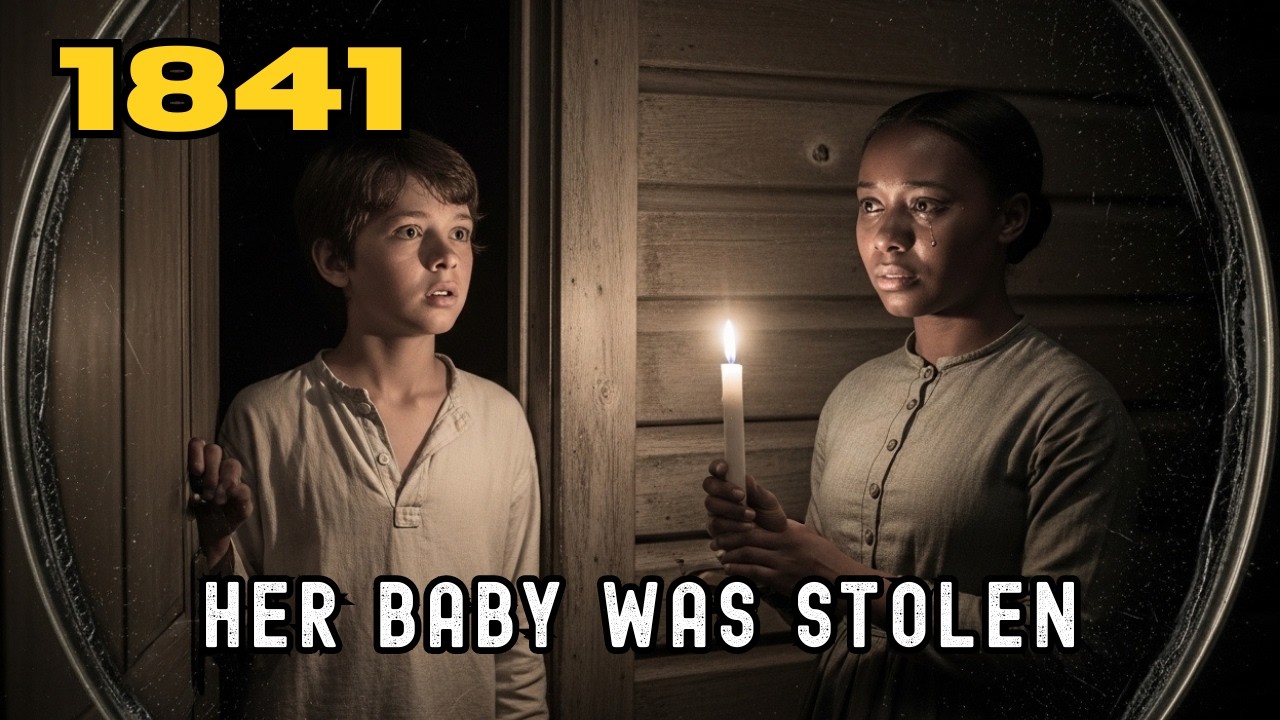
The truth he had circled for weeks, the suspicion that had grown since he had read his mother’s journal, was now confirmed beyond any doubt. How it had come to this was a story twelve years in the making, buried beneath family Bibles and burned correspondence along the Ashley River in the Carolina Low Country. The Rutledge plantation sprawled across three thousand acres of bottomland, its fields producing some of the finest sea island cotton that ever reached the Charleston market. The main house stood at the end of an oak-lined drive, a white-columned testament to wealth accumulated over three generations.
In 1843, the plantation was home to Nathaniel Rutledge, thirty-seven years old, and his wife Catherine, thirty-two—a couple whose childless marriage had become the subject of increasingly uncomfortable whispers among Charleston society. Nathaniel had inherited the property from his father in 1838, along with the labor of 143 enslaved people whose worth exceeded the value of the land itself. He was known as a progressive planter, one who read agricultural journals and experimented with crop rotation. He treated his enslaved people no worse than his neighbors did, which is to say he treated them as valuable livestock, their health and productivity matters of financial calculation rather than moral concern.
Catherine had come from a prominent Savannah family, the Hammonds, whose fortune rested on rice and naval stores. When she married Nathaniel in 1836, she brought a dowry of $20,000 and the expectation that she would quickly produce the heirs required to secure the family’s future. But seven years had passed without a pregnancy. The couple had consulted physicians in Charleston, Savannah, and even as far away as Philadelphia.
Catherine had endured treatments that ranged from the merely uncomfortable to the genuinely dangerous—mercury compounds, lead-based tonics, bleedings, and internal manipulations that left her bedridden for days. Nothing worked. The diagnosis, delivered with the brutal frankness common to medical men of that era, was that Catherine’s womb was inhospitable to the generative process. In simpler terms, she would never bear children.
For Nathaniel, this presented a problem both practical and social. Without legitimate heirs, the plantation would pass to his younger brother’s children, a prospect he found intolerable. For Catherine, the stakes were even higher. A barren wife could be set aside, her property returning to her family while she lived out her days in diminished circumstances, pitied by the very society that had once celebrated her beauty and accomplishments.
It was Catherine who first conceived the solution, though she would later claim the idea came to her in a dream sent by Providence itself. The spring of 1844 brought unusual heat to the Low Country, the kind of oppressive warmth that made even the lightest clothing feel like a burden. Catherine spent most of her days on the second floor of the house, where she could catch whatever breeze drifted in from the river. From this vantage point, she could see the entire sweep of the plantation—the cotton fields stretching toward the treeline, the collection of whitewashed cabins that housed the slave quarters, the brick buildings that held the cotton press and the carpentry shop.
It was from this view that Catherine began to truly study the enslaved women who worked in her house. She observed them with a new kind of attention, noting their ages, their builds, their features. She paid particular notice to a young woman named Delilah, who had been brought up to the main house two years earlier to train as a lady’s maid. Delilah was twenty-two years old, the daughter of the plantation’s most skilled cooper, Isaac.
Her mother had died of fever five years prior. She was literate, taught to read and write by a previous owner who had been censured by his neighbors for his dangerous liberality, and possessed what the family called refined features. More importantly, Delilah was light-skinned, the product of generations of forced mixture that had left her with features that could, with the right clothing and context, pass for white in dimmer light. Catherine began to treat Delilah with unusual attention.
She kept her close, training her personally in the intricate tasks of a lady’s maid—dressing hair, selecting clothing, managing correspondence. She spoke to her in tones that the other house slaves found unsettling, addressing her almost as an equal in private moments. And she began to ask questions about Delilah’s monthly cycles, her health, her family history—questions that made Delilah deeply uncomfortable, but which she dared not refuse to answer. By summer, Catherine’s plan had taken full shape in her mind.
She would have Nathaniel father a child on Delilah, then claim that child as her own. It was not unprecedented. Slave women bore their masters’ children constantly, and the resulting mixed-race offspring were simply absorbed into the slave population. But Catherine’s scheme went far beyond the casual rape that characterized plantation life.
She intended to take the child, raise it as white, and present it to Charleston society as the legitimate heir to the Rutledge fortune. The logistics were complex, but Catherine had always possessed a talent for organization. She began to complain of mysterious female ailments that required privacy and rest. She ordered the construction of a small cottage on the far edge of the property, claiming she needed a retreat for her recovery.
She sent away the older house slaves, replacing them with younger women who could be more easily controlled through fear and promises. Then, on a sweltering night in August, Catherine explained her plan to Nathaniel in his study, a room lined with law books and agricultural journals, illuminated by the soft glow of whale-oil lamps. Catherine had prepared her arguments carefully, framing the scheme not as a moral transgression but as a practical solution to an impossible problem. She reminded Nathaniel of what they stood to lose if they remained childless.
She painted vivid pictures of his brother’s children inheriting everything he had worked to improve and expand. She appealed to his vanity, his pride, his deep-seated belief that he deserved to found a dynasty. Nathaniel’s initial response was shock, then revulsion, then a kind of horrified fascination. The moral implications troubled him far less than the practical challenges.
How could they convince society that Catherine had borne a child when dozens of people knew she had not been pregnant? How could they ensure the silence of everyone who would inevitably learn the truth? Catherine had answers for every objection. They would stage a pregnancy, complete with clothing that suggested a growing belly.
They would claim Catherine needed rest and seclusion during her delicate condition, limiting visitors to the plantation. They would have the birth take place in the cottage she had built, attended only by those they could control through threats or promises. They would return to Charleston society months later with a healthy infant, its features ambiguous enough that no one would question its parentage. As for ensuring silence, the slaves who knew the truth would be bound by their very powerlessness.
What slave could accuse their master’s wife of such a scheme without facing immediate and terrible punishment? Any white person who learned the secret would be complicit in its maintenance, bound by the same social codes that protected all of the planter class’s transgressions. And the child itself would never know. Raised from infancy to believe Catherine was its mother and Nathaniel its father.
The conversation lasted until dawn. By the time the sun rose over the Ashley River, Nathaniel had agreed to every detail of his wife’s plan. The implementation began that very week. Catherine announced to the household that she was once again expecting, that the Philadelphia physician’s treatments had finally proven successful.
She made a great show of her delicate condition, retiring early from dinners, cancelling social engagements, spending long hours in her room with only Delilah in attendance. Delilah, meanwhile, had been moved into a small room adjacent to Catherine’s suite, close enough to be constantly available but isolated from the other slaves. She was told that she would be carrying a child for the mistress, that this was a great honor, that her cooperation would result in special treatment for herself and her father. The alternative was never explicitly stated, but hung in the air like the threat of an approaching storm.
What followed over the next several months was a grotesque pantomime of pregnancy. Catherine padded her clothing to simulate a growing belly while Delilah’s actual condition was hidden beneath loose-fitting dresses. The young enslaved woman was forbidden from leaving the main house, kept isolated from even her own father, fed a rich diet meant to ensure the health of the child she carried while Catherine maintained her own elegant figure through careful corseting beneath the padding. Nathaniel fulfilled his role with grim efficiency, visiting Delilah on three consecutive nights in September until Catherine deemed it sufficient.
He never spoke beyond his wife’s instructions, never acknowledged what he was doing beyond the physical act itself. To admit the reality would be to confront the full horror of the arrangement, and Nathaniel had spent his entire life perfecting the art of not seeing what was inconvenient to acknowledge. By December, Delilah’s pregnancy was unmistakable to anyone who might have seen her. But Catherine had ensured that no one beyond a carefully controlled circle had that opportunity.
The house slaves who brought meals to Delilah’s room had been chosen for their youth and their fear—girls barely in their teens who could be trusted to remain silent through terror of what might happen to them or their families if they spoke. Catherine made a single trip to Charleston that winter, appearing at her cousin’s dinner with her padded belly prominent beneath an expensive silk dress. She endured the congratulations and advice of society matrons who had long pitied her barrenness, playing her role with an actress’s skill. No one suspected that the child supposedly growing inside her was actually being carried by a slave woman locked in a room miles away.
Spring arrived with its usual assault of heat and insects. Catherine retreated to the cottage she had built, taking Delilah with her and dismissing the regular house staff with vague explanations about needing complete rest during her final weeks. The cottage had been fitted with heavy curtains, its windows positioned to prevent anyone from seeing inside. It was attended by only three people: Catherine herself, an elderly enslaved woman named Patience who served as midwife, and Delilah.
The birth occurred on a Friday in late April during an afternoon thunderstorm that sent torrents of rain hammering against the cottage roof. Delilah labored for fourteen hours, her screams muffled by thunder and the distance from the main house. Catherine remained present throughout, pacing the cottage’s small parlor, occasionally going to the bedroom door to check on progress. When the child finally emerged—a boy, healthy and loud—Catherine moved with decisive speed.
The baby was cleaned and wrapped by Patience, then immediately taken from Delilah’s arms before the young mother could even hold him properly. Delilah was given laudanum for the pain and instructed to rest, her body still heavy with milk that would never feed her child. Catherine took the infant directly to the main house, where she staged an elaborate scene of exhaustion and triumph. Nathaniel was summoned to meet his newborn son.
Servants were called to witness the blessed event. Messages were dispatched to Charleston announcing the arrival of William Nathaniel Rutledge, heir to one of the Low Country’s finest plantations. The baby was, by all accounts, perfect for Catherine’s purposes. His skin was fair, his features delicate and undefined in the way of all newborns.
When visitors came to offer their congratulations in the weeks that followed, they saw nothing to suggest the child was anything other than what Catherine claimed. Delilah remained in the cottage for six weeks, recovering from the birth in isolation. Her breasts became painfully engorged with milk meant for a child she would never nurse, then gradually dried up as her body adjusted to its loss. When she was finally returned to the main house, it was to a different role entirely: wet nurse to her own son, presented to the world as merely another slave woman paid to feed the master’s child.
This arrangement lasted only three months before Catherine deemed it too risky. The bond that might form between Delilah and the baby was too dangerous, the possibility of recognition too real. Instead, Catherine hired a wet nurse from a neighboring plantation, a woman with no knowledge of the circumstances surrounding William’s birth. Delilah was reassigned to work in the cotton fields, removed from the main house entirely, and forbidden from coming within sight of the child she had borne.
The deception, it seemed, was complete. The years that followed William’s birth settled into a pattern of careful maintenance and constant vigilance. Catherine proved herself a devoted mother by every measure that Charleston society valued. She dressed William in the finest clothes available, hired tutors to instruct him in Latin and Greek, ensured he learned to ride, shoot, and carry himself with the confidence expected of a planter’s son.
But beneath the surface of the seemingly perfect maternal arrangement ran a current of anxiety that never entirely subsided. Catherine watched the boy obsessively for any sign that might reveal his true parentage, studying his features as they developed, comparing them constantly to Nathaniel’s and to her own family’s characteristics. To her relief, William grew into a handsome child with fair skin and light brown hair, showing no obvious signs of his mixed heritage—no particular curl to his hair, no breadth to his nose, no fullness to his lips that might prompt uncomfortable questions. He looked, in short, like what he was supposed to be.
Nathaniel treated the boy with genuine affection, teaching him about cotton cultivation and estate management, introducing him to Charleston’s commercial elite, preparing him to eventually assume control of the plantation. If Nathaniel ever felt guilt about the circumstances of William’s conception and birth, he showed no outward sign of it. The enslaved community on the Rutledge plantation, however, remembered everything. Though no one dared speak openly about what had happened, the knowledge circulated in whispers and meaningful glances.
The older slaves understood that Delilah had borne a child who now lived in the main house as white. They watched as the young woman was worked brutally in the fields, her hands blistering and callousing from labor she had never been trained for. Delilah had been promised special treatment for her cooperation, but Catherine had reneged on every implicit promise once the baby was safely claimed. Her father, Isaac the cooper, grew gaunt with worry and rage.
He understood what had been done to his daughter, understood that she had been used and then discarded. The only thing he could do was try to make her life marginally more bearable—building her a more weatherproof cabin, ensuring she had sufficient food, protecting her from the worst impulses of the overseer. By 1856, William had grown into a boy who showed every promise of becoming a respected gentleman. At eleven, he was tall for his age, quick-minded, and possessed of the easy confidence that comes from never having been denied anything of importance.
He had developed a habit of wandering the plantation in the early mornings before the heat became oppressive and before his tutors arrived. On one such morning in June, William made his way to the cooper’s shop, drawn by the rhythmic sound of hammering and the rich smell of worked wood. Isaac, now in his fifties with hands gnarled from decades of labor, was already at work shaping staves for barrels. Something was different that morning.
William noticed that Isaac kept glancing at him with an expression the boy couldn’t quite identify—not the usual weariness or deference, but something that looked almost like pain. “Do you have children? ” William asked, with the thoughtless cruelty of a child who doesn’t understand that enslaved people’s families can be sold apart at any moment. Isaac’s hands stilled on the wood.
For a long moment he said nothing, and William began to feel uncomfortable in the silence. “Had a daughter,” Isaac finally said, his voice carefully neutral. “Still do, I suppose. She works the lower fields now.
”
“Why doesn’t she work here in the main house? ” William asked. “My mother always says the house slaves are better off than the field hands. ”
Isaac’s jaw tightened almost imperceptibly.
“Your mother has her reasons for everything she does, Master William. ” There was something in the way he said it, some subtle emphasis the boy couldn’t quite interpret, but that lodged in his mind like a splinter. That brief exchange might have faded from William’s memory entirely had not another incident occurred just two weeks later. Catherine had taken to keeping a journal, a leather-bound volume in which she recorded household expenses, social engagements, and her private thoughts.
She kept it locked in a small desk in her private sitting room, a space William had been taught to respect as off-limits. But on a humid afternoon when Catherine was visiting neighbors and Nathaniel was in Charleston on business, William’s curiosity overcame his training. The desk lock was flimsy, designed more for privacy than security. Within moments, he had the drawer open and the journal in his hands.
Most of what he found was mundane—records of linens purchased, notes about which families to invite to dinner, complaints about the difficulty of finding good help. But as he paged through entries from years past, he came across a section that made him stop breathing. The entries were from 1844 and early 1845, written in Catherine’s precise handwriting but with a tone of anxiety absent from her more recent writings. She wrote about physicians and treatments, about desperation and failed hopes, about her fear of losing everything if she couldn’t produce an heir.
Then, in an entry dated August 1844, she wrote something William read three times before his brain could fully process the words: “I have conceived a solution to our desperate situation. It is bold beyond anything I might have imagined myself capable of, and it requires Nathaniel’s cooperation in an act that society would condemn. But what choice do we have? I have identified a suitable candidate among the house servants—young, healthy, light enough that the result should pass scrutiny.
If Nathaniel agrees, we could have our heir within the year, and no one need ever know the circumstances of the child’s origin. ”
William’s hands were shaking as he turned the page, but the next several entries had been torn out, leaving only ragged edges along the journal’s binding. The entries resumed months later in April 1845 with a single line: “William Nathaniel Rutledge was born today. The answer to all our prayers.
”
The boy sat frozen, the journal open on his lap, his mind refusing to accept what the words clearly implied. He was eleven years old—old enough to understand the basic facts of where babies come from, old enough to know that a woman couldn’t be barren one year and suddenly pregnant the next without something unusual having occurred, old enough to understand on some level what his mother’s careful words were really describing. William returned the journal to the desk, his hands numb and clumsy as he reset the lock. For several days, he moved through his regular routines in a kind of daze, responding to questions without really hearing them, completing his lessons without retaining anything he’d learned.
Catherine noticed his distraction but attributed it to the oppressive summer heat. William found himself studying his parents with new eyes, searching for signs of the deception his mother’s journal had revealed. He noticed how Catherine sometimes looked at him with an expression that wasn’t quite maternal affection—something more complex, tinged with anxiety and calculation. He noticed how Nathaniel’s pride in him seemed slightly performative.
He began paying attention to the enslaved women who worked around the plantation, particularly those who seemed to be near his mother’s age. He started asking casual questions of the house servants: who had worked in the main house twelve years ago, who had been moved to fieldwork, were there any women who used to be ladies’ maids but weren’t anymore. The responses he received were universally evasive. Slaves learned early and thoroughly that curiosity from white people, even white children, could be dangerous.
But their very evasiveness told William he was on to something real. His inquiries eventually reached Catherine’s ears through the invisible network of information that connected the main house to the quarters. That evening, she summoned William to the parlor for what she called a conversation about appropriate behavior. “I’ve been told you’ve been questioning the servants about household matters from years past,” Catherine said, her voice level but with an edge beneath the surface.
“May I ask what prompted this unusual interest? ”
William felt his face grow hot. “I was just curious about how the plantation used to work before I was born. ”
“Curiosity is an admirable trait,” Catherine said, “when it’s directed toward appropriate subjects.
But the private affairs of this household are not appropriate topics for interrogating our servants. If you have questions about our family or our history, you should bring them to your father or to me. Do you understand? ”
“Yes, ma’am,” William said, but his voice was weak.
Catherine studied him for a long moment. “You’re growing up, William, and with that comes certain responsibilities. One of those responsibilities is maintaining the dignity and privacy of our family. There are things that are not discussed, not questioned, not examined too closely—not because they’re shameful, but because they’re private.
A gentleman learns to respect those boundaries. Do you understand what I’m telling you? ”
William understood perfectly. His mother was telling him to stop asking questions, to stop searching for answers about the meaning of those journal entries.
“I understand,” he said, and this time he meant it. Catherine smiled, a warm expression that didn’t quite reach her eyes. “Good. Now run along to your lessons.
And William, we won’t need to have this conversation again, will we? ”
“No, ma’am. ”
But as William left the parlor, he knew that his mother’s warning had accomplished the opposite of its intended effect. By telling him not to investigate, Catherine had essentially confirmed that there was something worth investigating.
The revelation came not through William’s investigation, but through simple, terrible chance. It was late August, and a fever had spread through the slave quarters. Isaac was one of the unlucky ones. By the time the overseer bothered to inform Nathaniel that the cooper was seriously ill, Isaac had been suffering for nearly a week.
Nathaniel sent for a physician—not out of compassion, but out of economic calculation, as Isaac’s skills were valuable and difficult to replace. The doctor, a heavyset man named Reeves, examined Isaac in his cabin and pronounced his condition serious but not necessarily fatal. Delilah was granted permission to tend to her father during his illness. William had learned her name through casual questions he tried to make sound innocent.
He had learned that she was twenty-two when he was born, which would make her thirty-four now. He had learned that she had once worked in the main house but had been reassigned to fieldwork around the time of his birth. The pieces were all there, arranged in a pattern too obvious to ignore once you knew to look for it. On the third night of Isaac’s illness, William found himself unable to sleep.
The heat was oppressive. He rose from his bed, dressed quietly, and slipped out of the house into the thick August darkness. His feet carried him toward the slave quarters with a purpose he didn’t want to acknowledge. Isaac’s cabin showed candlelight through cracks in the walls.
William approached slowly, his heart hammering so hard he could feel it in his throat. He moved closer to the open window and pressed himself against the rough wood of the cabin’s exterior wall. Isaac’s voice reached him first, barely audible. “You got to promise me something.
”
“Promise? Anything, Papa,” came the woman’s reply, and William recognized a distinctive timbre, slightly hoarse, as if from years of calling out across cotton fields. “That boy, the one at the big house. You got to tell him the truth someday.
Not now. Lord knows, not now. It would only bring trouble down on all of us. But someday, when the time’s right, when he’s old enough to understand and maybe do something with the knowledge.
You promise me. ”
There was a pause. “Papa, I can’t. You know I can’t.
Mistress Catherine would—I know what she’d do. ”
Isaac interrupted, his voice gaining terrible strength despite his illness. “I know all of it. I was there, wasn’t I?
I saw what they did to you. I saw how they locked you away like some animal. Saw how they took that baby from your arms before you could even hold him proper. I saw how they threw you out to the fields after, like you were nothing, like you hadn’t just given them everything.
That boy deserves to know where he came from. And you deserve for him to know you’re his mama, not that woman who stole from you. ”
William’s legs began to shake. “Promise me, Lily,” Isaac continued, using what must have been a childhood nickname.
“Promise me you’ll find a way when the time comes. I’m dying. Don’t shake your head at me, girl. We both know it’s true, and I won’t go to my grave knowing you’ll carry this alone for the rest of your life.
Promise me. ”
The woman’s voice broke on a sob. “I promise, Papa. I promise I’ll tell him someday when it’s safe.
”
“It’ll never be safe,” Isaac said, and there was a terrible wisdom in his words. “But maybe someday it’ll be possible. That’s all I’m asking for. Just possible.
”
William stood frozen outside the cabin, every muscle locked, his breath coming in shallow gasps he was desperately trying to quiet. The truth he had been circling around, the suspicion that had been growing since he’d read his mother’s journal, was now confirmed beyond any possibility of doubt. The woman inside that cabin, Delilah, Isaac’s daughter, the field hand he had never properly looked at in all his eleven years, was his mother. His real mother.
He thought about Catherine’s padded belly, about the convenient retreat to the cottage, about all the careful arrangements that had kept him ignorant of his own origins. He thought about how many people must have known—all the slaves, certainly, probably some of the white neighbors who had chosen to remain silent out of solidarity with Catherine’s deception, or simple unwillingness to acknowledge such a profound violation of the racial order. William knew he should leave, should return to the main house and pretend this night had never happened. But he couldn’t move.
Some force stronger than self-preservation or social conditioning kept him rooted to that spot. Finally, after what felt like hours but was probably only minutes, William pushed himself away from the wall and moved toward the cabin door. His hand was shaking as he reached for the rough wooden handle. He had no plan, no idea what he would say or do once he crossed that threshold.
He only knew that he had to see her. The door swung open with a creak that seemed impossibly loud in the night silence. Delilah’s head snapped up from where she sat beside her father’s bed, her face still wet with tears, her eyes widening in shock, and then fear, as she recognized who stood in the doorway. For a long moment, they simply stared at each other.
William saw her properly for the first time in his life. She was thin, worn down by years of field labor, her hands calloused and scarred, her clothing the rough homespun that marked her status. But her face showed the refinement that came from having once been educated, from having once been groomed for house service. And in her features he could see echoes of his own: the shape of her eyes, the line of her jaw, the way her forehead creased when she was distressed.
“Is it true? ” The words came out of him unbidden, cracking in the middle. “Are you my mother? ”
Delilah’s face went through a rapid series of expressions: shock giving way to fear, fear to something like resignation, resignation to a grief so profound it seemed to age her before his eyes.
She glanced at her father, whose eyes had opened at the sound of William’s voice, then back at the boy standing in her doorway. She could have denied it. She could have claimed he had misheard. But looking at his face, seeing the knowledge already there in his eyes, she understood the denial would be both useless and cruel.
“Yes,” she whispered, her voice barely audible. “Yes, I am. ”
“Tell me,” William said, and it was both a command and a plea. “Tell me everything.
I want to know how. I need to understand. ”
Delilah looked at Isaac again. He gave a barely perceptible nod.
“Come inside and close the door,” Delilah said quietly. “This isn’t a story for the open air. ”
William stepped into the cabin and pulled the door shut behind him. He sat in one of the rough chairs, his legs finally giving out completely.
Delilah remained standing, her arms wrapped around herself as if trying to hold her body together through sheer force of will. And then she began to speak. She told him about Catherine’s desperation, about the years of failed treatments and growing panic. She told him about being summoned to Catherine’s sitting room one evening and told that she had been chosen for a great honor, that she would help secure the Rutledge family’s future.
She told him how she hadn’t understood at first what Catherine was proposing, and how the understanding, when it came, had been like a physical blow. “I was twenty-two years old,” Delilah said, her voice taking on a flat, recited quality as if she was describing events that had happened to someone else. “I’d been educated to read and write by my previous owner, a man your grandparents bought me from when I was fifteen. I thought that education made me valuable.
Thought it meant I’d always work in the house, have an easier life than the field hands. I didn’t understand that it just made me useful in a different way. ”
She told him about the three nights Nathaniel had come to her room, how he had never spoken beyond instructions, how he had treated the act of creating William like a distasteful chore that needed to be completed as efficiently as possible. “He never looked at my face,” Delilah said, and there was no emotion in her voice now, just a terrible blankness.
“Not once. I don’t think he wanted to see me as human. It would have made what he was doing harder, I suppose. ”
William felt sick, bile rising in his throat as he understood the full mechanics of his own conception.
Delilah continued describing the months of being kept isolated, hidden away, while Catherine paraded around Charleston with her padded belly. She described the loneliness of that time, the fear, the growing connection she felt with the child developing inside her, even as she knew it would be taken away. “I used to talk to you,” she said, and now there was emotion in her voice, a raw tenderness that made William’s chest ache. “When I was alone in that room, I’d put my hands on my belly and tell you stories.
I’d sing you songs my own mama sang to me before she died. I’d make promises about all the things I’d teach you, all the love I’d give you. I knew they were lies. Knew you’d never really be mine, but I couldn’t help myself.
”
She described the birth, the hours of labor in the isolated cottage with only old Patience for help, and Catherine pacing in the next room like an expectant father. She described the moment William finally emerged, the overwhelming relief that he was healthy, the desperate need she felt to hold him. “They let me hold you for maybe two minutes,” Delilah said, tears streaming down her face now. “Mistress Catherine took you from my arms before I could even finish looking at you.
You were crying. You wanted to nurse. You were hungry. And she just took you and left.
I could hear you crying as she carried you away, and then I couldn’t hear you anymore. And I thought I would die from the pain of it. ”
Then she had been brought back to the main house, assigned briefly as William’s wet nurse—a piece of cruelty so perfect it seemed almost designed to maximize her suffering. “I fed you for three months,” Delilah said softly.
“I held you in my arms and gave you my milk and looked at your face and couldn’t say a word about what you were to me. ”
Then came the abrupt reassignment to fieldwork. “Why? ” William asked.
“Why did they treat you like that? If they needed you, if you’d given them what they wanted. ”
“Because I was dangerous,” Delilah said simply. “Every time I looked at you, every time I was near you, there was a chance someone would see something in my face, some tenderness or claim that would give away the truth.
Mistress Catherine couldn’t risk that. So she sent me away, put me where I couldn’t see you, and she made sure everyone understood that if I ever spoke about what had happened, if I ever tried to claim you or tell you the truth, I’d be sold away or worse. ”
“Have you been watching me all these years? ” William asked.
Delilah nodded slowly. “Every chance I got. When the field hands came back from work, I’d look for you in the windows of the big house. When we were allowed to go to church on Sundays, I’d watch you sitting in the white section with your parents.
I memorized your face at every age. I watched you become someone I could never reach, could never claim, could never call son. And it killed me a little bit more every single day. ”
The rawness of her pain was almost unbearable.
William found himself crying without having realized he’d started. “I’m sorry,” he said, the words inadequate but the only ones he had. “I’m so sorry. ”
Delilah crossed the small space between them and knelt in front of his chair, taking his hands in hers.
Her hands were rough, scarred from years of cotton and sun, but her grip was gentle. “You were a child,” she said firmly. “You are a child. None of this is your fault.
”
“But what am I? ” William asked desperately. “What am I supposed to be if you’re my mother? ”
“You’re my son,” Delilah said, squeezing his hands.
“That’s all that matters to me. You’re my son, and I have loved you every day of your life. Even when I couldn’t say it, even when I couldn’t show it, even when you didn’t know I existed, I have loved you with everything I am. ”
Behind them, Isaac made a sound, half cough, half sob.
“That’s right, boy,” the old man rasped. “You’re my grandson. Got my mother’s eyes if you want to know the truth. She was Gullah from down on the islands.
You got her way of looking at things, like you’re seeing more than what’s right in front of you. ”
“Does everyone know? ” William asked, turning back to Delilah. “All the slaves.
Do they all know who I really am? ”
“Yes,” Delilah said quietly. “They’ve always known. Secrets like this don’t stay secret among us.
We see everything, hear everything. We have to survive. But no one would ever speak of it to white folks. It would be signing their death warrant.
”
William felt the weight of that knowledge settle on him. Dozens, maybe hundreds of people walking around with the truth of his origins, forced into conspiracy by their powerlessness. “What do I do now? ” he asked.
“How am I supposed to—I can’t pretend I don’t know this. I can’t go back to how things were, but I don’t know what else to do. ”
Delilah’s face showed the complexity of emotions warring inside her. “I don’t know,” she finally admitted.
“I’ve thought about this moment for twelve years. Imagined a thousand different ways it might happen. But I never knew what I’d tell you when it did. The world you live in and the world I live in, they’re not meant to overlap.
You crossing that line wouldn’t make you free in my world. It would just make you enslaved like me. And I can’t wish that on you, no matter how much I want to claim you. ”
“But you are claiming me,” William said.
“Right now, you’re telling me the truth. That means something. ”
“It means I’m a selfish woman who couldn’t keep silent when given the chance to speak,” Delilah said. But there was a small, sad smile on her face.
“It means I’m weak enough to want you to know where you came from, even if that knowledge only brings you pain. ”
They sat in silence for a moment. Outside, a rooster crowed prematurely, confused by the approaching dawn. Soon it would be morning, and William would have to return to the main house.
“Can I come back to see you again, to talk to you? ” William asked. Delilah’s expression showed the war between desire and caution. “It’s dangerous,” she said.
“If Mistress Catherine finds out, if she suspects we’ve spoken—”
“I don’t care,” William said, and he was surprised to find he meant it. “You’re my mother. I want to know you. ”
“Then come,” Delilah said softly.
“Come when you can, when it’s safe. But be careful. The consequences of this truth coming out, they’d be terrible for both of us. ”
William nodded, understanding.
He stood slowly, his legs unsteady, and moved toward the door. But before he left, he turned back one more time. “Thank you,” he said, “for telling me. For not lying to me, even though it would have been safer.
”
“You deserve the truth,” Delilah said. “You’ve always deserved the truth. ”
William slipped out of the cabin into the pre-dawn darkness, his mind reeling, his entire sense of self shattered and reforming into something he didn’t yet understand. He walked back toward the main house like a stranger in his own life, seeing everything with new eyes—the slave quarters that housed people who shared his blood, the cotton fields his mother worked in brutal heat, the grand columns of the house built on wealth extracted from the labor of people who were his people.
Isaac died three days after William’s visit, his weakened body finally succumbing to the fever. Delilah was given a few hours to prepare his body for burial, then sent immediately back to the fields. William watched the funeral from a distance, a simple affair in the slave cemetery conducted by one of the older enslaved men who served as preacher for the community. He wanted to attend, wanted to stand beside Delilah and acknowledge Isaac as his grandfather.
But he understood that such an action would raise questions he couldn’t answer without destroying everything. So he stayed away and mourned privately. Catherine, meanwhile, was watching William with increasing concern. She cornered him one afternoon in the library.
“William, I need you to be honest with me,” she said, her voice carefully controlled. “Something has changed. Something is troubling you, and I need to know what it is. ”
William looked at this woman who had raised him, taught him his letters, comforted him through childhood illnesses, claimed him as her own—and felt a complex mixture of emotions he couldn’t begin to articulate.
Love, because she had been his mother in every practical sense for eleven years. But also betrayal, anger, a profound sense of violation at the lie she had built his entire existence around. “I’ve been thinking about Isaac,” he said, which was true even if it wasn’t the whole truth. “About how he died.
About how Delilah lost her father. ”
Catherine’s face showed carefully controlled relief. “That’s very sensitive of you,” she said. “It’s good that you have compassion for the slaves, but you mustn’t let it trouble you too deeply.
Death is part of life, and Isaac lived a long, useful existence. ”
The casual dismissal of Isaac’s humanity, the reduction of his life to usefulness, made William’s stomach turn. But he kept his face neutral, nodded as if accepting her wisdom. “You’re right, of course,” he said, and watched Catherine relax slightly.
“Good boy,” she said, touching his cheek with the same gesture of affection she had used throughout his childhood. “I know you have a tender heart. It’s one of the things I love about you. But you must learn to maintain proper distance.
These people, they’re not like us. They don’t feel things the same way we do. ”
William wanted to scream at her that these people included his actual mother, that they felt things exactly as deeply as white people did, that her entire worldview was built on a lie so profound it had deformed her basic humanity. But he said nothing.
Just nodded again and let her believe she had successfully addressed whatever had been troubling him. After that conversation, William became more careful about concealing his inner turmoil. He resumed his studies with apparent enthusiasm, participated in estate management with his father, played the role of dutiful son and future planter with a skill that would have made Catherine proud if she’d known it was a performance. But in the early mornings and late evenings, when he could move around the plantation without attracting attention, William sought out Delilah.
These meetings were brief, conducted in shadows and silence, always with the risk of discovery hanging over them. They talked about her life before his birth, about the world of the slave quarters that he had never seen, about the brutal realities of the system that had created and sustained his comfortable existence. Delilah taught him things no white child was meant to know. She taught him about the networks of resistance that ran through the enslaved community, the stolen moments of joy and connection that made survival possible, the dreams of freedom that people whispered about in the night.
She taught him that the people he had been raised to see as property were in fact fully human. And she taught him about himself, about the blood that ran in his veins. “Your great-grandmother was brought from Africa,” Delilah told him one night, her voice soft with memory. “My grandmother.
She spoke a language none of us ever learned. Used to sing songs in words we couldn’t understand. My father said she never forgot her homeland. Used to tell stories about the village she was stolen from.
That’s your blood too, William. Not just the white planter family Mistress Catherine likes to boast about. You carry Africa in you, whether the world acknowledges it or not. ”
These revelations were both painful and liberating.
But knowing the truth and being able to act on it were two very different things. William was still legally white, still the recognized heir to the Rutledge plantation, still expected to take his place among Charleston’s elite. And Delilah was still enslaved, still subject to being sold or punished or killed at the whim of the very people William called parents. He considered briefly the idea of exposing the truth publicly, of standing up in church or at some social gathering and announcing that he was the son of an enslaved woman.
But he understood that such a revelation would accomplish nothing except his own destruction. He would be declared enslaved by law, his property would revert to Nathaniel, and he would be either sold away or kept on the plantation as a slave himself. Delilah would likely be sold as well, separated from him and punished for having revealed the secret. The truth, William realized with bitter clarity, had no power in a world built on lies.
He considered running away, escaping to the North, where slavery was illegal. But he was twelve years old, with no money of his own, no knowledge of how to survive outside the protected world of the plantation. And running would mean abandoning Delilah, leaving her to face whatever consequences Catherine might impose for his disappearance. So William did what countless other people in impossible situations had done before him.
He adapted. He learned to live with cognitive dissonance, to hold multiple truths in his mind simultaneously without letting them paralyze him. He was William Rutledge, son of Nathaniel and Catherine, heir to a cotton plantation, member of Charleston society. That was the truth the world saw, and the identity that protected him from enslavement.
But he was also William, son of Delilah, grandson of Isaac, carrier of African and European blood, a living contradiction of every principle the slave society was built upon. Both truths were real. Both identities were his, and the tension between them would shape every decision he made for the rest of his life. As William grew into adolescence and then adulthood, he maintained his relationship with Delilah in secret, meeting with her when he could, learning from her, holding on to the connection that gave his life meaning beyond the empty rituals of planter society.
When he went away to college in Charleston, he wrote her letters that had to be smuggled to her through trusted intermediaries. When he returned to manage the plantation after his education, he used his authority to make her life marginally better—assigning her to easier tasks as she aged, ensuring she had adequate food and shelter, protecting her from the worst excesses of the overseers. But he never publicly acknowledged her as his mother. He never challenged the system that enslaved her.
When the time came, he married a white woman from a respectable family, had children who were raised as white, perpetuated the same lies and silences that had defined his own upbringing. He told himself he was being practical, that open rebellion would accomplish nothing except his own destruction and hers. He told himself he was doing what he could within the constraints of an unjust system. But in his private moments, in the dark hours before dawn when sleep eluded him, William knew he was simply choosing comfort over truth, choosing security over justice, choosing to benefit from a system he knew to be evil rather than sacrificing himself in futile opposition to it.
Delilah never blamed him for these choices. She had lived too long in the reality of slavery to expect any different. The fact that her son knew who she was, that he visited her when he could, that he called her mother in private even if he could never acknowledge her publicly—these things gave her a measure of peace that many enslaved mothers never received. She died in 1871 at the age of forty-nine, her body worn out from decades of labor and the accumulated trauma of a life lived in bondage.
William, by then thirty-eight years old, attended her funeral—not as her son, not with any public display of grief, but standing at a distance, one white man among several who had come to mark the passing of a longtime plantation worker. But after the service, when the other white observers had left, William stayed. He stood beside the fresh grave as the sun set over the Carolina Low Country, and he let himself cry for the first time since he was eleven years old. He cried for Delilah, for Isaac, for the relationship he had been allowed to have with them only in fragments and shadows.
He cried for the children he had fathered, who would never know their grandmother, who would grow up as white as he had, ignorant of half their heritage. And he cried for himself—for the boy who had learned a truth that changed everything and nothing, for the man who had chosen complicity over confrontation, for the son who had loved his mother but never been able to claim her. In his will, written in 1889 and filed after his death in 1892, William left a small bequest to the descendants of Isaac the cooper in recognition of his long and faithful service to the Rutledge family. It was the closest he could come to acknowledging the truth—a veiled reference that none of his white family members would understand, but that those who knew the real story might recognize as a final, insufficient gesture toward justice.
The secret died with him, or so he believed. His children never learned the truth of their heritage. His grandchildren grew up secure in their whiteness, their place in society, their identity as descendants of one of South Carolina’s old families. The story of Delilah and the child she had been forced to bear, then forbidden to claim, faded into the unmarked graves and forgotten corners of plantation history.
But secrets, even buried ones, have a way of leaving traces. In the careful genealogies kept by Black families, in the whispered stories passed down through generations, in the DNA that carries memory forward even when official records have been scrubbed clean—in all these places, the truth persisted. William Rutledge lived as a white man, died as a white man, was buried in the white cemetery in Charleston with full honors. His obituary praised his skill as a planter, his service to the community, his devotion to his family.
Not a word was said about where he really came from, about the mother who had loved him from a distance, about the terrible compromise at the heart of his existence. That silence was its own kind of monument—a testament to the power of lies when backed by law and custom, a reminder that injustice doesn’t require monsters, only ordinary people willing to accept comfort purchased through the suffering of others. The Rutledge plantation stands today as a historic site. Its main house carefully preserved, its gardens maintained, its story told to tourists who come to marvel at antebellum elegance.
There are plaques describing the family’s history, the cotton economy, the architecture of the big house. There is nothing about Delilah. Nothing about the theft of her child. Nothing about the twelve years of secrecy and the lifetime of silence that followed.
Nothing about the complicated grief of a son who knew two truths and could claim only one. Some truths remain too uncomfortable for historic preservation, too damaging to the myth society tells itself about the past. So they’re left out of the official story, relegated to footnotes if acknowledged at all, allowed to fade into the background noise of history. But they don’t stop being true just because they’ve been forgotten.
They don’t stop mattering just because they’ve been erased from the record. The horror of what happened to Delilah, the tragedy of William’s stolen identity, the compromise that poisoned his entire existence—these things remain real, remain important, remain a reminder of what human beings will do to each other when systems of power make cruelty convenient and profit from injustice.
