In December 1776, the war that was supposed to be over by spring had come down to a desperate gamble on the icy banks of the Delaware River. George Washington was putting 2,400 men into flat-bottomed boats, nine miles north of Trenton, New Jersey, while snow and freezing rain turned the river into a churning mass of ice. His soldiers wrapped their feet in rags and strips of cloth for lack of boots. Across the river waited a garrison of about 1,400 Hessian troops under Colonel Johann Rall, a professional officer of thirty-six years’ service who had already earned the honor of accepting the American surrender at Fort Washington a month earlier.
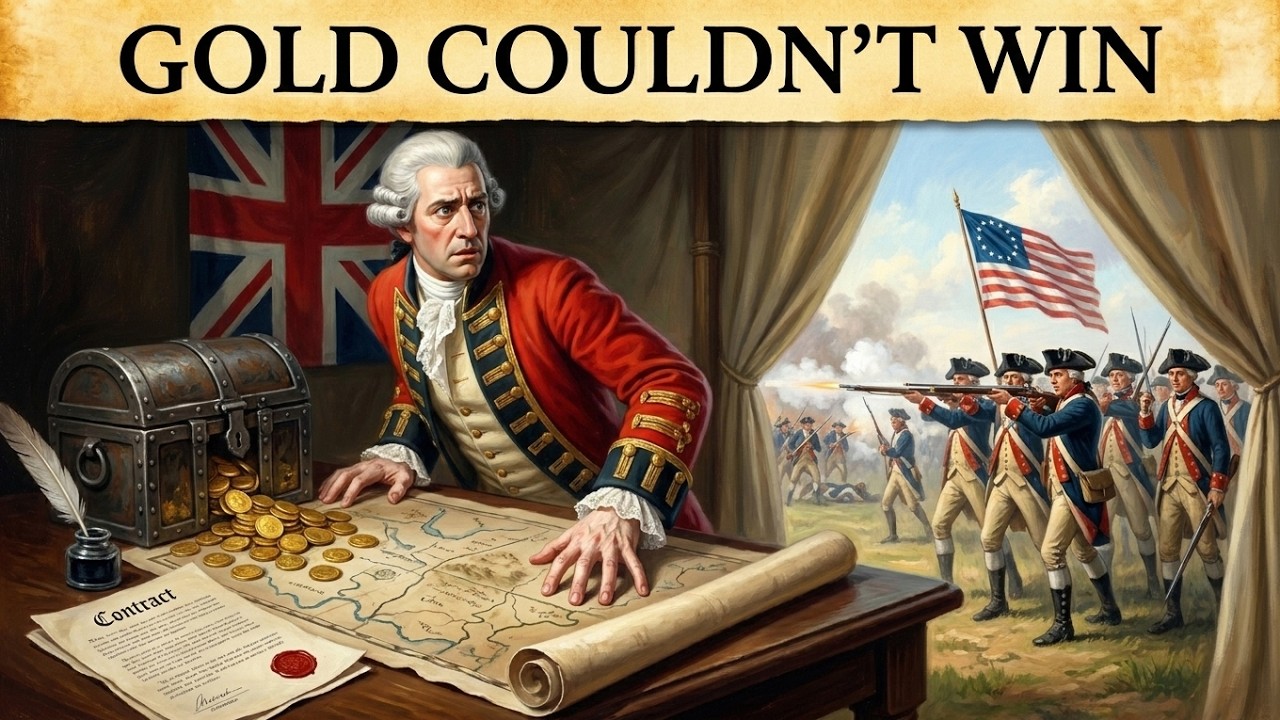
The entire Revolution now hinged on whether Washington could cross that river in the middle of a winter storm and take the town before dawn. The crisis that brought Washington to this crossing had its roots more than a decade earlier, in the arithmetic of the British treasury. When the Seven Years’ War ended in 1763, Britain had cut its army to the bone to pay off a crushing national debt. The reasoning seemed sound at the time: the navy protected the trade routes and the colonial ports, while maintaining a large standing army was ruinously expensive.
Parliament trimmed the infantry to the minimum and pointed the savings at the fleet. For twelve years the trade-off held. Then the shooting started at Lexington and Concord, and suddenly London needed tens of thousands of ground troops to cross the Atlantic and suppress a rebellion stretching from Massachusetts to Georgia. The men simply did not exist.
So King George III went looking for a substitute. He sent diplomats to Russia first, hoping to borrow twenty thousand soldiers from another empire. Catherine the Great refused outright; she wanted no part in a British colonial quarrel. The Dutch refused as well, and then one state after another declined to rent out its army for a war that most of Europe considered Britain’s own problem, to be solved with British soldiers.
Nobody at the time knew that six small German princes were about to say yes, and that their decision would shape the entire course of the war. Germany in 1775 was not a nation but a patchwork of more than three hundred tiny states, each ruled by a prince or duke or landgrave, each with its own small standing army. Some of those rulers had discovered something that would make modern defense contractors envious: soldiers were their most profitable export. Hesse-Kassel, a territory about the size of Connecticut in central Germany, had been leasing its trained military units to foreign powers for nearly a century.
Britain had already hired Hessian troops during the War of the Austrian Succession and again during the Seven Years’ War. The arrangement was simple. Britain paid the ruling prince a fee for every soldier supplied. The prince kept his army trained, equipped, and ready for shipment.
When a buyer appeared, Hesse-Kassel delivered complete military units with their officers, supply chains, and command structure intact. The soldiers themselves had no say in the deal. They went where they were sent. Between 1775 and 1776, Britain signed subsidy treaties with six German states: Hesse-Kassel, Brunswick-Wolfenbüttel, Hesse-Hanau, Waldeck, Anhalt-Zerbst, and Ansbach-Bayreuth.
Together these territories sent nearly thirty thousand men to fight in North America. More than half came from Hesse-Kassel alone, which is why every German soldier in the Revolution came to be called a Hessian, whatever his true origin. The financial terms were staggering. Landgrave Frederick II of Hesse-Kassel earned from the British deal an income equal to his territory’s total tax revenue for thirteen years.
Think about that: thirteen years of taxes from a single contract. He used the money to hire architects, fund painters and sculptors, and turn the city of Kassel into a glittering capital and showpiece of beauty. He kept taxes on his subjects low and public spending high. The whole arrangement looked brilliant, as long as you never asked where the money actually came from.
It came from selling his own people. About seven percent of Hesse-Kassel’s population bore arms at any given time during the eighteenth century, one of the highest rates of militarization in all of Europe, higher than Prussia. In a territory of roughly three hundred thousand people, this meant the army was not merely a profession or a duty. It was an industry, and the product was human beings.
The treaties also contained clauses that became notorious across Europe. Britain paid a fixed fee for every soldier who died in service. The Duke of Brunswick’s contract was the most explicit of all: he received a lump sum for every man killed or captured, and a smaller amount for every three soldiers wounded. Critics across Europe called these clauses blood money.
A satirical letter that circulated after the Battle of Trenton, sometimes attributed to Benjamin Franklin though historians have never confirmed he wrote it, captured the outrage perfectly. Written as a fake correspondence from a fictional German count to his commander in America, the letter had the count expressing delight that so many of his soldiers had been killed at Trenton, because the dead generated more profit per man than the wounded. He urged his commander to let the seriously wounded die rather than treat them, since a recovered soldier earned nothing while a corpse earned the full fee. The satire stung because the financial structure behind it was real.
The men who fulfilled these contracts had not volunteered for the privilege. In Hesse-Kassel, military service was part of daily life from childhood. Boys were registered for potential service at age seven. From sixteen to thirty, every man underwent an annual examination in which officials decided who would be called up.
If you were a farmer, you trained for a few weeks every summer and prayed you would not be sent overseas. If you were unemployed, bankrupt, or a vagrant, you were classified as a dispensable person, a legal category meaning the state could detain you and force you into uniform without a hearing or appeal. The recruiters were not precise about who qualified for that classification. Johann Gottfried Seume, a university student traveling through Hessian territory, was snatched off the road by recruiting agents.
They tore up his university papers, the only proof of his identity, and marched him to the fortress at Ziegenhain. Inside those walls he found hundreds of other new recruits packed together: craftsmen, students, petty criminals, and travelers who had simply been in the wrong place at the wrong time. They waited for weeks in that fortress while the garrison filled up, because shipments could not leave until enough men had been gathered to justify the cost of the crossing. Seume tried to organize an escape attempt.
Fifteen hundred men were ready. A tailor betrayed the plot. The authorities brought cannons into the courtyard. Two leaders of the revolt were condemned to hanging.
More than thirty men were punished by running the gauntlet, whipped while running between rows of soldiers, some forced through the ranks up to thirty-six times. Seume described the punishment as a brutal slaughter. He survived only because a sergeant who admired him intervened on his behalf. Later, Seume wrote that he stopped being angry not because things had improved, not because anyone had apologized or given him a choice, but because anger was useless once you had become mere merchandise.
The system did not care whether you were angry. It cared only whether you could march. The voyage itself confirmed that description. The ships left from Bremerlehe in northern Germany, stopped at the English port of Portsmouth, and then headed for America.
Seume recorded in his memoirs the rotten pork, the bread crawling with worms, and drinking water so foul that men vomited when they swallowed it. The soldiers were packed into berths below deck with almost no room to move. The crossing took more than three months. Two soldiers froze to death before they even reached the fighting.
On August 15, 1776, the first large German force arrived at Staten Island. Eight thousand six hundred men in blue coats and tall brass caps stepped off the transports into a war their rulers had assured them would be over within months. A smaller force had already reached Quebec earlier that spring. For a while, the princes looked right.
The Germans fought well in those first months. At the Battle of Long Island on August 22, about five thousand German soldiers fought alongside fifteen thousand British regulars. The combined force crushed Washington’s army. The Americans suffered about three hundred killed and eleven hundred captured.
British and German losses totaled around sixty. It was an overwhelming defeat. The victories kept coming. At Fort Washington in November, General Wilhelm von Knyphausen led his Hessians in an assault that swept through the American defenses.
Colonel Johann Rall commanded the troops that broke through the final perimeter, and he had the honor of accepting the American surrender. At White Plains, Hessian units shattered the American lines again. Washington’s army retreated across New Jersey, then across the Delaware River into Pennsylvania, leaving supplies and equipment behind. But the German victories came with side effects no one in London had anticipated.
The Hessians had a reputation for looting. Officially, plundering civilians was forbidden. In practice, officers looked the other way. Farms were stripped of everything edible.
Houses were broken into for valuables. Property was seized as spoils of war. And every time a Hessian unit stormed through a town in New Jersey or New York, the undecided residents made up their minds. The plundering pushed thousands of neutral colonists straight into the arms of the Patriot cause.
The army Britain had hired to win hearts and territory was losing both with every village it passed through. By December 1776, the Continental Army was collapsing. Enlistments were nearly up. Men were leaving the ranks.
Congress was quietly debating whether negotiations with London were the only option left. The hired German army was doing exactly what thirty thousand professional soldiers were supposed to do: crushing an opponent of unequal strength. Britain’s gamble appeared to be paying off. The war would be over by spring.
That was the prevailing assumption in London. Then came the night that changed everything. At three in the morning on December 26, Washington’s men were still landing on the New Jersey side of the Delaware. The crossing had taken far longer than expected.
The planned pre-dawn surprise attack was no longer possible. Washington pressed on anyway. Colonel Rall, commanding the Hessian garrison at Trenton, had made a series of decisions that would prove fatal. When his subordinates urged him to build earthworks and defensive positions around the town, he refused.
“We will meet the Americans with bayonets, not behind walls,” he said. When intelligence reports warned of a possible attack, he dismissed them. A spy named John Honeyman had fed the Hessians misinformation suggesting Washington’s troops were too exhausted to attempt anything. The Hessians posted no long-range patrols.
When the vanguard of Washington’s army appeared on the Pennington road on the morning of the twenty-sixth, the Hessian pickets fell back into the town within minutes. American artillery under Henry Knox took position at the heads of King and Queen Streets and opened fire straight down the main thoroughfares. Cannonballs tore through the Hessian formations trying to assemble in the streets. Muskets were nearly useless in the freezing rain.
Rall mounted his horse and tried to mount a counterattack against the high ground north of town, but his men could not form ranks under the artillery bombardment, and the attack collapsed before it began. The battle was over in about ninety minutes. Rall was wounded and fell from his horse during the failed assault, and was carried to his headquarters where he died that night. Twenty-two Hessians were killed in the fighting, eighty-three wounded, and nearly nine hundred captured, marched away from a town their commander had sworn was safe.
American losses were two men dead from exposure during the night march and five wounded during the battle itself. One of the wounded was a twenty-year-old lieutenant named James Monroe, a future fifth president, who took a musket ball in the shoulder and nearly bled to death before a surgeon tied off the artery. Ninety minutes. That was all it took to change the momentum of the entire war.
Before Trenton, the Revolution was dying. After Trenton, men reenlisted. New recruits arrived at Washington’s camps. The Continental Congress dropped all talk of negotiation.
And something else changed, something the German princes had not expected. The public perception of the Hessians shifted. They were no longer terrifying foreign professionals. They became men who had been sold into a fight that was not their own.
The Continental Congress had been building that argument for months. The Declaration of Independence, signed on July 4, 1776, long before the first large German force reached American soil, included the use of foreign mercenaries among its list of grievances against the Crown. Thomas Jefferson wrote the charge into the document not as a military note but as a moral indictment. He described the Hessians as foreign mercenaries sent to complete the works of death, desolation, and tyranny.
The wording was deliberate. Britain had hired foreign soldiers to suppress its own subjects, and Jefferson wanted the world to know it. John Jay, one of the most cautious members of Congress, later said that the news of Britain hiring German soldiers was one of the things that pushed him strongly toward independence. If the king would hire foreign armies to use against his own subjects, negotiation was pointless.
After Trenton, the propaganda campaign reached its peak. Congress had already issued a resolution the previous August offering German deserters fifty acres of land, full civil rights, and religious freedom. Washington smuggled copies of this offer into the Hessian camps and left them where the soldiers would find them. Later broadsides signed by Adams, Franklin, and Jefferson raised the stakes.
Enlisted soldiers were promised farmland. Officers were offered between one hundred and one thousand acres depending on rank. At first, very few Germans accepted. Most expected Britain to win, and the punishment for desertion was harsh enough to give any man pause.
Execution was a real possibility, as was a flogging brutal enough to cripple a man for life. Fifty acres and a cow were not worth the risk if you believed the war would end in a British victory within a year. But the war did not end within a year, nor the year after that, nor the year after that. As the months dragged on and the quick victory promised by the princes faded, the calculus changed.
Men who had watched their friends die of typhus in the Pennsylvania winter, or who had been told they would be home by Christmas of 1777 and were still fighting in 1780, began to look at those broadsides about free land with different eyes. Desertions rose, then accelerated. The war that was supposed to be a short, profitable military deployment stretched into seven years of exhausting combat along the entire eastern seaboard. Hessian soldiers fought from the frozen forests of Quebec to the swamps of the Florida frontier.
They were present in nearly every major battle of the war. At least a third of the British combat force in America at any given time consisted of Germans. At Bennington, Vermont, in August 1777, a German supply-gathering expedition under Lieutenant Colonel Friedrich Baum ran into an American militia force that vastly outnumbered it. Baum’s column was ambushed and wiped out.
A relief force of several hundred more Germans sent to rescue them was attacked and driven off before reaching the battlefield. The losses at Bennington opened a gap in Burgoyne’s northern army at the worst possible moment, because that army was already deep in hostile territory with barely functioning supply lines. Two months later at Saratoga, the consequences arrived. The Brunswick troops that had marched south from Canada as part of Burgoyne’s grand strategy to split the colonies in half found themselves surrounded, outnumbered, and cut off from supplies.
When Burgoyne surrendered his entire army on October 17, 1777, thousands of German soldiers laid down their arms alongside the British. It was the worst defeat of the war up to that point, and it convinced France to enter the conflict on the American side. The alliance that would eventually trap Cornwallis at Yorktown began at Saratoga, where the German troops bought with British gold became prisoners of the revolution they had been hired to crush. Here is a detail that reframes the entire cost of the war: disease killed far more German soldiers than American bullets ever did.
Of about 7,500 soldiers who died during the conflict, only about 1,200 were killed in battle. The remaining 6,400 were taken by smallpox, dysentery, typhus, and the harsh conditions of continuous military campaigns in terrain for which European armies were not built. Supply lines stretched three thousand miles across open ocean. Medicine was primitive even by the standards of the age.
Sanitary conditions in the camps were appalling. Men who had spent three months on transport ships arrived in North America already exhausted, and conditions in the field finished what the sea voyage had begun. For every German soldier killed by an American bullet, more than five died of something they could not fight. As the losses mounted year after year, the German princes faced a problem the subsidy treaties had not anticipated.
The contracts required them to replace every lost man and keep their units at full strength. In the early years they drew on their reserves, trained men who drilled every summer and could be sent on short notice. When that pool ran dry, the recruiting agents widened their nets. They drafted craftsmen, bakers, farmhands, men who had never held a musket in their lives.
These substitutes crossed the Atlantic with weeks of training instead of years, arriving at a theater of war where the enemy knew the terrain and the climate and enjoyed every advantage of fighting on home ground. Some of these replacement soldiers deserted before their ships even reached America. Others left their regiments within weeks of landing. Every man lost, whether to combat, disease, or desertion, created a gap that had to be filled by another recruit from a German village that had already given up far too many of its sons.
The business model that had looked so clever in 1775 was devouring itself. By 1781 it was over. At Yorktown, Virginia, the Hessian and Ansbach-Bayreuth regiments stood in the siege lines beside Cornwallis’s British forces while the French navy closed Chesapeake Bay and the French and American armies tightened the noose from the land side. When Cornwallis surrendered on October 19, the German soldiers who had crossed the Atlantic to end the rebellion in a single campaign became prisoners in the country they had come to subdue.
Seven years after the first treaties were signed, the purchase was complete and the buyer had nothing to show for it. The Treaty of Paris was signed in September 1783. The war was over. Britain had lost, and the final tally of the German soldier trade told a story no palace in Kassel could cover up.
Of the nearly thirty thousand German soldiers sent to America, about 17,300 returned home. Roughly 1,200 were killed in battle. About 6,400 died of disease, accidents, and the conditions of a seven-year campaign in unfamiliar territory. An estimated 5,000 deserted during the war, and between 5,000 and 6,000 chose to stay in North America permanently rather than return to the rulers who had sold their services.
Many of the captured Germans were held near Lancaster, Pennsylvania, a site chosen for its distance from the fighting and because it already had a thriving German-speaking community. The prisoners discovered something unexpected there: they had more in common with the German farmers of Pennsylvania who brought them food than with the aristocrats who had shipped them across the sea. They spoke a version of the same language. The food, the farming methods, the church traditions all felt like home.
By the end of the war, Congress was tempting German deserters with offers of livestock: two pigs, a cow, and full citizenship. Some of the men who had been snatched from the streets of Kassel or stopped during their university travels built farms in the Shenandoah Valley and the mid-Atlantic states. Their descendants are still there today. Johann Dohla, a soldier from Ansbach-Bayreuth who kept a diary throughout his service, wrote about the American countryside with genuine admiration.
He marveled at the size of the forests and the fertility of the soil, and wrote frankly about the opportunities awaiting anyone willing to stay. For a man whose only alternative was returning to a small German state that had treated him as expendable property, the choice was not difficult. The historian Friederike Baer has estimated that up to 3,500 Hessian soldiers settled permanently in the United States. Millions of living Americans today carry Hessian ancestry without knowing it.
Those soldiers shipped across the ocean as instruments of British imperial policy became, within a generation, part of the country they had been sent to destroy. In Germany, homecoming was devastating. Hesse-Kassel sent nineteen thousand men to America. Barely half returned.
The region was shaken by the scale of the losses and by the accounts that reached home of how the soldiers had lived, fought, and died. Public opinion turned against the mercenary system that had financed the ruler’s ambitions for generations. Hesse-Kassel never leased its army to a foreign power again. Frederick II, the prince who had arranged the deal and grown wealthy from it, spent the money exactly as he pleased.
He hired the architect Simon Louis du Ry to redesign his capital. He commissioned paintings and sculptures. He hosted artists and intellectuals. In some circles he was remembered as an enlightened ruler, a patron of culture and learning.
He lived in luxury until his death in 1785, two years after the war ended. His soldiers, the ones who survived, came home to a land that had traded its working population for construction projects and an opera house. The thousands who never returned had become merely a line item in a financial ledger, the cost of a transaction between a desperate empire and a willing seller. The total cost Britain paid for the German subsidy treaties ran to hundreds of thousands of pounds sterling, an enormous sum for the eighteenth century.
The Duke of Brunswick alone received nearly 750,000 Banco thalers during the war, and that was just one of six contracts. Britain spent a fortune to build an army it did not possess, to fight a war it could not win, in a country it could not control. The deeper failure went beyond money. Britain had assumed that professional soldiers could substitute for political legitimacy, that if it put enough armed men on the ground, the population would submit.
What it discovered, at enormous expense, was that an occupied people who believed in their cause would outlast an army that existed only because someone had signed a check. The Hessians fought bravely. Many of them fought skillfully. Captain Johann Ewald, a Hessian officer who served through nearly the entire war, later wrote with grudging respect about American tactics and with open frustration about British command decisions.
None of the failure was the fault of the soldiers themselves. Britain had built its entire strategy on the premise that hired troops could hold an empire together. That premise was flawed from the start. The Hessians were never the villains of the American Revolution.
They were the price that was paid. And that price tells you more about the empire that signed the check than about the men who were bought with it.
