In the summer of 1854, Augusta, Georgia was a city of quiet prosperity. Heat rose from the cobblestones of Broad Street in visible waves, and the Savannah River moved sluggishly past the cotton warehouses that had made the town one of the wealthiest in the South. But beneath the surface of Southern gentility, something was unraveling at the DuPree plantation on the outskirts of town, something that would remain buried in municipal records, church registries, and personal diaries for over a century. The plantation stood roughly three miles northwest of Augusta proper, where the land rose toward what locals called the Sand Hills.
A stately, white-columned main house overlooked nearly 500 acres of cotton fields worked by more than 70 enslaved people. The master of this domain was Charles DuPree, a third-generation plantation owner whose grandfather had received a land grant following the Revolutionary War. What set the DuPrees apart from other planter families was not their wealth, though it was considerable, but their reputation for unusual practices regarding their human property. According to the society pages of the *Augusta Chronicle* from 1853, Charles DuPree had married relatively late in life, at age 42, to Elizabeth Markham, twenty years his junior and the daughter of a Charleston merchant.
The marriage had produced no children, a fact that neighborly correspondence suggested was a source of constant tension within the household. The first visible crack in that household appeared in the plantation ledgers on June 19th, 1854. An entry, written in Charles DuPree’s distinctive slanted handwriting, recorded the acquisition of “one female, approximately 23 years of age, exceptionally fair featured, educated, $1,800. ” The entry was peculiar for several reasons.
The price was extremely high, nearly double the typical amount for an enslaved woman of prime working age. The notation “educated” was rarely, if ever, mentioned in such transactions. And most curiously, no name was recorded. What followed was more unusual still: a gap in the daily records that Charles DuPree had maintained without fail for over fifteen years.
For eleven days following the purchase, no entries appeared in the plantation ledger. When the records resumed on June 30th, they contained no mention of the woman. A receipt tucked between the pages of the ledger, dated July 2nd, documented a payment of $20 to Dr. Samuel Wilkins for medical services rendered to the household.
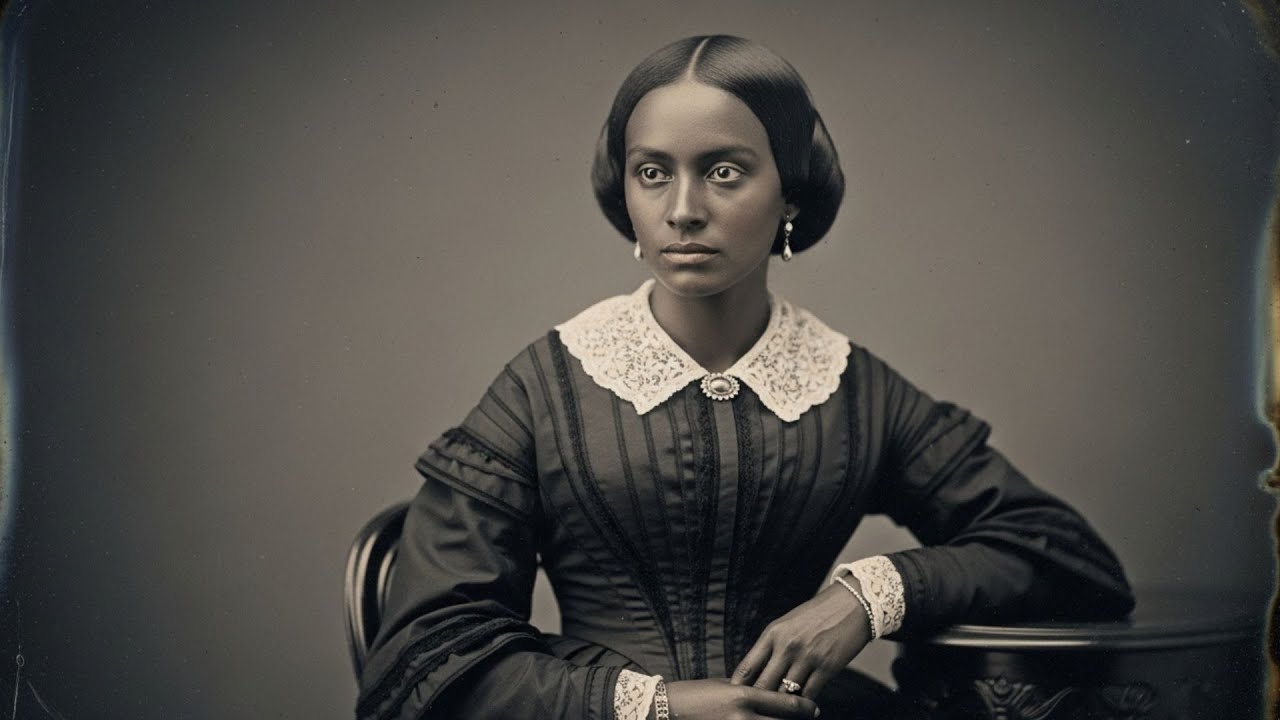
The first mention of the name Sarah appears not in the DuPree plantation records, but in the private diary of Margaret Phillips, the wife of the Episcopal minister whose parish included the DuPree estate. An entry dated July 17th reads: “Called upon Mrs. DuPree today, found her in strange spirits. She introduced a new addition to the household staff, a light-skinned woman called Sarah, who does not possess the manner of one born to servitude.
Mrs. D was peculiarly insistent that Sarah serve our tea personally and observe our conversation. The poor creature’s hands trembled so violently, she nearly broke the China. Mrs.
D seemed to take some satisfaction in this display of nerves. ”
For the remainder of the summer, Sarah’s presence at the estate is documented only through indirect references. The plantation overseer’s weekly reports note that Mrs. DuPree had removed one female from field labor for “household duties of a specialized nature.
” A letter from Elizabeth DuPree to her mother in Charleston mentions acquiring “an accomplished lady’s maid,” but provides no further details. Most tellingly, the seating arrangement for a dinner party hosted by the DuPrees in August showed a placement for “SD” at the far end of the table, a highly unusual position for a servant who would typically not be seated at all. Then, in September of 1854, Charles DuPree began construction on a small but well-appointed cottage approximately one hundred yards behind the main house, separated from the slave quarters by a stand of oak trees. Receipts from Augusta merchants show purchases of furnishings far too fine for slave accommodations: a mahogany writing desk, linen bed sheets, sterling silver candlesticks, even a small pianoforte.
The building, completed in October, appears in no official records, but is referred to in a letter from neighbor William Harrison to his brother as DuPree’s “peculiar new folly. ”
As autumn progressed, the written record of the DuPree plantation grows increasingly disturbing. Elizabeth DuPree, previously a regular attendee at St. Paul’s Episcopal Church, ceased appearing at Sunday services.
Her correspondence with family in Charleston dwindled, with her mother’s increasingly concerned letters going unanswered. Charles DuPree continued to attend to business in Augusta, but acquaintances described him as preoccupied and uncharacteristically abrupt. The most revealing document from this period is a partial diary attributed to Elizabeth DuPree, discovered in 1962 during renovations to what remained of the estate. The diary covers only the period from October 12th to November 23rd, and many pages appear to have been deliberately removed.
What remains paints a portrait of a household in the grip of escalating psychological torment. October 12th. “Charles spends every evening in the cottage. He returns to our bed near midnight smelling of lavender water and something else I cannot name.
When I inquired about his activities, he claimed to be reviewing plantation accounts, though I know the ledgers remain locked in his study. I no longer encounter S in the house. The other servants speak of her only in whispers and fall silent when I approach. ”
October 20th.
“Discovered today that C has given S my grandmother’s pearl earrings. Confronted him in a fury. He claimed it was merely to complete the picture, whatever that may mean, and that they remain his property to dispose of as he wishes, as does she. When I threatened to write to father, he reminded me that everything I possess came to me through our marriage.
I have never seen such coldness in his eyes. ”
October 30th. “The sounds from the cottage last night were unbearable. Not cries of pain, which might almost be understandable, but of what seemed like pleasure.
I sent Wilson to investigate, but he returned claiming he could not approach as C had set the dogs to patrol the path. I have written to mother begging to return to Charleston for Christmas. No reply has come. ”
November 7th.
“C informed me at breakfast that S is with child. He had the audacity to smile as he told me, as if I should share in his satisfaction. When I asked if he intended to sell her, he looked at me with such hatred I feared he might strike me. ‘She is to remain here permanently,’ he said.
‘You would be wise to accept this arrangement. ’ I cannot eat. I cannot sleep. The laudanum Dr.
Wilkins prescribed provides only a few hours of oblivion. ”
The final entry, dated November 23rd, consists of a single line: “I have found a way to end this. God forgive me. ”
On the night of November 24th, 1854, a fire broke out at the DuPree plantation.
According to the Augusta Fire Department report, by the time firefighters arrived from the city, the small cottage behind the main house had been completely consumed by flames. The report notes that despite the proximity, no attempt appears to have been made by plantation residents to extinguish the blaze. The main house suffered only minor damage from windblown embers. The aftermath produced the first major public anomaly.
Rather than appearing in the society pages or local news, the next mention of the family emerges in the financial section of the *Augusta Chronicle*, dated December 3rd: “DuPree Plantation to be sold at auction following the unfortunate demise of proprietor. Inquiries to be directed to J. B. Walton, Esq.
, executor. ” Church records from St. Paul’s Episcopal show funeral services for Charles DuPree held on November 27th. The cause of death is not recorded.
Elizabeth DuPree appears in the *Charleston Mercury* society pages in January of 1855, having returned to her family home following her “tragic widowhood. ” She never remarried and died in 1878, leaving her considerable estate to the Charleston Orphan House, with the peculiar stipulation that it be used exclusively for the care of “female children of fair complexion and good cognitive potential. ”
For over a century, the story of what happened at the DuPree plantation might have remained nothing more than rumors and fragments scattered across public records. No mention was made of any other casualties from the fire.
But in 1958, during the construction of a new county courthouse in Augusta, workers uncovered a sealed metal box in the cornerstone of the old building containing documents preserved from the previous century. Among them was the complete report of an inquest conducted by Richmond County Sheriff Thomas Bowen in early December 1854. The report, marked “sealed by judicial order,” contains testimony from plantation workers and neighbors regarding the events leading up to the fire. Most significant is the statement of Wilson Harris, the DuPree house servant mentioned in Elizabeth’s diary.
Harris testified that on the night of November 24th, he observed Mrs. DuPree entering the cottage shortly after 10:00 carrying what appeared to be a tray with a decanter and glasses. Approximately twenty minutes later, he reported hearing a commotion like furniture being overturned, followed by a lady’s scream, “not of fear, but of rage. ” Harris further testified that within minutes of these sounds, he observed flames beginning to engulf the cottage.
When asked if he attempted to raise an alarm, he stated: “Mrs. DuPree was standing on the back porch of the main house watching. She instructed me to wake no one and reminded me that my wife and children were housed in the North Field quarters. I understood her meaning clear enough.
”
But the most disturbing element of the inquest record is the coroner’s report. Three bodies were recovered from the cottage ruins: an adult male identified as Charles DuPree by his pocket watch and signet ring; an adult female described as young, with features suggesting mixed ancestry, in an advanced state of pregnancy; and a third individual, another adult female, identified by dental records as Elizabeth DuPree. This finding directly contradicts all public records of the time, which clearly document Elizabeth’s return to Charleston. Sheriff Bowen’s handwritten notes on the inquest document suggest a possible explanation: “Evidence indicates the unlikelihood of two Mrs.
DuPrees. Consider the implications of substitution and the remarkable resemblance noted between deceased female and the supposed Sarah. Request examination of Charleston communications for authenticity of handwriting. ”
The investigation was abruptly terminated on December 12th with a notation from the county judge ordering all documents sealed for a period of not less than 75 years, citing concerns for “public moral welfare and the reputation of several prominent families.
” No further legal proceedings are recorded. In 1960, historian Margaret Thornton attempted to locate the remains of Sarah for proper identification and burial. Her research led to the discovery that no burial record exists for the second female victim. According to church records, only Charles DuPree was interred in the family plot at St.
Paul’s. City cemetery records show no documentation for the other bodies from the cottage. Thornton’s research notes, archived at the University of Georgia, contain an interview with Adeline Johnson, aged 96, whose grandmother had worked in the DuPree kitchens. According to family oral history passed down to Johnson: “They didn’t bury the others proper.
The master’s body went to the church yard, but the others, they put in quicklime out past where the old ice house stood. Some said it was to hide the shame of what had been done, but my grandmama, she said it was because they wasn’t sure those women would stay dead. ”
In 1963, a developer purchased the former DuPree plantation land with plans for a suburban housing development. During preliminary surveys, ground-penetrating radar identified an anomaly near the site where the cottage had stood.
Limited excavation revealed a collection of small personal items preserved beneath what appeared to be a deliberately placed stone slab: a tarnished silver hairbrush with the initials “S. M. ”; a miniature portrait of a young woman in the style of the 1840s; and a leather-bound volume containing handwritten poetry. The items were transferred to the Augusta Historical Society, where they remained cataloged but largely unstudied until 1968.
That year, researcher Benjamin Walsh made a startling discovery while examining records of slave transactions in New Orleans. A bill of sale dated May 5th, 1854 documented the purchase of “one mulatto female age 24 answering to Sarah, educated in Paris, formerly ladies companion to Mrs. Marie Devereaux, deceased. ” Price: $1,800.
The buyer was listed as C. DuPree, Augusta, Georgia. What makes this document particularly significant is the notation at the bottom: “Subject represents herself to be born free in Philadelphia, name Sarah Markham, captured and sold unlawfully. Claims verified with Devereaux family but legal status maintained as per Louisiana statutes.
”
The surname Markham, identical to Elizabeth DuPree’s maiden name, suggests connections that move the narrative from merely disturbing to something far more complex. Parish records from Charleston confirm that Elizabeth had an older sister who died at age sixteen nearly a decade before the events in Augusta. That sister’s name was Sarah. A letter discovered in 1965 in the Charleston Historical Society’s collection, written by Elizabeth Markham to her cousin in Baltimore just weeks before her marriage to Charles DuPree, contains a passage that casts a shadow over everything that would follow:
“You ask why I have accepted Mr.
D’s proposal, knowing him to be so much my senior. I cannot speak openly even to you, dearest cousin, but will say only this. There are circumstances in my family that have made me an object of suspicion since childhood. Father has made it abundantly clear that my continued presence in Charleston has become untenable.
Mr. DuPree, whatever his other qualities, has offered a fresh beginning and asked remarkably few questions about my past. Perhaps in his house the whispers will finally cease. ”
The final piece of this fractured puzzle emerged in 1967, when a fire at the Charleston County Records Office led to the emergency removal of documents from a previously overlooked storage room.
Among them was a physician’s report dated September 12th, 1837 regarding the death of sixteen-year-old Sarah Markham. The report notes cause of death as “brain fever following severe melancholia,” but includes a disturbing addendum: “Patient maintained delusion that she was being systematically poisoned by younger sister E. M. age six.
Evidence insufficient to support allegation. Recommend close supervision of surviving child and evaluation of mental constitution at regular intervals. ”
What happened at the DuPree plantation in 1854 appears to have been the culmination of patterns set in motion decades earlier. Did Elizabeth Markham DuPree, haunted by childhood allegations and perhaps her own unacknowledged guilt, orchestrate the purchase of a woman who bore her sister’s name and possibly her resemblance?
Did Charles DuPree, upon discovering his wife’s history, engage in a complex psychological torment by elevating the enslaved Sarah to a position that mirrored or even usurped Elizabeth’s? Was the woman who died in the cottage fire truly Sarah, or had a substitution already occurred, with the real Sarah assuming Elizabeth’s identity and returning to Charleston to live out her days as the grieving widow? The Augusta property where these events unfolded was developed into the Meadowbrook subdivision in 1964. Residents have occasionally reported unusual phenomena: cold spots near certain property lines, the sound of piano music on still summer nights, the lingering scent of lavender and smoke.
The official explanation for the Historical Society’s closure of its DuPree exhibition cited environmental concerns in the display area, but internal memoranda suggest staff had documented at least seven instances of visitors claiming to hear whispered conversations in empty rooms, or feeling what one described as “a presence standing directly behind me, breathing on my neck. ” In 1968, the Society abruptly closed the exhibition following reports that visitors had experienced unexplained physical symptoms after viewing Sarah’s recovered possessions. In 1968, during the installation of a swimming pool at 87 Oak Ridge Drive, workers uncovered a small cache of charred items approximately three feet below ground: the remains of a pearl earring, a silver hairbrush handle, and a child’s porcelain doll with its face deliberately scratched away. The Augusta Historical Society maintains a small exhibition about the DuPree case, though many of the documents mentioned here are no longer available for public viewing.
The curator’s note explains simply: “Removed for conservation purposes. ” Requests to examine these materials are routinely denied. Perhaps most unsettling is the final entry in the accession log for the DuPree collection, dated October 31st, 1968: “All materials related to the DuPree case temporarily removed following break-in. Nothing appears to have been stolen, but items found rearranged in pattern resembling a cradle.
Investigation ongoing. ” No further entries appear, and no record exists of the collection ever being returned to public display. The land where the DuPree plantation once stood has changed hands multiple times since the development of Meadowbrook subdivision, with an unusually high rate of foreclosures and abandoned construction projects. Local real estate agents are reluctant to discuss the area’s history, though several acknowledge offering properties there at prices significantly below market value.
A survey conducted in 1965 found that houses built closest to the former cottage site remained on the market an average of three times longer than comparable properties elsewhere in Augusta. Perhaps the final word on this disturbing episode belongs not to the historians or documentarians who have studied it, but to the last living person who had direct connection to the events. In 1962, just months before her death at age 102, Adeline Johnson was interviewed one last time about her family’s oral history of the DuPree plantation. Her statement, recorded on magnetic tape now preserved in the University of Georgia archives, concludes with these words:
“My grandmama told me something she never told those white men with their notebooks and questions.
She said the night before the fire she was bringing in laundry after dark, and she saw Mrs. DuPree standing at the window of her bedroom looking out toward that cottage. Only then Mrs. DuPree turned her head and looked right at my grandmama and smiled.
And at that exact same moment my grandmama swore she saw another Mrs. DuPree dressed identical right down to the lace at her throat walking the path toward the cottage with a tray in her hands. Two women, same face, same dress, same everything. One at the window, one on the path.
My grandmama dropped her laundry basket and ran. She told no one but her own daughter, my mama, who told me, ‘Some things ain’t meant to be explained by all those papers and records. Some things just are and always will be, and the truth of Sarah DuPree is one of those things. ’”
The historical record falls silent after 1968.
No further excavations have been permitted on the property. No additional documents have surfaced in public archives. The story of Sarah DuPree, her origins, her brief life at the plantation, her terrible end, and the possibility that she somehow continued beyond it, remains one of Augusta’s most disturbing unsolved mysteries, buried beneath layers of Southern propriety, institutional silence, and the passage of time. But in the Meadowbrook subdivision, residents still report that certain houses cannot keep tenants for more than a year.
Gardens planted over a specific section of earth wither, regardless of care. Children avoid a particular stand of old oak trees where the cottage once stood, claiming they hear a woman calling them by names that are not their own. And sometimes, on the anniversary of the fire, November 24th, longtime residents claim to catch glimpses of a woman in 19th-century dress walking between the modern homes, her hands protectively cradling her abdomen, her gaze fixed on something or someone visible only to her. The truth, like Sarah herself, remains elusive.
A ghost story built on fragments of documented fact, a whispered name that echoes across centuries, a mystery that continues to resist all attempts at final resolution.
