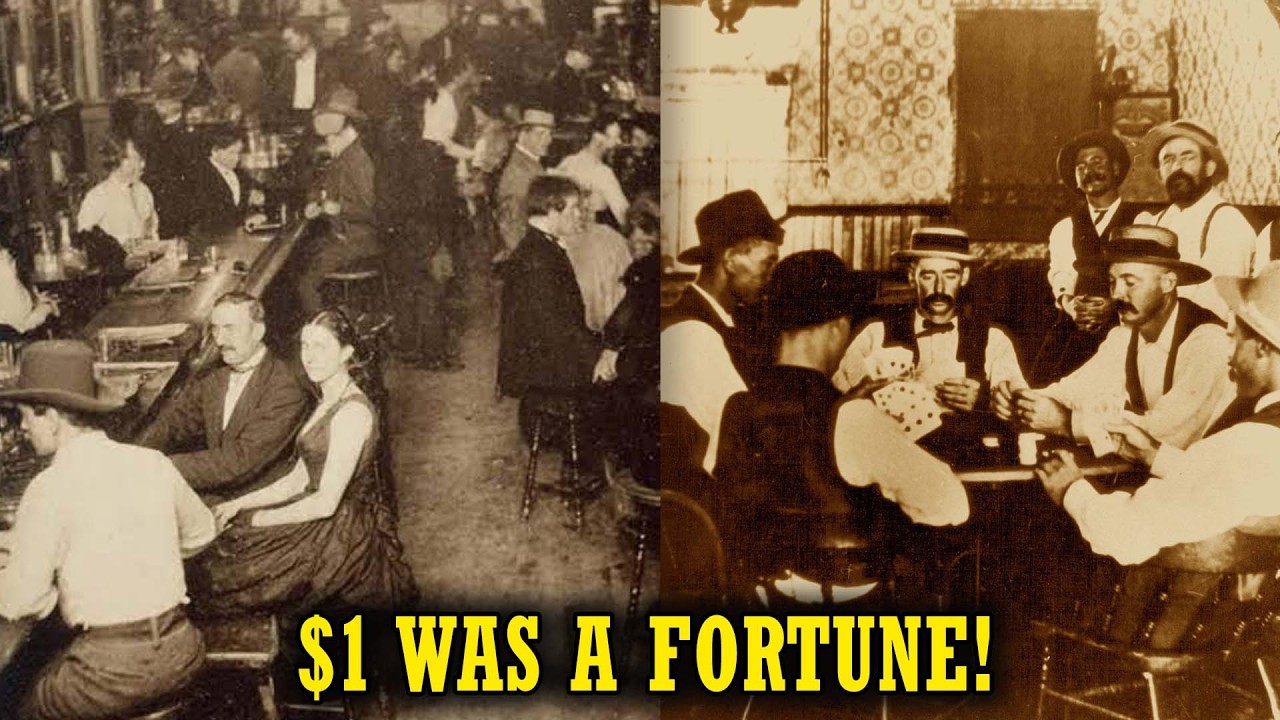
A silver dollar clattering onto a saloon bar in the 1880s American West was not pocket change. The men who threw it down had often worked a full day to earn it. A trail hand driving longhorns up the Chisholm Trail from Texas to the railheads in Kansas typically earned between twenty-five and forty dollars a month, with meals thrown in from the chuckwagon. That works out to roughly a dollar a day for fourteen hours or more in the saddle, breathing trail dust, sweating through summer heat, crossing swollen rivers, and keeping a spooked herd calm through the night.
A skilled carpenter might make about two and a half dollars a day around 1880, while boomtowns like Tombstone and Deadwood paid more; silver miners in Tombstone could earn about four dollars a day, though living costs there ran brutally high. Ordinary laborers made closer to a dollar and a quarter or a dollar and a half. At the bottom stood the frontier soldier, who in 1880 drew a base pay of just thirteen dollars a month. Even with food, shelter, and uniform provided, a trooper needed more than two days of patrols, drills, and horse care at some remote post to earn a single dollar.
When that cowboy rode into Dodge City, or that soldier walked out of the fort on payday, the money in his hand represented long days, aching muscles, and calloused fingers. Stepping from the bright prairie sun into a dark, smoky, noisy saloon, that dollar felt like a ticket to a few hours of relief. The question was how far it would stretch in a place run by sharp bartenders, crooked dealers, and businesses built to drain a man dry. The first stop for any thirsty traveler was always the bar.
If he wanted that hard-earned dollar to last, he did not order fancy imported liquor. He looked at the board on the wall and chose the workingman’s favorite, the nickel beer. In many saloons of the 1880s, especially in the cattle towns of Texas and Kansas and across much of the Midwest, five cents bought a glass of fresh beer. At that price, a dollar bought twenty glasses.
Prices varied, though. In remote mining camps and Pacific coast towns like Virginia City, Nevada, where nickels were scarce, the bit, worth twelve and a half cents, was the common coin. A drink often cost a bit or even a quarter. The same dollar might buy only four to eight glasses of beer there.
Anyone used to modern prices might call twenty beers for a dollar a dream, but drinking beer on the frontier was different in ways that mattered. Ice was a real nineteenth-century business, harvested from frozen lakes and stored in icehouses. By the 1880s, railroads and new refrigeration techniques brought cold beer to more towns, and saloons that had it advertised it as a major draw. In isolated places far from rail lines, ice was scarce and expensive.
On a hundred-degree July afternoon in Arizona Territory, a nickel bought beer that was at best cellar-cool and at worst lukewarm. Freshness was another problem. Brewers like Anheuser-Busch began pasteurizing bottled beer in the 1870s and shipping it in refrigerated rail cars, but keg and barrel beer had no such protection. Many saloons relied on regional breweries, and a barrel exposed to summer heat could turn sour quickly.
To rescue a barrel that had started to go acidic or lost its fizz, some saloon keepers secretly treated it. Nineteenth-century writings on food and drink adulteration described the practice of adding baking soda to sour beer to mask the bitterness and restore some head. It was a known trick of the trade, even if customers were not supposed to notice. The nickel beer was the core of the saloon business.
Customers were not just paying for the drink. They were paying for time and a place to belong. A single nickel bought a cowboy or miner a seat at a table, shelter from sun or wind, a chance to read a newspaper from the East, and a few hours of conversation without the bartender asking him to leave. For a man who paced himself, that one dollar covered twenty separate visits, which meant weeks of companionship in a lonely land.
But as many customers quickly learned, saloon keepers had a clever plan to make sure a man did not leave after spending just one nickel. When twenty glasses of lukewarm beer were not enough to wash away weeks of trail dust, a cowboy might catch the bartender’s eye and order something stronger. In many saloons of the 1880s, a shot of local whiskey cost between ten and twenty cents. In far-off mining camps and Western cities, a quarter was common, which meant a dollar bought only four drinks.
In cheaper cattle town saloons, the same dollar might stretch to eight or ten drinks. To the customer, that seemed a fair price for a quick warm glow. But unless he was drinking in a fine hotel bar serving genuine aged Kentucky bourbon, there was a good chance his money was buying something very different from what the label promised. Before the Bottled-in-Bond Act of 1897 and the Pure Food and Drug Act of 1906, almost no federal rules governed what went into a bottle sold as whiskey.
Much of the liquor sold in the West came from rectifiers, wholesale dealers who bought cheap neutral grain spirits, often up to ninety-five percent alcohol, and blended them to imitate aged whiskey. Some saloon keepers did the same in their back rooms, watering down the spirits and adding ingredients to mimic the color, smell, and taste of the real thing. Frontier patrons gave this concoction colorful names: gut-rot, snake poison, spider juice. Nineteenth-century bartender manuals and druggist recipe books show how it was done.
Burnt sugar, or caramel, along with molasses or prune juice, turned clear spirits into a rich amber hue that looked like it had spent years in an oak barrel. Color was only the beginning. Real aged whiskey had a distinct warmth and depth of flavor, so imitators added ingredients to create a sharp burn. Trade whiskey recipes sold on the northern plains, often traced to the Fort Benton trade in Montana, mixed alcohol and water with red pepper, ginger, chewing tobacco, and molasses.
Here the history gets murkier. Popular stories claim saloon keepers regularly added strychnine, sulfuric acid, kerosene, or lead acetate, known as sugar of lead, to give whiskey an extra kick or a sweeter taste. Some of these substances do appear in era accusations and warnings about adulteration, and lead compounds had a long history of being used to sweeten cheap wine. Yet historians have found little strong evidence that the more extreme additives, especially strychnine, were common practice.
Many of these tales were likely exaggerated by anti-alcohol campaigns and later storytellers. What is certain is that bad, strong liquor left its mark. A dollar’s worth of that rotgut could bring on a stomach ache, a nasty headache, and a miserable morning after. That potent and unpredictable drink also explains how a quiet evening in a saloon could turn rowdy fast.
A few glasses of high-proof spirits clouded a man’s judgment and turned a peaceful farmhand into a loud, belligerent troublemaker. This was one reason towns like Dodge City and Abilene hired marshals and passed strict local ordinances to keep order. Interestingly, historian Robert Dykstra’s research on Kansas cattle towns found serious trouble was rarer than Hollywood portrays. But the reputation of spider juice was earned just the same.
By the 1880s, the free lunch had become a familiar part of American saloon life, especially in big cities like Chicago, New Orleans, and San Francisco. Many saloons in Western towns offered their own versions, usually simpler ones. The idea was easy to grasp. Buy one drink, even a five-cent beer, and help yourself to what was laid out on the lunch table.
Depending on the place, that might mean ham, salt beef, cheese, crackers, pretzels, pickles, hard-boiled eggs, or pickled herring. At first glance it seemed an unbeatable deal. In many towns, a meal at a restaurant cost between twenty-five and fifty cents. A hungry cowboy could fill his belly for the price of one beer.
It looked like the perfect way to make one dollar cover both food and drink all day. In practice, though, free was not exactly free. Saloon keepers were running a business, and the food counter was one of their cleverest sales tools. There were practical reasons the menu leaned heavily on salty preserved foods.
Salted meats, pickles, and pretzels were cheap and kept without refrigeration. They also made people thirsty. Historians of the saloon, including Madelon Powers in her study of working-class bar culture, described the free lunch as a way to draw customers in and keep them drinking. A man might walk in intending to spend five or ten cents on a quick drink and a bite, but after a few slices of salty ham and a handful of pickles, that one glass of lukewarm beer no longer seemed nearly enough.
Before long he was back at the bar for another round, and then another. Bartenders watched the food counter closely too. The unwritten rule was roughly one plate per drink. Anyone trying to eat a full meal without buying more could expect to be asked, politely or not, to order something or leave.
A planned five-cent stop quietly grew into an evening of steady spending. By sundown, the silver dollar a cowboy had hoped would last him days in town had settled into the saloon’s cash drawer, all because he could not resist a free meal. The old saying that there is no such thing as a free lunch traces back to this very custom. The saloon food counter proved that a good deal usually came with a hidden catch.
While most workingmen spent their dollars on salted meats and rounds of cheap saloon whiskey, frontier saloons also served a wealthier crowd. When a prospector hit a rich vein of ore or a rancher closed a big cattle sale, he wanted everyone in the place to notice. He had no interest in the cheap blended whiskey served to others. This was his moment to celebrate in style.
In the finest saloons of boomtowns like Virginia City, Leadville, or Denver, the good stuff came at a steep price. A glass of top-shelf liquor could cost several times as much as local whiskey, and fancy celebrations often featured imported champagne, which sold for several dollars a bottle. Since a dollar was roughly a full day’s wage for a trail hand, spending that much on a single round was a showy act, like ordering a bottle worth a day’s pay at a fine restaurant today. What did that extra money buy?
Genuine aged Kentucky bourbon was often shipped west by rail after the transcontinental line was completed in 1869. Not every town sat on that line. Montana, for example, did not get a transcontinental connection until the Northern Pacific arrived in 1883, so early shipments often came by steamboat up the Missouri River to Fort Benton before continuing by wagon. Imported spirits made an even longer journey, crossing the ocean to an American port before heading west by train and finally by freight wagon.
French cognac was especially prized during the 1880s, partly because the phylloxera insect had devastated France’s vineyards, making genuine cognac rare and expensive. Scotch whisky, on the other hand, did not gain wide popularity in America until later in the century. For the customer willing to pay more, the whole experience changed. The best saloons boasted polished mirrors, carved back bars, chandeliers, and fine glassware instead of thick heavy tumblers.
Many also had quieter club rooms or upstairs parlors for card games and private gatherings, furnished with comfortable chairs and polished tables, a welcome escape from the noise and crush of the main bar. A man could also take his whiskey with him. Branded bottled whiskey grew in popularity, with names like Old Crow carrying a reputation for quality. A quart of good bottled whiskey might cost a dollar or more, depending on how far it had traveled.
Even bottles were not safe from tampering, though. Refilling branded bottles with cheaper whiskey was a known swindle, and Old Crow itself fought constant battles against counterfeiters. Reliable government assurance did not arrive until the Bottled-in-Bond Act of 1897, which placed a federal stamp over the bottle cap. Some cowboys tucked a bottle into their gear before heading to a remote camp, where a little warmth could see them through a cold prairie night.
Many ranches and work crews strictly banned alcohol on the job. Cattleman Charles Goodnight famously forbade drinking during trail drives. A bottle on the range was often a quiet, carefully guarded pleasure. Once a man had his drink, his attention usually turned to the back of the saloon, where the gambling tables drew the biggest crowds.
If you picture cowboys hunched over Texas Hold’em, that is Hollywood imagination again. Hold’em did not appear until the early twentieth century. Poker was certainly played in the 1880s, but the most popular game on the frontier was faro. Faro was everywhere in the West, attracting players of every kind, from miners and ranch hands to some of the era’s most famous figures.
Wyatt Earp dealt faro at the Oriental Saloon in Tombstone, and dentist-turned-gambler Doc Holliday earned much of his living at the faro table. Playing the game was called bucking the tiger, after the tiger image often painted on faro boxes and hung outside gambling halls. A dollar was enough to buy some chips and join in, but it was also a fast way to lose money. Part of faro’s appeal was that it looked fair.
Players did not compete against each other. They bet against the house on which cards would come out of a special dealing box next. Every card played was tracked on a beaded wire counter called a case keeper so everyone at the table could see what remained in the deck. In a fair game, the house advantage came mainly from splits, when two cards of the same rank appeared in a round and the dealer collected half the bets on that rank.
This gave the house an edge of only about two percent, among the lowest of any casino game even by modern standards. At a table with a twenty-five-cent minimum, a dollar covered four bets. With a little luck, a player might stretch his stake for an hour or two, sipping his drink and soaking in the excitement of the room. The problem was that fair games were often hard to find.
Because the natural house edge was so small, many dealers found ways to improve their odds. In his 1890 book Gamblers and Gambling, reformed gambler John Philip Quinn exposed many of the tricks used to cheat players, and many writers of the era warned that crooked faro games were common. The most notorious trick was the crooked dealing box. From the outside it looked like any ordinary box, but some were built with hidden springs and secret mechanisms.
With a slight press of his thumb, a dishonest dealer could deal two cards at once or hold back a card that would have paid players. These crooked boxes were not just homemade contraptions either. Gambling supply companies like Will & Finck in San Francisco openly sold cheating equipment through their catalogs. Playing cards could be rigged as well.
In a deck of strippers, the edges of certain cards were trimmed slightly so the dealer could identify them by touch. In a deck of sand-tells, one side of the cards was roughened so they stuck together, letting the dealer draw two cards as one. So when a cowboy put his dollar on a crooked faro table, he was not really playing a game of chance. He was walking into an elaborate scam run by a skilled dealer, where his four bets could vanish within a few turns of the cards.
Because the game was fast and exciting, a man who lost his first dollar often reached for another and then another, until a good portion of his monthly pay sat in the house safe. If a man preferred to test his wits against the men across the table rather than trust the dealer’s brass box, he avoided faro and looked for a poker table. Faro was a quick contest against the house. Poker in the nineteenth century, usually five-card draw or the newer stud game, was a slower, more deliberate duel between the players themselves.
For a cowboy or miner with only a dollar, sitting down at a poker table was a real gamble. It could begin a memorable night of good luck or leave him empty-handed before he finished his first drink. Stakes varied greatly from saloon to saloon. In a modest workingmen’s game, a quarter-dollar bet was common, which meant a single dollar covered only four bets.
In a drop game, the ante typically rotated among the players rather than being paid by everyone each round. A cautious player who folded weak hands and picked his moments wisely could make that dollar last a good while. Playing with such a thin stake was nerve-wracking. With only a few betting units, a player had no margin for a bold bluff or to ride out a run of bad cards.
Seasoned gamblers, known then as sharpers, quickly noticed a newcomer with a limited bankroll. With their larger stacks, they could raise the stakes early in a hand and pressure the cautious player into folding, leaving his ante behind. How much protection a small player got depended on the saloon’s rules. Many games were played table stakes, meaning no one could bet more than he had in front of him, and a player with a small stack could stay in a hand for what he had.
In games without that rule, a wealthier opponent could simply bet him out, and the poorer player had no choice but to fold. The saloon itself usually profited too. Although the house did not play against customers, many establishments took a small cut from each pot, called the take or the rake, or charged players for new decks of cards. Over a long evening, those small charges added up and gradually shrank the money on the table.
Then there was outright cheating. Nineteenth-century gambling exposé writers, including John Philip Quinn, described partners working together at the table, signaling the strength of their hands through gestures, coded words, or the placement of a cigar or stack of chips. Some cheats used marked cards sold openly through gambling supply catalogs, or palmed a prearranged deck into the game. In 1888, a San Francisco card cheat named P.
J. Kemplinger was exposed for using a hidden mechanical device concealed in his clothing that could secretly change cards in his hand. If a man somehow left the faro and poker tables with his dollar still in his pocket, he faced one last temptation: the saloon girls. Hollywood often portrays them either as glamorous stage performers or as wealthy independent businesswomen.
The historical record paints a more realistic picture. For many saloons and dance halls, these women were essential to the business, hired to keep customers entertained, dancing, and most importantly, drinking. Dances were usually sold by ticket or token, with prices varying by place and time. In the gold rush camps of the 1860s and in some later boomtowns, a dance might cost a dollar, while in other halls it was a quarter or fifty cents.
In either case, the dance itself was just the beginning of the spending. Why would a man pay a good part of his daily wage for a few minutes on a sawdust-covered floor? Much of the answer lies in the demographics of the West. The 1880 census showed men outnumbering women by nearly two or three to one in territories like Montana, Wyoming, and Arizona.
In mining camps and cattle towns, the imbalance could be even greater. A cowboy might spend two or three months on the trail with no company but cattle and fellow riders. Stepping into a warmly lit saloon and enjoying a dance, a little conversation, and the scent of perfume felt like rare pleasure, one many men were glad to pay for. Saloon girls were usually paid on commission.
When a customer bought a dance ticket or a drink, the woman often received a token or brass check, which she redeemed at the end of the night for her share of the money. The saloon kept the rest to cover costs and make a profit. For the women, this income was significant. A popular, hardworking dance hall girl in a boomtown could earn more in a single night than many workingmen made in several days, and sometimes more than schoolteachers or seamstresses made in a week.
But that money depended entirely on keeping customers dancing and drinking, and the work meant long, exhausting nights on their feet. The real profits came after the music stopped. In many places, a man was expected to escort his partner to the bar and buy her a drink as soon as the dance ended. A man who skipped this step might find the women far less eager to dance with him next time.
The drink he ordered for her was usually priced like liquor, often twenty-five cents or more, but the bartender typically poured cold tea, colored water, or a weak substitute so she could keep working all night. Meanwhile, the cowboys usually ordered whiskey for themselves too. By the time he stepped away from the bar, his dollar had evaporated, split between the saloon’s till and the dancer’s commission, while she was already greeting the next customer, waiting his turn. After a long night of cheap whiskey, card games, and dancing, a man finally needed a place to sleep.
A traveling cowboy, a newly arrived laborer, or a prospector without a cabin of his own usually could not afford a private room in a good hotel. Instead, he looked for the cheapest bed in town, sometimes that meant a room above the saloon, where some saloons rented out sleeping spaces alongside the common boarding houses and modest frontier hotels. Prices depended heavily on the town and how crowded it was. In many places, a bed or a share of a bed in a basic boarding house cost between twenty-five cents and a dollar.
In crowded boomtowns, a dollar was a common price. To the modern traveler that sounds like a bargain, but travel memoirs from the period make clear that this sum bought little comfort. To begin with, you often were not paying for a whole bed. Sharing a bed with strangers was a normal part of nineteenth-century travel, not just on the frontier but in inns across the country.
In crowded towns, a lodger might find himself lying shoulder to shoulder with one or more unwashed travelers he had never met. During the silver rush in Leadville, Colorado, around 1879, lodging was so scarce that some inns rented beds in shifts. A man might crawl into a bed someone else had just left. The beds themselves were crude.
Instead of feathers, mattresses were usually canvas bags stuffed with straw, corn husks, or dried grass that rustled and shifted with every turn. Cleanliness was another problem. Sheets, if any, were not always washed between guests, and many men slept in their clothes under a heavy wool blanket already used by countless previous travelers. Not surprisingly, vermin were a constant complaint.
Travelers often grumbled in diaries and letters about bedbugs, lice, and fleas lurking in the bedding and woodwork. A man paid for a restful night and spent hours itching, listening to the snoring, coughing, and sleepy mutterings of the men around him. Theft was a real concern too. In a room full of strangers, a sleeping traveler’s belongings were an easy target.
Many men kept their boots on or tucked them under their heads as pillows, hiding whatever coins or pocket watches remained deep in their clothing to keep them safe until morning. In the end, a dollar spent on a shared bed above a saloon was not about luxury. It was simply the price of a roof overhead and shelter from the cold night air. After weeks on the trail or months working in dusty mines, a man not only smelled of horses and dirt; he looked as rough as the country he had been living in.
Before heading to a gambling table or asking someone to dance, he usually wanted to clean up and feel human again. For a man caked in layers of trail dust, a dollar could buy a complete overhaul: a hot bath, a shave, a haircut, and a splash of bay rum cologne to finish. These services were usually found at a barber shop or bathhouse, sometimes part of a hotel or located on the same street as the saloons. The barber was a kind of transformation specialist, and that dollar was a man’s ticket to a fresh start.
Prices varied from town to town, but advertisements in frontier newspapers, such as the Black Hills Pioneer of Deadwood, show that baths, shaves, and haircuts were standard services with posted prices. In many places, a dollar went something like this. The hot bath, at about fifty cents, was the centerpiece. In the absence of indoor plumbing, the attendant hauled water bucket by bucket, heated it on a wood stove, and filled a large tin or zinc tub in a private room.
Paying full price usually meant getting fresh hot water to yourself. Popular stories suggest that customers who paid less sometimes had to make do with water someone else had already used. In crowded bathhouses, that was not out of the question. The haircut, at about twenty-five cents, cleared away months of thick matted hair.
Barbers relied on scissors and combs, and hand-cranked mechanical clippers were just beginning to appear in American barber shops in the 1880s. A shave typically cost ten to fifteen cents. The barber worked up a rich lather with a brush and shaving soap, laid a hot towel on the customer’s face to soften the whiskers, then carefully ran a sharp straight razor over cheeks and chin until weeks of beard were gone. The remainder of the dollar went to the finishing touches: a mustache trim, perhaps a scalp massage with tonic, and a generous splash of bay rum, the pungent cologne made from bay leaves and rum long imported from the Caribbean.
Some barbers also offered witch hazel, a soothing astringent often used after shaving. When a cowboy finally rose from the barber chair, he looked and felt like a different man. It was not just vanity. A clean, well-groomed man made a better impression on bartenders, hotel clerks, and potential dance partners, and he could expect to be treated as a respectable customer rather than a trail-worn drifter.
Most of what a man bought in frontier saloons did not last. Once the drink was gone, the bet lost, or the beard grown back, he had nothing to show for it. But a dollar could also buy something lasting. In the 1880s, that included a small, inexpensive pistol.
A traveler worried about his safety on a dark wagon road, or a card player feeling tense after a heated game, did not need to save fifteen or twenty dollars for a quality revolver like a Colt single-action. Instead, he could buy a cheap pocket pistol for a dollar or two. Today collectors call these guns suicide specials. From about 1870 into the 1890s, small companies, most of them in Connecticut and Massachusetts, produced them by the hundreds of thousands.
Firms like Hopkins & Allen and Forehand & Wadsworth sold these pistols under catchy trade names like Tramp’s Terror, Little Jim, and Blue Jacket. They were sold through hardware stores, general stores, and mail-order catalogs, often for a dollar or two, sometimes less. The famous nickname was not actually coined in the nineteenth century. Gun writer Duncan McConnell is usually credited with popularizing it in a 1948 article in American Rifleman, describing these pistols as cheap and of questionable quality.
The exact meaning of the name has been debated ever since. What is clear is that they were built to be low cost. Manufacturers kept prices down through simple designs, cheap soft iron or metal, and loose manufacturing standards. Many had small folding triggers with no trigger guard and were chambered for small, low-powered rimfire cartridges.
Their bad reputation for unreliability was well earned. Parts wore out quickly, mechanisms broke easily, and the short barrels, often only two or three inches long, made them inaccurate beyond very close range. Later stories claimed they blew up dramatically when fired. Historians point out that the bigger problems were poor durability and generally shoddy workmanship.
Their small size was a large part of their appeal, easily slipped into a coat pocket. That also made them controversial. Many cattle towns, including Dodge City and Tombstone, passed ordinances requiring visitors to surrender their firearms upon arriving in town and banning concealed weapons outright. Carrying one of these pocket pistols into a saloon was therefore often against local law.
On the frontier, the saloon was often far more than a place to drink. In remote mining camps, new railroad towns, and isolated cattle settlements, government buildings were scarce or nonexistent. There might be no courthouse, no city hall, no church yet, so the saloon often became the town’s default gathering place. Saloons hosted Sunday church services, served as polling places on election day, and hosted coroners’ inquests and court sessions.
In some towns, the saloon keeper himself took on public roles, such as postmaster or elected justice of the peace. That meant a couple who wanted to marry did not always have to wait for a traveling preacher to pass through town. If a justice of the peace was available, even one who poured drinks for a living, they could often marry on the spot. The most famous example was Judge Roy Bean, the self-styled law west of the Pecos.
Beginning in 1882, Bean served as justice of the peace in Langtry, Texas, while running his saloon, the Jersey Lily, where he held court and performed marriages. He also reportedly issued divorces, something he had no legal authority to do. To the modern mind, the idea of marrying between drinks seems almost unbelievable: no long planning, no waiting periods, no marathon of paperwork. But marriage laws in the nineteenth-century West were mostly simple.
Depending on the state or territory, a couple might need a license from the county clerk and a ceremony performed by an authorized official. Justices of the peace charged modest fees, often only a few dollars. Many places also recognized common-law marriage, meaning a couple living together and presenting themselves as husband and wife could be considered legally married even without a ceremony. A wedding at a saloon was quick and informal.
The justice filled out the certificate, the bartender or a customer signed as witness, and the whole ceremony might be over in minutes, followed most likely by a celebratory round of drinks. As with many quick deals in a saloon, these marriages did not always last. Some couples married in haste, while others entered practical arrangements for companionship or financial security. On the frontier, where people were constantly moving, leaving was easy.
A young man might marry, live with his new wife for a while, then move on when his luck ran out without bothering to get a formal divorce. Record keeping across remote towns and territories was spotty and irregular. It was also possible for a man to marry in the West while still having a wife back East. Cases of bigamy did appear in frontier court records and newspapers.
In fact, when the United States government compiled nationwide marriage and divorce statistics for the years 1867 to 1906, the Western states consistently recorded some of the highest divorce rates in the country. While a man weighed his options inside the saloon, deciding between a few shots of whiskey and a ticket for a quick dance, he could not forget the animal tied up outside. On the frontier, a horse was not a luxury. It was a tool of the trade, a means of making a living, and often the only way to get from one place to another across vast empty country.
Leaving a tired horse tied to a fence for hours in summer heat or a freezing mountain night could seriously harm the animal and leave its rider stranded. For that reason, a wise rider often made the livery stable his first stop, even before ordering a beer. For a fee, the stable would shelter, feed, and care for his horse while he enjoyed his time in town. Livery prices varied greatly from town to town and season to season.
In cattle towns like Dodge City, Ogallala, and Miles City, stabling a horse for a day might cost anywhere from twenty-five cents to a dollar, depending on the services included and how crowded the town was. A dollar for full service might cover something like this. The largest part went for shelter and bedding: a covered stall with a fresh layer of straw where the horse could finally rest its legs after long days of travel. Another substantial portion went for feed.
A working horse needed plenty of fuel, so good stables provided a generous ration of hay, usually timothy, along with a portion of oats. Hay provided the horse’s basic diet, while oats added concentrated energy for a hard-working animal. Water was included too. Stable hands hauled or pumped fresh water so the horse could drink its fill throughout the day, especially important after a dusty journey.
The remainder covered grooming and basic services. A stable hand might brush off dried mud and sweat with a stiff brush, pick gravel from the hooves, and make sure the horseshoes were secure. Notably, many trail cowboys did not actually own the horses they rode. On cattle drives, each rider usually worked with a string of horses that belonged to the ranch herd, known as the remuda.
Cowboys often owned their saddles, but not their horses. When a drive ended near a cattle town, the crew usually camped outside town with the herd and horses, taking turns going inside to spend their pay. For a cowboy who owned his horse, or was responsible for a company horse, paying for good stabling took a real chunk of his wages. A dollar was close to a full day’s pay, the same money that could buy several whiskeys or a long evening of cheap beer.
Whiskey and gambling got most of the attention in frontier saloons. But another habit kept the cash drawer busy too: tobacco. In the 1880s, tobacco was a near-constant companion for many men, especially those working long lonely stretches on the trail or long shifts underground in the mines. People generally believed smoking or chewing calmed the nerves and eased hunger, and the strong smell helped mask the unpleasant odors of crowded rooms, unwashed travelers, and towns without proper sanitation.
Many saloons sold tobacco right at the bar alongside the general stores and tobacco shops in town. Prices varied by place and brand. But in an era of cheap tobacco, a dollar could buy enough to last days or even weeks. Cigars were a cheap favorite among workingmen.
At about five cents apiece, a dollar bought around twenty cigars. The long, thin stogies, named after the Conestoga wagon drivers in Pennsylvania who supposedly favored them, and open-ended twists were simple, inexpensive smoking options. Contrary to the mental image of factory-made cigars, most cigars of that era were rolled by hand, often in large urban workshops; cigar-making machines did not become widespread until the early twentieth century. For a man celebrating a big win or a profitable cattle sale, a quarter or more could buy a fine imported Havana cigar from Cuba.
Upscale saloons and first-class hotels kept these luxury brands carefully behind the counter, and lighting one up was an easy way to show off success. Pipe smokers had plenty of affordable options. Smoking tobacco came in small cloth bags, and Bull Durham, made in Durham, North Carolina, from bright leaf tobacco, was one of the most famous brands of the period. Those same bags were also popular among men who rolled their own cigarettes.
Depending on the brand and region, a dollar bought a large quantity of loose tobacco. Chewing tobacco might have been the most popular choice of all. For most of the late nineteenth century, chewing was the most common form of tobacco use in the United States. It left a man’s hands free for roping, riding, or swinging an axe, making it ideal for workingmen.
Chewing tobacco came in pressed, dense plugs, often sweetened with molasses or licorice. A cowboy could cut off a small piece with his knife whenever he wanted a chew. Plugs were often sold for five or ten cents, so a dollar could supply a man for weeks. Tobacco had its own customs in the saloon.
Chewers were expected to use the brass spittoons placed around the room. Missing the spittoon, especially if it stained the floor, the bar, or another man’s boots, was considered crude and could sour a mood quickly. In the decades that followed, concerns about tuberculosis led many towns to pass laws banning spitting in public places. Like the salty free lunches, tobacco may also have helped keep customers in the saloon.
A smoke-filled, stuffy room could make a man thirsty, and a cold beer or a shot of whiskey was always close at hand. For the saloon keeper, tobacco was a profitable, steady commodity that kept customers lingering and spending, a cigar or a chew at a time. Cheap beer, strong whiskey, and crooked gambling made for a combustible mix, and Hollywood would have us believe trouble in frontier saloons was inevitable. The real picture was more complicated.
Crowded rooms of tired, drunken men with bruised pride certainly produced their share of sharp quarrels; a careless remark or an accusation of cheating at cards could turn a quiet evening into loud noise. But the idea of lawless towns where anything went is largely a myth. Robert Dykstra’s research on Kansas cattle towns found that serious incidents were far rarer than the movies suggest. Many of these towns were run by businessmen who wanted order because rowdy behavior was bad for trade.
A man whose wild night got out of hand did not just wake up with a headache. He often ended up before the local judge. Most minor disturbances were handled in police court, and fines for offenses like drunkenness, disorderly conduct, or disturbing the peace were among the most common cases on the docket. The amounts varied by town, but a fine of a few dollars plus court costs was customary, and some minor cases drew fines of only a dollar or two.
Emerging towns like Tombstone in Arizona Territory and Deadwood in what was then Dakota Territory could not afford to keep many people in jail for long. A quick fine was simpler and cheaper than housing and feeding prisoners. A town marshal or his deputy might escort a rowdy customer to the local justice of the peace or police judge, who in some towns held court in a rented room, a store, or even a saloon. After a short hearing, the offender paid his fine and court costs and went on his way.
For a working cowboy, even a modest fine stung. Paying a few dollars might mean giving up several days’ wages for a moment of lost temper. Penalties rose quickly when things got more serious. Many cattle and mining towns banned the carrying of firearms within city limits altogether, requiring visitors to check them at a hotel, stable, or saloon upon arrival.
Tombstone’s famous 1881 ordinance, for example, prohibited carrying weapons in town, and violating these rules drew fines far heavier than a simple disturbance. Property damage was another expense. A saloon keeper who had invested in fine furnishings expected to be compensated. Large bar mirrors and carved woodwork were usually shipped from the East at great cost, so breaking one could cost a man far more than a month’s wages.
For the towns themselves, this system also helped pay the bills. Dykstra found that cattle towns like Dodge City and Abilene relied heavily on fines and periodic license fees collected from saloons, gambling halls, and other businesses serving visiting cowboys. That money helped pay the salaries of the marshal and his deputies and funded civic improvements. For the cowboys, the fine was a harsh lesson in the cost of losing their temper.
In the Old West, even a moment of poor judgment came with a price. In the Old West, a dollar could buy far more than we might expect today. But for the men who earned it, that coin often represented hours of exhausting labor. Every purchase at the saloon, the nickel beer, the shot of rotgut whiskey, the free lunch that was never really free, the faro bet, the dance ticket, the shared bed, the hot bath, the cheap pocket pistol, even a wedding performed by a saloon-keeping judge, carried the weight of that labor.
The saloon was built to make that dollar disappear, and it usually succeeded. Yet for the cowboy, miner, soldier, or drifter who walked through the batwing doors, that single silver coin was the price of admission to the only entertainment, comfort, and human connection the frontier had to offer.
