The clippers move across your skull in one unbroken motion, and within seconds the hair that made your head look like your own is piling up on the floor around the chair. The man holding the clippers does not slow down. He does not look at your face, because yours is the two hundredth head he has done today, and there are two hundred more stacked up behind you. You watch a stranger with your haircut get up from the chair ahead of you and walk away.
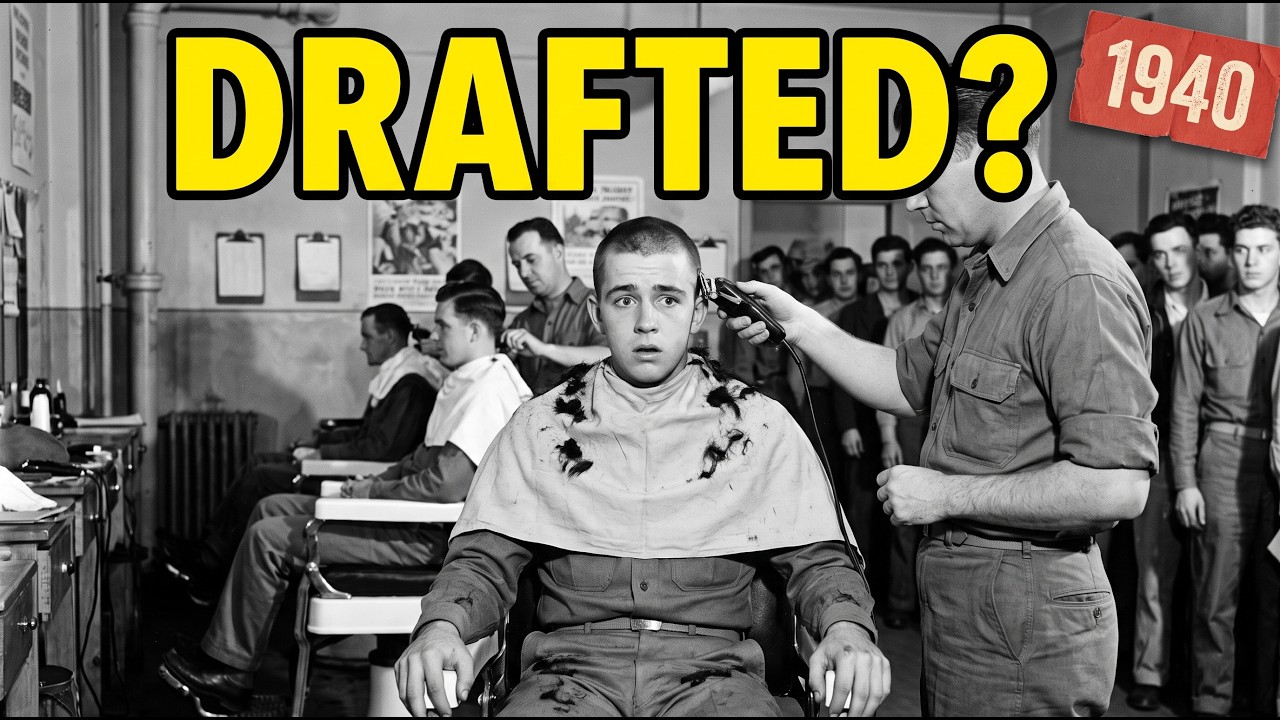
Then it is your turn, and ninety seconds later you are that stranger. This morning you woke up as yourself—a name, a face, a life with a particular shape to it. By tonight, you will be something else, something the country needs far more than it needs you to keep being you. This is your first day in the army, and the whole point of this day, though no one will say it out loud, is to begin taking the old you apart.
This is the morning the war really started for most of the men who fought it. Not on a beach, not in a plane, not in a foxhole, but in a line in a drab building in their own hometown or the next town over, holding a letter. Beneath the battles and the medals, there was a bureaucratic machine the size of the whole country, and its one job was to reach into ordinary life, pick a man out of it, feed him in at one end, and push a soldier out the other. What happened to you on that first day inside that building is the part nobody makes movies about.
And it says more about how a free country turns its sons into an army than any battle ever could. It began with a letter, but the machine that sent it had been built a year before the shooting ever reached America. In 1940, with Europe already burning, the government did something it had never done in peacetime: it passed a law requiring every young man to register for the draft. The idea was bitterly controversial.
The country had spent twenty years swearing off foreign wars, and conscription in a time of peace struck a great many Americans as the sort of thing European dictators did, not something a free republic should do. The law passed over loud objection. The following summer, with the first draftees’ single promised year nearly served and the men packing to go home, Congress voted to keep them in uniform. That extension passed the House of Representatives by exactly one vote.
Grown men counting down the days to their discharge learned they were staying in by a single vote, months before the country was even attacked. Nearly fifty million men would eventually sign their names on registration cards at little tables set up in schools and post offices, handing the government a list of almost every man of fighting age in America. And then, so no one could call it rigged, they held a lottery. In a hall in Washington, thousands of small capsules, each with a number inside, were poured into an enormous glass bowl.
A blindfolded official reached in—the blindfold, as it happened, cut from a strip of cloth taken from a chair that had stood at the signing of the Declaration of Independence—and drew out the first capsule. The president read the number aloud to a nation gathered around its radios: 158. And in draft boards in every corner of the country, more than six thousand men who happened to hold that number learned in that instant that they would be among the first to go. Families sat by the radio writing down numbers, doing the terrible arithmetic of which of their sons had just been chosen.
All of that came before the country was even in the war. Then came the seventh of December 1941 and the attack on Pearl Harbor, and overnight the mood turned. Lines formed around the block outside recruiting offices the next morning—men who had dreaded the draft now rushing to get out ahead of it, partly out of fury, and partly because a man who volunteered got some say in which branch took him, while a man who waited for the letter took whatever he was handed. Draft or volunteer, the end of the road was the same building, the same physical, the same number.
But the war had stopped being an argument and become a fact. When your number came up, the letter arrived. It opened with the single word that an entire generation would come to dread: *Greetings*. And beneath that polite little opening was an order to report on a stated day at a stated place to be made into a soldier.
You could be spared if you had children, or a wife who leaned on you, or work the country needed more than your rifle—a farm to run, a place on a factory line, a berth in a shipyard. But if none of that shielded you, the letter was no invitation. It was the end of one life and the start of another, carried to your door by a mailman with no idea what he was handing over. For the family, it landed like a stone.
A mother reading it over her son’s shoulder at the kitchen table knew exactly what it might cost. There would be a sendoff at the train station—mothers and sweethearts and little brothers in a small knot on the platform, waving at a line of boys leaning out the windows and working hard to look unafraid. Then the train would pull away, and the town would go quiet, and the waiting would start. A whole life stayed behind on that platform: the job at the plant that someone else would do now, the girl who promised to write, a car up on blocks in a garage, a half-finished something on a workbench, a seat at the supper table that would sit empty for years or forever.
Time itself seemed to stop in the towns these men left, frozen at the moment the train pulled out, waiting to see who would step back off it when it finally came the other way. On the appointed morning you report, and the first thing that strikes you standing in that crowd of called-up men is how many of you there are. You are not special, and the day will go out of its way to make sure you understand that. The army you are joining had, only a short while before, been almost nothing—a couple hundred thousand men, smaller than the forces of countries most Americans could not find on a map.
Within a few short years it would swell past fifteen million. More than six thousand local draft boards were scattered across the country, ordinary neighbors deciding the fate of neighbors, feeding names upward into induction centers that ran like factories: a man every few minutes down a line of stations and out the far end, a soldier. You are one anonymous drop in the largest flood of human beings the country had ever tried to organize, and the machine about to process you was built for exactly that—not to see you, but to move you through fast, in enormous numbers, with as little fuss as possible. Your first days were spent at a reception center, a sorting yard for human beings, where the army took your measurements and your history and ran you through the one thing every man of that generation remembered the same way: the needles.
You walked a line between medics who drove an inoculation into one arm and then the other—typhoid, tetanus, smallpox, one after another—and strong young men who would face down the draft without a flinch keeled over at the sight of it. You were being made safe to ship, like any other cargo bound for strange corners of the world. The line itself was a cross-section of the whole country flattened: the farm boy who had never seen a city stood beside the bank clerk who had never held a shovel, beside the college man, beside the kid who had lied about his age—rich and poor, every accent in America, all handed the same haircut, the same uniform, the same few inches of shelf in the same barracks. Whatever a man had been out in the world, the machine was busy reducing him to the same raw material as everyone around him.
The first stop was the physical, and it stripped away the last of your privacy along with your clothes. You took off everything you owned and stood in a line of naked men shuffling forward from station to station while doctors who had examined thousands of bodies that week examined yours. They looked in your eyes and your ears and your mouth. They counted your teeth, listened to your heart, checked your spine and your feet.
At your hearing they pressed and prodded and wrote on a card that would decide the next four years of your life—or end the whole business right there. They weighed you, measured you, took your blood, and somewhere in the shuffle a clerk fitted you into a category that was now the single most important fact about you. If you were sound, you were 1-A: fit, available, going. If a family or a vital job stood behind you, you might be deferred.
And if your body failed the examination, you were stamped 4-F: rejected, and sent back out the door you came in, into the strange limbo of being told in the middle of a national emergency that your own country had looked you over and decided it could not use you. There was no dignity in any of it, and none was offered. You were not a person getting a checkup. You were a piece of equipment being inspected before purchase.
But that physical, the one that felt like such an indignity, turned out to reveal something about the country that no one had seen coming. Everyone had assumed American men were fundamentally sound—that a nation could reach into its young male population and pull out soldiers more or less at will. What the physicals found instead was a generation the last ten years had quietly broken. The machine ran something like seventeen and a half million men through those examinations over the course of the war, and something like a third of those called were rejected as unfit.
In some places, in the early days, closer to half were turned back at the door. And the reasons were not exotic. They were the Great Depression written into human bodies. The single most common cause of rejection was teeth—mouths so neglected by men who had never once been able to afford a dentist that they failed the basic standard the army set for being able to chew its rations.
After the teeth came bad eyes, weak hearts, the lingering wreckage of diseases left untreated for want of a doctor, and, for a startling number of men, the plain inability to read—the mark of a childhood pulled out of school to go to work. The draft had been built to measure the country’s military strength. What it accidentally took was an X-ray of the country’s poverty. The picture that came back was alarming enough that it helped drive school lunch programs and public health campaigns for years afterward.
The first casualty the war exposed was not on any battlefield. It was the health of the ordinary American, and a third of the toughest generation the country ever produced was turned away at the door because the hungry years before the war had already done them in. Rejection carried its own quiet cruelty. The stamp 4-F became an insult on the street, shorthand for a shirker, a man not pulling his weight—even though the overwhelming majority who wore it had wanted in and been refused.
Some went back again and again, hoping to pass on a second or third try. Many poured themselves into war work instead, into the plants and the yards, doing in overalls what they had been told they could not do in uniform. The country needed them badly, and still found ways to make them feel like less. If you were one of the men who passed, the day was not finished with you.
You were gathered with the others who had made it through, and you raised your right hand and swore an oath to defend the country and to obey the officers set over you. In the space of a single sentence, the law reached out and took hold of you. It is a strange thing to be able to point to the exact sentence that ended your freedom. There was usually no ceremony to speak of—no music, just a tired officer and a room of nervous young men repeating words after him.
But it was as binding as any contract ever signed. A minute before, you were a civilian who could turn and walk out the door. Now you belonged to the army, and walking out that door had become a crime. The only lawful answer you had left to any order—even an order into fire on the far side of the world—was yes.
Which service you ended up in—army, navy, marines—was often decided for you right there by quotas and clerks, with no more say on your part than a parcel has in where it is sent. And the army set about at once making you look and feel the part by stripping away the things that had marked you as yourself. The haircut came first, the near-shaving of every head, partly about lice and cleanliness and mostly about something else entirely. A yard full of men who all look the same is a yard full of men who have begun to forget they were ever different.
Then the uniform, thrown at you down a line by men who glanced once and guessed your size, so that you traded the clothes you had chosen for clothes the army had chosen for everyone. And then the thing that sealed it: you were given a number, your serial number, yours alone, to be stamped onto a pair of metal tags you would wear against your chest from that day until the day the army was finished with you, alive or otherwise. The tags carried your name, that number, your blood type, and a single letter for your religion. There were two of them, for a plain and awful reason—one to stay with the body, and one to be collected and sent back so the record could be closed.
Men joked that the little notch in the tag was for jamming between a dead man’s teeth. It was really just the slot the stamping machine used. But the joke told you everything about what the tags were for, and about the thing every man in that line was working hard not to think about on his very first day. You had walked in that morning as a name.
You would spend the next years of your life as a number. There is one more thing about that induction line that the old newsreels quietly pass over. Not every man in it was standing in the same line. If you were a Black American, the machine processed you too—it needed your body as much as any other—but from nearly the first moment it sorted you away from the white men beside you, into separate units, separate barracks, separate everything, to fight for a country that would not yet let you fight alongside its white sons.
The bitterness ran deep, and it ran into strange places. Much of the science behind the army’s own blood banking program—the plasma that would save thousands of wounded men—had been pioneered by a brilliant Black physician who resigned in protest when he watched the blood of men like him being labeled and set apart in the bottles. Black Americans answered all of it with a demand of their own: a double victory, they called it—one over the enemy abroad, and one over the bigotry at home. Hundreds of thousands of them served, most held in labor and supply units, driving the trucks, loading the ships, building the roads the rest of the army ran on—drafted, inducted, and marked as less on the very first day, under the very same flag.
By nightfall of that first day, or soon after, you were on a train or a bus to a camp you had never heard of, in a part of the country you had never seen, to begin the weeks of training that would finish what the induction center had started. It ran for three or four months—marching until your feet bled, crawling under live fire, taking a rifle apart and putting it back together until your hands could do it in the dark, being screamed at without pause by a man whose whole job was to beat the civilian habits out of you and leave a soldier where they had been. The drill instructors took the raw, frightened, stripped-down thing the paperwork had made of you and built a soldier on top of it through exhaustion and repetition and a hundred small humiliations, until you marched, shot, and obeyed without thinking, and moved as part of something instead of as yourself. For a great many of these men, it was the first time they had ever been away from home, the first time out of their own state, the first night ever spent in a room full of strangers.
By the end of it, the boy who had read that letter at his mother’s kitchen table a few weeks before was mostly gone. So come back to that chair, and the clippers, and the hair on the floor, on the first morning of all of it. Ten million men would be drafted before it was over, pulled one at a time out of ordinary American life by a letter that opened with the word *Greetings*. Every one of them had a first day like this one: the lottery, the letter, the naked line, the oath, the number hung around the neck.
And every one of them was, for that single day, exactly what you are right now—a civilian being quietly taken apart, not yet a soldier, and no longer entirely himself. Anyone who was ever handed a uniform and a number on one overwhelming morning would know this day without being told: the letter that began with a pleasantry and ended a life, the line of men reduced to bodies, the quiet alarm of what those bodies revealed, the name traded for a number stamped into metal against the chest. The battles kept their names and their anniversaries. But every one of them began here, in a plain building in an ordinary town, on the day a free country reached into one more young man’s life and began gently and completely to take him apart.
Some of those numbers came home. Several hundred thousand did not. And on this first morning, there was no way to know which was which—least of all for the man in the chair, watching his own hair drop to the floor at the start of the longest road of his life.
The war would spend the next years deciding which of them he would be.
