On the first day of September 1939, a 58-year-old American in a plain white civilian suit raised his right hand inside a modest office in Washington and swore an oath that would quietly end the careers of 600 fellow soldiers. He wore no medals that morning, no braid, no sash. In the American tradition, an officer at his own promotion ceremony inside the capital did not parade the badges of his rank; he came dressed as any citizen might, in mutti, a reminder that the army walked into its own hallways not as a conqueror but as a servant. And at that exact hour, 5,000 miles across the Atlantic, German dive bombers were already screaming over Warsaw and Panzer columns were tearing across the Polish plain.
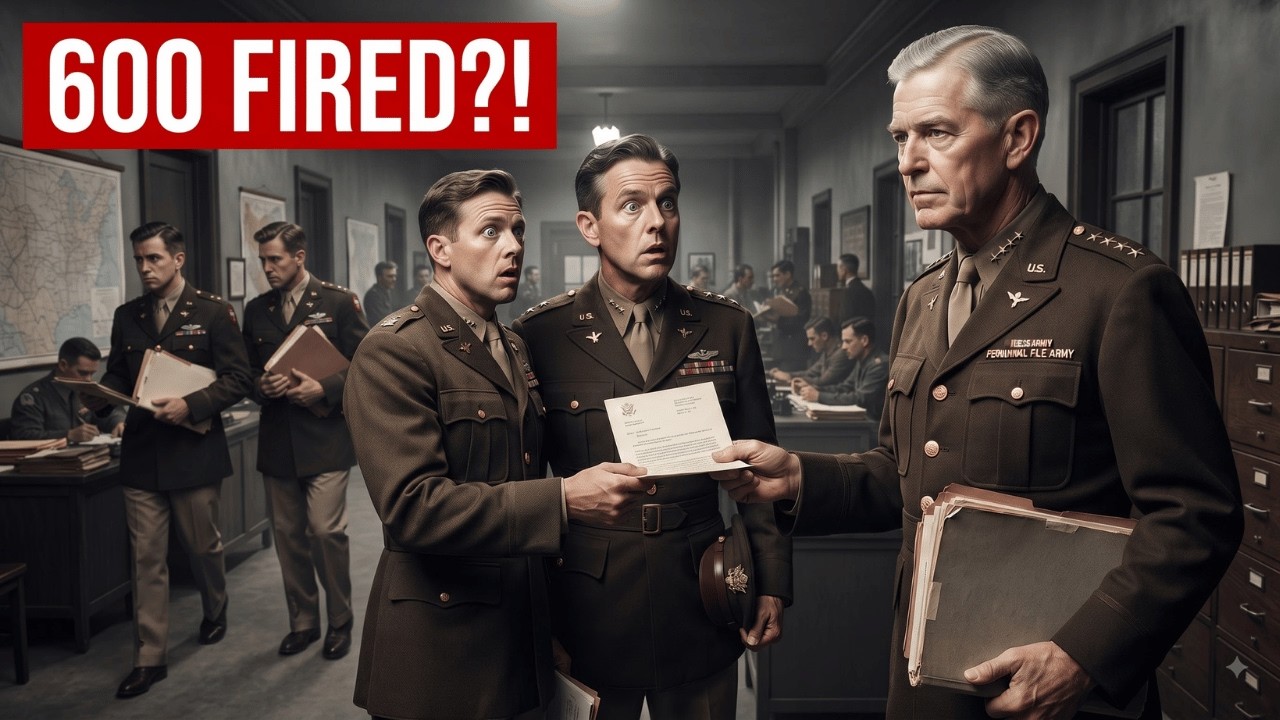
The man raising his hand was George Catlett Marshall, and the oath made him chief of staff of the United States Army on the same morning Adolf Hitler’s invasion of Poland began. In the 27 months that followed, before a single American soldier fired a shot in anger, he would quietly break the army his countrymen had known in order to save the one they would eventually fight in. The appointment had been arranged weeks earlier on the ordinary bureaucratic calendar of the War Department, long before anyone in Washington knew what date Germany would move. But history had arranged its coincidences with a novelist’s sense of timing.
The man now responsible for preparing American soldiers for the storm gathering across two oceans took command on the exact date the storm broke loose. What he inherited was almost impossible to believe. The United States Army numbered fewer than 190,000 men, scattered thin across a country of more than 130 million people. By raw size, the American army ranked around 19th in the world, smaller than the armies of Portugal, Switzerland, and Belgium.
Nations most Americans could not have found on a map fielded larger fighting forces. Germany, on the very morning Marshall took his oath, invaded Poland with more than a million and a half soldiers. Even if every soldier in every camp from Georgia to California had been called up the same day, the American army could not have fielded an eighth of that number. The equipment was worse than the numbers.
The army had fewer than 500 tanks in its entire inventory, most of them light, thin-skinned scouting machines. That summer, soldiers on maneuvers had trained using civilian trucks with cardboard signs taped to the doors reading “tank” in black paint, because there were not enough real machines to go around. That is not a metaphor. There are photographs of grown men in olive drab riding around a Louisiana field in a Ford truck with a cardboard sign pretending it was armor.
Many of the rifles still in service were the old bolt-action Springfields from 1918, hauled out of storage and reissued to boys who had never fired a shot in anger. On paper, the army claimed nine infantry divisions; in reality, only three were anywhere close to full strength. The other six existed mostly as names on a roster, each numbering roughly 3,000 men when a properly manned infantry division needed something close to 15,000. To understand what Marshall was walking into, you have to understand the country he was walking into it inside.
The United States in September 1939 was not a country that wanted a large army. The Great Depression was ten years old. There were still men selling apples on street corners in Chicago and Cleveland, still families in Oklahoma who remembered the dust that had blown their farms into nothing. American parents remembered the last war: the telegram, the boys who came home with lungs ruined by chlorine gas at Belleau Wood, the promises made in 1917 that this would be the war to end all wars.
An organization called America First had risen out of that memory, drawing to itself some of the most famous voices in the country. Charles Lindbergh, the aviator who had flown alone across the Atlantic in 1927, spoke at rallies and told Americans that Europe’s wars were not America’s wars, that the ocean was still wide enough to keep the country safe. Congress had passed the Neutrality Acts in the 1930s, designed to make it legally difficult for the United States to be pulled into a European war. Presidents were forbidden from selling weapons to belligerent nations; American ships were forbidden from carrying passengers into war zones.
Franklin Roosevelt understood the political ground he was standing on better than anyone. He was in the middle of his second term and would run for an unprecedented third in the fall of 1940, so he could not be seen to be openly preparing the United States for a war the American people did not want to fight. But Roosevelt knew what was coming. On the 9th of April 1939, in the quiet of the library at the White House, he had made the appointment that would matter more than any other single personnel decision of the coming war.
He had chosen George Marshall. But Marshall did not believe the crisis he faced was primarily a crisis of machines. Tanks could be built, rifles manufactured, divisions filled with fresh recruits, given enough time and political will and factories running double shifts. What could not be manufactured quickly was leadership.
And leadership, Marshall believed, was exactly where the American army was rotting from the inside. He had a phrase for it: considerable arteriosclerosis, a hardening, a narrowing of the vessels that should have carried fresh blood through the officer corps. Over 20 quiet years of peacetime routine, the system had calcified slowly. For two decades, promotion in the peacetime army had run almost entirely on seniority, not on performance or battlefield judgment, simply on time served standing in a line that barely moved.
This created what officers had taken to calling “the hump. ” During the First World War, thousands of young men had been promoted rapidly to fill the sudden demand for officers. Then the war ended, the army shrank back to a peacetime skeleton, and all of those wartime officers found themselves frozen in place, waiting for the men above them to retire or transfer or die before they could move up a single grade. Nearly 4,200 officers, close to one-third of the entire regular officer corps, sat trapped inside this narrow age band.
More than 1,800 captains were over the age of 40. More than a thousand officers had already met every requirement for promotion to lieutenant colonel and were still wearing captain’s bars. Even at the lieutenant level, normally the youngest rank in the corps, 234 lieutenants were already over 40. Marshall understood this rot because he had nearly been consumed by it himself.
Born on the last day of 1880 in the small industrial town of Uniontown in the coal country of southwestern Pennsylvania, he had grown up in a family that was neither poor enough to be desperate nor comfortable enough to be secure. His older brother Stuart had gone to the Virginia Military Institute and done well there. When George announced he intended to follow, Stuart argued privately with their mother that George was not capable of the work, and George overheard the conversation. He never spoke of it publicly, but he told a friend decades later that hearing his own brother judge him unworthy was the single moment that determined the shape of everything he did afterward.
He entered VMI in the fall of 1897 at age 16. He was not brilliant in the classroom, but he was steady. Cadets who served alongside him remembered a young man who never lost his composure, who spoke rarely but was worth listening to when he did. He graduated in 1901, ranked first in his class not in academics but in the estimation of his fellow cadets, who elected him first captain of the corps.
He was commissioned as a second lieutenant in 1902 and spent the next 37 years slowly climbing a ladder that seemed designed to punish patient men. During the First World War, he had served as a temporary colonel, one of the most capable staff officers in the American Expeditionary Force, coordinating the movements of nearly a million men in the final brutal months of the war on the Western Front. General John J. Pershing considered him one of the finest officers wearing an American uniform.
Then the armistice was signed, and Marshall’s temporary rank vanished. In 1920, he reverted to his permanent rank of captain. It took him 13 more years of patient, grinding, unglamorous service before he finally earned his way back to the rank of colonel in 1933, the same rank he had already proven himself capable of holding two decades before under fire. The very system that had nearly buried Marshall’s career was now the system he had the power and responsibility to tear apart.
And here is what only a few people in Washington understood about him in September 1939: he was not going to hesitate. There is a story from earlier in his career that explains something essential about the man. As a young officer, Marshall once contradicted General Pershing directly in front of other officers during a planning session, where a lesser man would have simply nodded along. Marshall believed Pershing’s assumptions were wrong, and he said so clearly, without flattery.
He expected, walking out of that room, that his career might well be finished. Instead, Pershing promoted him. The lesson stayed with him for the rest of his life: honest counsel delivered with respect, but without cowardice, earned more trust than any amount of polite agreement. That same reserve carried into his relationship with Roosevelt himself.
At an early meeting, when Roosevelt addressed him as “George,” Marshall reportedly asked the president quietly but firmly not to do so. First names were used only among true intimates, and Marshall did not intend to be a president’s intimate; he intended to be a president’s adviser. Roosevelt was one of the great charmers of American political history, and almost everyone who spent significant time in his orbit came away magnetized by him. Marshall was the exception.
He was polite, disciplined, professionally deferential in every way the office required, and he refused quietly and consistently to be charmed. In a small circle of Roosevelt’s inner staff who watched this pattern day after day, it became clear that the president himself, the man who could disarm senators and dictators alike, was slightly intimidated by the plain colonel from Uniontown who would not smile on command. In April 1940, seven months into his new office, Marshall stood before a committee of Congress and said in plain, unsparing language exactly what he believed was wrong with the army he had inherited. Leadership in the field, he told them, depends to an important extent on one’s legs and stomach and nervous system, on the physical ability to withstand hardship and lack of sleep and still be disposed energetically and aggressively to command men, to dominate men on a battlefield.
It was a direct challenge to every aging officer still clinging to a command he could no longer physically fulfill. Too many of the generals he had inherited were simply too old to command troops in battle under the terrific pressure of modern war. Their minds, he said, were set in outmoded patterns and they could not change to meet the new conditions the world was rapidly presenting them. This was not theory born out of frustration alone.
Marshall had studied closely what German forces had just done to Poland. He saw speed, boldness, initiative pushed all the way down to junior officers, men empowered to make decisions on their own without waiting for permission to climb back up a rigid chain of command. That kind of army had just shattered a much larger, more traditional opponent in a matter of weeks. Marshall understood with total clarity that an American army led by men too old, too cautious, and too comfortable to adapt would suffer the exact same fate, only at a far higher cost paid in American lives.
But knowing the problem and solving it were two very different things. Removing a senior officer from the United States Army was never going to be as simple as writing a name on a list. This was an institution with traditions stretching back to the Revolution, a closed and guarded world of loyalty, friendship, and unwritten obligation. Many of these officers had classmates from West Point sitting in the halls of Congress.
Many had cultivated friendships inside American industry, men who could make phone calls and apply quiet pressure. Their wives ran the social circles of Washington, the dinner parties and garden functions where reputations were built and where reputations could just as easily be quietly destroyed. Marshall was not simply reorganizing an army chart; he was preparing to dismantle a way of life that hundreds of powerful American families had built their entire identities around. And he was going to do it anyway.
He had spent 13 years fighting his own way back through the same system he was about to break. He had felt what it did to a good soldier in his own career, in his own pay envelope, in the quiet dinners he ate with his first wife Lily in a small officer’s quarters, wondering if he would ever wear the eagles again. Lily had died in 1927 after a lifetime of poor health, suffering from a heart condition that made even ordinary activity difficult. When she died, colleagues remembered, Marshall did not weep in public, nor, so far as anyone knew, in private.
He put himself back into his work the way a man puts a tool back into its drawer, cleanly, deliberately, without ceremony. Three years later, in 1930, he married again, to Katherine Boyce Tupper Brown, a widow with three children of her own, who would become the great steadying presence of the rest of his life. The building where Marshall went to work that autumn was not in any way worthy of the country it belonged to. The Munitions Building was a long, low, drab structure of poured concrete and small windows stretched along the north side of the National Mall between the Washington Monument and the Lincoln Memorial.
It had been thrown up during the First World War as a temporary headquarters for the War Department, temporary in the American federal sense, meaning that it was still there 20 years later. Marshall’s office was on an upper floor, modest by Washington standards: a desk, a row of filing cabinets, a window that looked out across the grass of the Mall toward the Washington Monument. This was the room where the American Second World War was in a very real sense invented. The orders that would eventually put 8 million American men in uniform started as pencil marks on paper on that desk.
The promotions that would raise an officer named Dwight D. Eisenhower to five stars in the space of three years began as notations in that room. Marshall walked to that office every morning. He came in early, read the overnight cables, drank his coffee, worked.
He lived across the river in the chief of staff’s quarters on the grounds of Fort Myer in Arlington, Virginia. Each morning before the workday began, he rose early to ride one of the horses stabled at the post, a private ritual he had kept since his own days as a young cavalry officer in the Philippines at the turn of the century. He rode alone, said little to the grooms, came back, showered, dressed, and drove into the city. By the time most of his subordinates were arriving, Marshall had already been at his desk for over an hour.
But the office was only the second most important room in his life that autumn. The first was a school. To understand the American army that fought and won the Second World War, you have to travel south to a piece of red clay ground on the Chattahoochee River just outside Columbus, Georgia, to Fort Benning. And you have to go back to a five-year window in the late 1920s and early 1930s when Marshall, then a lieutenant colonel with a career that had been quietly wilting for years, took an assignment that on paper looked like nothing much at all: assistant commandant of the United States Army Infantry School.
From 1927 to 1932, for five years in a small red brick classroom building on a Georgia post that most of America had never heard of, George Marshall watched. He watched instructors teach and students learn. He watched young officers work under the artificial pressure of classroom problems and out in the humid Georgia woods on exercise, sweat running down under their olive drab shirts, mosquitoes at their necks. He watched who volunteered for the extra work and who found reasons not to.
More than that, he changed how the school taught its material. When he arrived, the curriculum was built around doctrinal problems that always had embedded in them a single officially correct answer. Marshall found the entire approach unfit for its purpose. Real war, he told his instructors, does not come with an answer key.
Real war presents a commander with incomplete information, an unclear enemy, and a fluid situation, and demands that he make a decision anyway. So Marshall rebuilt the way Benning taught. He gave his students problems for which no correct answer had been prepared. He deliberately withheld information they thought they needed.
He rewarded students who admitted the uncertainty in front of them and worked past it rather than pretending it away. Hundreds of officers passed through Fort Benning during those five years; some estimates run close to a thousand counting students and instructors together. Marshall was watching all of them. There is a legend, still repeated in books and documentaries today, that Marshall kept a little black book, a private ledger where he wrote down the names of promising young officers.
It is not true. No such notebook has ever been found. The George C. Marshall Foundation, which has spent decades organizing his papers in Lexington, Virginia, has confirmed that no black book of that description exists anywhere in his personal records.
What Marshall actually carried out of Fort Benning was something more remarkable than any notebook could have held: he carried it in his head. Colleagues who worked with him for the rest of his career described his memory in language that bordered on the unnerving. Officers who had briefly served under him a decade earlier would find years later that Marshall could recall exactly what they had done on a specific exercise on a specific afternoon in Georgia in 1929. He remembered the way a man had spoken, the way he had hesitated, the way he had answered a question that had surprised him.
Ten, twelve, fifteen years later, he still remembered. Dwight Eisenhower was not at Benning during those five years; Marshall would meet him later. But George Patton was in and out of the Georgia post repeatedly. Joseph Stilwell served on the faculty.
Omar Bradley was there. Matthew Ridgway passed through. Terry Allen, J. Lawton Collins, Walter Bedell Smith, Anthony McAuliffe, and dozens of other men whose names Americans would come to recognize during the war walked those red clay parade grounds under the eye of the quiet lieutenant colonel.
Stilwell, in particular, made a strong impression. He was sharp-tongued, famously impatient with fools of any rank, nicknamed “Vinegar Joe,” not entirely as a compliment. Marshall watched him teach a tactics class one afternoon and concluded that this was one of the finest infantry officers in the United States Army. He wrote nothing down, never told Stilwell.
But when the war finally came and Marshall had to find someone to send into an impossible situation in China, he already knew who he was going to call. Bradley made a different kind of impression, being deeply competent in a way that did not draw attention to itself. Marshall came to trust him precisely because he never had to ask a second time. Now, the instrument.
It was one thing for Marshall to know which officers should rise and which should be removed. It was another thing entirely to have the legal authority to do it. For 30 years, the army had operated under rules that made rapid promotion of a junior officer and rapid removal of a senior one almost mechanically impossible. The rule below brigadier general was seniority, time in service, time in grade, a calendar rather than a judgment.
Marshall could not break that system by himself. Congress had made the rules; only Congress could change them. In the summer of 1940, Congress did. The Second Supplemental Appropriation Act of 1940 stripped away the seniority rule for promotions below the rank of brigadier general.
Now performance mattered, now judgment mattered, and the man holding that new authority was George Marshall. He did not wield it personally. That was the first sign of how carefully he had thought this through. A purge ordered directly by the chief of staff would have looked like exactly what his enemies already whispered: a personal vendetta dressed up in the language of readiness.
So Marshall built a board of six retired officers and placed at its head the one man whose judgment could not be questioned without questioning the integrity of the entire United States Army: General Malin Craig, his own immediate predecessor as chief of staff, the man who had held the position from 1935 to 1939, the man who knew every name on every promotion list better than Marshall himself did. If Craig signed off on a name, no one could credibly claim that Marshall was settling old scores. The board became known within the army by a name that stuck because it was so bluntly accurate: the Plucking Board. There was nothing dignified about it.
Its authority was simple and terrifying in its simplicity: it could remove any officer from consideration for promotion permanently, for reasons deemed good and sufficient. No trial, no formal charges, no appeal to a jury of peers. Just six old soldiers reading a service record, weighing a reputation, looking at a fitness report, deciding whether the man in front of them on paper belonged in the army that was coming. The board sat in a small room in the Munitions Building not far from Marshall’s own office.
The members read fitness reports written by superiors over the previous three to five years and made their determinations based on those written records alone, with no opportunity for the officer under review to appear in person. The whole procedure was deliberately designed to prevent the phone calls and the wives- calling-wives maneuvering that had historically shielded senior officers from consequences. Officers who were plucked were not thrown into the street the next morning. They were given a year, a window to arrange a retirement that looked like a retirement and not a firing.
But everyone inside the officer corps understood what that year actually was: a death sentence with a grace period. The career was over. Only the paperwork remained. The old army, the polite army, the peacetime army, where you rose in a straight and orderly line for 30 years and then retired to a small brick house in Virginia with a good pension and a set of memories about the Argonne Forest, was quietly ending.
Marshall put his philosophy into words for the members of the plucking board themselves: “The mission is not to weigh a long and successful career against a failure in 1940 or 1941. It is not the function of the board to determine how good a man he has been. Rather, it is to determine the worth and value of the individual to the army today. Critical times are upon us.
The measure must be today’s performance. ” He was asking six men to ignore 30 years of loyal service, to ignore the medals, the friendships, everything the old army had trained them their entire lives to respect, and to judge a man only by what he could do in the war that had not yet started. Two stories in particular traveled from post to post that year, told and retold in officers’ messes until they became something close to legend. They come down to us mostly through secondhand accounts, gathered years later from officers who heard them from other officers who claimed to have been in the room.
The exact words may not have been said in exactly the order reported, but the shape of them is confirmed by everyone who worked closely with Marshall during those years. The first happened, in one telling, at Fort Leavenworth in Kansas, where a senior general was given a direct order to revise the army’s training curriculum, to tear it open and rebuild it around the hard lessons the German army had just taught Europe. The general studied the assignment and came back with a number: 18 months. Marshall offered him three.
The general refused, insisting the scope made three months impossible. Marshall came back with four. Still the general held his ground. Marshall told him to think very carefully before he gave that answer again.
The general did not blink; he repeated the same position. Marshall’s reply came instantly, without heat, without a raised voice: “I am sorry. Then you are relieved. ” The general was gone within days.
Afterward, the curriculum he swore could not be finished in less than 18 months was completed by other men in four. The second story carried a different kind of chill, almost domestic in its details. A general officer received orders to depart for France on an assignment of real consequence. He told his superiors he could not leave immediately; his wife was traveling, the house had not been packed, there were arrangements to make before a man could simply disappear across an ocean.
When the explanation reached Marshall, he picked up the telephone himself and asked the general whether that was truly his reason for delay. The general confirmed it. Marshall’s answer needed no rehearsal: “Well, my God, man. We are at war and you are a general.
I am sorry, too, but you will be retired tomorrow. ” A general’s household logistics had once been an acceptable reason for delay. Now it ended a career in the time it took to hang up a receiver. In the five years before Marshall took office, only 37 officers had been removed from the army in total, an average of fewer than eight men a year.
Marshall increased that rate more than five times over. In the summer and fall of 1941 alone, the board removed 31 colonels, 117 lieutenant colonels, 31 majors, 16 captains, and 269 officers of the National Guard and the reserve. Marshall himself, looking back later in life, estimated that he had removed at least 600 officers before the United States had even entered the war. Six hundred careers, six hundred families, six hundred men who had built their entire adult lives around the assumption that the army rewarded patience and loyalty.
There is a detail from those months that almost nobody knows. Marshall wrote personal letters to the families of the men he removed. Not form letters, not staff-drafted paragraphs: handwritten notes, some signed after midnight in the small hours when the office was empty, explaining in the language of one soldier writing to the wife of another why a career had come to an end. Notes that were kind, that were not sentimental, that took full responsibility for the decision without apologizing for it.
Many of those letters survive today in the George C. Marshall papers at the Virginia Military Institute in Lexington. Marshall understood better than his enemies ever gave him credit for understanding that every name he crossed off a list was a life, that somewhere in a small brick house in Georgia or a bungalow in San Diego, a woman was going to open an envelope from the War Department and read that her husband, the colonel she had followed from post to post for 20 years, was finished. He wrote her a letter in his own hand late at night because he owed her that much.
The backlash was immediate and loud. The military press turned on him first, publishing pieces accusing him of getting rid of all the brains of the army. Marshall’s response cut the argument off at the root: “I could not reply that I was eliminating considerable arteriosclerosis. ” He was not removing brains; he was removing hardening, the slow calcified thinking that settled into an army that had not fought a real war in more than two decades.
The political pressure was more dangerous, because it came with actual leverage attached. National Guard generals with political connections, men whose commissions had been shaped as much by friendships with governors and congressmen as by battlefield merit, found themselves suddenly vulnerable. In one confrontation that became a parable inside the War Department, a politician pressed Marshall directly about removing a National Guard general with strong backing. Marshall said it plainly: “I am not going to leave him in command of that division.
So I will put it to you this way. If he stays, I go, and if I stay, he goes. ” The politician backed down. There was nowhere else for the conversation to go once Marshall had made his own resignation the price of the argument.
Even the intellectual establishment tried to intervene. Supreme Court Justice Felix Frankfurter passed along a complaint from a friend serving in the reserve, a gentle suggestion that Marshall might be moving too fast, cutting too deep. Marshall’s answer to a sitting Supreme Court justice was not gentle at all: “Most of our senior officers on such duty are deadwood and should be eliminated from the service as rapidly as possible. ” There was no hedging in that sentence.
If the Plucking Board was the scalpel, the Louisiana Maneuvers were the diagnosis, the moment when Marshall finally got to see whether the surgery had actually worked. Through August and September of 1941, nearly 400,000 soldiers moved across Louisiana and into eastern Texas in the largest peacetime military exercise the United States had ever attempted, a war game so vast it swallowed entire counties and turned quiet farmland into a simulated battlefield stretching for miles. Louisiana in August is a country of standing water, mosquitoes, and heat that presses down like a wet wool blanket. Marshall poured his officer corps into that country and turned them loose on each other.
He did not sit behind a desk reading after-action reports; he moved constantly between command posts, watching how generals reacted when the situation on the ground stopped matching the plan on paper, watching whether exhausted men still trusted the officers giving them orders at two in the morning after three days without sleep. He was looking for men who could think when the script disappeared. The heat that summer was murderous. Louisiana in August routinely reached 100 degrees Fahrenheit at midday, and at night the humidity kept the temperature high enough that sleeping under canvas was closer to lying in a warm bath than resting.
Soldiers came down with heat stroke by the hundreds. Trucks broke down constantly. Radios failed. Maps of the exercise area were sometimes so poorly drawn that entire battalions got lost.
Every single one of those problems was, in Marshall’s view, exactly the point, because the war that was coming would be fought in exactly those conditions. Dozens of general officers commanded divisions and armies during those maneuvers; only a fraction of them ever went on to hold real combat command once the shooting started. The rest were quietly set aside, their performance under the Louisiana sun becoming one more entry on the ledger the Plucking Board had already started keeping. No single moment inside those maneuvers captured what Marshall was hunting for more perfectly than what a 55-year-old cavalry officer named George Patton did with his tanks.
Patton commanded the Second Armored Division. His orders in one phase of the exercise called for him to be stopped cleanly by a prepared defensive line. Patton looked at that plan and simply refused to fight the battle the way it had been designed. Under cover of darkness, he pushed his armor on a long night march around the flank, moving his tanks fast enough and far enough that the umpires lost him entirely.
At dawn, Patton’s tanks rolled straight into the headquarters of Lieutenant General Hugh Drum and, in the language of the exercise, captured the opposing commander outright. A story told for years afterward claimed that Patton had personally paid for gasoline out of his own pocket to keep his tanks moving that night. The story may or may not be exact in every detail. What is not disputed is that Patton drove his armor harder, faster, and further than any officer in that exercise had believed possible, because he had already decided he was not going to play a war game the way the umpires wanted.
He was going to play it the way the German army had just played the last one. Patton had proven he could move faster and think faster than the man standing across from him. Hugh Drum had proven something too: that when the situation changed without warning, he could not adapt. It is worth stopping on Drum a while longer, because his story is the shadow side of everything Marshall was building.
Hugh Drum was born in 1879, making him 62 in the summer of the Louisiana Maneuvers. By 1930 he had already reached the rank of major general. During the First World War he had served as chief of staff of the First Army in France, a position of such genuine influence that Douglas MacArthur himself later credited Drum with running much of the operational side of that army. By every traditional yardstick the army had ever used to measure a man, Hugh Drum should have been the one who became chief of staff in 1939, not George Marshall.
But Drum made a mistake that had nothing to do with tactics. He campaigned for the position too openly, too aggressively, too visibly for anyone in Washington to miss it. He courted the press and let reporters know that the position of chief of staff belonged to him as a matter of natural succession. And in doing so, he made an enemy of the one man whose opinion actually mattered.
Roosevelt watched Drum position himself with an entitlement that read to a president who prized discretion and personal loyalty above almost everything else as arrogance. When the appointment was finally decided in 1939, Roosevelt passed over Drum entirely, reaching down the seniority list to a brigadier general who had been outranked by close to 20 major generals and 11 brigadier generals with more time in grade. Roosevelt chose Marshall. Drum never forgave the humiliation and never stopped angling for the senior field command he believed history still owed him.
When the war finally arrived, Drum returned expecting command of American forces in Europe, the most consequential post the army could offer. Instead, Marshall offered him something else entirely: chief of staff to Chiang Kai-shek in China. Drum’s reaction was immediate and furious. He described the assignment as nebulous, uncertain, indefinite, and he was not wrong to see it that way; it would require him to serve three masters simultaneously.
When Marshall told him plainly that no large American force would ever be sent to China, that the theater would remain small and starved of resources, Drum made the remark that likely sealed his fate: he said he would be wasted in a posting that minor. Marshall concluded in the flat, unsentimental language he reserved for these judgments that Drum lacked the enthusiasm the assignment required and recommended he not be sent at all. The China posting went instead to Joseph Stilwell. The contrast between the two responses tells you almost everything you need to know about why one general rose and the other did not.
Stilwell was born in 1883, 58 years old in the winter of 1942 when Marshall came to him with the same difficult, thankless, politically impossible assignment. His answer carried none of Drum’s wounded pride: “I will go where I am sent. ” Six words. No conditions, no mention of what he was owed, no negotiation, no delay.
Stilwell received his orders on January 14, 1942, and left to build an army out of almost nothing on the far side of the world. He would spend the next three years fighting a war on a shoestring in a theater the American public barely knew existed. He would come home eventually exhausted and thin and privately bitter about much of what he had seen. But he had gone where he was sent.
Hugh Drum did not go anywhere at all, not really. He was assigned to command the Eastern Defense Command, a posting responsible for the coastal defense of the eastern seaboard. Essential in its own bureaucratic way, but a world away from the battlefield command he had spent his entire career preparing for. He reached the army’s mandatory retirement age of 64 in September 1943 and was retired on schedule, no exception made, no final campaign granted.
At the ceremony marking his departure, he received his second Distinguished Service Medal. In a detail heavy with quiet irony, it was Marshall himself who stood at the podium and read the citation aloud. When the Sunday morning came that nobody in Washington yet saw coming, it arrived the way Marshall had feared it would: without warning, without mercy, without the slightest concern for whether the United States Army was ready. Japanese aircraft crossed the shoreline of Oahu at 7:55 in the morning local time on December 7, 1941.
By midday, the Pacific Fleet, the force supposed to buy America time in the ocean between California and Tokyo, sat broken in shallow water, battleships on the bottom, sailors in the harbor with black oil in their hair. Marshall, in a detail historians have never quite been able to explain away, was not at his desk when the first news of the attack began arriving in Washington. He was on his Sunday morning horseback ride at Fort Myer, alone in the Virginia woods across the Potomac. He came back to the stables, showered, dressed, drove into the office.
By the time he reached the Munitions Building and understood what was happening in Hawaii, it was already too late for any warning he might have sent to matter to the men aboard the ships in the harbor. There is a piece of that morning that has always haunted the official record. When Marshall finally did draft a warning to send to the American commanders in Hawaii and the Philippines, atmospheric conditions were making the army’s own secure radio channels unreliable. Rather than delay further, he sent the warning by commercial telegram.
It reached Honolulu after the attack was already over. A boy on a bicycle delivered it, in Marshall’s own words, to a command that no longer needed warning about anything. He would carry the weight of that detail privately for the rest of his life. He never made an excuse for it, never publicly blamed anyone else.
When asked about it years later in the investigations that followed the war, he answered every question directly and truthfully, and offered no defense. One week later, on December 14, Marshall did something that told you everything about how his mind worked. Even in the middle of catastrophe, he picked up a telephone and summoned a newly minted brigadier general back to Washington. His name was Dwight David Eisenhower.
He was 51 years old, had been a colonel only three months earlier, serving as chief of staff of the Third Army out of Fort Sam Houston in San Antonio. On paper in December 1941, Eisenhower was almost a nobody. He had graduated from West Point in 1915 in what would later be called the class the stars fell on, but he had spent almost his entire career in staff work rather than frontline command. He had spent the 1930s as an aide to Douglas MacArthur, first in the office of the chief of staff and then in the Philippines, and had loathed almost every minute of it.
He had come home from Manila in 1939 convinced his career was going nowhere, a light colonel with almost no troop command experience. He wrote in his private diary that summer that he did not know what he was going to do with himself for the next 20 years. Then the Louisiana Maneuvers had happened, and Eisenhower, serving as chief of staff to General Walter Krueger’s Third Army, had performed brilliantly in the routine planning and coordination work that made a peacetime exercise function like a real war. Marshall had noticed.
Marshall laid a map out in front of Eisenhower and described the Philippines, where Eisenhower himself had served for four long years, already under attack, isolated, running out of options by the hour. The Pacific Fleet that was supposed to relieve them had just been gutted. Then Marshall asked a single question, direct and unadorned: “What should be our general line of action? ” Eisenhower did not reach for an answer.
He asked for a few hours and a desk. Marshall gave him both. When Eisenhower came back, he came back with a memorandum that did not flinch from the truth. The Philippines, he concluded, could not be saved, but they could not be abandoned either, not in spirit, not in the eyes of every ally around the world watching to see whether America would honor its commitments when the cost turned out to be real.
His recommendation looked past the islands toward a longer war: “Build Australia into a base,” he wrote, a foundation from which the Pacific could eventually be fought back across, mile by mile, island by island. Marshall read it. Then he said something Eisenhower remembered for the rest of his life: “Eisenhower, the department is filled with able men who analyze their problems well but feel compelled always to bring them to me for final solution. I must have assistance who will solve their own problems and tell me later what they have done.
” Eisenhower had passed the test. It was the same test in miniature Marshall had been administering to the entire American officer corps for two years: can you think without me standing over your shoulder? Eisenhower could. The army moved him accordingly at a speed with no precedent in its history: brigadier general in December 1941, major general four months later, lieutenant general in July, full general in February 1943, five-star General of the Army in December 1944, four days after Marshall himself received his own fifth star.
It is worth pausing to look at what the alternative actually looked like. The alternative was not hypothetical; it had already happened in real time to one of the most celebrated armies on Earth. When Germany attacked in May 1940, the French army possessed more tanks than the German army that was about to destroy it. France fielded roughly 5 million men under arms and had built the Maginot Line, the most elaborate feat of military engineering the modern world had ever seen.
On paper, France should have stopped the German attack cold. But the men who led France into that spring were old and rigid, and their minds were still fighting the last war. General Maurice Gamelin, the French commander-in-chief, was 67 years old and ran the campaign from a headquarters at the fortress of Vincennes outside Paris, a medieval castle with no modern communications equipment at all, no radio, a command post where orders had to travel by motorcycle courier through roads clogged with refugees. When the German columns tore through the forest of the Ardennes, terrain Gamelin had judged impassable to tanks and left defended by only 10 reserve divisions, the French high command collapsed.
The man sent to replace him, General Maxime Weygand, was 73, and did not even reach the front to take command until May 19, nine full days after the German attack had begun, by which point the outcome was no longer in doubt. France fell in six weeks. Roughly 90,000 French soldiers were killed in May and June of 1940 alone. They did not die because they lacked courage or equipment.
They died because the men above them could not think fast enough, could not move fast enough, could not let go of a war that had already ended so that they could see the one that had actually begun. That is the fate Marshall was purging his own army to avoid. It would be a lie to tell you that Marshall got every decision right. He did not.
There was one man in particular he trusted, and who failed him, and the failure very nearly became a catastrophe of its own. His name was Lloyd Fredendall, and Marshall had genuine affection for him, called him one of the best, said you could see determination all over his face. On the strength of that judgment, Fredendall was given command of the largest task force in Operation Torch, the Allied invasion of North Africa in November 1942. Three months later, at a place in the Tunisian desert called the Kasserine Pass in February 1943, that judgment collapsed.
Fredendall ran his command from a headquarters roughly 70 miles behind the front line, inside an elaborate underground bunker complex his engineers had spent weeks constructing, weeks his combat units desperately needed those engineers for something else. He issued orders in a personal code so convoluted his own subordinates frequently could not decipher what he was telling them to do. He referred to units by nicknames he had invented, to hills as “the top of the hill” and “the bottom of the hill,” without ever giving the grid coordinates professional soldiers had been trained for a century to use. When his corps commanders asked for clarification, he grew angry.
The German force he was facing was commanded by Erwin Rommel, a man who had spent the preceding two years watching his enemies make exactly the kinds of mistakes Fredendall was now making. When Rommel struck on February 14, 1943, the American units were poorly positioned, badly coordinated, and cut off from their own headquarters by the exact bureaucratic fog Fredendall had created. The result was the worst defeat American ground forces suffered anywhere in the European theater of the war: more than 6,000 soldiers killed, wounded, or captured in a matter of days. Green boys from Iowa and Illinois and Pennsylvania cut down in a desert most of them could not have pointed to on a map, tanks abandoned along dusty roads, artillery batteries overrun, American units retreating 50 miles in a matter of hours.
But watch what happens next, because this is the part of the story that actually matters most. The system Marshall had built did not protect Fredendall the way the old army would have protected him. It corrected itself. Fredendall was relieved, and the man sent to replace him was George Patton, the same cavalry officer who had gone tearing around a flank in the Louisiana mud two years earlier.
Patton took a defeated, demoralized American army and turned it into a fighting force again in a matter of weeks. He reinstated basic discipline, required men to wear neckties in the desert heat, was widely mocked for it, and did not care. Within two months, the II Corps under Patton was fighting again and winning again. Fredendall was not thrown away or publicly disgraced; he was sent home to train new recruits, a posting where his organizational instincts still had genuine value.
The system had failed once honestly, and it had fixed itself just as honestly. By the time the guns finally fell silent, the praise for what Marshall had built arrived from every direction that mattered. Winston Churchill called him the true organizer of victory, and in a separate tribute, the noblest Roman of them all. Eisenhower said plainly that the American army and the American people had never been so indebted to any soldier.
Harry Truman put it more simply: millions of Americans had given magnificently to their country, he said, but George C. Marshall gave it victory. Time magazine named him Person of the Year twice, once in 1943 in the middle of the war and again in 1947 for the reconstruction of Europe. But the most consequential recognition came in a form no other soldier in American history had ever received.
To understand what he did to earn it, you have to follow him past the end of the war, out of the Munitions Building, and into the final act of his career. Marshall retired as chief of staff in November 1945, three months after the Japanese surrender aboard the battleship Missouri in Tokyo Bay. He was 64, exhausted, and wanted more than anything to go home to Leesburg, Virginia and work in his garden with Katherine. He got about a week.
Then Truman called and asked him to fly to China, where the country was tearing itself apart in a civil war between the nationalist forces under Chiang Kai-shek and the communist forces under Mao Zedong. Truman wanted Marshall, the man who had rebuilt the American army, to see if he could broker a peace. Marshall went anyway. He spent 13 months in China, flying back and forth between Chungking and Yenan, negotiating, proposing, listening, watching both sides use the negotiations only as cover for the military moves they were preparing against each other.
In January 1947 he came home with nothing to show but a clear-eyed understanding that the Chinese Civil War would end with a communist victory. Truman asked him to serve as Secretary of State. He said yes. He was sworn in on January 21, 1947, and on the 5th of June of that year, in a speech delivered at Harvard University’s commencement, he proposed what would become the Marshall Plan.
The speech itself was not dramatic; it ran barely 15 minutes. Marshall read it in his usual dry, understated voice, without theater. He observed that the physical destruction and dislocation caused by the war in Europe were far worse than most Americans understood, that hunger, disease, and political instability were likely to follow, and he proposed that the United States help, not as charity, but as an investment in the kind of stable, prosperous Europe in which American values and American commerce could both survive. The plan that emerged from that speech sent more than $13 billion to 16 European countries over four years, in current terms closer to $150 billion.
It rebuilt bridges, railroads, factories, the roofs of houses. It fed people who had spent five years watching bombs fall on their cities. Truman insisted over Marshall’s own objections on calling it the Marshall Plan, knowing that the name George Marshall would command bipartisan respect in a Congress suspicious of foreign aid on almost every other question. He was right.
The plan passed. Europe recovered. Marshall retired from the State Department in January 1949 at age 68, exhausted for the second time in five years. He went back to Leesburg, back to his garden, assumed his years of public service were behind him.
He got about 18 months. Then in September 1950, three months into the Korean War, Truman called again and asked him to come back as Secretary of Defense. He said yes. He served exactly one year, through the worst of the Korean War, through the crisis in the spring of 1951 when President Truman relieved General Douglas MacArthur of command, and Marshall had to testify before an angry Senate committee about a decision he had helped the president make.
That same year, Senator Joseph McCarthy delivered a three-hour speech on the floor of the Senate accusing Marshall of being part of a conspiracy so immense and an infamy so black as to dwarf any previous such venture in the history of man. Marshall said nothing publicly in response. In private, he told friends that a man who had done his duty for 50 years did not owe an accounting to a man who had done his duty for none. He served out his year at Defense and in September 1951, at age 70, retired for the third and final time.
In 1953, at age 72, Marshall became the only professional soldier in history to receive the Nobel Peace Prize, awarded for the plan that bore his name, the plan that rebuilt a shattered Europe out of the same discipline he had once used to rebuild an army. He gave a short acceptance speech in Oslo, spoke quietly about the connection between military service and civilian responsibility and about the debt any generation owes to the generation that follows it. Then he went back to his hotel, and then back to Leesburg, and took no personal celebration from the honor beyond acknowledging politely that it had been given. What he did with recognition in the end tells you more about the man than any medal ever could.
When Roosevelt died in April 1945, plenty of people in Washington assumed Marshall would finally claim something for himself: command of the invasion of Japan perhaps. He did not take it. He stayed in Washington running a global war from behind the same desk he had always used. When Eisenhower was chosen to command the Normandy invasion, the single command Marshall himself had quietly hoped for throughout the entire war, Marshall accepted the decision without a word of complaint, because the war needed him in Washington more than it needed him famous.
Roosevelt had genuinely wanted Marshall to have the Normandy command; every historian of the period agrees Marshall was the president’s first instinct. But when the moment came to make the decision, Roosevelt asked Marshall plainly whether he wanted the job. Marshall would not answer. He told the president that this was not a decision Marshall could make for himself, that the president must decide what was best for the war, that whatever the president decided, Marshall would faithfully execute.
Roosevelt sat with that for a long moment. Then he said quietly that he could not sleep at ease if Marshall was out of Washington. The Normandy command went to Eisenhower. Marshall never spoke of the disappointment publicly for the rest of his life.
There is a note in his private papers written to Eisenhower in June 1944 congratulating him on the success of the landing. It contains no trace of resentment. And here, at the very end of the story, sits a small quiet detail that says more than any speech ever could. In the northern part of the state of New York there stands a large United States military installation called Fort Drum, named for Hugh Drum, the general who spent his entire career chasing the one thing that was always kept just out of his reach.
His name is carved in stone on the gate of an American fort. Soldiers train there today. Marshall’s name is not on a single American fort. There are schools named for him, a plan named for him, a museum in Lexington, Virginia, stamps, statues, streets in small Pennsylvania towns.
But no fort, no base, no installation full of soldiers. The general who never got the field command has a fort with his name on it. The general who won the whole war does not. There is one last detail from his private life that ought to be told.
In May 1944, on a coastal road not far from Anzio in Italy, an American army officer named Allen Tupper Brown was killed by a German sniper’s bullet. He was Marshall’s stepson, Katherine’s boy, the youngest of the three children she had brought into their marriage in 1930. Marshall had helped raise him, had watched him grow up, had taken pride in the fact that Allen had chosen the army. The telegram arrived at Marshall’s office.
He read it. He excused himself, went into an inner room, and closed the door. When he came back out several minutes later, his face gave no sign of what had happened. He returned to the work of the day.
He accepted quietly the letters of condolence that reached him from Eisenhower, from Roosevelt, from Churchill. And he continued to run the largest military organization in the history of the world for another year and a half, until the war he had prepared for was finally won. Katherine years later would say that Marshall had grieved for Allen every single day of the rest of his life. He simply never let anyone see it.
He died in October 1959 at Walter Reed Army Hospital in Washington, a few miles from the small office in the Munitions Building where 20 years earlier he had first raised his hand and taken the oath. He was 78 years old. His funeral was small by his own request. He was buried at Arlington, in a plot he had chosen carefully on a slope of ground he knew well, alongside his first wife Lily and his second wife Katherine.
The stone over his grave is plain. It gives his name, his rank, his dates. It does not list the 600 careers he ended, the Nobel Prize, the plan that saved Europe, the young officer from San Antonio who became the general who won the war.
You have to know all of that already before you walk up to the stone.
