On the fifth of December, 1865, the royal family of Great Britain was not celebrating. The official announcement of Princess Helena’s betrothal to Prince Christian of Schleswig-Holstein had barely left the palace before the household divided against itself. Princess Alexandra of Denmark, wife of the Prince of Wales and daughter of King Christian IX, considered the match a personal insult. The duchies of Schleswig and Holstein had been wrenched from her father’s crown in the war of 1864, and now her sister-in-law was to marry a prince who claimed rights to those very lands.
Alexandra’s husband, the future King Edward VII, sided with her. So did Princess Alice. All three opposed Queen Victoria’s decision, convinced that the widowed monarch was sacrificing Helena’s happiness merely to keep her daughter close. The queen, feeling challenged in her own household, did not forgive the defiance easily.
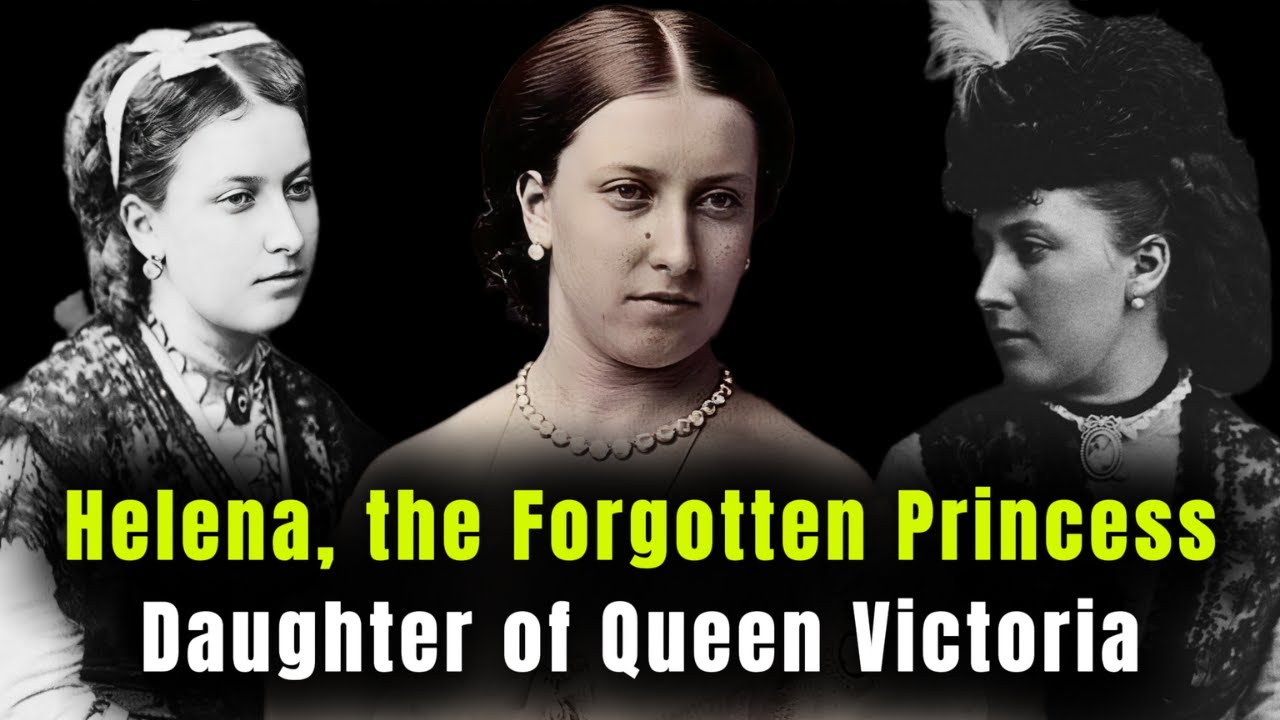
But her will prevailed, and a wedding was arranged. Only the quiet intercession of Alice, who persuaded Edward to attend rather than boycott the ceremony, kept the family scandal from erupting in full public view. Helena Augusta Victoria had been born on the 25th of May 1846 at Buckingham Palace, one day after her mother’s twenty-seventh birthday. She was the third daughter and fifth of nine children of Victoria and Prince Albert.
Named for one of her aunts, she was called Lenchen within the family, a German diminutive that followed her through life. From birth she carried the title Her Royal Highness Princess Helena, and with it the weight of every expectation the crown placed upon her. She was educated at home under a rigorous program designed by Prince Albert and his adviser Baron Stockmar, studying languages, the arts, and intellectual discipline alongside her elder sisters Victoria and Alice. As a small child she was lively and expressive, fond of drawing and horse riding.
By age three her scribbles were earning praise from the queen’s ladies-in-waiting. She played the piano well, shared her father’s early interest in science and technology, and loved boating on the royal lakes. When Princess Louise arrived in 1848, Helena became, quite literally, the middle child. Her talents were sometimes eclipsed by her sisters’ more striking accomplishments.
Victoria was graceful, Alice charismatic; Helena, by contrast, earned a reputation for steadiness and dependability, a loving child eager to help. That quiet character would determine her entire life. Her childhood unfolded across the royal residences of Britain, Buckingham Palace, Windsor Castle, and Osborne House on the Isle of Wight, where Victoria and Albert encouraged a close family life far removed from the frivolous pomp of court. The children absorbed the Victorian values their parents modeled: moral rectitude, religious devotion, and a profound sense of duty.
It was a happy childhood, full of affection and learning. It ended on the 14th of December 1861, when Prince Albert died at the age of forty-two. Helena was fifteen. A month later she wrote to a friend: “What we have lost can never be replaced, and our grief is very, very bitter.
I adored Papa, loved him more than anything on earth. His word was sacred law. He was my help and counselor. Those hours were the happiest of my life.
And now all is over. ”
The queen collapsed into inconsolable mourning and withdrew with her daughters to Osborne House. Alice was first called upon as unofficial secretary, handling personal affairs and correspondence. Helena seemed the natural successor, but Victoria considered her too sensitive; the young princess was easily moved to tears by any strong emotion.
For that reason the queen initially preferred to assign certain duties to the more composed Louise. When Alice married in 1862 and departed for Hesse-Darmstadt, Helena finally assumed the role of her mother’s intimate assistant. A biographer of the time described her as the queen’s staff of old age, always at her side. In practice she drafted letters dictated by the queen, assisted with political correspondence, and kept her company through long periods of seclusion.
At sixteen, she had exchanged youthful play for the solemn task of comforting the sovereign of the British Empire. In the early 1860s, while the court was still deep in mourning, Helena developed a close friendship with Carl Ruland, her father’s former librarian. Cultured and German-born, Ruland had remained in the royal household after Albert’s death, earning the queen’s trust by teaching German to the Prince of Wales. For Helena, yearning for affection in those somber years, his attentive company became a source of solace.
Whether it ever grew into romance is not recorded, but Queen Victoria, discovering her daughter’s feelings for a member of the household staff, reacted with characteristic severity. In 1863 she dismissed Ruland and sent him back to Germany in disgrace. Helena was never allowed to bid him farewell. The episode taught her a harsh lesson: her private life would always be subject to her mother’s will.
Queen Victoria never forgave the former librarian’s audacity, nor her daughter’s imprudence. After Ruland’s dismissal, the queen set about finding Helena a husband. The conditions were strict. The groom must reside in the United Kingdom, always within reach of the queen’s call.
Helena, neither eldest nor youngest, was not a key piece in Europe’s dynastic chessboard, and her prospects were limited. At fifteen a court biographer had described her as sturdy and plain, far from the ideal of delicate beauty expected of a princess. The choice fell upon Prince Christian of Schleswig-Holstein, fifteen years her senior, a prince of royal blood but modest means, amiable and respectable, though politically problematic. Christian’s family claimed ducal rights in open opposition to Denmark.
Only Princess Victoria, the crown princess of Prussia, supported the marriage, having a friendly relationship with Christian’s family and trusting his character. The wedding took place on the 5th of July 1866 at Windsor Castle. Out of respect for the queen’s unending mourning, it was held in the private chapel rather than the grand St. George’s Chapel.
Victoria, dressed in deep black, lightened her attire only with a white lace veil and cap draped over her back. She gave away the bride, taking the place of the absent father. One guest remarked that Christian, with his prematurely gray hair, looked old enough to be Helena’s uncle. At thirty-five he appeared considerably older beside the twenty-year-old princess.
It was even said that when Christian was first summoned to England, he feared the widowed Victoria intended him for herself rather than for her daughter. The couple spent their first night at Osborne House before departing on honeymoon to France and Switzerland, far from the murmurs of the court. Unlike her elder sisters, who had married reigning German princes, Helena did not leave England. As the queen decreed, the couple remained in Britain, establishing their principal residence at Cumberland Lodge in Windsor Great Park.
In London they occupied apartments at Buckingham Palace and later at Schomberg House. The queen secured from Parliament an annual allowance of six thousand pounds, provided a dowry of thirty thousand, and added one hundred thousand from her own private funds. Prince Christian received an honorary appointment at the Windsor Court, though he lacked political ambition and preferred walking his dogs and shooting pigeons to formal duties. For Helena, everything she valued was fulfilled.
She had married for love, and she had pleased her mother by remaining close. “Despite the difficulties, Helena was happy with Christian and wanted to marry him,” wrote contemporary chronicles. Between 1867 and 1876 she gave birth to six children. Four survived infancy.
Prince Christian Victor was born in 1867, Prince Albert in 1869, Princess Helena Victoria in 1870, and Princess Marie Louise in 1872. Their fifth child, Prince Harold, died at just eight days old in May 1876. Another son was stillborn in 1877. Helena suffered these losses profoundly, and her sister Louise commissioned a tender monument in memory of the little ones who had died.
Helena proved a devoted mother, deeply involved in her children’s upbringing despite her other duties. She visited the queen almost daily, or assisted her in official engagements, while at Cumberland Lodge she sought to give her husband and children as normal a family life as possible. Her own health was fragile. She became dependent on opiates and laudanum, prescribed by her doctors to relieve pain and insomnia, a common medical practice in the Victorian age.
Victoria refused to believe her daughter was truly ill, accusing her of hypochondria indulged by an overly lenient husband. In letters to the crown princess of Prussia, the queen complained that Helena and Christian gave in far too easily to doctors’ and nurses’ recommendations. The records tell a different story. In 1869 Helena had to cancel a journey after falling ill.
In 1870 she suffered rheumatic fever and severe joint pain. In 1871 a bout of pulmonary congestion caused such alarm that the British press reported on it. In 1873 she traveled to France to recover. During the 1880s she visited Germany to consult an oculist about her eyesight.
None of these afflictions weakened her willingness to serve. After Prince Albert’s death, Victoria had increasingly relied on her younger daughters. In time the youngest, Princess Beatrice, assumed the role of chief secretary and companion to the queen. Yet Helena remained indispensable.
Victoria reserved her most sensitive affairs for Beatrice while entrusting Helena with numerous lesser but important responsibilities, organizing charitable events, drafting less urgent correspondence. When her own children grew older, Helena involved them in the queen’s household service. Her unmarried daughter, Princess Helena Victoria, would later assist by copying out the aging monarch’s personal journal in her final months. Within the family, Helena was valued as the loyal and conciliatory sister.
Her younger brother Prince Alfred considered her his favorite and enjoyed her affectionate manner. By the late nineteenth century Helena experienced both joy and sorrow. In 1891 she watched her daughter Marie Louise marry Prince Aribert of Anhalt in a splendid ceremony at Windsor. It would be the only marriage among her children.
Helena Victoria remained unmarried by choice, and her sons never wed. Helena was delighted by the match, dreaming of her daughter’s happiness. The union soon collapsed. In 1900 Aribert abruptly repudiated Marie Louise, dissolving the marriage without issue and leaving her deeply distressed.
That same year brought a more devastating blow. Her eldest son, Prince Christian Victor, died at thirty-three. Serving as an officer in the British Army, he had been deployed to fight in the South African War, where he succumbed to fever during the Boer campaign. Queen Victoria noted sadly in her journal: “Poor dear Lenchen, poor Christian, who is abroad.
They loved this son so much. ” Prince Christian was traveling abroad at the time, leaving Helena to bear her grief almost alone, with her usual quiet fortitude. Her only consolation that year came in secret: her younger son Albert fathered a daughter out of wedlock in Berlin. The child, Valerie Marie, would remain Helena’s only grandchild.
From the 1870s onward Helena had embraced public service with genuine passion. During the Franco-Prussian War of 1870 she chaired the women’s committee of a new humanitarian organization. She was a founding member of the British Red Cross, dedicating herself to recruiting nurses and organizing the shipment of medical supplies to the wounded. Perhaps sensitized by her own experience of caring for her widowed mother and enduring illness herself, she became a lifelong advocate for improving the training and status of professional nurses.
In 1872 she became the first president of the Royal School of Needlework, founded to preserve traditional textile arts. Around 1887 she was appointed president of the British Nurses Association and campaigned vigorously for professionalization. She firmly supported the creation of a state register of qualified nurses, convinced that formal recognition would enhance both the quality of care and the prestige of the women devoted to it. This conviction brought her into disagreement with Florence Nightingale, who opposed formal state regulation.
Despite Nightingale’s cautionary advice, Helena used her influence to champion the cause, writing letters to newspapers and rallying public support. Britain would later establish the official registration of trained nurses, a reform completed only a few years after Helena’s death. She also presided over the Workhouse Infirmary Nursing Association, devoted to improving care in the impoverished infirmaries of poorhouses. She supported orphanages, hospitals, and convalescent homes, and created a holiday home for disabled and underprivileged children.
Not all was smooth in her public career. In the early twentieth century, when her brother Edward VII ascended the throne, Queen Alexandra assumed several of Helena’s former patronages. In particular, she displaced Helena as president of a military nursing body, causing a noticeable cooling in relations between the two royal ladies. The king found himself mediating between his sister and his wife.
Helena was not a woman given to public quarrels. She accepted the changes with dignity and continued to support the same causes privately. In 1916 the Royal College of Nursing was founded, eclipsing the older association Helena had led. Unselfishly, she proposed merging the two organizations for the common good, though her former association declined.
Queen Victoria died on the 22nd of January 1901 at Osborne House. Helena was among the children who accompanied their mother in her final hours. Throughout four decades of widowhood, the queen had relied heavily on Helena and Beatrice, calling them her supporting daughters. After Victoria’s death, Helena continued to reside at Schomberg House with her husband.
The intimate gatherings that had once revolved around the queen ceased. Her role within the royal circle gradually diminished, and she turned instead to reinforcing her philanthropic commitments in the capital. Afflicted by rheumatic problems, she often spent periods of rest at continental spas. By 1910, with the death of Edward VII and the succession of George V, Helena was already one of Queen Victoria’s eldest surviving daughters, alongside Louise and Beatrice.
She enjoyed the respect of the new monarch and of the British press, which regarded her as a stable, traditional figure, a living symbol of the Victorian era. In 1916 Helena and Christian celebrated their golden wedding anniversary, becoming the first of Victoria’s children to reach that milestone. The marriage had been long and harmonious. Christian’s health was frail, and he died shortly afterwards on the 28th of October 1917 at Schomberg House.
Helena, seventy-one, was deeply affected by his loss. During the First World War she endured great anxiety as the conflict divided the royal family between its British and German branches. Her son Albert lived in Germany and served in the Imperial Army, a source of sorrow for her, while her nephews fought on the British side. In 1921 Albert inherited the title Duke of Schleswig-Holstein.
Two years earlier, in 1917, King George V had renounced all German titles, and Helena accordingly ceased using her German style, adopting instead the simpler title Her Royal Highness Princess Helena. In April 1923 Helena made one of her final public appearances. She attended, with her daughter Princess Helena Victoria, the wedding of the Duke of York, the future King George VI, and Lady Elizabeth Bowes-Lyon at Westminster Abbey. A few months later, on the 9th of June 1923, she died peacefully at Schomberg House, aged seventy-seven.
She was interred in the Royal Vault of St. George’s Chapel, Windsor. In 1928 her remains were transferred to the royal burial ground at Frogmore, beside those of her husband.
The forgotten princess, who had served her mother for forty years, married for love within the bounds of duty, and fought quietly to professionalize nursing, was finally laid to rest.
