By December 1862, Lieutenant Samuel Whitaker had seen enough of war to believe nothing could surprise him. He had led patrols through country where both armies and the bushwhackers who preyed on them had left their marks, and he had learned to read a landscape the way other men read a ledger. So when a winter storm forced his Union cavalry patrol to seek shelter at a seemingly abandoned farmstead on the White River, he noted the details with a soldier’s eye: the two-story log cabin with its stone chimney, the smokehouse built of river rock, the barn large enough for eight horses, and the outbuildings arranged in a careful semicircle around a central yard. The place appeared deserted, but the chimney still held warmth.
Whoever had lived here had fled not long before. What his men found inside would stay with them longer than any battlefield. In the smokehouse hung meat that, upon closer inspection, was not from any conventional livestock. In the cellar, barrels held preserved portions in brine that no man among them could look upon without revulsion.
In the barn, they found personal effects that could only have belonged to numerous different individuals: watches, rings, spectacles, boots, all sorted and cataloged in a methodical fashion. A trunk held clothing of various sizes, including garments belonging to women and children, each folded neatly with a paper tag affixed, noting what appeared to be a date. And beneath the cabin, in a root cellar, they found human bones, picked clean and stacked like cordwood. Some showed signs of having been split open, presumably to extract the marrow.
In one corner stood a large copper kettle, its interior stained in a manner the sergeant who wrote about it declined to describe. The patrol burned the structures to the ground and continued its pursuit of Confederate forces. Lieutenant Whitaker filed a report recommending that after the present conflict was resolved, a thorough investigation should be conducted to determine the full extent of the atrocities committed at this location. That investigation would not take place for nearly a century.
The Ozarks in 1862 existed in a perilous state of disorder. The rugged terrain had always fostered a certain independence among its inhabitants, people who valued self-sufficiency and privacy above all else. When the Civil War erupted, this already isolated region became even more disconnected from outside authority. Neither fully Union nor Confederate, the mountains became a patchwork of divided loyalties.
Neighbors who had once shared meals now regarded each other with suspicion. Regular patrols from both armies moved through the area, requisitioning supplies and questioning loyalties. The dirt roads connecting Springfield to the small settlements scattered throughout these mountains became treacherous paths where travelers risked their lives with each journey. Taney County, situated in the heart of the Missouri Ozarks, was particularly affected by the breakdown of civil authority.
The county seat of Forsyth had been burned during military operations in July 1861, leaving local government effectively suspended. The county sheriff and most deputies had joined military units, leaving law enforcement virtually non-existent. Court records from this period are fragmentary at best, consisting mainly of hastily written notes in ledgers that were often transported from location to location as officials fled advancing troops from either side. Within this vacuum of authority, the perfect conditions existed for predators to operate undetected.
The property that Lieutenant Whitaker’s patrol had stumbled upon belonged to a family named Holloway. According to land records examined by researchers in the 1960s, Ezekiel Holloway had purchased the 160-acre property along the White River in 1848. The land sat at a strategic location where the main road from Springfield descended from the highlands toward Arkansas, approximately 23 miles south of Springfield near what is now Forsyth. The purchase price, noted as substantial in Dr.
Eleanor Whitfield’s 1964 monograph, raised questions about the family’s financial resources given their reported modest origins in eastern Tennessee. This discrepancy would later be viewed as the first indication that the Holloways may have engaged in nefarious activities before their arrival in Missouri. The homestead itself spoke of a certain prosperity. Tax assessments from 1859 valued the property at considerably more than neighboring farms, suggesting the Holloways enjoyed relative wealth despite their limited participation in the local economy.
A curious detail noted by Dr. Whitfield was the absence of records indicating livestock sales or crop production commensurate with the size and apparent prosperity of the farm. An anomaly that would take on sinister significance in light of later discoveries. The family consisted of Ezekiel Holloway, approximately 53 years old in 1862 according to census records; his wife Martha, believed to be in her mid-40s; three sons, Jeremiah 26, Silas 23, and Caleb 17; and two daughters, Ruth 19 and Esther 15.
A notation in the 1850 census indicated that Martha was Ezekiel’s second wife, though no records of his first marriage or its dissolution have been located. The children were all listed as Ezekiel’s offspring, suggesting that Martha may have been stepmother to at least the older children. Church records from a Baptist congregation near Forsyth listed the family’s attendance at religious gatherings during their first two years in the area, but their names disappeared from these records after 1850. A notation in the church ledger discovered during Dr.
Whitfield’s research mentioned concerns regarding the Holloway family’s absence from worship and fellowship, but provided no specific details about the nature of these concerns. This pattern of initial integration followed by withdrawal would be repeated in subsequent locations where the family settled. Descriptions of the Holloways come primarily from statements given by neighbors after the discovery of their activities. Thomas Wilkins, whose farm was located approximately three miles from the Holloway property, provided a statement in 1863 that offers one of the few contemporary descriptions.
“They kept mostly to themselves, but Ezekiel would come to town for supplies every few weeks, always polite, paid in good coin. Martha and the girls might come once or twice a year for cloth and such. The boys I saw less often. Strong-looking fellows, didn’t talk much.
Nothing about them that would make you take particular notice. ”
Sarah Thornton, whose husband operated a general store in Forsyth before the war, provided a slightly different perspective in a letter to her sister, discovered in family papers donated to the Missouri Historical Society in 1959. “The Holloway man comes to the store perhaps once a month, always with good silver to pay for his purchases. The wife I have seen only twice in five years, a thin, severe woman who speaks little.
The daughters stay close to her side, eyes downcast. I find it curious that despite having a substantial farm, they never bring produce or livestock to trade as other farmers do. Mr. Thornton says they are simply private folk, but something in the old man’s gaze makes me uneasy.
I am not sorry that they live at some distance from town. ”
William Cartwright, who delivered mail along the Springfield-Forsyth route before the war disrupted regular service, recalled in an 1867 interview with a Springfield newspaper that the Holloway property always seemed oddly quiet for a working farm. “Most homesteads you’d pass, there’d be the sounds of animals, children playing, work being done. The Holloway place was different.
Quiet in a way that made the back of your neck prickle. I delivered letters there maybe half a dozen times over three years. The old man would always be waiting at the road as if he knew I was coming, never invited me to approach the house proper. I noticed they got few letters themselves, and those mostly seemed to be from Tennessee or Arkansas.
”
The Battle of Pea Ridge in March 1862 marked a turning point in the war in the western theater and had significant implications for the Ozark region. Union victory secured Missouri for the North, but led to increased movement of troops, refugees, and displaced civilians through the area. Military supply wagons regularly traveled the road past the Holloway property, as did civilians seeking safer locations or attempting to reunite with family members. According to recovered documents from the Taney County Courthouse, this was precisely when the first documented disappearances began.
County records indicate that between April and November of 1862, no fewer than 17 travelers were reported missing along the 20-mile stretch of road where the Holloway property stood. The reports themselves were sparse, often just a name, approximate date of disappearance, and last known location. A notation in the county sheriff’s log book dated June 12th, 1862, mentioned another disappearance near the White River crossing, but noted that with the present hostilities, investigation must be deferred. Military correspondence recovered from Union archives in 1965 referenced suspicious circumstances regarding civilian movement in the area, but with battles raging across Missouri and Arkansas, these reports received scant attention from authorities overwhelmed by the demands of war.
Among those reported missing was Jonathan Meyers, a 42-year-old merchant from Springfield who left the city on April 23rd, 1862, to assess conditions at his warehouse in Batesville, Arkansas. His business partner reported him missing after he failed to return within the expected time frame. A cavalry patrol reported having seen a man matching his description on the road near the White River crossing, but no further trace was ever found. Personal effects later identified as belonging to Meyers would be among those recovered from the Holloway property.
Another documented disappearance involved the Ballard family. Samuel, 35, Elizabeth, 32, and their children, William, 9, and Mary, 6, were traveling north from their farm near Batesville after it was destroyed in military operations. Neighbors in Batesville later testified that the family had planned to stay with relatives near Springfield. They were last seen passing through Forsyth in early June 1862.
Items of children’s clothing recovered from the Holloway farm would later be identified by Elizabeth Ballard’s sister as belonging to William and Mary. Perhaps the most poignant case was that of Emma Whitaker, a 19-year-old school teacher who had been employed in a small settlement near Harrison, Arkansas. When the school closed due to the war, she set out to return to her family in Springfield. According to a letter from her father to military authorities dated July 18th, 1862, Emma had written that she had secured passage with a traveler heading north and expected to arrive by mid-July.
The letter, written when she failed to appear, desperately sought information about her whereabouts. A locket containing a miniature portrait identified by her father as belonging to Emma was among the personal effects recovered from the Holloway property. Lieutenant Samuel Whitaker, the officer whose patrol would eventually discover the family’s crimes, was her brother. What makes this case particularly disturbing is not just the number of disappearances, but the systematic nature of what investigators would later discover.
The Holloways did not merely kill travelers. They processed them with the same methodical precision they applied to livestock. According to a journal discovered behind a loose stone in the chimney during a renovation in 1957, they referred to their victims as “provisions” and selected them based on apparent health and size. Entries in this journal, which academic researchers have dated to approximately 1861-1862 based on paper composition and ink analysis, contain disturbing notations such as “male approx 30 years good condition yielded 67 pounds of usable product” and “female older less satisfactory yield but bones made excellent stock.
”
The journal, currently preserved in the Missouri State Archives under restricted access, contains approximately 40 entries spanning an 18-month period. Each entry follows a similar format: a brief description of the individual, date of acquisition, method of processing, and notation of yield. The clinical detachment evident in these entries shocked even experienced researchers. Dr.
Theodore Montgomery of the Smithsonian Institution, who examined the journal as part of his analysis of remains recovered from the site, noted in his report that “the precision and dispassion of the recordkeeping suggests a complete moral disconnection from the humanity of the victims. The entries might as well describe the butchering of cattle or hogs. ”
One particularly disturbing aspect of the journal is its indication that the Holloways developed specific techniques for different categories of victims. An entry from September 1861 notes, “Young male subjects provide optimal ratio of muscle to fat.
Processing should commence within 4 hours of acquisition to ensure quality. ” Another entry from January 1862 states, “Winter preservation method using snowpack and salt proves superior to previous attempts. Sample from November remains in excellent condition after 60 days. ”
The White River area of the Ozarks in 1862 was isolated even in the best of times.
During the war, with regular mail service disrupted and military checkpoints restricting movement, the isolation was nearly complete. The few families remaining in the area were scattered widely across the rugged landscape, each homestead separated from its neighbors by miles of dense forest and steep terrain. This created perfect conditions for the Holloways’ activities to continue undetected for months. According to a deposition given in 1863 by Jacob Cranston, one of the few travelers to encounter the family and survive, the Holloways presented themselves as helpful locals, offering shelter to those passing through troubled territory.
“I came upon their place near sunset,” Cranston stated in his account, preserved in military intelligence reports. “The old man, Ezekiel he called himself, was splitting wood in the yard and offered me supper and a place to sleep in the barn. Said the roads weren’t safe to travel after dark, what with deserters and bushwhackers about. ”
Cranston’s account continues: “During the meal they seemed mighty interested in which direction I was headed, and who might be expecting me.
When I mentioned I was just passing through with no particular destination, something in the old man’s eyes changed. I felt a chill despite the fire blazing in the hearth. The younger daughter served the meal, some kind of stew, but ate nothing herself, which I found curious. The mother and older daughter remained in the kitchen area, watching, but saying little.
The sons spoke among themselves in low tones I couldn’t make out. ”
After the meal, Cranston excused himself to tend to his horse in the barn, where he overheard a whispered conversation between two of the Holloway sons about preparing the smokehouse and checking the hooks. Feeling uneasy, he slipped away during the night, leaving behind his saddle and pack rather than risk alerting the family. He traveled on foot for nearly two days before encountering a Union patrol to whom he reported his suspicions.
His report was filed but not investigated until after the war ended. A second account, less detailed but equally troubling, comes from a letter written by Mary Whitam to her brother in St. Louis dated September 1862. “Our journey south was delayed when one of our wagon wheels broke near a river crossing.
A family living nearby offered assistance, the father and sons helping to repair the damage while the mother and daughters provided a meal. The children were struck by how little the daughters spoke and later told me they had seen what appeared to be blood stains on the back of one girl’s apron. I attributed this to normal farm butchery, but my husband later remarked that for a farm with apparently prosperous owners, there was a curious absence of livestock visible in the yards or pastures. We continued our journey as soon as repairs were completed, my husband encouraging haste, despite the late hour.
”
What eventually brought attention to the Holloway homestead was not these passing suspicions or the pattern of disappearances, but rather a chance discovery. In December 1862, Lieutenant Whitaker’s patrol, pursuing a band of Confederate guerrillas known to be operating in the area, was forced by a winter storm to seek shelter and came upon the seemingly abandoned property. Whitaker’s report dated December 18th, 1862, is circumspect in its details, as was common for official military correspondence of the era, but references human remains in various states of preservation and evidence of systematic processing that no decent mind could imagine. A more detailed account comes from a personal letter written by Sergeant James McFerson to his brother in Illinois, later donated to the Missouri Historical Society in 1958.
“The place appeared deserted when we arrived, though the chimney still held warmth, suggesting the occupants had fled not long before. What we discovered as we searched for supplies made the hair stand on my neck. The smokehouse contained meat of a sort that, upon closer inspection, was determined not to be from any conventional livestock. Several barrels in the cellar held preserved portions in brine that no man among us could look upon without revulsion.
”
McFerson’s letter continues: “In the barn we found personal effects that could only have belonged to numerous different individuals, watches, rings, spectacles, boots, sorted and cataloged in a methodical fashion. Most disturbing was a trunk containing clothing of various sizes, including garments belonging to women and children, each folded neatly with a paper tag affixed, noting what appeared to be a date. Lieutenant Whitaker ordered these items collected as evidence, though what authority might investigate such matters in these chaotic times, I cannot say. ”
“Most disturbing of all was the root cellar.
What we found beneath the Holloway cabin will haunt me more than any battlefield I have seen. Human bones, picked clean and stacked like cordwood. Some showed signs of having been split open, presumably to extract the marrow. I counted remains from at least nine individuals, though there may have been more.
In one corner stood a large copper kettle, its interior stained in a manner I shall not describe. Various implements hung from hooks on the wall, saws, knives, cleavers, all showing signs of regular use and careful maintenance. One of our company, a man who had worked in his father’s butcher shop before the war, observed with horror that the tools were arranged precisely as they would be in a professional slaughterhouse. ”
Private Thomas Jenkins, another member of the patrol, provided additional details in a journal entry dated December 19th, 1862.
“What we found in that place has destroyed my faith in the inherent goodness of mankind. Beyond the tools and remains already noted by others, we discovered a small room adjoining the cellar that appeared to be where they prepared those they took. Iron rings set into the wall with chains attached. A drain in the center of the floor leading to a covered pit outside the foundation.
Everything arranged for efficiency, like a well-organized farm operation. The thought that such preparations were made with deliberate care over time for the specific purpose of processing human beings as if they were livestock is more horrifying than any sudden violence I have witnessed in battle. ”
The military’s documentation of the scene was limited by the exigencies of war. After removing what portable evidence they could carry, including the ledger and several personal effects believed to belong to missing travelers, the patrol burned the structures to the ground and continued their pursuit of Confederate forces.
The Holloways themselves vanished into the chaos of the Civil War. Military and civilian authorities had more pressing concerns than tracking down a single family, regardless of their crimes. The war in Missouri had devolved into a brutal guerrilla conflict with atrocities committed by both sides. Against this backdrop of widespread violence, the Holloway case, despite its horrors, became just another notation in overflowing record books.
A dispatch from Colonel William McDowell, commanding Union forces in the Springfield area, acknowledged receipt of Lieutenant Whitaker’s report and noted that “the atrocities described are of such a nature as to warrant investigation, but current military exigencies preclude allocation of resources to civilian criminal matters, however heinous. ” The information had been forwarded to appropriate authorities in St. Louis, though response was likely to be delayed due to ongoing hostilities. A letter from Brigadier General James Totten to the Provost Marshal in St.
Louis dated January 1863 made brief reference to the case. “Among the many reports of criminal activity facilitated by wartime conditions, the attached account of discoveries made by Lieutenant Whitaker’s patrol stands out as particularly disturbing. While military authorities lack jurisdiction in this matter, I recommend that civilian authorities be notified to institute appropriate proceedings should the individuals in question be apprehended. ” No record of any such proceedings has been discovered, suggesting that the information never resulted in concrete action.
By early 1863, the war in Missouri had intensified following the Battle of Prairie Grove, and civilian governance in many areas had effectively collapsed. The Provost Marshal’s Office in St. Louis, overwhelmed with cases directly related to the war effort, appears to have filed the report without further action. Occasional reports surfaced over the following years.
A family matching their description seen in southern Arkansas in 1864. Rumors of similar disappearances near Shreveport, Louisiana, in 1866. A wanted notice published in the Arkansas Gazette in July 1865 offered a reward for information leading to the apprehension of “Ezekiel Holloway and family, formerly of Taney County, Missouri, wanted for questioning regarding disappearances,” but there is no record of any responses. One intriguing document discovered in the archives of the Freedmen’s Bureau in 1967 suggests that at least some authorities continued to search for the Holloways after the war.
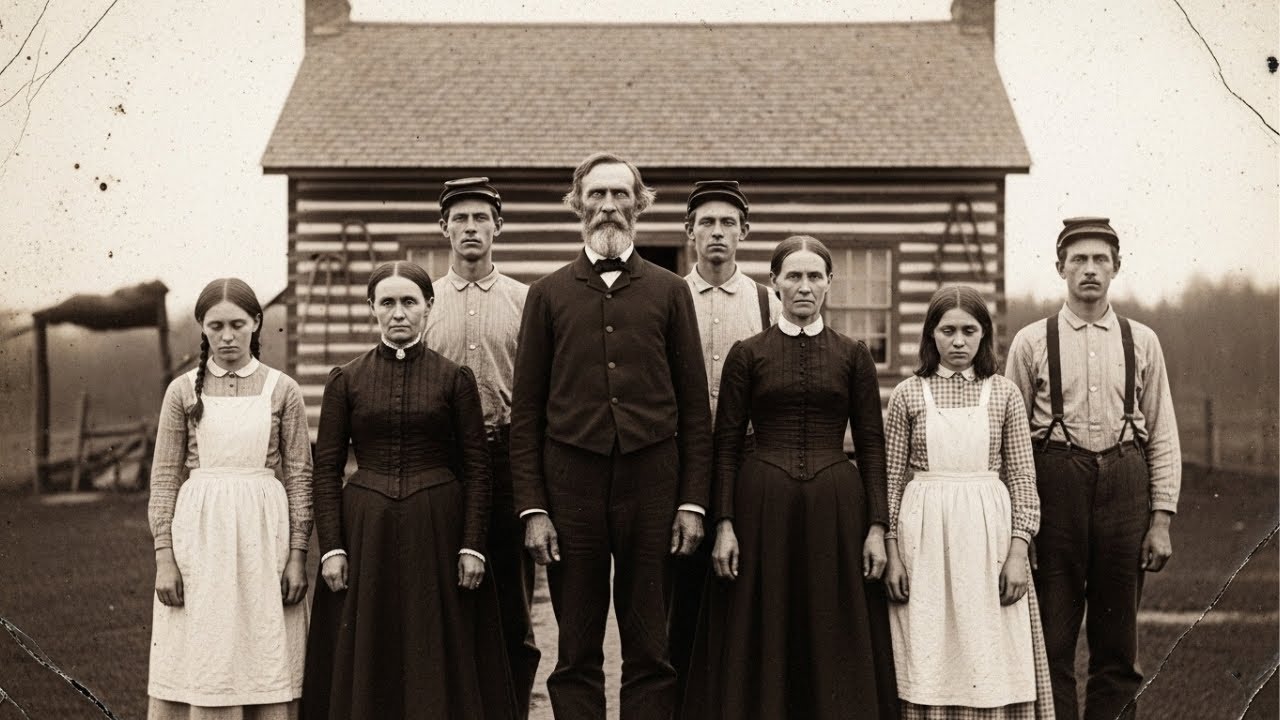
A memo dated March 1866 instructed agents in Louisiana and eastern Texas to remain alert for signs of the Holloway family, “known to have engaged in predatory activities in Missouri during the late conflict. ” The patriarch Ezekiel was described as tall and gaunt with a gray beard and cold demeanor. The family may have adopted an alias, but likely maintained its structure of father, mother, three sons, and two daughters. No follow-up reports have been discovered, suggesting the search yielded no results or was abandoned as the bureau focused on its primary mission of assisting freed slaves.
It wasn’t until 1961 that the story resurfaced in academic circles. Dr. Eleanor Whitfield, researching Civil War-era crimes for her doctoral dissertation at the University of Arkansas, discovered references to the Holloway case in military correspondence archived at the National Archives. Her initial interest was purely academic: the Holloway case represented an extreme example of how the breakdown of civil society during wartime could enable criminal behavior.
However, as she delved deeper into available records, she began to suspect that the scope of the Holloways’ activities might have been far greater than initially documented. In an interview published in the Arkansas Historical Quarterly in 1962, Dr. Whitfield described her growing fascination with the case. “What began as a footnote in my broader research into crime during the Civil War period gradually emerged as something far more significant.
The Holloway case offers a unique window into how completely moral structures can collapse under certain conditions. The family appears to have created its own internal value system entirely divorced from societal norms, maintaining this separate moral universe for years while presenting a facade of normalcy to those they encountered casually. ”
Dr. Whitfield’s subsequent investigation, combining archival research with archaeological examination of the former Holloway property, uncovered evidence that suggested the family’s activities may have begun years before the first official disappearances were noted and continued well beyond 1862.
County death records from as early as 1854 noted occasional disappearances of travelers in the White River area, though these were generally attributed to accidents or banditry. More significantly, similar patterns of disappearances could be traced along what appeared to be the Holloways’ route of flight after abandoning their Missouri homestead. The archaeological examination of the Holloway property presented significant challenges. The site had been burned in 1862, then subjected to decades of erosion and forest regrowth before being partially inundated by the creation of Bull Shoals Lake in the 1950s.
Dr. Whitfield secured permission from the Army Corps of Engineers and funding from the University of Arkansas to conduct limited excavations during the summer of 1963 when lake levels were at their lowest. Dr. James Thornton of the University of Missouri, who supervised the archaeological work, noted that “much of the site is now permanently underwater, and what remains has been heavily disturbed by the construction of the dam and subsequent shoreline erosion.
Nevertheless, we were able to locate the foundation of the main house and outbuildings, which corresponded precisely with the descriptions in Lieutenant Whitaker’s report. ”
Despite these challenges, the excavation yielded significant findings. The stone foundation of the root cellar remained largely intact, including the drainage system described by Private Jenkins. Metal artifacts recovered included iron shackles, hooks consistent with those used in slaughterhouses, and fragments of tools that had survived the fire.
Most significant were the human remains. Bone fragments from at least 23 individuals were recovered from what had been the root cellar and smokehouse areas. Analysis of these remains conducted at the Smithsonian Institution by Dr. Theodore Montgomery yielded disturbing insights into the Holloways’ practices.
“The bones exhibit clear evidence of systematic processing,” Dr. Montgomery reported. “Cut marks are consistent with butchery techniques used for livestock, made with sharp, well-maintained tools wielded by individuals with considerable experience. Many fragments show signs of having been exposed to smoke and heat, while others exhibit the characteristic staining associated with brine preservation.
”
Dr. Montgomery’s analysis also revealed that the victims represented a cross-section of the traveling population of the time. Based on skeletal indicators, the remains included adult males and females ranging in age from approximately 16 to 60 years, as well as at least two adolescents between 10 and 15 years of age. No infant or young child remains were identified, though this absence may reflect disposal practices rather than victim selection.
Perhaps most chilling were the personal artifacts recovered alongside the remains. Buttons, hair pins, dentures, and other small items had been carefully collected and organized in small wooden boxes, suggesting a ritualistic aspect to the killings that went beyond mere pragmatism. A partial journal, its pages nearly illegible from decades of exposure to the elements, contained what appeared to be recipes and preparation instructions that no researcher has been willing to quote directly. Dr.
Whitfield noted in her monograph only that the contents indicated a disturbing level of experimentation and refinement of techniques over time. The picture that emerged from Dr. Whitfield’s research was of a family that had developed a system for targeting, capturing, and processing travelers with terrifying efficiency. According to her analysis, the Holloways specifically targeted individuals who appeared to be traveling alone or in pairs and who were unlikely to be missed immediately.
They offered hospitality, a critical resource in the isolated Ozarks, and used the opportunity to assess potential victims. The isolation of the region and the disruption caused by the Civil War provided perfect cover for their activities, but evidence suggested they had been operating on a smaller scale for years before the conflict began. The war simply provided them with more opportunities and less risk of discovery. Further research by Dr.
Whitfield uncovered troubling indications that the Holloways’ activities in Missouri may have been a continuation of practices begun elsewhere. Records from eastern Tennessee, where the family reportedly originated, revealed a similar pattern of disappearances in Hancock County between 1843 and 1847. A sheriff’s report from 1847 mentioned an investigation into a family named Halloway after concerns expressed by neighbors regarding unusual activities, but the investigation was apparently abandoned when the family left the area. The report included a statement from a neighbor describing smoke from their chimney at odd hours and strange sounds in the night.
Though no direct evidence of wrongdoing was documented, the possibility that the Holloways had established their pattern of predation before arriving in Missouri added a disturbing dimension to the case. Dr. Whitfield wrote: “Rather than representing an aberrant response to the chaos of civil war, their activities may have been a long-established practice temporarily facilitated by wartime conditions. This suggests a level of intergenerational transmission of deviant behavior rarely documented in historical cases.
”
A particularly troubling aspect of the case, noted by several researchers, is how the family apparently normalized their behavior within their own social unit. The evidence suggests that even the youngest children participated in the processing of victims, indicating a complete moral inversion within the family structure. A journal entry recovered from the homestead, believed to be written by one of the daughters, dispassionately describes helping to prepare “the day’s yield,” as if discussing routine farm chores. This transformation of an entire family unit into what effectively functioned as a predatory organism represents a rare and frightening phenomenon that few criminologists have studied in depth.
Dr. Robert Lancaster of Vanderbilt University, who conducted a retrospective psychological assessment based on available historical records, suggested that Ezekiel Holloway likely exhibited characteristics consistent with what modern clinicians would classify as antisocial personality disorder. “The methodical nature of the killings,” Dr. Lancaster wrote in his 1966 analysis, “the apparent lack of remorse as evidenced by the continued practice over years, and the involvement of the entire family unit suggests a patriarch with extraordinary power to influence or intimidate those around him.
The record suggests Ezekiel Holloway created a closed system of morality within his family where normal social prohibitions were replaced by a utilitarian view of human life as merely another resource. ”
Dr. Lancaster’s assessment also addressed the question of how an entire family could participate in such activities. “Historical cases of family-based criminal behavior typically involve varying levels of participation, with some members serving as active participants and others as reluctant accomplices or silent witnesses.
The Holloway case is unusual in that all evidence points to full participation by all family members, including the younger children. This suggests either extraordinary coercion by the patriarch or a complete socialization into an alternative moral framework where the activities were normalized from an early age. ”
What remains unclear is the fate of the Holloway family after they fled their homestead in December 1862. Dr.
Whitfield’s research uncovered tantalizing clues that suggest they may have continued their practices elsewhere. Census records from 1870 list a family named Holland in northeastern Texas with similar ages and first names to the Holloways, and local newspapers from the area contain reports of disappearances similar to those in the Ozarks. A sheriff’s report from Bowie County, Texas, dated October 1871, mentioned concerns regarding travelers who have failed to arrive at expected destinations after passing through the northeastern part of the county, the same area where the Holland family had established a remote homestead. “The pattern is consistent,” noted Dr.
Whitfield. “Selection of an isolated location along a travel route. Establishment of a homestead with specific structural elements including a substantial root cellar and smokehouse. A period of apparent normalcy while the family integrated minimally with the surrounding community, followed by a series of disappearances that attracted little immediate attention due to the transient nature of the victims.
”
In 1965, a collection of letters was donated to the Arkansas Historical Society by the descendants of William Barnett, a Confederate soldier who returned to his home near Batesville, Arkansas after the war. One letter dated July 1867 describes an encounter with a strange family recently arrived from Missouri who invited him to dinner. Barnett writes that he declined the invitation after noticing something unsettling in their manner and “the way they looked at me as if assessing a horse for purchase. ” The family is not named, but the description of the patriarch as a tall, gaunt man with a long gray beard and cold eyes matches accounts of Ezekiel Holloway.
Barnett’s letter continues: “The homestead was well established for a family claiming to have arrived recently, with a substantial smokehouse that the eldest son seemed reluctant to allow me to approach when I expressed interest in its construction. I noted that despite the apparent prosperity of the property, there was a curious absence of livestock, save for two horses and a few chickens. When I inquired about this, the old man explained that they had not yet had time to acquire proper stock, but were adequately provisioned nonetheless. Something in his tone made my skin crawl, and I made my excuses to continue my journey despite the late hour.
”
Most intriguing is a notation in the records of the Texas Rangers dated March 1873 regarding an investigation into a family named Halloway living near the Sabine River. The record indicates that when rangers approached the isolated homestead, they found it recently abandoned with evidence of practices inconsistent with legitimate farming or hunting. The report mentions a substantial underground chamber containing implements of suspicious nature and barrels of preserved material that the accompanying physician declined to identify definitively. No further details are provided, and the investigation was apparently closed due to lack of evidence and the family’s disappearance.
The most recent development in the case came in 1968, when construction workers expanding Highway 63 near Hardy, Arkansas uncovered a mass grave containing the remains of at least 11 individuals. Analysis conducted by the Arkansas State Medical Examiner determined the remains dated to approximately 1867-1869, and several showed the same distinctive butchery marks as those found at the Holloway Homestead in Missouri. Local land records indicated that a family named Halloway had briefly owned property in the vicinity during that period before disappearing once again. The investigation was closed due to the age of the case and the presumed death of all involved parties, but the similarity to the Ozark killings was striking.
Dr. Malcolm Jenkins of the Arkansas State Medical Examiner’s Office, who examined the remains discovered near Hardy, noted in his report that “the consistency of the processing techniques with those documented in the Missouri case suggests either the same perpetrators or an identical methodology. The precision of the cutting marks, the systematic separation of specific body parts, and the evidence of preservation techniques all point to a continuation of the practices attributed to the Holloway family. ”
The discovery near Hardy provides the last concrete evidence of the Holloways’ activities.
Subsequent traces become increasingly speculative, though Dr. Whitfield identified several promising leads that she was unable to fully investigate before her death in 1967. Newspaper reports from eastern Texas in the mid-1870s mention a series of disappearances near Jefferson, then an important river port. A report in the Marshall, Texas Republican from November 1874 notes that “authorities are investigating the disappearance of several individuals who were last seen traveling the road between Jefferson and Shreveport.
The frequency of such incidents has raised concerns among the traveling public and prompted calls for increased patrols along major routes. ”
A particularly intriguing document discovered in the archives of the Texas State Asylum in Austin refers to a patient admitted in 1878 who claimed to be a former member of “a family of manhunters who operated along the borders of civilization. ” The patient, identified only as C. H.
in the records, was diagnosed with acute melancholia and delusions and died in the institution in 1879. Dr. Whitfield speculated that this might have been Caleb Holloway, the youngest son, who would have been in his early 30s at that time. Without more specific information, however, this connection remains speculative.
A final disturbing coda to the Holloway story emerged in 1968, when an elderly woman in a nursing home in Texarkana claimed to be Esther Holloway, the youngest daughter. According to staff reports, the woman, who had been admitted under the name Elizabeth Harrison, began making statements during episodes of dementia that referenced “helping father in the smokehouse” and “processing the travelers. ” When lucid, she denied these statements and refused to discuss her early life. Attempts to verify her identity proved inconclusive, and she died in early 1969 before researchers could conduct a thorough interview.
Whether this woman was actually Esther Holloway or simply an individual suffering from confabulation influenced by local legends remains unknown. Without further evidence, their ultimate fate remains as murky as the waters that now cover the scene of their original crimes. What drove the Holloway family to such extremes remains a matter of speculation. Some historians have suggested that the isolation of frontier life, combined with the moral breakdown that often accompanies war, created conditions where such behavior could emerge and continue unchecked.
Others point to reports from neighbors that the family had always been strange and kept to themselves, suggesting a predisposition to antisocial behavior that manifested in horrific ways when opportunity presented itself. Dr. Whitfield’s conclusion in her 1964 monograph suggests a more disturbing possibility: that the Holloways represented an extreme example of frontier pragmatism twisted into something monstrous in an environment where survival was never guaranteed. She writes: “The Holloways appear to have decided that other humans were simply another resource to be harvested.
Their methodical approach, their recordkeeping, their careful processing of remains all suggest not frenzied violence, but a calculated decision that human life was a commodity. The Civil War, with its widespread dehumanization of the enemy and general breakdown of social norms, may have simply provided additional justification for practices they had already begun. ”
The impact of the Holloway case on the surrounding communities was significant, though largely undocumented in contemporary records. Dr.
Whitfield’s research uncovered several indirect references to changes in local behavior following the discovery of the family’s activities. A letter from a Forsyth resident to relatives in St. Louis, dated spring 1863, mentions that “since the terrible discoveries at the Holloway place, travelers are viewed with more suspicion, and likewise, households that offer shelter to strangers are regarded with newfound wariness. The bonds of trust that once allowed survival in these isolated hills have been damaged in ways that may never fully heal.
” This erosion of trust in a region where mutual assistance had been essential for survival represents one of the more profound impacts of the Holloway case. The isolated nature of Ozark communities had fostered a tradition of hospitality toward travelers, a tradition that the Holloways exploited for their own purposes. The revelation of their activities introduced an element of suspicion into these interactions that, according to some accounts, persisted for generations. Today, the site of the Holloway Homestead lies beneath the waters of Bull Shoals Lake, inundated when the dam was constructed in the 1950s.
The flooding occurred before the full archaeological significance of the site was recognized, resulting in the permanent loss of potential evidence. Perhaps it is fitting that this place of horror has been erased from the landscape, though the story itself refuses to remain submerged. The fragmentary records, the archaeological evidence, and the chilling details preserved in military correspondence continue to paint a picture of methodical evil that challenges our understanding of human nature. Local folklore in the Ozarks has incorporated elements of the Holloway story, though often with supernatural embellishments that the historical record does not support.
Tales of hauntings near the original homestead site persist, with fishermen on Bull Shoals Lake occasionally reporting strange sounds or unexplained lights near where the property once stood. Historians attribute these stories to the natural human tendency to process extreme horror through supernatural frameworks rather than accepting the more disturbing possibility that the Holloways’ actions represented a rational choice made by humans not fundamentally different from ourselves. Dr. James Thornton, who participated in the archaeological excavation of the Holloway site, commented on this phenomenon in a 1967 article.
“Folklore surrounding the Holloway case frequently introduces supernatural elements: spirits of victims seeking vengeance, inhuman abilities attributed to family members, curses associated with the land itself. These narratives serve a psychological function, allowing communities to distance themselves from the uncomfortable reality that the perpetrators were, in fact, ordinary humans who made extraordinary moral compromises. The supernatural framework places the events outside the realm of normal human experience, when in fact the historical record suggests a methodical, rational approach to predation that is perhaps more disturbing than any ghost story. ”
What became of the Holloways themselves?
The trail grows cold after the Hardy, Arkansas discoveries in the late 1860s. Some researchers speculate that they may have continued their nomadic existence, moving whenever suspicions arose, possibly changing their name with each relocation. Others suggest that they eventually met with violence themselves, perhaps at the hands of an intended victim who realized their true nature. A newspaper article from Shreveport, Louisiana, dated 1876, briefly mentions the murder of an elderly man with a long gray beard, whose body was found with his throat cut in a boarding house.
The article notes that no one claimed knowledge of the deceased, who had arrived in town only days before. But there is insufficient evidence to connect this incident definitively to Ezekiel Holloway. Dr. Whitfield, in her final paper on the subject published shortly before her death in 1967, proposed that the family may have eventually dispersed, with the younger members integrating into other communities and suppressing their past.
Census records from 1880 show individuals with matching first names and approximate ages scattered across Texas, Arkansas, and Louisiana, though without DNA evidence, no definitive connections can be established. “Perhaps the most disturbing possibility,” Dr. Whitfield wrote, “is that descendants of the Holloways live among us still, carrying genetic heritage if not the behavioral patterns of one of America’s most methodical predatory families. ”
The Holloway case file in the Missouri State Archives remains open, technically unsolved, though all participants are presumed deceased.
The most enduring legacy of the Holloway case may be its illustration of how quickly the veneer of civilization can be stripped away under the right circumstances. In the isolated hollows of the Ozarks, with the structure of society crumbling under the weight of civil war, the Holloways created their own moral universe where human life held value only as a resource to be exploited. Their story serves as a stark reminder of the darkness that can emerge when opportunity and isolation combine with a fundamental disregard for human dignity. The Holloway family story is preserved primarily in fragments: military reports filed by men with more pressing concerns, land records documenting ownership without revealing what occurred on that land, archaeological evidence that speaks to what happened but not why.
Perhaps this fragmentary nature makes the case all the more unsettling. Like a puzzle with key pieces missing, it allows our minds to fill in the gaps with horrors that may exceed even the reality. The Ozarks have changed dramatically since 1862. Highways now cross what were once nearly impassable mountains.
Tourists flock to lakes created by dams. And the isolation that sheltered the Holloways has largely vanished. Yet travelers in the region still occasionally report an uneasy feeling when passing certain remote stretches of road as darkness falls. Local folklore maintains that the spirits of the Holloways’ victims remain restless.
But perhaps what truly haunts these mountains is not the supernatural, but the knowledge that such calculated evil once found harbor there, hiding behind a facade of frontier hospitality. As one elderly resident of Taney County told Dr. Whitfield during her research: “Some stories ain’t meant to be forgotten, even when they curdle your blood to hear them. The Holloways are gone, but remembering what they did might just make folks a bit more careful about who they trust and where they stop when traveling these hills.
” In a region where hospitality remains a point of pride, the Holloway case stands as a dark counterpoint, a reminder that sometimes an invitation to supper can conceal the most sinister of intentions.
