Inside a cluttered office in suburban Pennsylvania, on a Saturday afternoon in the fall of 1979, a benefits consultant named Ted Benna sat flipping through the Internal Revenue Code. He was looking for a way to design a tax-efficient retirement savings plan for a banking client, and as he worked, his eyes landed on a short, technical provision buried deep in the tax law: Section 401, subsection K. It had been written to address a narrow issue, the tax treatment of cash or deferred compensation arrangements used for executives. But Benna saw something in those words that nobody else had grasped.
The language could be read far more broadly than its authors intended. It could be used to create a plan where all employees, not just executives, could contribute a portion of their own salary on a pre-tax basis, with employers adding matching contributions. In Benna’s own words, it was an aggressive interpretation. There was nothing in the law explicitly saying ordinary workers could contribute their own pre-tax money, but there was also nothing saying they couldn’t.
Benna saw the gap and drove a truck through it. He designed a plan based on that reading and pitched it to his client, who turned him down, worried the IRS would catch on and shut the whole thing down. Benna was not deterred. He implemented the plan at his own company, making it the first 401(k) savings plan in the United States.
He then introduced the concept to Treasury officials and helped shape the regulations that would govern it. In 1981, the IRS formally sanctioned the 401(k) as a retirement savings vehicle funded through salary deductions, and the door swung open. Today, more than 60 million Americans put money into a 401(k) with every paycheck. It has become so embedded in how we think about work and retirement that most people assume it has always been there, like some ancient pillar of American life.
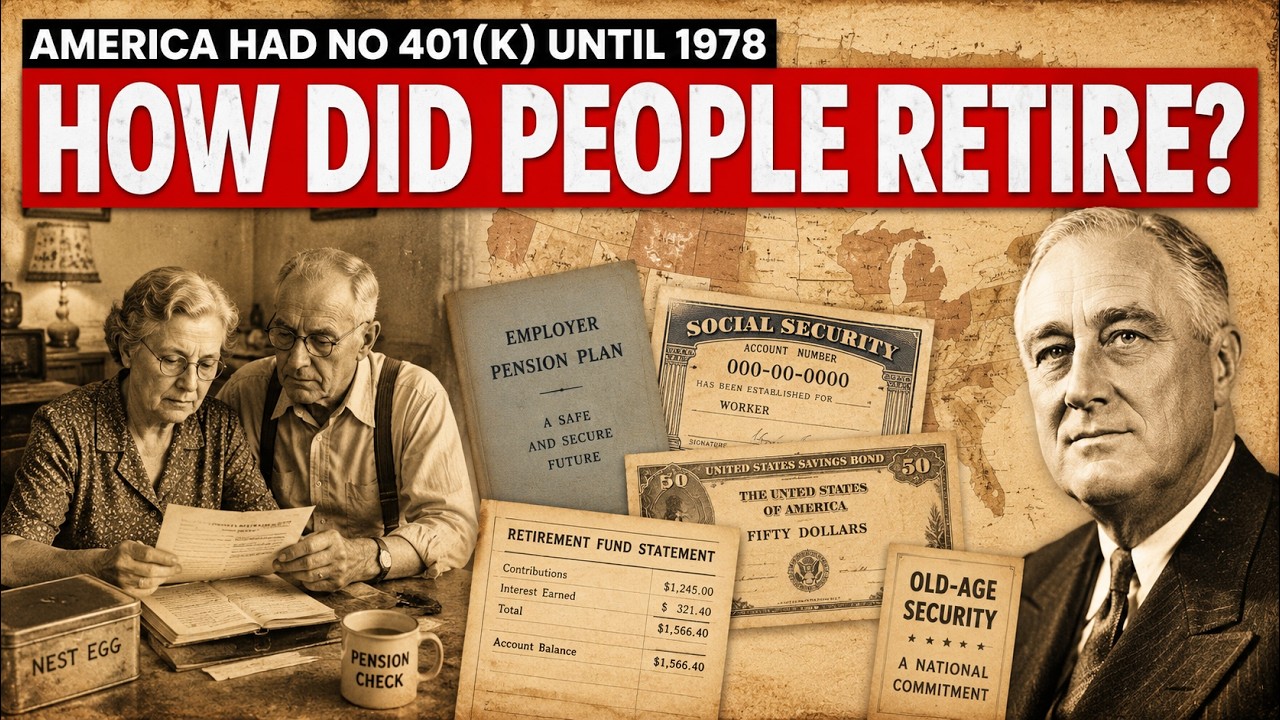
But the 401(k) did not exist until 1978, and it was not even used until 1980. That means your grandparents, and in many cases your parents, lived in a completely different world when it came to growing old and stopping work. A world where the concept of retirement itself was barely a concept at all. So if there was no 401(k), no target date funds, no employer match, no Roth conversion ladders, how on earth did people retire?
The answer is darker and more revealing about the nature of American capitalism than most people realize, because for the vast majority of American history, retirement wasn’t a right. It wasn’t even an expectation. It was a luxury almost nobody could afford. And the road from that brutal reality to the system we have today is paved with broken promises, corporate betrayals, political accidents, and one man’s creative reading of a page and a half of tax code.
For most of human history, there was no such thing as retirement. People worked until they physically couldn’t anymore, and then they either relied on their children, their community, or they simply died. In 1900, the average global life expectancy was just 31 years. In the United States, it hovered around 47.
Most people didn’t live long enough to need a retirement plan. The question of what happens when you get too old to work was, for most of civilization, answered by a grim and simple truth: you kept working, or you perished. There was no dignified middle ground. Then the Industrial Revolution changed everything.
As America transformed from an agrarian society into an industrial powerhouse in the late 1800s, the entire fabric of how families lived and worked was torn apart. Before industrialization, most Americans lived on farms. Families were large, and for good reason. Children weren’t just a legacy; they were a labor force and a retirement plan.
When a farmer got too old to plow the fields, his sons and daughters took over. The elderly stayed on the family land contributing what they could, cared for by the same household they had spent their lives building. It wasn’t glamorous and it wasn’t always kind, but it was a system. It had worked for centuries.
Then the factories came. Young people flooded into cities like Pittsburgh, Cleveland, Chicago, and New York, chasing wages and a new kind of life. The geographic bond that had held families together for generations was suddenly severed. Sons and daughters who once would have stayed on the family farm were now hundreds of miles away working twelve-hour shifts in steel mills and textile factories.
The parents they left behind were on their own. And for the elderly who couldn’t work, who had no family nearby, and who had no savings, there was only one place left to go: the poorhouse. Poorhouses, also known as almshouses, were public institutions that existed from the colonial era into the early twentieth century. Operated by local governments, they were designed as a catch-all solution for anyone who couldn’t support themselves.
The elderly, the sick, people with disabilities, orphans, widows, and the mentally ill were all thrown together under one roof. These were not places of comfort or dignity. They were places of last resort, and everyone in America knew it. By the 1880s, the poorhouse had become so deeply feared that a ballad called Over the Hill to the Poorhouse by Will Carleton became one of the most popular songs in the country.
It told the story of an elderly woman abandoned by her children, making her final journey to the local almshouse. It struck a nerve because it reflected a reality that millions of Americans either lived or dreaded. The poorhouse wasn’t just an institution; it was a symbol of what happened when you outlived your usefulness in a society that measured human value by productivity. In the biggest cities, the poorhouses were enormous.
Bellevue Almshouse in New York City, which later became Bellevue Hospital, and the Cook County Alms House in Chicago, which became Cook County Hospital, were sprawling complexes that housed thousands of people in miserable conditions. The residents, often called inmates, lived in overcrowded dormitories with minimal food, minimal medical care, and almost no privacy. For the elderly who ended up there, it was usually where they would spend the rest of their days. And here was the most telling part: as reformers throughout the 1800s managed to remove other groups from the poorhouses, children to orphanages, the mentally ill to asylums, those convicted of crimes to prisons, the one group that remained, the permanent residents who had nowhere else to go, were overwhelmingly the elderly.
The poorhouse became, in effect, America’s first retirement home. Except it wasn’t a home. It was a warehouse for people society had discarded. The dread of ending up in the poorhouse shaped how entire generations thought about money, about saving, about the meaning of self-sufficiency.
To end up there wasn’t just a financial failure; it was a moral one. Society told you that if you ended up there, it was your fault. You hadn’t worked hard enough, hadn’t saved enough, hadn’t been enough. That shame was a feature, not a bug, of the system, meant to motivate people to avoid dependency at all costs.
But for most working-class Americans, no amount of hard work or discipline could protect them from the economic realities of old age in an industrial economy. There were early exceptions to this bleak picture. Fraternal societies and religious groups created their own safety nets. Irish benevolent societies, German mutual aid organizations, Jewish charitable funds, and fraternal orders like the Odd Fellows and the Masons established homes for their aging members.
These groups operated like early insurance programs: members paid monthly dues while they were young and working, and in return they received care and housing when they grew old. In Brooklyn alone, by the end of the 1800s, you could find dozens of these facilities: the Baptist Home, the Brooklyn Home for the Aged, the German Evangelical Home. The Little Sisters of the Poor opened a home in Washington, D. C.
in 1873 that provided housing and care regardless of religion or race. These organizations offered a far better alternative to the poorhouse, but they were limited. They only served their own members or their own communities. For the vast majority of working Americans, there was nothing.
Then, in 1875, something happened that planted the very first seed of what would eventually become the modern retirement system. The American Express Company established the first private corporate pension plan in the United States. At the time, American Express was primarily a railroad-related freight company, not the credit card giant we know today. The pension applied to workers who had been with the company for at least twenty years, had reached the age of sixty, had been recommended for retirement by a manager, and had been approved by a committee and the board of directors.
If you met all those conditions, you could receive half of your annual salary in retirement, up to a maximum of $500 per year. It sounds modest, and it was, but it was revolutionary. For the first time, a private company was acknowledging that it had some responsibility for the well-being of its workers after they stopped working. The idea spread slowly.
By the turn of the twentieth century, some of the largest corporations in America had followed suit. Standard Oil, U. S. Steel, AT&T, Eastman Kodak, Goodyear, and General Electric all created pension plans before 1930.
The Revenue Act of 1913 even gave these plans a boost by making employer contributions to pensions exempt from federal corporate income tax. But there was a critical detail most people overlook: these pensions covered a tiny sliver of the American workforce. By 1926, only about 200 private pension plans existed in the entire country. And as late as 1932, only 15% of American workers had access to any kind of company pension.
That meant 85% of the workforce was on their own. And even for those who did have a pension, there was a terrifying catch. These early plans had virtually no legal protections. There was no law requiring companies to actually set aside money to pay future benefits.
There was no regulation requiring them to honor their promises. A company could offer a pension, take credit for the goodwill it generated, and then revoke it at any moment for any reason. Workers could spend thirty years building their careers at a company, counting on a pension that had been promised to them, only to find out on the day they retired that the money simply wasn’t there. This wasn’t theoretical.
It happened constantly. Before the pension problem fully revealed itself, America was hit by something far worse: the Great Depression. When the stock market crashed in October of 1929, it didn’t just destroy wealth; it destroyed the very idea that individuals could take care of themselves in old age. More than 9,000 banks failed between 1930 and 1933, and with them went the life savings of millions of ordinary Americans.
People who had been responsible, who had saved diligently their entire lives, suddenly had nothing. The elderly were hit hardest of all. Older workers were the first to be laid off during the Depression and the last to be rehired. By 1934, approximately half of all elderly Americans were not financially self-sufficient.
One quarter of the entire workforce was unemployed. The poorhouses that had been slowly declining in relevance were suddenly overflowing again. Millions of elderly Americans found themselves destitute, with no income, no savings, no pension, and no family able to support them, because their families were struggling too. The scale of elderly poverty during the Depression created a political crisis the federal government could no longer ignore.
President Franklin Delano Roosevelt understood that the old ways of dealing with poverty and old age, family support, charity, the poorhouse, were completely inadequate for a modern industrial economy. On August 14, 1935, Roosevelt signed the Social Security Act into law. It was one of the most transformative pieces of legislation in American history. For the first time, the federal government created a permanent, compulsory social insurance program that would provide monthly retirement benefits to workers.
It was funded by payroll taxes, split between employees and employers, and it promised something that had never existed before in America: a guaranteed income floor for the elderly. But Social Security was never designed to be the sole source of retirement income. It was deliberately modest. The initial benefits were small, and the program was limited, covering only workers in commerce and industry, and excluding agricultural workers, domestic servants, and the self-employed, which disproportionately left out Black Americans and women.
The first monthly benefits weren’t even paid out until 1940, and the average monthly benefit in those early years was about $22. Still, the psychological impact was enormous. For the first time, Americans had a promise from their government that they would not be left destitute in old age. The poorhouse was no longer the inevitable final destination for those who outlived their ability to work.
Social Security also served a second, more strategic purpose that is often overlooked. By encouraging older workers to leave the labor force, it freed up jobs for younger, unemployed Americans during one of the worst economic crises in the nation’s history. It was simultaneously a humanitarian act and an economic stimulus, getting purchasing power into the hands of elderly citizens who would spend it immediately while making room for younger workers who desperately needed employment. Over time, the program expanded significantly.
In 1939, benefits were extended to the spouses and children of retired workers and to survivors of deceased workers. In 1956, disability insurance was added. In 1965, Medicare was signed into law by President Lyndon Johnson, providing health insurance to Americans sixty-five and older, plugging another enormous gap in the safety net. Today, the program single-handedly keeps 22 million Americans out of poverty.
But Roosevelt and the architects of Social Security always envisioned it as just one leg of a three-legged stool. The first leg was Social Security itself, the second was the employer-provided pension, and the third was personal savings. Together, these three sources of income were supposed to provide a comfortable and secure retirement. For a while, at least for some people, the three-legged stool actually worked.
The post-war economic boom of the 1940s and ’50s was a golden era for American workers. Unions were powerful, wages were rising, and large employers were competing fiercely for labor. Offering a generous pension became a standard tool for attracting and retaining workers, especially in manufacturing. By 1970, about 45% of all private sector employees were covered by some kind of pension plan.
If you worked for General Motors, Ford, US Steel, or any of the other corporate giants of mid-century America, you could reasonably expect that after thirty years of loyal service, you would retire with a monthly check that, combined with Social Security, would allow you to live comfortably for the rest of your life. This was the era that shaped the image of retirement that still lives in our collective imagination: the gold watch ceremony, the lakeside cottage, the afternoon spent gardening or fishing. It was real for a generation of American workers, and it felt permanent. But it was built on a foundation far more fragile than anyone realized.
The first major crack appeared in 1963 in South Bend, Indiana, at a company called Studebaker. Studebaker was one of America’s oldest and most storied manufacturers, founded in the 1850s as a wagon-making business. The five Studebaker brothers started as blacksmiths, moved into building wheelbarrows during the Gold Rush, supplied wagons to the Union Army during the Civil War, and eventually transitioned into making automobiles. For decades, Studebaker cars were well-regarded for their quality and design, but behind the scenes, the company’s finances were a mess.
By the early 1960s, Studebaker was struggling to compete with the Big Three automakers: General Motors, Ford, and Chrysler. Sales were declining, costs were rising, and the company was bleeding money. And there was another problem nobody on the factory floor fully understood: Studebaker’s pension fund was severely underfunded. The company had been promising generous retirement benefits to its workers for years, but it hadn’t been setting aside nearly enough money to actually pay for those promises.
In December of 1963, Studebaker closed its production plant in South Bend. Shortly afterward, the company terminated its retirement plan for hourly workers, and the plan defaulted on its obligations. The consequences were devastating. At the time, the pension plan covered roughly 10,500 workers.
About 3,600 of them had already retired and, in a stroke of relative luck, received their full benefits because annuities had already been purchased for them. But approximately 4,000 workers between the ages of 40 and 59, people who had given decades of their lives to the company, received only about 15 cents for every dollar of benefits they had been promised. Their average age was 52. Their average years of service were 23.
They had spent the best years of their working lives building Studebakers, and they got almost nothing in return. Another 2,900 employees with less than ten years of service received absolutely nothing at all. The Studebaker disaster was a gut punch to the American worker. It exposed a terrifying reality that had been hiding in plain sight: a company’s pension promise was only as good as its willingness and ability to fund it.
There were no federal laws requiring companies to adequately fund their pensions. There was no insurance program to protect workers if a pension plan failed. There was no safety net whatsoever. And Studebaker wasn’t an isolated case.
This was happening across the country, in industries ranging from textiles to steel to meat packing. Workers were losing their promised pensions every time a company went bankrupt or simply decided it didn’t want to honor its commitments anymore. Studebaker was just the case that finally captured the public’s attention. The collapse didn’t lead to immediate reform.
It took more than a decade of political wrangling, jurisdictional disputes between congressional committees, and intense lobbying from both unions and business groups before anything was done. Senator Jacob Javits of New York introduced legislation to protect pension benefits shortly after the Studebaker disaster, but progress was painfully slow. The infamous Teamsters boss Jimmy Hoffa’s conviction on pension fraud charges added even more urgency. Finally, on September 2, 1974, a date that fell on Labor Day, in a deliberate nod to the workers who would benefit, President Gerald Ford signed the Employee Retirement Income Security Act into law.
ERISA, as it came to be known, was a landmark piece of legislation. It created the Pension Benefit Guaranty Corporation, or PBGC, a government agency that functions like an insurance company for traditional pension plans. If a company with a pension plan goes bankrupt and can’t pay what it promised, the PBGC steps in to pay retirees a guaranteed portion of their benefits. ERISA also established minimum standards for how pension plans must be funded, how benefits must be vested, and how workers must be informed about their rights.
For the first time, there were real legal protections for workers’ retirement benefits. A Studebaker-style collapse was, at least in theory, never supposed to happen again. But ERISA also had an unintended consequence that would reshape the entire retirement landscape. By imposing new regulations, funding requirements, and administrative costs on traditional pension plans, ERISA made pensions significantly more expensive and complicated for employers to maintain.
Many smaller companies that had been offering modest pension plans simply couldn’t afford to comply with the new rules. Larger companies began looking for alternatives that would shift the financial risk away from themselves and onto their employees. The ground was being prepared for a seismic shift. The catalyst arrived in 1978, buried inside an obscure piece of tax legislation that almost nobody noticed.
The Revenue Act of 1978 was a sprawling overhaul of the federal tax code. Among its hundreds of provisions was a short, seemingly technical section tucked under Section 401 of the Internal Revenue Code, subsection K. This provision was originally intended to address a narrow issue: how to handle the tax treatment of certain cash or deferred compensation arrangements that companies used for their executives. It was written to limit the ability of corporations to create tax-advantaged profit-sharing plans that mostly benefited highly paid employees.
The entire provision was only about a page and a half long. Nobody in Congress thought it was a big deal. It wasn’t debated on the floor. It wasn’t covered in the newspapers.
It simply became law and sat there waiting. For two years, nothing happened. The provision became effective on January 1, 1980, but there were no regulations written to implement it, and nobody was rushing to figure out what to do with it. Then came Ted Benna’s Saturday afternoon in the fall of 1979.
After Benna implemented the plan at his own company, The Johnson Companies, making it the first 401(k) savings plan in the United States, he used his business connections to introduce the concept to Treasury officials and helped steer the regulatory framework that would govern these new plans. In 1981, the IRS issued regulations formally sanctioning the 401(k) as a retirement savings vehicle funded through salary deductions. The door was officially open. What happened next was an explosion.
By 1982, major corporations like Johnson & Johnson, Pepsico, and Honeywell were racing to set up 401(k) plans. The mutual fund industry saw an enormous new market and began designing products specifically for these plans. Financial services firms, brokerages, and insurance companies all piled in, eager to manage the trillions of dollars that would eventually flow through the system. Wall Street had found a new gold mine, and American workers were the ones filling it.
By the mid-1980s, the 401(k) was everywhere. And as it grew, something else was quietly disappearing: the traditional pension. At the peak in 1975, private sector defined benefit pension plans had around 27 million active participants. By 2019, that number had been cut by more than half, to about 12.
6 million. Meanwhile, defined contribution plans like the 401(k) soared from 11 million participants to over 85 million in the same period. The shift was dramatic, rapid, and largely irreversible. Companies had powerful incentives to make the switch.
A traditional pension is a defined benefit plan, meaning the employer promises a specific monthly payment at retirement and bears all the investment risk. If the stock market crashes, or interest rates drop, and the pension fund doesn’t have enough money, the company has to make up the difference. With the 401(k), which is a defined contribution plan, the employer’s obligation ends the moment the matching contribution hits the account. Whatever happens after that, whether the market goes up or down, whether the employee makes wise investment choices or terrible ones, is entirely the employee’s problem.
The 401(k) didn’t just change how Americans saved for retirement; it fundamentally transferred the risk of retirement from corporations to individuals. And this transfer happened so gradually, so quietly, that most workers didn’t fully understand what was happening until it was too late. The original proponents of the 401(k) have been remarkably candid about this. Many of them have publicly said that the plan was never designed to be a primary retirement vehicle.
It was supposed to supplement pensions and Social Security, not replace them. The forecasts used to sell the plan in its early days were, by their own admission, too optimistic. And Ted Benna himself, the man who created the whole thing, has become one of its loudest critics. He has spoken publicly about how the system has been corrupted by high fees, how it opened the door for Wall Street to extract enormous profits from ordinary workers’ retirement savings, and how he regrets that it helped push out traditional pensions, especially for workers who now must manage their own retirement funds without the expertise or resources to do it effectively.
The numbers tell a sobering story. According to the Employee Benefit Research Institute, nearly half of Americans age fifty-five and older have no retirement savings at all. The average American savings account holds about $41,700, but the median, a far more telling number, is only $5,300. When the median is that far below the average, it means a small number of people at the top are pulling the average up, while the vast majority have almost nothing.
For all the innovation, all the legislation, all the financial engineering of the past century and a half, millions of Americans today face a retirement crisis that would be disturbingly familiar to their great-grandparents. They work until they can’t anymore. They rely on family when family is available. They depend on a government program, Social Security, that was never designed to be their sole source of income.
And they hope, against growing evidence, that it will be enough. The three-legged stool that Roosevelt envisioned is, for millions of Americans, collapsing. One leg, the pension, has all but disappeared from the private sector. Another leg, personal savings through the 401(k), is failing the majority of workers who either don’t have access to one, can’t afford to contribute enough, or make poor investment decisions because they were never taught how to manage money.
And the third leg, Social Security, is under constant political threat, with debates about benefit cuts, eligibility age increases, and the program’s long-term solvency dominating Washington every few years. Every phase of this evolution was presented as progress. The poorhouse gave way to company pensions. Pensions gave way to Social Security.
Social Security was supplemented by 401(k) plans. Each step was framed as an improvement, a modernization, a better way to handle the ancient problem of growing old without income. And each step did help some people. Pensions gave a generation of factory workers a dignified retirement.
Social Security lifted millions of elderly Americans out of poverty. The 401(k) allowed disciplined savers and high earners to build substantial retirement wealth, especially during the long bull markets of the 1990s and 2000s. But at every step, the benefits were unevenly distributed. Pensions were available to some workers but not others, and they could be revoked without warning.
Social Security excluded entire categories of workers for decades. The 401(k) rewards those who can afford to save and punishes those who can’t, and it generates enormous fees for the financial industry regardless of whether workers’ investments actually grow. The story of retirement in America is, at its core, a story about who bears the risk of growing old. For most of American history, that risk fell entirely on individuals and their families.
Then, for a brief and remarkable period in the mid-twentieth century, employers and the government shared that risk through pensions and Social Security. And now, through the rise of the 401(k), that risk has been steadily shifted back onto individuals, who are expected to navigate complex financial markets with little guidance, high fees, and no guarantee of success. The poorhouse is gone, thankfully, but the fear that drove people to dread it, the fear of aging without resources, without support, without dignity, is alive and well in America today. It just wears a different face.
Instead of over the hill to the poorhouse, it’s a retirement calculator on a financial website showing you in cold, digital numbers that you don’t have enough, that you’ll never have enough, that the system designed to protect you was never really designed for you at all. And maybe that’s the most important lesson from this entire history. The 401(k) wasn’t created by some grand social engineering project to help American workers retire in comfort. It was an accident.
A page and a half of tax code, a benefits consultant with a creative interpretation, and an IRS that said, “Sure, why not? ” The entire retirement system that 60 million Americans now depend on was, in the words of the people who created it, never meant to carry this weight. The next time you log into your 401(k) account and see that balance, whether it’s six figures or $600, remember this: the system you’re relying on is younger than most of the people using it. It was built by accident, embraced by corporations because it saved them money, expanded by Wall Street because it made them money, and left to individuals because nobody else wanted the responsibility.
That’s the real story of how America retires, and if history is any guide, the next chapter is already being written by forces most of us won’t see coming until it’s too late.
