In late 1992, during the expansion of State Route 54 in San Diego County, heavy machinery digging into the earth brought up something unexpected. Richard Cerutti, the paleontologist on duty, noticed unusual bone fragments caught in the equipment. They belonged to a massive mastodon, an animal that should not have been there under the circumstances the bones suggested. What made the site strange was not just the presence of the remains, but the way they lay.
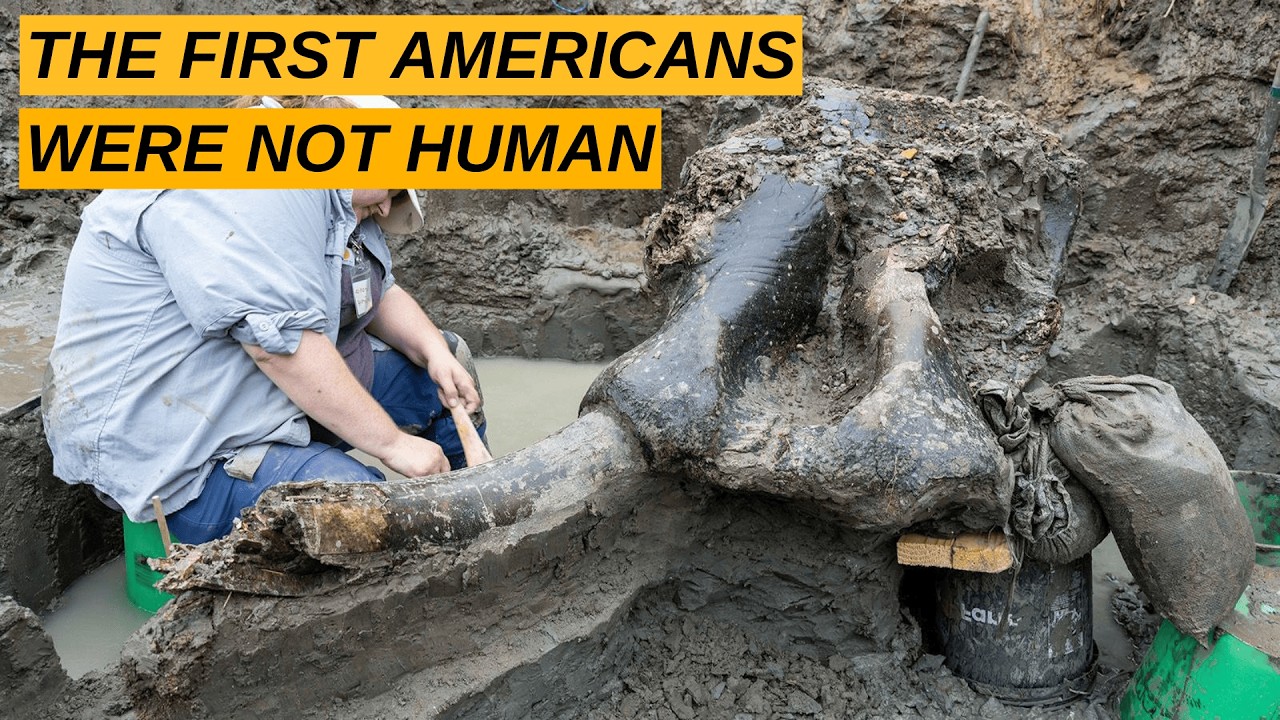
A mastodon tusk was embedded vertically in the soil. The bones were scattered, not arranged as if from a natural death. Large stones lay alongside them, stones that did not belong to the fine-grained sediments of the area. One weighed nearly thirty pounds.
River currents could not have carried rocks that heavy into that position. The pattern pointed toward deliberate violence. Cerutti began to suspect the site was a bone-processing location, a place where someone had butchered the animal, broken its bones, and extracted the marrow. Proving that idea to the scientific world would take twenty-five years.
For decades, the accepted story of the peopling of the Americas held that humans first crossed from Asia into the continent via the Bering Strait near the end of the last ice age, roughly 13,000 to 15,000 years ago. According to the Clovis-first theory, the first Americans were spear-wielding mammoth hunters who arrived during that narrow window. The San Diego discovery threatened to overturn that entire framework. If the stones were tools and the bones were broken by hominins, then the site was not a few thousand years older than the Clovis culture.
It was more than a hundred thousand years older, a timeline that placed human presence in the Americas in a completely different chapter of human prehistory. The main obstacle to confirming the find was dating. The technology required to accurately date such ancient bones did not exist at the time of the discovery. That changed in 2011 and 2012, when scientists from the United States Geological Survey applied advanced techniques measuring uranium and thorium ratios within the bones.
The results were staggering. The mastodon had died around 140,000 years ago. At that time, modern humans, Homo sapiens, had not yet migrated out of Africa in large numbers. The Americas were presumed to be completely empty.
If the San Diego site was genuinely the result of human or hominin activity, then some other human species had been present in the Americas more than 130,000 years before anyone had ever imagined. The study, published in the journal Nature, presented a detailed forensic case. Researchers argued that the fractures on the mastodon’s femur bones occurred while the bone was still fresh, a process known as green bone fracture. Instead of breaking in the brittle patterns of dry bone, the femurs had snapped in spiral patterns, the kind produced when a heavy object such as a hammerstone strikes fresh bone to reach the nutritious marrow inside.
To support this claim, the team conducted experiments on modern elephant bones, breaking them with stones similar to those found at the site. The fracture patterns were strikingly similar. The stones themselves showed wear marks consistent with being struck against other stones or bones. Archaeologist Richard Fullagar of the University of Wollongong noted that the marks matched what would be expected from tools used in bone-breaking activities.
Crucially, the stones did not match the local geology. Someone had carried them there. Extraordinary claims require extraordinary scrutiny, and the Cerutti Mastodon site quickly became one of the most controversial claims in American archaeology. Leading archaeologists around the world voiced strong objections.
The central problem was the absence of a clear human signature. There were broken bones and large stones, but no flaked stone tools, no spear points, and, most critically, no human remains. At sites from this period, one would normally expect to find stone flakes or hand axes. None were found at Cerutti.
Skeptics proposed alternative explanations. Heavy construction equipment could have broken the bones. Natural processes might have transported the stones. In response, team member Steve Holen argued that some archaeological sites in the Americas functioned solely as bone-processing locations where stone tools were not left behind.
According to Holen, these hominins came only to extract marrow or to use bones as raw material for tools, employing crude stones as hammers and anvils before moving on. If the traces at Cerutti truly belonged to a human species, the question became who. Around 130,000 years ago, while Homo sapiens remained largely confined to Africa, other human species lived across Eurasia. The Neanderthals, our cold-adapted cousins, occupied much of Europe and western Asia.
The mysterious Denisovans inhabited parts of Asia. The older species Homo erectus still existed in some regions. If Neanderthals or Denisovans had reached the Americas, how did they get there? The world at that time was in a warm interglacial period, before the last ice age, and sea levels were considerably higher than they are today.
The Bering Strait was submerged. A land crossing was impossible. The implication was that these ancient explorers must have crossed the ocean by boat or raft, a scenario that would force a fundamental rethinking of early human seafaring abilities. Similar-aged finds on Crete had demonstrated that early humans could travel by sea, but a voyage from Siberia to the Americas would have been a far greater challenge.
The discovery also drew comparisons to tool use among primates. Capuchin monkeys in Brazil and chimpanzees in Africa are known to use stones as hammers. But lifting a thirty-pound stone and shattering a mastodon femur would require strength far beyond that of a small monkey. Such force pointed instead toward human-like anatomy.
Geological evidence deepened the mystery. The sedimentary layers at the site indicated slow-moving, low-energy waters, conditions incapable of transporting heavy stones. That anomaly strengthened the argument that the stones had been deliberately carried to the location. Today, the Cerutti Mastodon site remains unresolved.
The bones rest in the archives of the San Diego Natural History Museum, at the center of an ongoing scientific debate. Tom Deméré and his team continue to defend their interpretation. They are now conducting protein residue analyses on the stones, searching for traces of mastodon tissue. If microscopic residues are found within the pores of the stones, it would provide definitive proof that they were used to break bones.
The site may yet illuminate a lost chapter of the American continent, suggesting that different human species inhabited this land far longer than previously imagined. For now, the evidence consists of broken bones, displaced stones, and a date reaching back 130,000 years. Those silent witnesses suggest that the story of the discovery of the Americas stretches far beyond Columbus, far beyond the Vikings, and far beyond the Clovis hunters, into a region of human history that remains largely unknown.
The secret buried beneath the San Diego highway may only be the beginning.
