October 1946. Lucky Luciano cut off every numbers runner in Harlem between one night and the next. Three men were dragged from an alley on West 138th Street. Twelve thousand dollars disappeared before dawn.
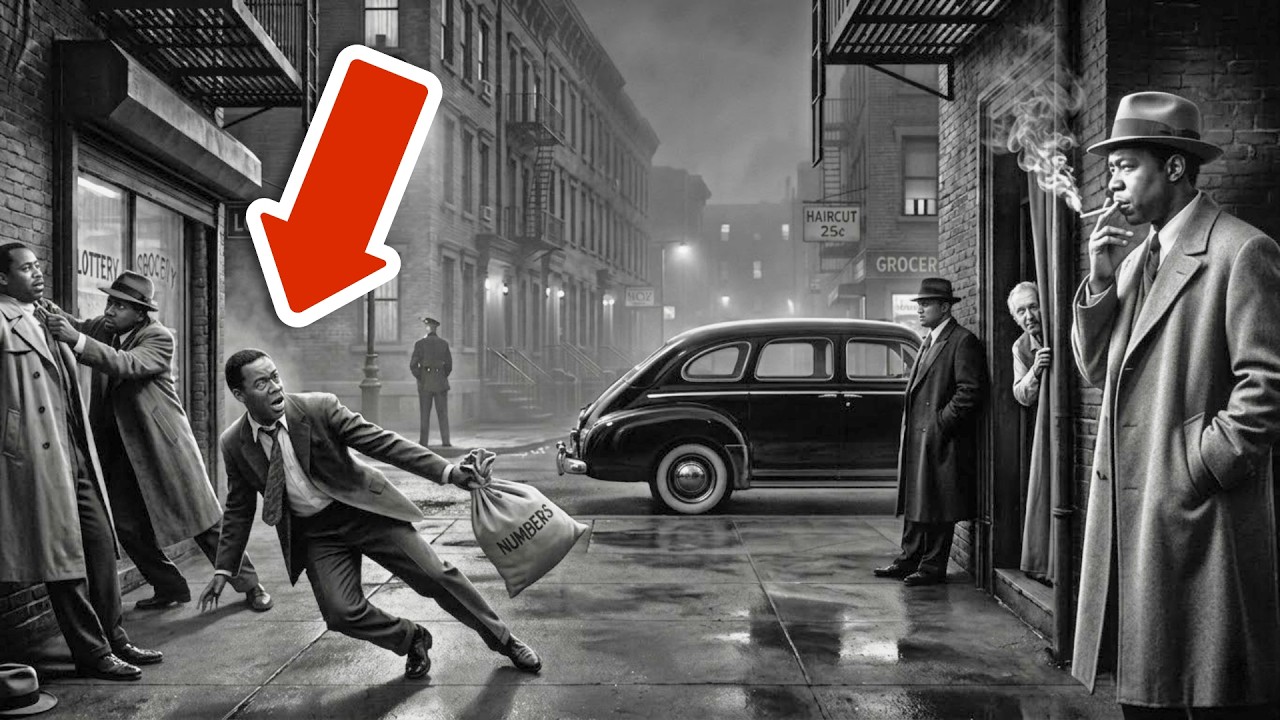
He owned the network. He owned the money. But within six weeks, something shifted that no one saw coming. So what exactly did Bumpy Johnson do to make Luciano never dare set foot in Harlem again?
To understand that, you have to go back to the night the money stopped moving. Harlem in the fall of 1946 smelled of coal smoke and cheap whiskey, with a particular kind of dread that crept through the neighborhood when something invisible went wrong. The leaves along Lenox Avenue turned brown and fell early that year, as if the street itself had decided to shed what it could no longer carry. The numbers runners who moved through Harlem like a second circulatory system, quiet and steady and essential, slowed until they nearly vanished.
Not because anyone was arrested. Not because anyone was shot. Because the order came from somewhere above the street, and the money simply stopped flowing. Luciano had cut the lines.
He did it cleanly, like a surgeon removing something without leaving a mark on the surface. No public announcement, no threatening letters, no men sent to make speeches at the Savoy. Just a quiet chain of instructions carried through Joe Adonis to the financial middlemen who processed Harlem’s numbers revenue. Instructions that redirected collection percentages, delayed transfers, introduced new requirements no Harlem operator had agreed to and none of them could practically refuse.
Within two weeks, three of Bumpy Johnson’s most trusted collectors stopped showing up at their collection points. Within three weeks, seven club owners received visits from men they didn’t know, who explained the new arrangements in language that was polite and final at the same time. Red Tobin was the man on the ground. He was forty-one, built like a man who had spent his life absorbing punishment without complaint, and he had worked the Harlem collection routes for eleven years without missing a single date.
He showed up at Bumpy’s door on a Wednesday morning holding his hat in his hand, with a look on his face that Bumpy recognized immediately: the look of a man who had been made small in a place where he had always felt large. “Three of my stops won’t open their doors,” Tobin said. “I knocked. I called out.
One of them, Mrs. Haroff on 131st Street. She opened the door and looked at me like she didn’t know who I was. We’ve been doing business for six years.
” Bumpy poured coffee and set a cup in front of Tobin. Did she say anything? She said she’d been told her arrangement was suspended. That was the word she used.
Suspended. As if it were a business decision she had made herself. Tobin put his hat on the table. She was afraid, not of me, but of whatever told her to close the door.
Bumpy drank his coffee and said nothing for a long moment. Madame Queenie found him that evening in the card room on 128th Street. She was in her sixties, heavyset, with eyes that had recorded thirty years of Harlem’s secrets and a voice like gravel wrapped in velvet. She ran the most reliable information network in the neighborhood, not through any formal arrangement, but through the simple fact that she knew everyone, and everyone trusted her enough to talk in her presence.
She sat across from Bumpy and folded her hands on the table. It’s Luciano, she said, not through anyone local, but directly through Adonis. The word I’m getting is that this isn’t about money yet. It’s a test of how Harlem responds when the ground shakes beneath it.
A test of what? A test of whether there’s still a center, Queenie said. Whether Harlem holds together or comes apart when the pressure comes from above instead of from the street. Bumpy looked at her.
Who else knows? It’s Luciano. Everyone who needs to know already suspects. “The frightened act frightened,” Queenie said.
“And the opportunists have started calculating. You know how it goes. ”
He knew exactly how it went. The dangerous move was to respond with anger.
Luciano had built the pressure specifically to provoke a visible reaction, something that could be characterized as instability, a loss of control, proof that Harlem’s operation had no leader and was therefore available. A public confrontation would serve Luciano’s purposes more than Bumpy’s. So Bumpy did something that from the outside looked like nothing at all. He went home.
He read the newspaper. He ate dinner. He sent no messages, issued no threats, called no meetings. He let two full days pass in total silence while Harlem watched and waited and slowly began to whisper.
The whispering was the part he was waiting for. In a neighborhood under pressure, the people who talked too much and too quickly were rarely the ones with nothing to hide. They were the frightened and the calculating, and Bumpy needed to know who was who before he made any move. The old men of Harlem would say later, in the careful way people describe things they witnessed but cannot fully prove, that those two days of silence told Bumpy Johnson more about his neighborhood than ten years of daily operations.
Power in that world did not die by a bullet. It died when the people who were supposed to carry it to the next corner stopped showing up. Bumpy understood that. Luciano understood it too.
The question was whether Harlem would hold long enough for Bumpy to answer in the only language that mattered. By the end of the second day of silence, three names reached him through channels he trusted. Three people in his operation who had talked more than they should have, in places they shouldn’t have been, with people they had no reason to talk to. He didn’t write any of those names down.
He simply remembered all three. Rain fell on Lenox Avenue Thursday night and did not stop until Sunday morning. It was heavy enough to flood the drains and push the street’s smell upward. Gasoline and rot and something metallic underneath it all.
The smell of a neighborhood holding itself together by friction alone. Umbrellas sagged over shop fronts and began to drip. The few people still outside walked quickly with their heads down, not looking at each other, which was itself a sign of how bad things had gotten. When the numbers runners lost their collection routes, the smaller operators in Harlem’s hidden economy did not wait patiently for the situation to resolve itself.
They did what the hungry always do. They turned on each other. Walter Freeman ran a bar on 126th Street that had worked for four years as one of Bumpy’s informal collection points. A place where collectors stopped, ordered a drink, left an envelope, and moved on.
The arrangement was clean and profitable for everyone involved. Freeman took a percentage. The collectors had a reliable station, and the bar’s legitimate revenue provided enough cover that no one looked too closely at the envelopes. When the roots collapsed, Freeman stopped receiving envelopes, which meant Freeman stopped receiving his percentage, which meant Freeman, who had borrowed money on the expectation of that percentage continuing, now owed more than he made.
Johnny Byrd found Bumpy Friday morning with the details. Johnny was thirty-two, thin, quick, and Bumpy’s most trusted field operator for six years. He had the ability to move through Harlem without being noticed, to sit in a bar for three hours and leave without anyone being able to say whether he’d been there at all. He was the kind of man whose value is hard to explain to someone who has never needed that particular kind of person.
Freeman went to Nicky Russo yesterday afternoon, Johnny said. He stayed two hours. He came out looking like a man who had just sold something he didn’t own. Bumpy was quiet.
Nicky Russo was a mid-level middleman who worked the border between Harlem operations and the Italian financial structure that processed part of their revenue. He wasn’t dangerous in any direct sense. He was dangerous the way a slightly open door is dangerous when the weather outside is bad enough. What does Freeman know about the collection schedule?
Bumpy asked. Enough, Johnny said. He knows four backup locations. He knows the names of two runners who’ve used the bar since last year.
He doesn’t know the main routes because we never told him, but what he knows is enough to do damage if he heads in the wrong direction. Bumpy thought about it. “Go see Reverend Cole,” Bumpy said. “Don’t tell him anything specific.
Just ask him what he’s been hearing from the congregation this week. Cole notices things he doesn’t always realize he’s noticed. Let him talk. ” Johnny nodded and left.
Reverend Cole ran a small Baptist church on 129th Street that served as one of the neighborhood’s true moral centers. The kind of place people came to not just for Sunday service, but on Tuesday afternoons when something was wrong and they needed to say it out loud to someone who wouldn’t repeat it. Cole wasn’t part of Bumpy’s operation in any formal sense. He simply occupied a position in the community where things came to him whether he sought them or not.
Johnny reported later that evening that three separate members of the congregation had come to him in the past week with variations of the same story. Someone had been asking quiet questions about Bumpy. Not threatening questions. Patient questions.
Questions about his habits, his schedule, which blocks he visited on which days. Patient questions were worse than threatening ones. Bumpy spent the weekend moving through Harlem carefully, visiting the operations that still worked, sitting with the people who had stayed loyal and letting them see that he was still there, still thinking, still in the room. He brought no money.
He made no promises. He simply showed up, which in Harlem carried its own specific weight. The operators who saw him that week said later that he seemed unhurried, that he drank coffee and asked about their families and talked about the weather and baseball and said almost nothing about the situation directly. His calm was either the most reassuring thing they’d seen all week, or the most unsettling, depending on how well they knew him.
He moved his most trusted collectors to locations known only to him and Johnny. He kept three backup routes in total secrecy. He worked on a schedule he changed every forty-eight hours. He had Johnny put out a specific message through the neighborhood’s informal channels.
Not a threat, not a statement, just a single sentence people passed among themselves. Bumpy Johnson is still counting. The sentence was chosen with great care. It meant he was still in the game.
It meant the situation was being studied, not panicked over. And it meant to anyone who understood Bumpy’s methods that this counting would eventually produce an answer. The accounts of this period come from people who lived through it, and memory sharpens some details while softening others. But the outline stayed consistent in every telling.
What Bumpy realized by Sunday night was that the destabilization of his operation was too precise to be accidental. The routes that failed first were not random. They were the ones insiders would know were the target if the goal was maximum disruption with minimum noise. He was already looking for the door being opened from inside.
He just didn’t yet know whose hand was turning the handle. The nights in Harlem had a sound that changed with the seasons. By late October 1946, the sound was hushed and cautious. Fewer voices in the streets.
Windows closed earlier. Jazz from the clubs muffled behind doors that used to stay open until two in the morning. Bumpy noticed the quiet the way a doctor notices a patient’s breathing. Not as atmosphere, but as information.
The collection routes that were intercepted hadn’t been targeted randomly. That was what kept him awake Tuesday night, with the light off and the window open a crack, cold air drifting in from Lenox Avenue carrying the smell of rain and cold smoke. Random interception would have produced a scattered pattern. Some stations hit, others ignored, no logic to which ones stopped first.
What Bumpy was seeing was the opposite. The stations that failed were the ones that varied their schedules most, the ones whose locations were known only to people inside the close circle of his operation. You couldn’t know which stations varied their schedules unless someone told you. And the only people who knew were the ones Bumpy trusted most.
He set the trap on a Wednesday. He called it “route adjustment. ” He told gentle Eddie Bell, who coordinated with the lower-level distributors, that three new collection points had been established on the West Side. He gave Eddie one address.
He gave Johnny Byrd a different address. And he gave a man named Cyrus Neal, who handled logistics for the northern routes, a third address. All three addresses were real locations. All three pickup times were real.
None of the three men knew about the others. Each had received different information. Then he told Miss LaVerne. Miss LaVerne ran a rooming house on 133rd Street that had operated for twenty years as a place where men with complicated lives paid their rent on time and didn’t ask each other questions.
She heard things through walls and floors and the particular acoustics of a building where many people lived close together. She wasn’t an informant in any formal sense. She was simply a woman who remembered everything and sometimes shared what she remembered with people she decided deserved to know. Bumpy told Miss LaVerne a fourth address.
A fictional one. A location on the East Side that didn’t exist as a collection point in any version of the operation. He also told Ben Little Moore. Ben was nineteen and had worked in numbers distribution for eight months.
He was young enough that people talked around him without thinking deeply about what they said. Bumpy had noticed that Ben possessed a rarer quality than intelligence. He watched without appearing to watch. And he remembered without appearing to remember.
Bumpy had been watching him for three months, deciding whether to trust him with something real. He gave Ben the fictional East Side address and told him to be there Thursday at seven o’clock. Thursday morning, the West Side address given only to Cyrus Neal was hit. Two men intercepted the runner at 6:45, took the envelope, and disappeared before anyone could react.
The runner wasn’t hurt. He was just relieved of his load with surgical precision by people who knew exactly when and where to be. Bumpy received the report at eight o’clock from Johnny, who had watched from a position two buildings away. He sat with the report for a long time.
Cyrus Neal had worked for him for four years. He was thirty-seven. Quiet, reliable, the kind of man whose value comes from consistency rather than genius. There was no obvious reason for him to betray anyone.
No debts Bumpy knew of, no visible grudge, no visible connection to anyone tied to Luciano’s organization. Which meant his reason was either invisible, or he was being used by someone who knew how to reach a man without leaving visible marks. Bumpy brought Neal to the dry cleaning shop Friday afternoon. He brought no one else.
He poured two cups of coffee, set them on the table, and sat across from Neal with a particular stillness that those who knew Bumpy well recognized as something other than calm. Neal understood what the meeting was before Bumpy spoke a single word. Bumpy watched it play across the man’s face. The calculations running, the options narrowing, the slow arrival at the only position that left any room to maneuver.
“They took my brother,” Neal said. Bumpy waited. “He borrowed money eight months ago from people connected to Adonis. Not a large amount.
But when he couldn’t pay, they took him somewhere and told me the debt now had to be paid in service. Not in money. In information. ” How long?
Bumpy asked. Six weeks. What have you given them? Neal told him.
It took nine minutes and covered three collection schedules, the names of two runners, and the locations of four backup points. He spoke in a flat, emotionless tone, the tone of a man who had spent weeks hating himself for what he was doing and had run out of energy to perform shame. When he finished, Bumpy stood and walked to the painted window and stood with his back to the room for a long moment. The historical record of these events is fragmentary by nature, drawn from accounts passed down through Harlem’s community over the years, but the pattern it describes has never been seriously challenged.
What Bumpy realized standing at that window was that Cyrus Neal wasn’t the problem. Cyrus Neal was just a mechanism. The problem was the structure that had reached inside his operation and found a man with a vulnerable brother and turned that weakness into a tool. That structure was patient, well-resourced, working on a timeline longer than a single season.
He turned around. “Your brother’s debt,” Bumpy said. “I’ll handle it. ” Neal looked up.
“You’ll keep doing exactly what they asked you to do,” Bumpy said. “Every piece of information you pass them from now on will be information I give you specifically for that purpose. You’ll be the most useful thing I have right now. ” Neal was silent for a long time.
“And afterward? ” he said. “What happens afterward depends on what comes after,” Bumpy said. “But you’ll still be standing.
” He meant it. That was the part Neal hadn’t expected. Cyrus Neal’s name would become, in the years that followed, one of those names in Harlem that people mention with a particular kind of complexity. Not as a traitor, not as a victim, but as a man caught between two forces larger than himself who found, at the last moment, a way to be useful to the one who deserved his loyalty.
The door was still open. But Bumpy was the one deciding what came through it now. The back room of the barbershop on 131st Street smelled of hair oil and old wood, and the particular musty scent of a place that had hosted difficult conversations for so long the walls had absorbed them. Bumpy arrived at ten o’clock at night and found Cyrus Neal already there, sitting on the only chair, hands on his knees, eyes on the floor.
Johnny Byrd stood near the door. No one else was present. The front of the shop was dark and locked. The metal shutters were drawn tight against the street.
Bumpy sat across from Neal and said nothing for a full minute. The silence wasn’t theatrical. It was functional. Bumpy used it the way a surgeon uses a sterile surface, to prepare the conditions in which the next thing would happen with precision.
“Tell me about Delia Hart,” Bumpy said. Neal looked up. Delia Hart was thirty-one, the companion of a numbers runner named Samuel Price, who had died eight months earlier in what the police report described as a botched robbery on 134th Street. Samuel Price had worked Bumpy’s northern lines for three years.
He was reliable and careful, and had no enemies anyone knew of. His death had faded into the general violence of Harlem’s streets without special investigation. Neal’s jaw tightened. “She came to me in September,” Neal said.
“Two weeks after I started passing information to Adonis’s people. She told me she knew what I was doing. She said Samuel wasn’t killed in a robbery. She said he was killed because he refused to give information about the routes when Adonis’s people first approached him, six months before his death.
” Bumpy was completely still. “She told me Samuel said no, and they killed him for it,” Neal continued. “Then she looked at me and said I’d said yes, and she wanted to know if I understood what that meant about the difference between us. ” The room was perfectly quiet.
“She wasn’t threatening you,” Bumpy said. “No,” Neal said. “She was telling me what I already knew and couldn’t say out loud. That I was alive because I cooperated, and Samuel was dead because he didn’t.
And that there was no version of that fact I could make acceptable, no matter how I arranged it in my head. ”
Bumpy stood and walked to the small window at the back of the room. Outside was an alley, dark and narrow, smelling of garbage and cold air. What Delia Hart had told Neal matched what Bumpy had suspected for weeks but couldn’t confirm directly.
Samuel Price’s death hadn’t been random. It was the first step in a patient campaign, a demonstration of consequences aimed at one man to set the terms for everyone who came after. But there was a second part. The part Bumpy hadn’t known until this moment.
“The rumor,” Bumpy said. “The one that started three weeks ago. That I knew Samuel was under pressure and didn’t protect him. ” Neal was silent for a long moment.
“Adonis started it,” Neal said. “He told Delia. Specifically told her that you’d been informed Samuel was a target, that you’d decided he was expendable, that protecting him would have cost you a financial deal you didn’t want to lose. ” Bumpy turned.
“And Delia told people because she believed it? ” “She had no reason not to,” Neal said. “Adonis gave her enough detail to make it sound like it could only have come from inside. ” There it was.
Luciano hadn’t just cut the money routes. He’d planted a story. A specific, targeted story about a dead man and a leader who let him die. Planted it in the one person in Harlem whose grief gave the story credibility, and whose community connections gave it circulation.
By the time the rumor had traveled through three Harlem neighborhoods, it had taken on the character of something many people had heard from multiple sources, which is exactly what a single lie becomes after two weeks of circulation in a community where trust was already damaged. Johnny spoke from near the door. “How many people believe it? ” he asked.
His voice was cautious. “I don’t know exactly,” Neal said. “Enough. The middlemen who’ve been staying silent.
Some of them aren’t staying silent because they’re afraid of Luciano. They’re staying silent because they’re no longer sure which side they should be on. ” Bumpy sat back down. He didn’t raise his voice.
He didn’t hit the table. He sat with the information the way a man sits with a wound, deciding how to treat it. Measuring it, understanding its depth, before determining what the response should be. The people who knew Bumpy described this quality in nearly identical words across many accounts.
His calm in a moment of crisis was not the calm of a man who had stopped feeling. It was the calm of a man whose feeling had become so concentrated and precise it had nowhere to go but inward, where it became something colder and more permanent than anger. “Money can be recovered,” Bumpy said finally. “Roots can be rebuilt.
What Luciano took this time wasn’t the revenue. It was the story. And you can’t rebuild a story with money. ” He looked at Neal.
“Delia Hart,” he said. “Where is she now? ” “Still on 134th Street,” Neal said. “She hasn’t left the neighborhood.
” “I need to talk to her,” Bumpy said. “Not to silence her. To tell her the truth about Samuel and let her decide what to do with it. ” Johnny looked at him.
“And if she doesn’t believe you? ” “Then I’ll earn her trust,” Bumpy said. “The same way I earn everything else. ” He stood and put on his coat.
The most dangerous weapon Luciano had used wasn’t money or manpower. It was a story about a dead man that made the living doubt the one person holding Harlem together. Bumpy had spent weeks focusing on the financial structure of the attack. He’d been looking at entirely the wrong structure.
Real power, he now understood with a clarity that felt like cold water, wasn’t about who held the gun. It was about who controlled what people said to each other in the dark. The fog came off the river before dawn and settled over Harlem like something that had decided to stay. It muffled the street noise, softened the edges of the buildings on Lenox Avenue, and made the neighborhood look, in the gray morning light, like a place still deciding what it wanted to become.
Bumpy Johnson had been awake since four in the morning, not because he couldn’t sleep, but because there was work that required the privacy of the hours when most of the city wasn’t watching. He went to see Hester Lane first. Hester was forty-four, had been widowed eight months earlier when her husband, a numbers worker named Desmond Lane who had operated in Bumpy’s East Side territory for six years, was severely beaten during an interception and died of his injuries four days later in Harlem Hospital without fully regaining consciousness. The police filed a report and did nothing after that.
The report described the incident as a dispute of unknown origin. Bumpy knocked on Hester’s door at 6:15 in the morning. She opened it after a long pause, in a housecoat, hair pinned back, eyes carrying the exhaustion of a woman who hadn’t slept well in months and had learned to function within that exhaustion as a permanent condition. She looked at Bumpy for a moment without speaking.
“I’m not here to ask you for anything,” Bumpy said. “I came to tell you that Desmond’s death wasn’t an accident and it wasn’t random. The people responsible are known to me. And I came to bring you this.
” He held out an envelope. She didn’t take it immediately. “What’s in it? ” she said.
“Six months of living expenses,” Bumpy said. “No conditions. No arrangements. No expectation of anything from you in return.
Desmond worked for me for six years and died because of work connected to my operation. That makes his family my responsibility. ” Hester looked at the envelope for a long moment. “People say things about you,” she said.
“I know,” Bumpy said. “Take the envelope. Believe what you need to believe. That’s your right.
” She took the envelope. He spent the rest of that week moving through Harlem the same way. Not loudly, not with visible escorts or announcements, but with steadiness. He showed up at the right times because he’d spent enough years in the neighborhood to know which moments mattered to the people watching to see if he still cared.
He appeared at a small shop on 128th Street Tuesday afternoon when three men arrived to collect protection money the owner could no longer afford. Bumpy didn’t threaten the three men. He paid the debt himself, in cash, in front of the owner, and told the men the account had been settled. Thursday night he was in a building on 133rd Street when a delivery runner named Calvin Rhodes came back from his route visibly shaking, having been followed by two men he didn’t know for six blocks.
Bumpy sat with Calvin for an hour in the building’s lobby. No strategy discussions. Just presence. Just being there, until Calvin’s hands stopped trembling and he could eat the sandwich Johnny brought from the corner restaurant.
Madame Queenie watched all of this from her privileged position in Harlem’s information network, and she briefed Bumpy every three days on what she heard. She told him Friday afternoon, sitting in the back room of her establishment on 127th Street: “It’s moving. Slowly, but it’s moving. People talk about what they see more than what they hear.
And what they see is you out there. ” “What about the rumor? ” Bumpy said, meaning Samuel Price. Queenie was silent for a moment.
“Still circulating,” she said. “But it’s got competition now. People don’t stop believing a story just because it’s false. They stop believing it when they find a better story to believe instead.
”
Father Lewis had been a fixture of the quiet work over the past two weeks without knowing exactly what role he was playing. He ran a Catholic mission on 131st Street that served meals three days a week and asked nothing from the people who came. Bumpy had arranged, through a third party, to anonymously fund the mission’s supplies for the next four months. Father Lewis didn’t know where the money came from.
He only knew it arrived when the mission was two weeks from running out. The people who ate at the mission knew about it, the way such things were always known in Harlem, even when the source was never officially identified. Johnny found Bumpy Saturday evening on the roof of the dry cleaning shop, standing in the cold air looking south toward midtown. “You know Luciano’s watching this,” Johnny said.
“I know. He’ll adjust. ” “What you’re doing works against the rumor,” Johnny said. “But it doesn’t work against a man with unlimited patience and a financial structure bigger than anything we can match head-on.
” “I’m not trying to match his structure,” Bumpy said. “I’m trying to make his structure irrelevant. ” Johnny looked at him. “Luciano controls the money,” Bumpy said.
“He can’t control what Harlem decides to remember. Those are two different things. One of them ends. The other doesn’t.
”
Some details of this period survive only in the accounts of those present, filtered through decades of retelling. But the essential pattern they describe held constant. Bumpy realized by the end of that week that the first phase of what Luciano had begun was failing. Not because Bumpy had defeated it, but because he had refused to fight it on its own terms.
The second phase would be different. The restaurant was called Villa Serena, on a street at the city’s outer edge, where the buildings were lower and the silence between them had a different quality than Harlem’s silence. The tablecloths were white linen, freshly pressed, the kind of whiteness that suggested not comfort but a surface designed to show any mark left on it. The candles were real wax.
The wine had already been poured. The whole arrangement had a subtle gentleness, like a room whose preparer wanted you to feel, for as long as possible, that you were in a safe place. Bumpy arrived alone at eight o’clock. Nicky Russo had delivered the message four days earlier through a middleman.
A folded note handed to Johnny Byrd outside the dry cleaning shop, reading only: dinner, Villa Serena, Thursday, eight o’clock, with an address. No signature. No explanation of who would be there or what the conversation was about. Bumpy knew what it meant immediately.
Frank Costello was at the table when Bumpy walked in. Costello was fifty-five, silver-haired, with a face that looked like it belonged in a bank advertisement. Calm, trustworthy-looking, the face of a man who had built his entire career on the principle that violence was a last resort, used only by those who had run out of better options. Joe Adonis sat to Costello’s right.
Adonis was the one who had started the rumor about Samuel Price. He was forty-three, immaculately dressed, and he watched Bumpy cross the room with the particular attention of a man who collected information rather than living the experience. Bumpy sat down. A waiter appeared and filled his water glass.
No one spoke until the waiter moved away. “Thank you for coming,” Costello said. “You said dinner,” Bumpy said. “I came for dinner.
” Costello smiled slightly. “We want to talk about structure,” Costello said. “Something that works for everyone. Harlem is a productive neighborhood.
It generates significant revenue, and it has residents who respond more openly to local leadership than to external management. We understand that. We’re not here to dismantle what you’ve built. ” “Then tell me why you’re here,” Bumpy said.
Costello folded his hands on the table. “Partnership,” Costello said. “Formal. You continue to run Harlem’s numbers and protection structure.
A percentage of the revenue flows through our financial channels, which gives it stability and protection from federal attention. In return, the pressure that’s been applied to your operation over the past few weeks is removed entirely. Your runners work freely. Your collection points reopen.
Your men stop being followed home. ” He paused. “And you receive a direct payment,” Costello said. “Monthly.
A number that reflects your value in this arrangement. ” Bumpy looked at him. “What percentage? ” he said.
“Forty,” Adonis said. It was the first word he’d spoken. “Forty percent of Harlem’s revenue flows through your channels,” Bumpy said. “It’s a standard structure,” Costello said.
“Applied consistently across multiple arrangements in multiple neighborhoods. ” Bumpy picked up his water glass and drank slowly. He understood the offer completely. Not just its surface terms, but its internal structure.
What it was designed to produce over time, and what it would cost him, not in money, but in the nature of what he would become if he accepted. Forty percent of revenue flowing through Costello’s channels meant forty percent of his operation’s lifeline flowing through a pipe he didn’t own and couldn’t close. It meant every decision he made in Harlem would be colored by the awareness that the people at the other end of that pipe could narrow it or open it whenever they chose. He would still be in Harlem.
He would still hold the title. He would still wear the suit and walk the streets and be known in the neighborhood. He would be a manager. Well-paid, locally respected, but fundamentally missing the one thing that had defined every decision he’d ever made.
Johnny had told him the night before the dinner to look at the long-term price. Not the monthly payment. Not the restored roots. But the price of what acceptance would mean for every subsequent negotiation, every subsequent pressure, every future moment when the people across this table decided they wanted something different from what the current arrangement provided.
“I want to tell you something directly,” Bumpy said. Costello waited. “What you built over the past six weeks was impressive,” Bumpy said. “Cutting the roots.
Planting the rumor. Using the story of a dead man to destabilize trust inside my operation. That was patient work, and it was executed with skill. I want you to know that I recognized it for what it was.
” Adonis watched him without expression. “But the offer you’re making me tonight is the same move in a different form,” Bumpy said. “You’re offering me money and restoration in exchange for a structural position that makes Harlem accountable to you through me. I become the local face of an arrangement I don’t control.
And the next time you want something I haven’t agreed to, you’ll come back to this same table and the conversation will be shorter because I already accepted the first term. ” Costello was silent. “I decline,” Bumpy said. The room absorbed it.
The old men of Harlem who heard this story years later always said the same thing. Some handshakes leave marks that no amount of soap removes. Bumpy Johnson had known that before he sat down at that table. Costello looked at him for a long moment with the expression of a man recalculating his numbers.
“That decision has consequences,” Costello said. The politeness was still in his voice. But it simply no longer conveyed warmth. “I know that,” Bumpy said.
“I’ve been living with the consequences of my last decision for six weeks. I’m still in Harlem. ” He stood, folded his napkin on the table, and walked out of Villa Serena without looking at Adonis. Outside, the cold night air hit him immediately.
The street was empty and quiet, smelling of exhaust and fallen leaves. He had just refused the most financially rational offer he would likely ever receive. He did it because he understood, with the clarity of a man who had spent his entire life watching what happened to those who accepted arrangements they couldn’t leave, that some offers are designed to be accepted only once. Luciano would now move to the final phase.
The one that comes after money and promises have both failed. Bumpy had known it was coming before he sat down to dinner. And he had come anyway. Luciano never took Harlem.
Not because he lacked the money or the men, but because Bumpy Johnson understood something no financial structure could buy: a neighborhood that chose to remember. You are stronger than any army sent to replace you. The roots reopened. The runners returned.
The rumor about Samuel Price died the slow death lies die when enough people see the truth walking their street every morning. But Bumpy carried something heavier after 1946. He had learned that the most dangerous weapon used against him had no trigger. It was a story.
And stories, once released, never entirely disappear.
