In the early morning of March 20, 1955, Bumpy Johnson stood in the kitchen of his Harlem home, looking at the woman who had shared his life for thirty years. Mame, his wife, had just asked him how he could balance the demands of his family with the life he led. Bumpy had answered honestly, telling her about the promise he had made when they were young. He had promised to always come home, to always choose her when it mattered.
Had he kept that promise? He admitted, “Mostly. ” Sometimes the work had won victories. Sometimes she had.
But she had always known that she came first in his heart, even if not always in his actions. Mame had gone silent at that, then said the words that hung in the air. “I don’t know if I can do this. ” Bumpy looked at her.
“Then you’ve already lost me,” he replied, not as an accusation, but as a quiet truth. He closed the phone. Bumpy sat thinking about his choices, his priorities, and what truly mattered. Two days later, on Tuesday, March 22, 1955, Bumpy drove from Harlem to Philadelphia, to the home of Mame’s sister, Eleanor.
The neighborhood was beautiful, quiet, peaceful, the opposite of everything Harlem had become for them. He knocked, and Eleanor opened the door. She looked at him critically. “You look exhausted.
” “I feel terrible,” he admitted. “Well, you deserve it. ” She reluctantly let him inside, warning that Mame was there but did not want to see him. He asked for five minutes.
Eleanor stepped aside. Mame was in the living room, reading. When she looked up, she did not smile. She did not frown.
She just watched him. He sat across from her and spoke. He apologized for everything. For putting her in danger.
For starting a war. For choosing revenge over her. “That’s a lot of apologies,” she said. He meant them all.
Mame closed her book. “Bumpy, I love you, but I can’t live like this anymore. Constantly afraid. Constantly watching.
Constantly waiting for the next attack. ”
He had no answer. She suggested he could leave. Leave Harlem, the life, the violence, everything.
They could go somewhere and start over, live a normal life. Bumpy shook his head. “I’m fifty years old. I’ve been a gangster for thirty-five years.
I don’t know how to be normal. ” “Then learn,” Mame pressed. “I don’t know if I can,” she admitted. Then Bumpy said something that changed the course of everything.
“If you can’t choose me over that life, then I’ll go. I love you, but I love myself more. And I deserve a better life than one lived in fear. ” He asked her one final time: would she leave Harlem, leave the empire, leave everything he had built?
“Yes,” she answered. “For me? ” he asked. “Yes.
” “You would do that? ” The question hung there. She had almost died because of him, because of his choices, because of his enemies. She deserved safety.
She deserved peace. And he could give it to her—if he was ready to sacrifice everything else. Bumpy thought of thirty-five years spent building an empire, earning respect, collecting power. He looked at Mame, her strength, her beauty, her loyalty.
For thirty years she had stood beside him through arrests, violence, enemies, and wars. She had never asked him to change. Not until now, when she had nearly died because of him. He spoke softly.
“If I leave, someone else will take charge. Harlem will fall, or the Italians will take it. Everything I built will be lost. ” “I know,” she said.
“You’re willing to accept that? ” “If it means keeping you. ” “Why? ” “Because Harlem will survive without you.
I won’t. ” That was the difference. He took her hand. “If I do this, if I leave, we’ll go somewhere far away, where no one knows us.
No crime, no violence, no empire. Just us. ” Mame agreed. Where would they go?
California seemed too obvious, Florida full of mobsters. Bumpy suggested Canada. Montreal. He had heard it was beautiful.
Quiet. They could disappear there. She asked when. “Soon.
I need to transfer power. Make sure Harlem is protected, make sure my people are taken care of. Then we go. ” Two weeks, he promised.
“Two weeks to dismantle thirty-five years? ” she asked, skeptical. “I’ll make it work. ”
He made her a promise then.
It was not a trick. He would choose her over everything else—over Harlem, over power, over life itself. Mame began to cry. “Finally.
” “Finally? ” “Finally. ” They would go together, to Montreal, and start again. “Thank you,” she whispered.
“For what? ” “For choosing me. ” Bumpy thought of all the years he should have made that choice. “Better late than never.
”
The two weeks began on March 23, 1955. Bumpy spent them preparing, handing every piece of his empire to Johnny Byrd, his most trusted disciple. In a private conversation, Bumpy laid it out plainly. Johnny would take over Harlem—all of it.
The businesses, the territory, the people. Johnny protested earnestly. He was not ready. But Bumpy insisted.
“I taught you everything for twenty years. You’re ready. ” He had already spoken to the commission. They accepted Johnny as legitimate, recognized, protected.
The protection would continue. The businesses would continue. Life would continue, just without Bumpy. The only thing that would change was the face of the man in charge.
If Johnny failed, Tommy Chin and Stephanie St. Clair would back him up. And Inspector O’Brien. He would not be alone.
April 5, 1955, was the day of departure. Bumpy said his goodbyes at Small’s Paradise. He shook hands, embraced some, wept with others. Then he boarded the train with Mame and left Harlem—his empire, his identity, everything—behind for her.
They arrived in Montreal the next day, April 6, 1955, and found a small apartment in a quiet neighborhood. No guards. No guns. No enemies.
Bumpy Johnson, age fifty, former gangster, the king of Harlem, now lived under a new name: William Bennett. He worked an ordinary job at a bookstore, earned an ordinary salary, and lived an ordinary life with Mame, who was, at last, genuinely and completely happy. One evening, two months later, in June 1955, they were having dinner at home, Mame cooking, Bumpy setting the table like any ordinary couple. She asked if he missed it—Harlem, the power, the respect.
He admitted he did, sometimes. Did he regret leaving? “No. ” “Why?
” “Because you’re here, and you’re happy, and that’s all I ever wanted. ” She asked if he was happy too. Bumpy thought, then smiled. “Yes, I am.
Truly. It’s different. Quiet. Simple.
But it’s good. Better than I expected. ” “Better than the violence? ” “Much better.
I don’t wake up wondering if someone’s trying to kill me. I don’t fall asleep planning wars. I just live. It’s beautiful.
” She kissed him. “I’m proud of you. ” “For what? ” “For choosing this.
For choosing us over everything else. It took more courage than any fight, any war, any violence. True courage is choosing peace when you’re wired for war. ”
Five years passed.
They were happy, peaceful, anonymous. No one knew William Bennett was really Bumpy Johnson. No one cared. Then a letter arrived from Johnny.
Harlem was thriving. Crime had dropped. Business flourished. The community was strong.
Everything Bumpy had built still stood. Johnny wrote how he used the lessons Bumpy taught him every day, and thanked him for the trust, the opportunity, and for showing that power without purpose was empty. He signed off with respect and ended with a hope that Bumpy was at peace because he deserved it. Bumpy read the letter three times, then showed it to Mame.
He was proud. He did not want to go back. “Never,” he said. “Mame, I chose you.
I chose this life. I don’t regret it. I wouldn’t change it. This is my place.
With you. ” Mame smiled. “Because I would never let you go back to that life. Never.
” He told her he was grateful. “For what? ” “For saving me from myself. ”
On July 7, 1968, Bumpy Johnson supposedly died in Harlem.
That is what history would record. But Bumpy Johnson no longer existed. What actually died was William Bennett, sixty-three years old, of a heart attack, peacefully, at home in Montreal, with Mame holding his hand. He had lived thirteen years in peace, love, and happiness, invisible, ordinary, complete.
At his small, quiet funeral, attended by twenty people, Mame spoke. She revealed that William Bennett had been her husband for forty-three years. But he had not always been William. Once, he had been someone else.
Someone powerful. Someone dangerous. Someone whose name was feared. He chose to become William, she said, to become ordinary, to become hers.
She was grateful for every day they had together, for every choice he made to put her first, to choose peace, to choose love. That was his legacy, Mame told the mourners. Not the power. Not the empire.
Not the violence. His legacy was choosing to be better, to be different, to be just a man who loved his wife more than anything. “That’s enough,” she said. “That’s all.
”
Twenty-two years later, in 1990, Mame, now eighty-two and still living in Montreal, still kept the secret that Bumpy had not died in Harlem in 1968 but peacefully in Montreal. Only she and Johnny knew, and Johnny guarded it for forty-three years. Finally, Mame wrote her memoirs. The book, titled *Godfather of Harlem: The Testimony of My Husband, Ellsworth “Bumpy” Johnson*, was published in 1990.
In it she told the truth about Bumpy’s life, his crimes, his power—but also about his love, his sacrifice, his choice to leave everything for her. The book ended in 1955. Bumpy Johnson had vanished. People assumed he had died, or fled, or been killed.
But the truth was simpler and more beautiful. He had chosen her over Harlem, over power, over everything. They lived thirteen more years in peace. In 2025, seventy years after the poisoning that almost killed her, a young historian named Marcus Williams was researching Bumpy Johnson’s life for a documentary.
He found Mame’s memoir, read the ending, and refused to believe it. A mobster retiring and living an ordinary life? Impossible. He began investigating.
He found records in Montreal. William Bennett had died in 1968 of a heart attack. The description matched Bumpy. The timeline matched.
He found Mame’s grave in Montreal, buried next to William Bennett. The headstone read: “Mame Johnson-Bennett, 1908–2008, beloved wife who taught me that love is stronger than power. ” Marcus stood there, finally understanding. Bumpy Johnson, the legend, the gangster, the king of Harlem, had done the strongest possible thing.
He had walked away for love. That was his real legacy. Not violence, not empire, but the choice to be better, to choose love over power. It was a story no one had known until now.
The story of how Bumpy Johnson came to make that choice, and how he built the alliance that made it safe, began years before, in the fall of 1957. On Thursday, November 14, 1957, a meeting was called at the home of Joseph “Joe the Barber” Barbara in Apalachin, New York. Fifty-eight mobsters from across America gathered—the largest assembly of organized crime leaders in history. It was the annual meeting of the commission, where territories were divided, disputes settled, and the future determined.
On the agenda that day: Bumpy Johnson’s counteroffer. Bumpy had not been invited. Mobsters did not attend commission meetings. But his proposal was present—in Meyer Lansky’s briefcase and on Frank Costello’s mind.
The Five Families were all represented. Carlo Gambino, Vito Genovese, Frank Costello, Joe Bonanno, Tommy Lucchese, plus representatives from Chicago, Detroit, Cleveland, New Orleans, Kansas City, and Philadelphia. Everyone who mattered in organized crime, all in one room, discussing one subject: Harlem. At ten in the morning, Frank Costello stood and addressed the gathering.
“Gentlemen, we have a matter requiring your attention. Harlem—as you know—we offered Bumpy Johnson $10 million for full control. He refused. ” Murmurs of anger and surprise rippled through the room.
Vito Genovese spoke dismissively. “Then we’ll take it by force. ” Costello raised a hand. “Wait.
He didn’t just refuse. He countered. ” “With what? Money?
” “No. With something better. ”
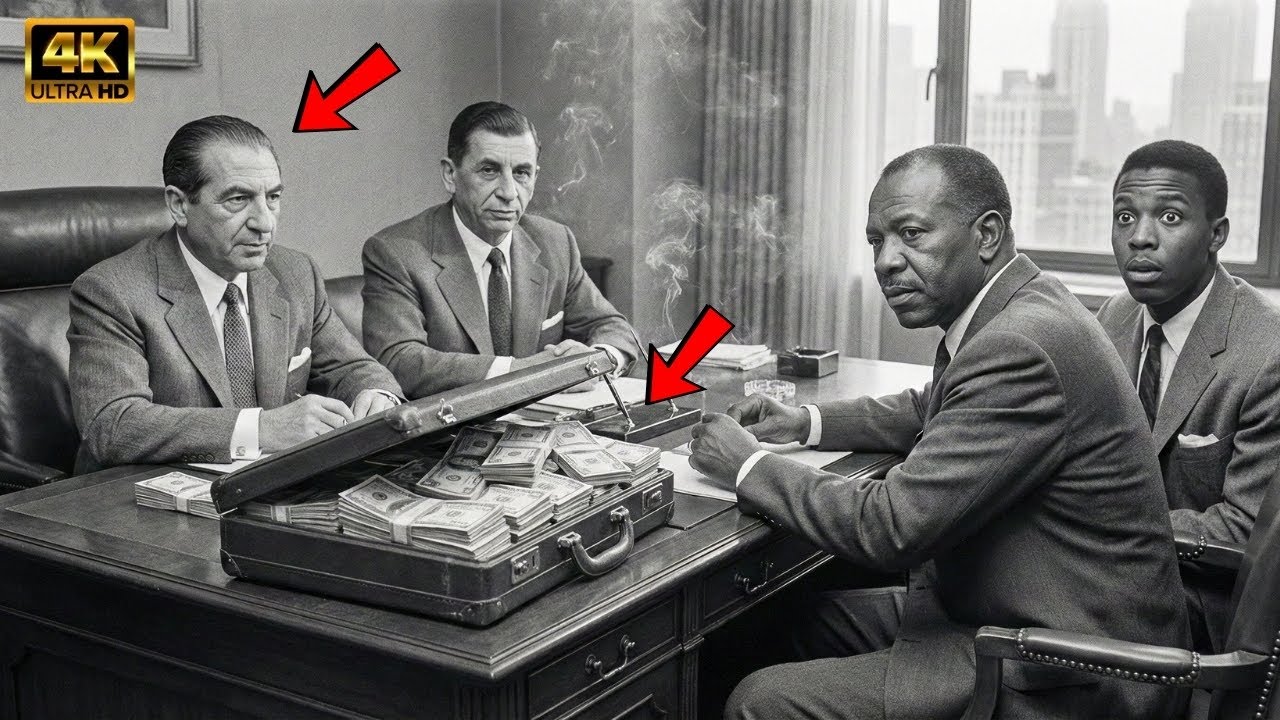
Costello nodded to Meyer, who passed out copies of Bumpy’s proposal—seven pages—to every boss. They read in silence.
Some quickly, some slowly, all carefully. When they finished, the room was quiet. Albert Anastasia spoke first. “Interesting.
He wants to keep Harlem, but he’s offering us intelligence, political influence, and expansion opportunities nationwide. ” Joe Bonanno added, “The value proposition is compelling. We’d get more than just Harlem. We’d get access to Black communities across the country with a trusted partner who knows the streets and the people.
” Carlo Gambino, always the strategist, spoke cautiously. “The question is trust. Can we trust Bumpy Johnson to deliver what he promises, or is this just stalling? ”
Meyer Lansky answered for his old ally.
“I’ve known Bumpy for twenty-five years, since he was a young man working with Stephanie St. Clair. He’s a man of his word. If he promises something, he delivers.
I vouch for him. ”
At eleven, the debate began. It was sharp, divided, and contentious. Vito Genovese led the opposition.
“This is absurd. We are the commission. We don’t negotiate with outsiders. We dictate.
We take. We control. If Bumpy refuses to sell, we take Harlem by force. Let’s show everyone the commission doesn’t ask permission.
” Albert Anastasia agreed. “Vito’s right. We look weak negotiating with a Black gangster. No offense to Bumpy, but that sets a precedent that anyone can refuse us and negotiate.
That’s dangerous. ”
Carlo Gambino saw it differently. “This isn’t weakness, it’s wisdom. Bumpy has controlled Harlem completely for twenty-two years, since Dutch Schultz.
We could take it, yes, but at what cost? A war in Harlem with residents who support him? We’d win eventually, but we’d lose men, money, and time, and we’d create resentment that lasts decades. Why do that when we can partner, gain more than just Harlem, and avoid bloodshed?
” Joe Bonanno sided with him. The expansion opportunity alone was worth it. Black neighborhoods in every major city were growing, thriving, but inaccessible to them as Italians, as outsiders. Bumpy could provide the entry point.
The commission could earn hundreds of millions over ten years. Frank Costello pointed out the intelligence network was invaluable. The FBI under Hoover, the IRS, congressional investigations—they needed early warnings. Bumpy’s connections in Black communities, churches, political organizations, could provide that.
Tommy Lucchese, quiet until then, came down cautiously in favor. “A war is expensive and uncertain. A partnership is profitable and strategic. We’re businessmen, not soldiers.
Let’s act accordingly. ”
At noon, the vote was called. Who favored accepting Bumpy’s counteroffer? Carlo Gambino: yes.
Joe Bonanno: yes. Tommy Lucchese: yes. Frank Costello: yes. Vito Genovese: no.
By a vote of four to one, the proposal passed. Harlem would remain independent under Bumpy Johnson’s leadership, in exchange for intelligence, political influence, and expansion opportunities. The deal was struck. Vito stood in anger.
“You’re all making a mistake. A fatal mistake. ” Carlo answered quietly, “Perhaps. But it’s our mistake as a majority.
You lost the vote, Vito. Accept it. ” Vito glared and sat down. He had lost, but he would not forget.
The meeting continued, finalizing details, drafting contracts, signing agreements. But the decision was final. Bumpy Johnson had negotiated with the commission and won. The very next day, everything changed.
On November 15, 1957, at 12:40 p. m. , New York State Police, led by Sergeant Edgar Croswell, raided the Barbara estate. They had noticed a large number of cars with out-of-state license plates, raised suspicions, called for reinforcements, and surrounded the property.
Fifty-eight mobsters scattered into the woods. Many were arrested and identified. The Apalachin meeting became a disaster for the commission—a public relations nightmare, front-page headlines, a raid on a mob summit that exposed organized crime to the world. The commission’s secrecy was shattered.
Its authority was questioned. Its future was uncertain. But one decision made the previous day survived: Bumpy’s deal. Because it was wise.
Because it was necessary. Because even in the chaos, the commission needed what Bumpy offered—intelligence, protection, partnership. On November 20, 1957, Meyer Lansky arrived at Small’s Paradise in Harlem to finalize the agreement with Bumpy. The two men sat alone.
Two outsiders to the Italian mob—one Black, one Jewish—both essential to its survival. Meyer confirmed the commission had accepted the counteroffer. “I heard about Apalachin,” Bumpy noted. “Yes, unfortunate.
But it doesn’t change our deal. ” Meyer slid papers across the table. “The contract. Read it carefully.
”
Bumpy read all seven pages. The terms were clear. First, Harlem remained an independent territory under Ellsworth “Bumpy” Johnson’s leadership until death. No interference, no takeover, no challenges.
Second, Bumpy would provide monthly intelligence reports on federal investigations, political threats, and law enforcement activities affecting commission interests. Third, Bumpy would facilitate political relationships, using civil rights leaders, clergy, and community organizers to pressure politicians away from pursuing the mob. Fourth, Bumpy would help the commission expand into Black neighborhoods nationwide, introducing them to key figures, guaranteeing partnerships, splitting profits sixty-forty in the commission’s favor. Fifth, after Bumpy’s death, Harlem would pass peacefully to commission control with full cooperation from his successor.
Bumpy looked up. “This is fair. ” Meyer nodded. “It’s more than fair.
It’s brilliant. You gave us more than we asked while keeping what you wanted. That’s the art of negotiation. You could have fought, died, lost everything.
Instead, you partnered, kept Harlem, made allies. That’s intelligence. That’s survival. That’s power.
” Bumpy signed. Meyer signed. The deal was done. December 1957 was the first test.
Would Bumpy deliver? Would the commission trust him? The answer was yes. On December 10, in his first intelligence report, Bumpy warned the commission of an IRS investigation into Meyer Lansky’s offshore accounts.
His source was a Black accountant who worked at the IRS, attended Bumpy’s church, and owed him a favor. The warning allowed Meyer to move his money before the investigation began, saving millions. The commission was impressed. In his second report, on December 20, Bumpy warned that the FBI had bugged Carlo Gambino’s social club.
His source was a Black telephone company employee who had installed the wire and informed Bumpy. The warning allowed Carlo to feed the FBI false information while conducting real business elsewhere. The commission was impressed again. By January 1958, the partnership was running smoothly.
The first expansion came that same month. The commission asked Bumpy to facilitate expansion into Philadelphia’s Black neighborhoods. Bumpy contacted his connections there—ministers, bookmakers, community leaders. He introduced them to Angelo Bruno, Philadelphia’s mob boss, vouched for him, and explained the deal: sixty-forty profit split, commission protection, community investment, no violence, fair terms.
The Philadelphia operators trusted Bumpy more than they trusted any Italian. The deal closed. Revenues reached $500,000 in the first year. The commission received $300,000 for almost nothing but allowing Bumpy to introduce them.
That was the power of partnership. By December 1958, Bumpy had facilitated expansions in Philadelphia, Detroit, Chicago, Baltimore, and Washington, D. C. Total new revenues reached $3 million annually.
The commission took $1. 8 million—far more than Harlem alone would ever have produced. The commission realized Bumpy had been right. Partnership was better than conquest.
In 1960, two years into the deal, everything had changed. Harlem remained independent and thriving. The commission expanded into Black neighborhoods across the country. Profits soared.
Investigations stalled because Bumpy’s intelligence kept them a step ahead. Lansky called Bumpy to thank him. The partnership had been exceptional. Bumpy had delivered everything promised and more.
But Bumpy had something to say. “You offered $10 million for Harlem. I offered a partnership. You accepted.
Now, two years later, you’ve earned nearly $3 million from expansion profits? ” “Yes. ” “So within seven more years, you’ll have earned more than $10 million without owning Harlem. ” “Exactly.
” “And Harlem is still independent. ” “Yes. ” “This is good business for both of us. ” “Right, but more importantly, it’s respect.
”
“What do you mean? ” Bumpy explained. The commission could have taken Harlem by force, killed him, installed their own men, run it their way. Instead, they negotiated.
Partnered. Respected his position, his men, his independence. That meant more than money. Meyer understood.
“I don’t think most of the commission gets it. Some do—Carlo, Joe, Tommy—they understand partnership is stronger than domination. Vito doesn’t. ” “No, he doesn’t,” Meyer agreed.
“Watch your back with him. ” “I will. ” “But Bumpy, thank you for teaching us there’s another way. ”
Bumpy Johnson died on July 7, 1968—officially of a heart attack at Wells Restaurant, age sixty-two.
The commission honored the agreement, sending representatives to the funeral. Carlo Gambino, Meyer Lansky, and Joe Bonanno all attended in person—unprecedented for a non-Italian. At the funeral, Carlo spoke privately with Johnny Byrd, Bumpy’s successor. “The deal stands.
Harlem is yours until you die. We keep our word. ” He added that Bumpy was unique, having negotiated with the commission as an equal. Few had done that and lived.
“He did it because he was smarter than us, bolder than us, more principled than us. He taught us that partnership trumps conquest, that respect overcomes fear, that intelligence beats violence. We profited greatly from his knowledge, and the commission will never forget what he gave us. Not just the profit, but the wisdom.
”
Johnny kept the agreement. He provided intelligence. He facilitated expansion. He maintained independence.
He ran Harlem until his death in 1985. Then, as agreed, Harlem passed to commission control—peacefully, respectfully, profitably. But something strange happened. The commission ran Harlem for five years, from 1985 to 1990, and discovered it was no longer profitable without Bumpy—without his connections, his wisdom, his respect.
Revenues declined. Community relations deteriorated. Problems multiplied. In 1990, the commission made a decision unprecedented in mafia history.
It returned Harlem to the community and withdrew completely. Why? Because it realized what Bumpy had known all along. Some things cannot be bought, cannot be taken, cannot be controlled by outsiders.
Harlem was one of them. It needed someone from within—someone who understood it, who cared about it. The commission did not, so it left. It was the ultimate proof that Bumpy’s counteroffer was not just intelligent, but prophetic.
He understood that Harlem’s value lay not in money, but in meaning. In identity. In independence.
And that was priceless.
