Some mothers lose their sons to war. Others lose them to illness, distance, or time. Queen Mary lost her son while he was still alive, still breathing, still writing her letters from exile. The tragedy was not that he died.
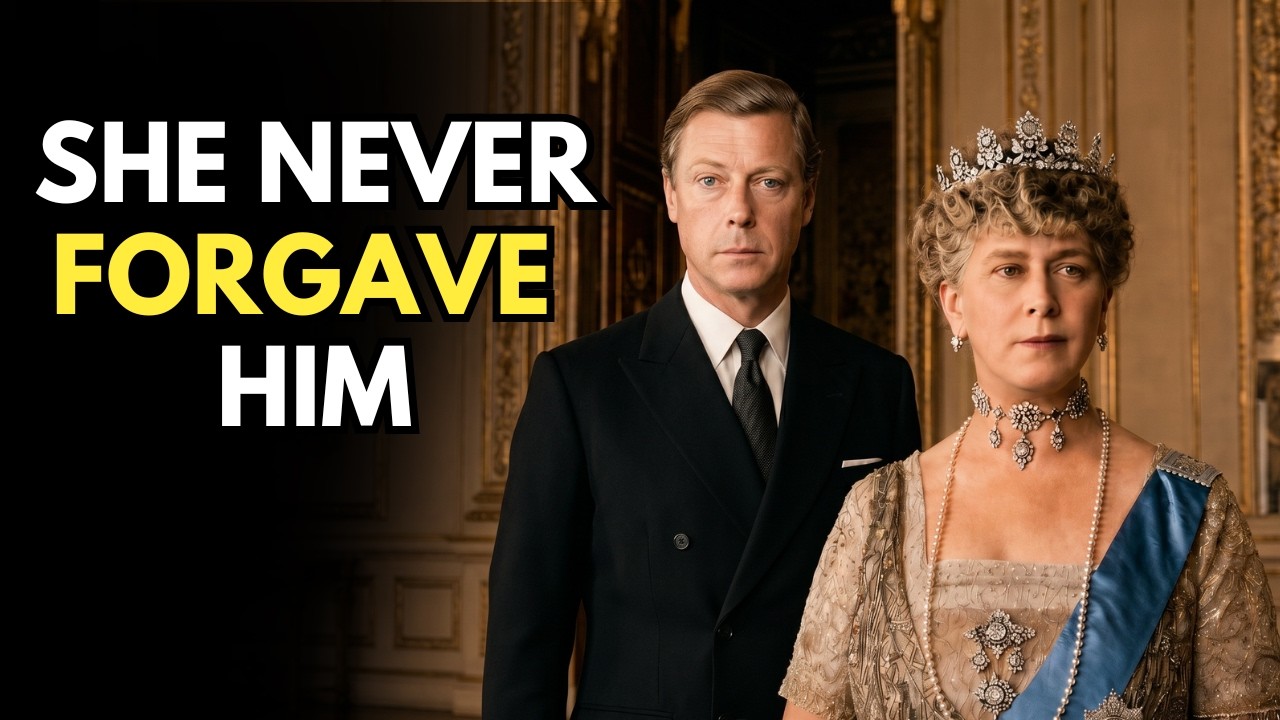
It was that she believed she could never forgive him. And the strangest part of the story is that she may have been right. To understand why, you have to go back before Wallis Simpson, before the instruments of abdication, before all of that. You have to go back to a nursery in Buckingham Palace in 1894, where a boy was born who would one day hold the greatest empire in human history in his hands.
One idea was repeated to him so often that it stopped being an idea and became something closer to fact. The crown comes first. Always before comfort, before affection, before the person who wears it. Mary of Teck did not invent that idea.
She inherited it, just as she inherited the role of queen consort to a man who took monarchy as seriously as any ruler in modern British history. George V ran his household the way he ran fleet inspections: precise, formal, unyielding. Mary stood beside him not from a lack of affection, but because she believed warmth was a luxury a monarchy in crisis could not afford. Did she love her children any less?
Probably not. But in that house, love was not synonymous with softness, and Edward would spend the rest of his life unable to tell the difference. Mary and George watched their cousins lose their thrones, and in the case of the Romanovs, their lives. They watched the old European order collapse within a single generation, swept away by war, revolution, and the erosion of public trust in inherited authority.
The British monarchy was one of the few that survived. To them, that survival was no accident. It was discipline, paid for daily without complaint. So when Edward was born, the lesson came first.
Not affection first. Duty first. It did not look like a choice from the outside. It looked like parenting.
But it was a decision about what kind of family the heirs to the British throne would be raised in. And at the time, it seemed like the only reasonable decision. Put yourself in their position. You are raising the future King of England during the most unstable period the European monarchy had ever faced.
Which lesson do you teach your son? Caution, or the freedom to feel whatever he wants whenever he wants regardless of consequence? There was no middle path available. Edward learned self-restraint before he learned self-expression.
He was taught that the institution mattered more than the individual before he reached an age where he could understand either word. His tutors drilled etiquette and protocol the way other children were drilled in arithmetic. His father corrected his posture, his manners, his public expressions, treating every misstep not as a childish error but as a small failure in the role he was born to play. For a time, it worked exactly as planned.
Edward grew into a young man the public adored. He served on the front lines during the First World War despite his father’s refusal to allow it, toured the Empire before enormous crowds, and possessed a charm his father lacked and a warmth his mother rarely showed in public. Crowds in Canada, India, and Australia received him like a movie star, not a future king. From the outside, the system had produced exactly what it intended.
But behind that performance, something else was happening. Something his parents, by the very nature of the lessons they had taught him, were not positioned to notice. Edward was not only learning duty. He was learning that his feelings were a debt to be managed and deferred, paid quietly for a role he never chose and could not resign from.
A child taught that lesson long enough does not always become a man at peace with sacrifice. Sometimes he becomes a man who counts what others owe him. No one in the palace asked whether that ledger would ever come due. They assumed duty, once planted, was permanent.
It took more than forty years to discover otherwise. Because somewhere inside that boy raised to serve the crown above all else, a quieter belief was taking root, one no one saw forming until it was too late to stop it. He began to believe that one day he would be the one to decide what he owed. Did Queen Mary see it coming?
Years later, some accounts suggested she did but said nothing. George V died in January 1936. Immediately, the palace made its second decision, one that seemed as logical then as the first: say nothing. Edward had been seeing Wallis Simpson, an American socialite twice divorced, for years before he became king.
She resembled nothing the court had imagined for him. Sharp-tongued, independent, and entirely unimpressed by royal formalities. For a man raised to treat every personal impulse as something to be managed, that indifference may have been exactly what drew him to her. Inside the palace and in the upper levels of government, nearly everyone knew about the relationship.
The British press printed nothing, in a silence it imposed on itself. Foreign newspapers covered it freely. The British public had no idea. While ministers debated constitutional theory behind closed doors, Queen Mary faced a far simpler question alone.
Could she save her son without destroying everything she believed a king should be? She did not yet have an answer. But every week that passed without one made the question harder to escape. Who could have stopped this and did not?
Start with Prime Minister Stanley Baldwin, who learned early and chose for months to manage the relationship quietly rather than confront the king directly, hoping it would simply burn out like previous royal infatuations. That caution gave Edward time. He used it to become more determined, not less. The Archbishop of Canterbury understood that a king who served as Supreme Governor of the Church of England could not marry a divorced woman whose former husbands were still alive.
But the Church waited for the government to move first. And the government waited for a clearer reason. Everyone was waiting for someone else to take the costly first step. Then there was the family.
Queen Mary knew. Edward’s brothers knew. None of them sat with him early on to tell him plainly that this could not happen, while there was still time to end the relationship quietly. Why not?
Partly fear, not of Edward’s anger, but of being the one who caused an irreparable rupture. Partly the structure of the monarchy itself, which granted a ruling king enormous personal freedom with no real mechanism to refuse his request. And partly an uncomfortable hope that the problem would resolve itself before anyone had to end it. Every silence, reasonable in itself, taught Edward the same lesson: no one would stop him.
A man raised his whole life to interpret silence as obedience to higher authority was now, perhaps for the first time, interpreting it as permission. By the time anyone moved, it was no longer possible to end the relationship quietly. Edward had stopped asking whether he would marry Wallis. He began asking when.
So the government turned to compromise. A morganatic marriage, in which Edward kept the throne and married Wallis without her becoming queen. A sincere attempt to find a way out. It failed.
The governments of Australia, Canada, and South Africa refused outright. That should have ended it. Instead, it granted a few more weeks of false hope. Edward spent those weeks searching for a settlement that did not exist.
Did Queen Mary ever believe a settlement existed? From nearly the beginning, no. At some point during those final weeks, she made the decision that would define the rest of her life. She did not write Edward a pleading letter.
She did not threaten him. She did something quieter and more devastating. She refused to lend her support to any arrangement that kept him on the throne with Wallis at his side. In her silence, as much as in any spoken word, she made clear she stood with constitutional principle, not with her son.
She was not voting against Edward in some abstract political sense. She was deciding, in the most painful arena any parent can face, that the institution she had devoted her life to serving mattered more than her son’s happiness. Unlike Baldwin, unlike the Archbishop, she was not balancing constitutional theory against political risk. She was balancing her son against everything she had ever believed in.
She chose what she had always been taught to choose. On December 10, 1936, Edward VIII signed the instrument of abdication. The next day, in a radio broadcast heard across the Empire, he said he found it impossible to discharge the duties of king without the help and support of the woman he loved. It is one of the most famous speeches in modern royal history.
It is also an admission, though not the one most listeners thought they were hearing. A man raised his entire life to believe duty preceded self had, at the final moment, irrevocably chosen self. The immediate cost was political and real. Clouds were gathering over Europe quickly.
Hitler had remilitarized the Rhineland that same year. Mussolini’s Italy had invaded Ethiopia. Spain was sliding toward civil war. A British monarchy that appeared unstable or ruled by personal whim would have handed a gift to every authoritarian regime in Europe.
The abdication resolved the crisis quickly and without violence. Constitutionally, the system worked exactly as designed. But the deeper cost was not political. It was human, and it was never resolved.
Albert, Edward’s younger brother, became King George VI, a role he did not seek and was said to dread. A man with a severe stammer was now required to lead a nation toward war. His daughter Elizabeth, only ten years old, became heir to the throne overnight. Her entire future was rewritten by a decision she had no part in making.
The crown that had driven her uncle to rebellion would, in time, become the defining legacy of her long life. Queen Mary lived another seventeen years carrying her burden. Did she ever consider forgiving him? Some accounts suggest she came close more than once, but pulled back each time.
Because forgiving Edward would not have meant merely pardoning a son who made a personal choice. It would have meant acknowledging that everything she had built her life around, the idea that the crown stood above the individual, the lesson she had spent four decades instilling, was ultimately negotiable. She could not make that concession. Not from a lack of love, but because it would have meant admitting that her life and George V’s life had been spent defending a principle that had not, in the end, held.
Popular memory casts Edward as the romantic who chose love, and Mary as the cold traditionalist who chose duty and lost her son because of it. That is not wrong, but it is incomplete, because it treats the abdication as a single decision when it was the final link in a chain stretching back decades, pulled by dozens of people who never intended the outcome they reached. George and Mary did not intend to raise a son who would abandon the throne. Baldwin did not intend to let the crisis fester.
The Church did not intend to push a king into open defiance. And Queen Mary did not intend to lose her son forever. She intended to protect the one thing she had been taught her whole life was worth protecting. Institutions do not usually collapse, and families do not usually fall apart, because someone chose cruelty.
They fall apart because a long series of individually reasonable decisions narrows every available option down to one, until the person holding it has no real choice left. By 1936, Queen Mary’s decision had been made long before, not that year, but decades earlier in a nursery, by parents who believed they were doing the only responsible thing available to them. Queen Mary never met Wallis Simpson. Not once.
Not in all seventeen years, not even after Edward begged her. She died in 1953, the same year her granddaughter was crowned queen, carrying that decision with her to the end. History remembers the king who left.
It rarely remembers the mother who stayed behind and spent the rest of her life paying for a choice she made before she ever knew what it would cost.
