In October 1985, a congregation gathered at Calvary Baptist Church in Gadsden, Alabama, to mourn Donna Jean Petway. She had been found strangled in her home eleven days earlier. A man who had known her since she was twelve stood in the third row. When the pastor asked the congregation to bow, he bowed.
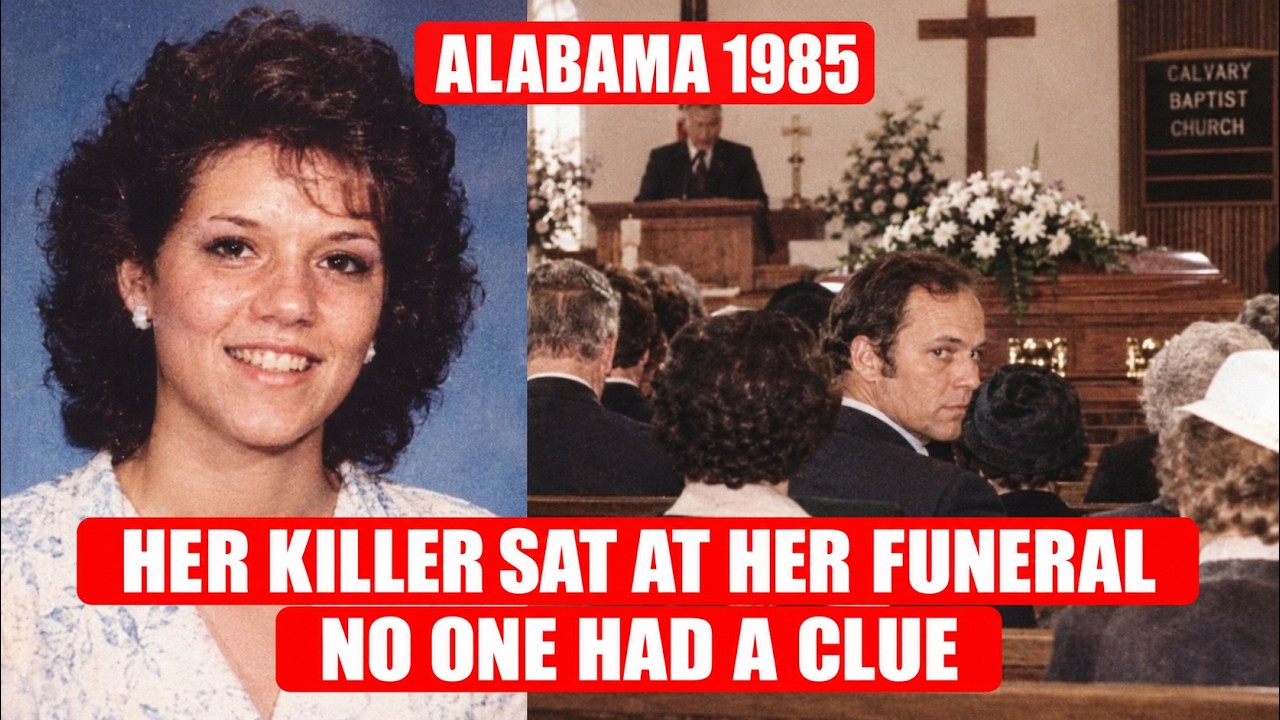
When the choir began, he wiped his eye. After the service, he walked to the family, took Donna Jean’s mother’s hands in his, and told her how terribly sorry he was for their loss. No one in that church understood what they were witnessing. It would take thirty-eight years, a graduate student’s persistence, a detective who worked weekends without pay, and technology that did not exist in 1985 to explain it.
Gadsden, Alabama, in the fall of 1985 was a working town in the northeast corner of the state, folded into the Coosa River valley below the Appalachian foothills. The Goodyear tire plant employed 2,400 people and set the rhythm of half the city’s households by its shift whistle. Steel mills and textile plants filled the rest. It was a city of 43,000 where people knew each other’s business, trusted their neighbors, and went to church on Sundays.
Donna Jean Petway was twenty-six. She worked as a medical records technician at the Etowah County Medical Center, a job she had held for four years and was good at. Her supervisor called her dependable in a way that actually meant something. She lived in a rental house on Magnolia Street with a black and white cat named Hector and a vegetable garden she was proud of.
She drove a 1979 Datsun with a busted passenger window she had duct taped over in March and never gotten around to fixing. She called her mother every Sunday evening at seven. She had been saving money for two years toward a trip to New Orleans. Her mother, Cecil Petway, had raised three children largely alone after her husband’s death in 1974.
She taught Sunday school at Calvary Baptist for twenty years. She knew everyone in that congregation. She trusted the people in those pews the way you trust the walls of your own house. That trust was the thing the killer used.
September 17, 1985, was a Tuesday. Donna Jean left the hospital at 4:30, stopped at the Piggly Wiggly on Broad Street for milk and dog food, and arrived home between five and five-thirty. A neighbor saw her car in the driveway at 5:15. By six, something had happened inside that house that would not be discovered for another fourteen hours.
When Donna Jean did not appear for her shift the next morning, her supervisor called the house. No answer. She called again. At nine, she called Cecil Petway.
Cecil drove to Magnolia Street immediately, knocked, tried the door, and went around to the back. The screen door was unlatched. The back door stood three inches open. She pushed it the rest of the way.
Gadsden Police arrived at 9:41 a. m. Detective Carl Hubbard, forty-three years old, fifteen years on the force, took the lead. He had worked more than forty homicides.
He would later say this one settled differently in him than most. There was no sign of forced entry. Nothing was missing. Her purse sat on the kitchen table.
Her keys hung by the front door. The cat was crouched under the bed in the back bedroom and would not come out. The state medical examiner determined the cause of death as manual strangulation. There was no sexual assault.
The absence of forced entry told Hubbard something specific. Donna Jean had opened the door for whoever came. She had not been afraid. She had let him in.
Over the next eight weeks, Hubbard interviewed sixty-one people. He spoke with neighbors, co-workers, her brother and sister, both quickly eliminated. He spent two weeks on a man she had dated briefly the year before before phone records and a witness placed him unambiguously in Montgomery that week. He spoke with the men and women of Calvary Baptist congregation, including a man named Clifton Reese.
Reese was forty-four. He had grown up in Gadsden, spent two years in the army, and had worked at the Goodyear plant for twenty-six years. He had known Cecil Petway through Calvary Baptist for decades. He had watched Donna Jean grow up.
He was well-liked, known as a man who showed up for funerals, for moves, for repairs that needed doing. He pressed hands at services and wiped his eye when the choir sang and was simply part of the fabric of the place. Hubbard interviewed him for forty minutes. Reese was cooperative.
He said he had seen Donna Jean at church a few Sundays back but had not spoken with her in some time. He expressed deep sadness. His alibi for the evening of September 17th was his wife, Norma Jean, who said he had been home all evening watching television. She was certain.
Hubbard noted nothing that moved Reese toward the center of the investigation. The case ran hard for five months, then slowed, then stopped producing anything new. With no physical evidence connecting a specific individual to the scene, no witnesses who had seen anything unusual that evening, and no forensic technology capable of processing the biological evidence that had been collected, the case went cold. Hubbard kept it on his desk for three more years before retiring.
He told the detective who replaced him this one was worth a second look. Nobody looked. Cecil Petway buried her daughter and lived. She attended Calvary Baptist every Sunday.
She taught Sunday school for fifteen more years. She sat in the same pews as Clifton Reese, whose wife Norma Jean organized the church potlucks. Cecil died in 2004. She never had an answer.
Ray Petway, Donna Jean’s brother, took over asking the questions. He wrote to the Gadsden Police Department every year on September 17th, the anniversary, requesting any update on his sister’s case. The responses said the case remained open. By 2010, a form letter had been developed for exactly this kind of correspondence.
Gadsden changed the way all those towns changed. The Goodyear plant closed in 2002. The textile plants followed. Clifton Reese retired from his second career at a hardware store in 2009.
He and Norma Jean moved to a smaller house on the east side of town. He still attended Calvary Baptist when his knees allowed it. He was seventy-two. He had been carrying what he knew for twenty-five years and showed no particular signs of the weight.
In 2018, a graduate student in forensic genetics at the University of Alabama named Priya Mehta began working on a project to process biological evidence from unsolved homicides using investigative genetic genealogy. The technique uploaded crime scene DNA to public ancestry databases and traced distant relatives backward through family trees to identify an unknown contributor. It was the same approach that had cracked the Golden State Killer case that year. Mehta’s supervisor forwarded her twelve case files for review.
Donna Jean Petway’s was among them. The biological evidence collected from the Magnolia Street house in 1985 had been stored properly in the state evidence archive. It was intact. It was sufficient.
The DNA profile was uploaded to a public genealogy database in March 2019. Mehta spent a year building the family tree of the unknown male contributor, working through thousands of speculative branches on evenings and weekends. In February 2020, she had a name. She drove to the Alabama Department of Forensic Sciences and set her printout on the table in front of Sergeant Diane Flornoy, the cold case detective who had been working Donna Jean’s case in her off hours since 2016.
Flornoy looked at the name for a moment. Is he still alive? Mehta said she believed so. Flornoy said, then let’s go make sure.
The name on the printout was Clifton Reese. The confirmation came from a coffee cup. Flornoy located Reese through public records, established his routine, and on a Wednesday morning in March 2020, the same week Alabama’s first COVID lockdown was announced, she sat in a parked car outside a gas station on the east side of Gadsden and watched Clifton Reese, seventy-eight years old, walk inside. He came out with a large coffee in a paper cup.
He drove away. She went inside. The lab confirmed a match to the 1985 crime scene sample within six weeks. The arrest came on a Tuesday in June 2020, thirty-five years and nine months after the night Clifton Reese walked through the back door of Donna Jean Petway’s rental house and she let him in because he was a man her mother trusted and she had known since she was twelve and there was no reason in the world not to open the door.
The name was released. People who had attended that funeral recognized him immediately. The reaction moved through disbelief, the specific disbelief that comes from doubting your own memory of a person, then something colder. Every potluck he had helped organize.
Every funeral he had attended with that face arranged in grief. Every Sunday in those pews next to Cecil Petway, who never knew. Norma Jean Reese, his wife who had provided his alibi in 1985, made no public statement. Clifton Reese was charged with murder in the first degree.
His attorney entered a not guilty plea. At a preliminary hearing in 2021, the genetic genealogy evidence was admitted. Motions challenging the science were denied. Court documents confirmed the match’s probabilities at greater than one in one quadrillion.
In October 2022, Clifton Reese accepted a plea agreement. He pled guilty to murder in the second degree. He was sentenced to twenty years in the Alabama Department of Corrections. He was seventy-nine years old.
He would serve whatever portion of that sentence his remaining years allowed. At the sentencing hearing, Ray Petway stood and read a statement. He had been writing it for two years, he said, and it was still not right. He spoke about his mother.
He spoke about the letters he had written every September 17th for eighteen years. He spoke about his sister’s vegetable garden on Magnolia Street, which he had passed once years later and found overgrown with pokeweed and clover, and how he had stood on the sidewalk looking at it longer than he intended. He did not look at Clifton Reese. He said he was speaking for his mother, who could not be there, and for Donna Jean, and for the Sunday school class his mother had taught for twenty years in the same building where this man had sat and grieved and lied with his whole body.
There was a long quiet in the courtroom after he finished. Justice found Donna Jean Petway after thirty-eight years, carried through a coffee cup, a database, and a graduate student who could not let it go. The man who killed her had stood in the exact center of everything she trusted and used that position like a key. She was a woman with a duct-taped car window and a cat she loved and a vegetable garden she took pride in and a trip to New Orleans she kept almost taking.
She opened that door because she had been taught reasonably and rightly that the people in her world were safe. The lesson the killer drew from that was no person should ever have to teach.
