On the 26th of January, 1978, a blizzard buried Chicago under two feet of snow, shut down the expressways, and stranded half a million commuters. Schools closed, businesses locked their doors, and the National Guard rolled armored vehicles down Lake Shore Drive. In a small apartment in the Wrigleyville neighborhood, a 32-year-old IBM systems engineer named Ward Christensen picked up his telephone and called his friend Randy Seuss. The two men belonged to the same computer hobbyist club, the Chicago Area Computer Hobbyists Exchange, and they had been kicking around an idea for weeks.
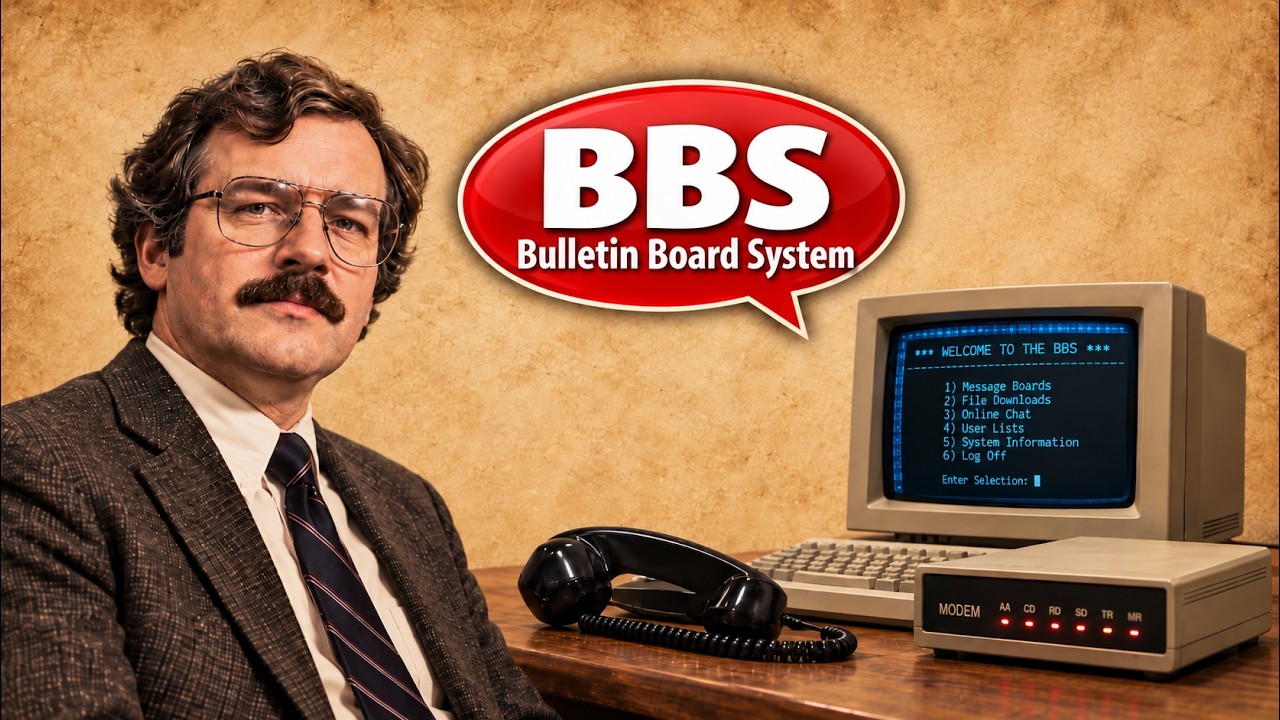
They wanted to build something that had never existed before: a computer that could answer a telephone, let a stranger type a message, and hold that message until someone else called to read it. The blizzard gave them what no amount of ambition could buy, time. Christensen began writing software in Intel 8080 assembly language at his desk. Seuss, a Navy veteran and hardware builder who had worked at both IBM and Zenith, began soldering together an S-100 bus computer in his apartment.
Between them, connected by a phone line, they were about to invent the future of human connection. To understand what they were building, you first have to understand what the world was missing. In 1978, the personal computer existed, but it was an island. An Altair 8800 or an Apple II did whatever its owner could program it to do and nothing more.
There was no network, no connection to anyone else. The ARPANET existed, but it was locked behind institutional walls no hobbyist could climb. CompuServe had just begun offering time-sharing for businesses, but the cost was prohibitive and the interface was built for professionals, not tinkerers. If you wanted software another hobbyist had written, you drove to a club meeting, handed over a floppy disk, and drove home.
The computer itself was mute. It could compute. It could not communicate. There was one lonely precursor.
In 1973, activists in Berkeley, California had set up a project called Community Memory, a single terminal inside a record shop wired by phone line to a government surplus mainframe across the bay. Anyone could walk up, type a message with a keyword, and search for messages others had left. The idea was right, but the technology was not ready for ordinary people to replicate. Ward Christensen was the kind of person who made technology ready by refusing to wait for it.
Born in 1945 in West Bend, Wisconsin, he had built a computer that won first place at his high school science fair in 1963, earned a degree in physics and chemistry from Milton College, and walked straight into a job at IBM as a systems engineer. He stayed at IBM for 44 years, but the work that mattered he did at home, on his own time, for free. In 1977, a year before the blizzard, Christensen had written a small program he called MODEM, later refined and renamed XMODEM, that allowed two personal computers connected by telephone to transfer a file between them. He released it into the public domain.
It became the first widely adopted file transfer protocol for personal computers, transmitting files in 128-byte packets, each one checked for errors and retransmitted if corrupted, a method so reliable it remained in use for over a decade. Randy Seuss was the other half. Born in 1945 in Skokie, Illinois, he had served in the Navy and developed an instinct for hardware that matched Christensen’s instinct for code. He was also an amateur radio operator, comfortable with the idea of signals traveling through wires and air to reach strangers.
He understood what it meant to maintain shared infrastructure on your own time and at your own cost. When the blizzard sealed them both inside their apartments, the division of labor was already clear. Christensen would write the software. Seuss would assemble the hardware and host the machine in his apartment, on his phone line, at his expense, for anyone who wanted to call.
They finished in two weeks, though they later told people it had taken four because they did not want the work to seem rushed. On February 16, 1978, the system went live. Christensen had named it CBBS, for Computerized Bulletin Board System, a name patterned after the cork boards and push pins in grocery store lobbies. He had coined a term that would define a generation of technology.
The system could do exactly three things: answer the telephone when a stranger’s modem called, let that stranger leave a message, and let the next stranger who called read that message. One phone line, one caller at a time. When someone was connected, everyone else heard a busy signal. Within that simplicity lived something that had never existed in the hands of ordinary people: a place where you could speak to strangers without knowing their names, without being in the same room, without anyone’s permission.
The computer, for the first time, was not just a tool. It was a meeting place. The limitations were brutal. 300 baud was the speed of the modems that connected to CBBS in 1978, roughly 30 characters per second, slow enough that you could read each letter as it arrived.
A full screen of text took the better part of a minute to fill. Downloading a single small file could take an hour. If someone picked up a phone extension while you were connected, the transfer died and you started over. But the people who called did not care about speed.
They cared that a machine had answered the phone, accepted their words, and promised to hold them for the next person who called. CBBS would eventually receive over a quarter of a million calls before it was retired, all arriving one at a time through that single line in Wrigleyville. Christensen had placed XMODEM in the public domain. He did the same with the concept of the bulletin board system.
He published the idea, explained how it worked, and invited anyone with the hardware and the will to build their own. They did. Slowly at first, a handful of boards appeared in other cities in 1979 and 1980, each one an island with its own phone number and its own sysop, the system operator who ran the machine and paid the phone bill. The early sysops were not entrepreneurs.
They were hobbyists running a public service from a spare room on a budget of nothing but enthusiasm and telephone charges. That something arrived in April 1981. Dennis Hayes and his co-founder Dale Heatherington, working out of Hayes’s home in Norcross, Georgia, released the Hayes Smartmodem at a retail price of $299. It was not the first modem, and it was not the fastest.
What it was was smart. Previous modems required manual operation, flipping switches, listening for a dial tone, placing a telephone handset into an acoustic coupler. The Smartmodem eliminated all of it. It introduced the AT command set, a simple language of text commands that let software control the modem directly.
For the first time, a personal computer could pick up the phone by itself. For bulletin board systems, this was an ignition. Before the Smartmodem, running a BBS meant babysitting the hardware. After, it meant leaving the computer on and walking away.
Within two years, hundreds of new boards appeared. But the boards were still islands. A caller in Chicago could reach every local board for free, but calling a board in Los Angeles meant paying long-distance rates, and long-distance in the 1980s was not cheap. A three-minute call across the country could cost $2 or more, and a BBS session rarely lasted three minutes.
An hour spent on a board in another area code could generate a phone bill that arrived like a letter from a creditor. Every bulletin board was a village, and no road connected the villages to each other. The person who built that road was a queer punk from Boston named Tom Jennings. Around Christmas of 1983, Jennings wrote a BBS program he called Fido because the assembled hardware, scavenged from surplus and second-hand parts, was, in his words, a real mongrel.
In June 1984, Jennings released the first version of FidoNet, a protocol that allowed two Fido systems to call each other automatically in the middle of the night, exchange messages, and hang up. The messages would then be available to every caller on both boards the next morning. It was store-and-forward networking, built from telephone wire and free software, given away because that was the only way it would work. The genius of FidoNet was in its economics.
Long-distance calls were cheapest after midnight, so Jennings designed the system around a concept called zone mail hour. Every FidoNet node in a given time zone would stop accepting callers at the same hour in the dead of night, dial its designated hub, upload outgoing messages, download incoming messages, and hang up. The entire exchange might take minutes. The long-distance charges were pennies.
It worked because the people who ran it believed it should exist. By August 1984, 30 systems were connected. By January 1985, over 160. By the early 1990s, FidoNet linked roughly 20,000 nodes across more than 100 countries, with an estimated 4 million users.
It was the largest volunteer-run computer network in history, built without a dollar of venture capital, without a headquarters, without a CEO. By the late 1980s, the bulletin board had evolved into a universe of its own. Discussion boards became forums for politics, religion, science, and arguments that could last for months. Writers ran boards to workshop fiction, posting drafts for strangers to critique.
During the AIDS crisis between 1985 and 1993, over 100 bulletin boards provided HIV and AIDS information and support when mainstream media would barely say the word. Then there were the door games. Legend of the Red Dragon, written in 1989 by a young programmer named Seth Robinson, was the most beloved. The premise was simple: you were an adventurer in a small village threatened by a dragon.
The game kept track of your character between sessions, so when you hung up and someone else dialed in, they might find your name on the leaderboard or discover that you had attacked them in their sleep. It sold 30,000 copies to sysops across the country and became the first massively multiplayer game that most Americans ever played, running on a phone line at 1200 baud. Alongside the games, an entire art movement built itself from nothing but the 256 characters of the IBM extended ASCII set and 16 colors of ANSI escape codes. ANSI artists made paintings from punctuation, and competitive groups like ACID Productions formed to push the craft further.
By 1994, the bulletin board system had reached its peak. One estimate put the count at 60,000 BBSes serving 17 million users in the United States alone, with more than 106,000 boards operating at some point over a span of 20 years. In the St. Louis area alone, more than 360 systems were running by June 1994.
The boards had, without anyone in charge directing them, built something that looked very much like the internet before the internet. Every sysop who added another phone line, every FidoNet node that relayed messages at 4:00 in the morning, every caller who endured a busy signal and dialed again was proving the same thing: people wanted to be connected. The turn, when it came, was not subtle. In 1993, a team at the National Center for Supercomputing Applications at the University of Illinois released a web browser called Mosaic.
It displayed images alongside text and let a user click from one page to another anywhere in the world without dialing a new number. There were no busy signals, no waiting for a single phone line to clear. Within a year, commercial internet service providers began offering dial-up access for a flat monthly fee. A single phone call connected you not to one system, but to every system.
The BBS’s fundamental architecture, one phone line, one connection, one board at a time, was a limitation, and the internet routed around it. The fall was fast. The St. Louis BBS scene, 360 systems strong in June 1994, collapsed to a fraction of that by June 1995.
Across the country, sysops watched their call logs thin as their regulars discovered the web. By December 1995, over 95% of newly created internet service providers were former bulletin board systems converting their phone lines from hosting communities to providing dial-up internet access. Hayes Microcomputer Products, the company whose Smartmodem had ignited the revolution in 1981, filed for bankruptcy in 1994, filed again in 1998, and was liquidated in 1999. Tim Stryker, the creator of Major BBS, died in 1996 at the age of 44.
GalaxyCom folded in 1999. FidoNet, which had peaked at 39,000 nodes, eventually leveled off at roughly 2,500. Boardwatch Magazine ceased publication in 2002. The human cost was measured in the sysops who unplugged their machines one evening and never plugged them back in.
They had built the message boards, the chat rooms, the file archives, the online games, the art scene. They had built all of it first, and none of it was credited to them. They packed up their modems, reformatted their hard drives, and went back to being private citizens. Randy Seuss died on December 10, 2019 at the age of 74.
He had hosted CBBS from his apartment for over two decades, paying the phone bill every month, answering the calls of strangers who never knew his face. Ward Christensen died on October 11, 2024 at the age of 78. The Electronic Frontier Foundation had given him its Pioneer Award in 1993, and Chicago’s mayor had declared February 16, 2003 as BBS Day in the city. When Christensen died, most of the obituaries had to explain what a bulletin board system was.
The term he had coined, the infrastructure he had seeded, the protocol he had given away for free, had done their work so completely that the world they made possible had forgotten where it started. But the boards are not entirely gone. The Telnet BBS Guide lists over a thousand systems still running today, most accessible over the internet but operating the same software, hosting the same door games, displaying the same ANSI art. In Taiwan, the PTT Bulletin Board System, launched in 1995, still serves millions of users as one of the most active online communities in the country.
The hobbyists who run boards today do not do it because they need to. They do it because something about connecting to a single machine run by a single person with a community small enough to remember your name is worth preserving. That telephone line in Wrigleyville is disconnected now. Both men who made it are gone.
But every notification that lights up every phone in every pocket in America, every message that arrives without being asked for, every stranger’s words appearing on a screen in your hand, is a descendant of what happened on February 16, 1978, when a computer answered a telephone for the first time and a stranger’s words traveled down a wire into a machine that promised to remember them. The bulletin board system did not fall to the internet. It taught America to want the internet, and the internet never learned where the lesson came from.
