On the night of July 26, 1997, nineteen-year-old Tiffany Johnston pulled into the Sunshine Car Wash on Northwest 23rd and Council Road in Bethany, Oklahoma. She had been married for exactly sixty days. Her husband, Ryan, was finishing a shift that would end at eleven, and they had plans to meet at their usual spot, a small ritual for a young couple still building their life together. Tiffany took her car mats off the tires and hung them on the wall of the stall, the way anyone does before washing a car.
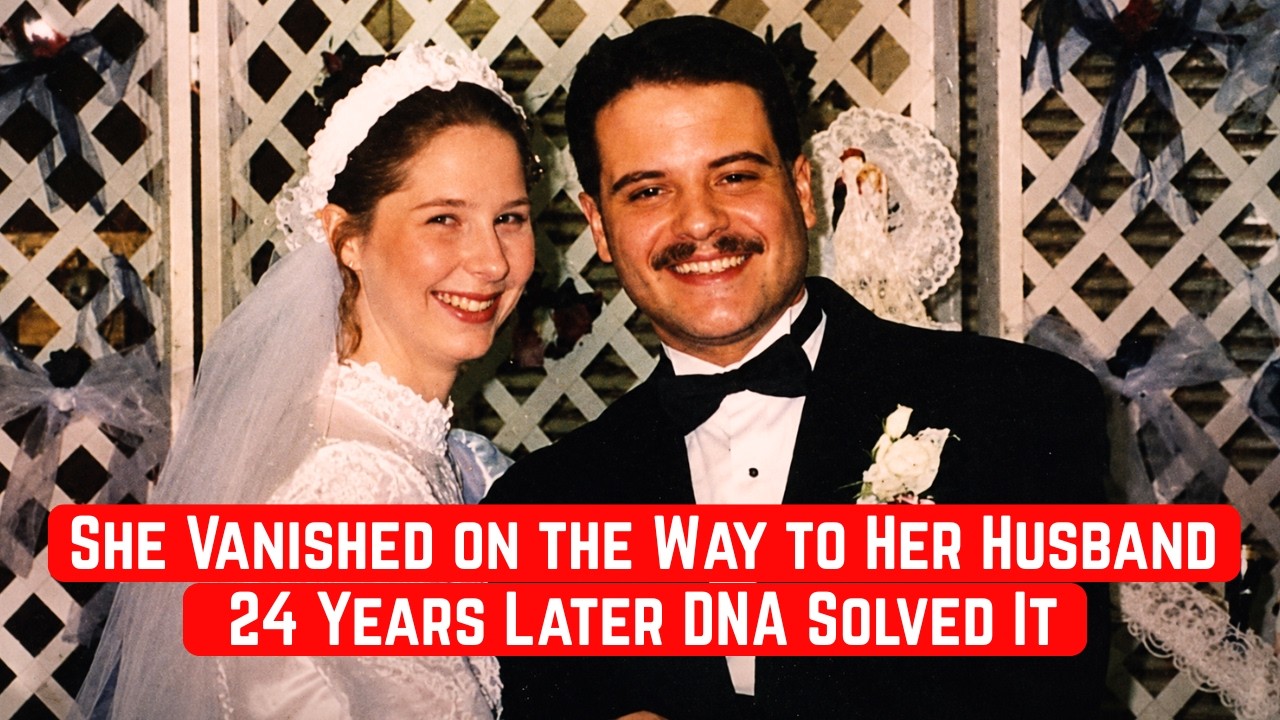
That was the last confirmed sighting of her alive. Sergeant John Reed was on duty that night, running a routine call elsewhere in Bethany. On his way, he drove past the car wash and caught a small detail in his peripheral vision: a white Dodge Neon sitting alone in the far west stall, nobody around it. He noted it, kept driving, and finished his call.
On the way back, the Neon was still there, the only vehicle left in the lot, past midnight. Reed pulled in. The car was unlocked, keys in the ignition, purse on the seat with money inside, and the car mats still hanging on the wall. Whoever owned this car had started washing it and then simply stopped existing.
There was no broken glass, no scattered belongings, no sign of a struggle. The scene was unnervingly calm. Reed ran the plates. The car belonged to Tiffany Johnston.
Inside the glove box he found a phone number for her mother, Kathy, who lived sixty miles away in Anadarko. When the phone rang in the middle of the night, Kathy later said she knew something was wrong before she was fully awake. Tiffany was supposed to be meeting Ryan. She never showed up.
Ryan Johnston had already been pacing for hours. His shift ended at eleven. Tiffany wasn’t there. She hadn’t left a note.
She wasn’t answering. He got in his car and started driving, checking their usual spots, retracing routes. Then his pager went off. The number on the screen was a police station prefix.
He drove straight there. The officer at the desk told him they had found Tiffany’s car. She wasn’t in it. She wasn’t anywhere near it.
Ryan Johnston walked out of that station no longer a worried husband, but a man whose world had just split in two. The next morning, a search party in Canadian County was wrapping up a separate missing person’s case when one of them noticed something odd in the tall grass alongside the highway. It was pressed down, flattened, like something heavy had been laid on top of it. A young woman was lying motionless in the dirt.
Investigators arrived and took a photograph, which was brought to Ryan Johnston. He didn’t have to look for long. It was Tiffany. In every homicide investigation, there is an unwritten rule: when a married woman is murdered, you start with the person who shares her bed.
Bethany police had a dead wife, a crime scene with no signs of a struggle, and a husband who, by his own account, had been driving the streets alone all night with no one to confirm where he was. Ryan Johnston became the prime suspect. But Ryan Johnston didn’t do it. He was questioned and told investigators everything.
He cooperated, he was shaking, he answered every question. Investigators verified every detail. They talked to his co-workers, pulled his work records, and confirmed his shift started at three in the afternoon and didn’t end until eleven that night. Multiple people placed him at his workplace during the exact hours Tiffany disappeared.
Ryan agreed to a polygraph test without hesitation. He passed. He provided a DNA sample. He was eliminated completely, officially, beyond any doubt.
The investigation was bigger than Bethany could handle, so they called in the Oklahoma State Bureau of Investigation. The OSBI worked every angle: co-workers, ex-boyfriends, acquaintances, anyone who had ever crossed paths with Tiffany. Buccal swabs were collected from every male person of interest in her orbit. One by one, each came back excluded.
DNA testing was still in its early stages in 1997, and the samples yielded no answers. There were no eyewitnesses, no physical evidence pointing anywhere useful. The leads dried up and then stopped completely. Tiffany Johnston’s case was filed away, cold.
Her mother Kathy refused to let it stay that way. She called the Bethany Police Department regularly, pushing, asking questions, demanding to know if anyone was still working on her daughter’s case. More often than not, the answer was silence, not because nobody cared, but because there was genuinely nothing left to chase. But across the state line in Texas, a young woman was fighting for her life, and she would eventually crack this case wide open.
Sandra Sapaugh was nineteen years old and pregnant. In May of 1997, two months before Tiffany’s murder, she pulled into a parking lot near a Waffle House in Webster, Texas, and noticed her tires had been slashed. She was stranded, alone. Then a man appeared.
He offered to help, said he could give her a ride. She got in his truck. The moment the door closed, everything changed. Brandishing a weapon, he trapped her inside and sped onto Interstate 45.
Sandra noticed that the back door of the truck wasn’t fully locked. At seventy miles per hour, she made a harrowing leap for freedom, fracturing her way out of the moving vehicle. Against all odds, she survived. The man panicked and sped away into the night.
She couldn’t immediately put a name or a face to her attacker. In May, Sandra escaped. In July, Tiffany was murdered. It wasn’t until October of 1997, three full months after Tiffany’s death, that police in Texas finally arrested a man for Sandra’s kidnapping.
His mugshot ran on news stations across Texas and Oklahoma. The owner of the Sunshine Car Wash in Bethany was watching the evening news when a face flashed across his screen. He knew that face. The man on the screen was a regular customer at his car wash, someone who came in often, someone who drove a heavy white dually pickup truck and sometimes pulled a horse trailer behind it.
Investigators finally had a name: William Lewis Reese. When the OSBI ran his background, the room went quiet. Reese was a convicted rapist who had served time in an Oklahoma prison. He had been released just nine months before Tiffany’s murder.
He had lived in the Anadarko area, the same town where Kathy called home. Phone records confirmed that Reese had used a payphone in Yukon, Oklahoma, just minutes from the Sunshine Car Wash, on the very night Tiffany disappeared. But in 1997, suspicion wasn’t enough for a warrant. There were no eyewitnesses to the abduction.
Forensic science at the time couldn’t bridge the gap. Investigators were staring directly at the man who almost certainly took Tiffany Johnston, and legally, their hands were tied. William Lewis Reese walked away into the shadows. William Reese was born in 1959 in Oklahoma, one of thirteen children.
He grew up on a farm near Yukon, parts of his childhood spent in foster care, never fully rooted anywhere. On paper, he looked like a thousand other men living ordinary lives in rural Oklahoma. But in April 1986, in Norman, Oklahoma, a nineteen-year-old woman’s car broke down on the side of a highway. A man in a semi truck pulled over and offered her a ride.
He drove her to a loading dock at an air conditioning plant. She survived only because she managed to attract the attention of a worker and got away. Two months later, in Anadarko, a twenty-year-old woman woke up in the dark to find William Reese looming over her inside her own bedroom while her family slept down the hall. She survived and identified him.
Reese was convicted and sentenced to twenty-five years in prison. He served ten. In October of 1996, the prison gates opened and he walked back out into the world. Nine months later, four young women were dead or missing.
On April 3, 1997, in Friendswood, Texas, twelve-year-old Laura Smither, an aspiring ballerina, asked her mother if she could go for a jog before breakfast. She was less than a quarter mile from her front door. She never came back. Her body was found in a retention pond ten miles from home seventeen days later.
On July 15, 1997, in Denton, Texas, twenty-year-old Kelly Cox, a criminology student at the University of North Texas, stood outside a jail after a field trip and called her boyfriend from a payphone. He arrived minutes later. Her car was there, her keys inside, but Kelly was gone. She was never seen alive again.
Eleven days after Kelly disappeared, William Reese was in Bethany, Oklahoma, and Tiffany Johnston was at the Sunshine Car Wash. In August 1997, on Tiki Island, Texas, seventeen-year-old Jessica Cain drove home from a cast party along Interstate 45. Her car was found abandoned on the side of the highway, the door open, her belongings still inside. No Jessica.
Between April and August of 1997, five months, four young women, two states. William Reese didn’t hunt in dark alleys. He operated in the most ordinary spaces of ordinary life: a neighborhood street, a parking lot, a car wash, a highway. By the fall of 1997, William Reese was sitting in a Texas prison on a sixty-year kidnapping sentence for Sandra Sapaugh’s abduction.
But nobody had connected the dots. As far as the world was concerned, those four cases were separate tragedies investigated by separate departments. Four families had no answers. Four cases were cold.
In 2012, OSBI Special Agent Tammy Blankenship pulled Tiffany’s file and asked one simple question: with everything science can do today that it couldn’t do in 1997, can we try again? The lab technicians opened evidence bags that had been sealed since Tiffany’s autopsy fifteen years earlier. The DNA had degraded. What they extracted was a partial profile, not complete, not clean, not enough to run through the national database.
But it was something. It was the biological fingerprint of a man who had been with Tiffany Johnston on the night she was murdered. They went back to every person who had ever been connected to Tiffany. They collected swabs from co-workers, ex-boyfriends, witnesses, names pulled from fifteen-year-old notebooks.
They even went back to Ryan Johnston, who gave another swab without hesitation. He was excluded. Every single man they tested was excluded. Every one of them, except one: William Lewis Reese.
In 2013, OSBI investigators reached out to former Texas Ranger Stephen Jeter. Reese was already in a Texas prison. Jeter made the drive to Huntsville prison and sat down across from William Reese. He asked for a buccal swab.
Reese agreed. In 2015, the results came back. The partial DNA profile extracted from Tiffany’s evidence matched the known puzzle pieces of William Reese’s direct sample. Reese could not be excluded as the source of that biological material.
Every other man had been eliminated. But investigators understood that a partial DNA match in a court of law is not a conviction. A defense attorney could argue that the degraded profile could theoretically point to Reese or any of his paternal male relatives. They needed more than a lab result.
They needed him to say it himself. In 2016, Texas Ranger Jim Holland sat down with William Reese inside a Texas prison visiting room and began what would become one of the most consequential interrogations in Oklahoma criminal history. He didn’t accuse. He didn’t threaten.
He laid information on the table quietly, one piece at a time. He put the phone records in front of Reese showing the payphone call in Yukon, minutes from the car wash. He told Reese they had the DNA result. Then Reese said something that made the room go completely still.
He admitted he knew of Tiffany Johnston. Tiffany’s mother, Kathy, was the best friend of Reese’s own mother. Their families had been connected through the small, tight-knit communities of rural Oklahoma for years. Reese had never met Tiffany, never seen a photograph of her.
But her name had existed in the web of his world long before that Tuesday night. He had not stumbled onto a complete stranger at that car wash. He had stumbled onto the daughter of a woman his own mother had known for decades. Holland made the situation clear.
Oklahoma was pursuing the death penalty, but cooperation might influence how things moved forward. It wasn’t a promise, but silence had no upside left for William Lewis Reese. Reese took a breath and agreed to talk. Not just about Oklahoma.
About everything. He was ready to lead them to the graves. In Brazoria County, investigators were led to a remote flooded field. Crews worked for weeks, digging through mud and water.
They found Kelly Cox. Then Reese led them to Southeast Houston, to a field behind a bar. They dug again. They found Jessica Cain.
Two families finally had answers after nineteen years. The wheels of justice moved slowly. The trial was delayed for years, first by legal proceedings, then by a global pandemic. It wasn’t until May of 2021, twenty-four years after Tiffany Johnston stopped at the Sunshine Car Wash, that William Lewis Reese finally sat down in an Oklahoma County courtroom.
The trial lasted nearly three weeks. Bethany Police Chief John Reed took the stand and described what he had found that night. Ryan Johnston testified about what had been taken from him. Medical experts walked the jury through the DNA process.
And then the prosecution played the tapes. The courtroom went quiet. What came through those speakers was William Lewis Reese’s own voice, calm, unhurried, almost conversational, describing in detail what he had done to Tiffany Johnston on the night of July 26, 1997. He described an argument at the car wash, a confrontation over water that escalated into violence, throwing Tiffany into the horse trailer.
He described Tiffany fighting back, grabbing a horseshoe and striking him with it. Then he described what he did next. He strangled her, first with his hands, then with a rope used to lead horses. He described it the way someone describes a problem they solved, without remorse, without weight.
The defense argued the confession had been coerced, that Ranger Holland had dangled the death penalty like a weapon. They pointed to the imperfect DNA match. They called a psychologist who testified for more than five hours about Reese’s below-average IQ, his PTSD, his difficult childhood. On cross-examination, prosecutors asked a single pointed question: can PTSD be caused by committing multiple rapes and murders?
The doctor answered yes. The defense rested without calling a single witness of their own. The jury left the courtroom to deliberate. They came back in less than one hour.
Guilty. First-degree murder, kidnapping, on every count. The verdict took longer to read than it took the jury to reach it. During the sentencing phase, Kathy Dobry sat in that courtroom and watched the man who had killed her daughter finally face consequences.
Gay Smither, Laura’s mother, was there too, the woman who had built an entire nonprofit organization in her daughter’s name. And then there was Kelly Cox’s daughter, a toddler in 1997, too young to understand, old enough to feel the absence. She was twenty years old when she finally learned that her mother hadn’t left. Her mother had been taken.
The jury recommended death. On August 19, 2021, Oklahoma County District Judge Susan Stallings asked William Lewis Reese if he had anything to say before she handed down his sentence. He did not. Judge Stallings spoke four words that Kathy Dobry had been waiting twenty-four years to hear: justice will not be delayed.
She sentenced William Lewis Reese to death. After the verdict, he was transferred back to Texas, where he pleaded guilty to the murders of Laura Smither, Kelly Cox, and Jessica Cain. He received three consecutive life sentences. In January of 2026, he was transferred back to Oklahoma to the Oklahoma State Penitentiary in McAlester, where he now sits on death row.
In July of 2025, the Oklahoma Court of Criminal Appeals unanimously upheld his death sentence. His case now sits before the United States Supreme Court. Kathy Dobry said after the verdict, not with relief, not with triumph, but with the quiet worn honesty of a mother who had been fighting for twenty-four years and knew exactly what justice could and could not give her back: there will never be closure. She was right.
No verdict brings Tiffany back to the Tuesday night she was supposed to have. No death sentence gives Ryan Johnston back the life he was building with his wife. No courtroom moment returns Laura Smither to the breakfast table or puts Kelly Cox back in her criminology class or drives Jessica Cain safely home from that cast party. The families got truth.
They got accountability. They got the knowledge that William Lewis Reese will never stand in another parking lot, another car wash, another neighborhood street, and destroy another ordinary moment. But closure was never on the table. Tiffany Johnston stopped at a car wash on an ordinary Tuesday evening in 1997.
She was nineteen years old. She had been married for sixty days. She hung her car mats on the wall of the stall. She was going to meet her husband at eleven.
It was just another Tuesday. She never got to grow old. She never got to have children. She never got to say goodbye to the people who loved her.
She never got to finish washing her car. Some monsters don’t hide in the dark. Some of them pull into the stall right next to yours in a white dually pickup truck on an ordinary evening, and the whole world keeps moving like nothing is wrong because nothing looked wrong.
