In May 1945, the fog of the British countryside concealed a strange new landscape. Across fields and forests, giant vehicle parks stretched to the horizon, filled with tens of thousands of American trucks arranged in precise, military squares. Their olive-drab paint, already chipped and rusted, bore the scars of desert sand and European mud. These were not British-built machines.
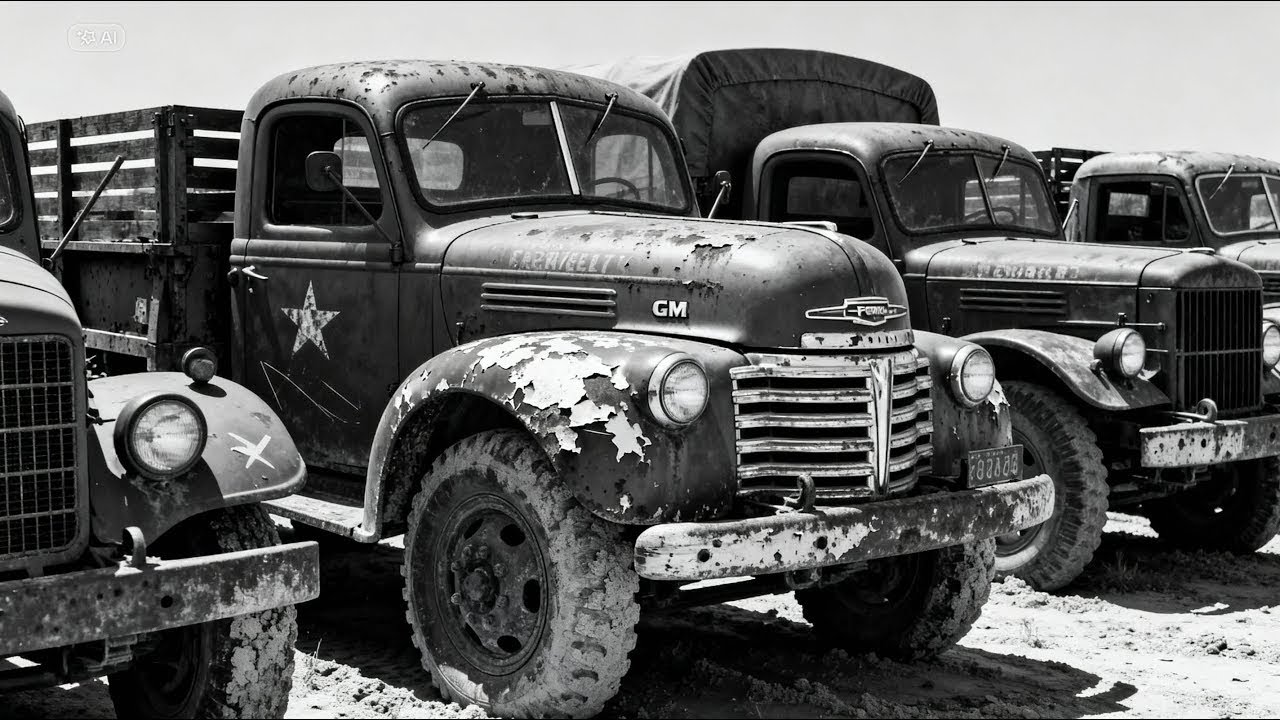
The sharp lines of Detroit styling were unmistakable: rounded Chevrolet hoods, the upright grilles of Fords, the flexible frames of GMCs, and the heavy hearts of Studebakers. The American industrial giant had sent its iron offspring to Britain. More than 480,000 trucks and tractors had crossed the Atlantic under the American flag through the Lend-Lease program, and most had settled on British soil. Europe was free.
The white flag had been raised over Germany, and Japan’s surrender was a matter of weeks away. Yet this vast armada of vehicles had suddenly transformed from a weapon of victory into a puzzling burden for bureaucrats and economists alike. This army of technology belonged to the United States. Britain had fueled it, repaired it, and worn it out quickly on roads from the sands of Libya to the plains of Flanders, but she had never become its true owner.
The spring of peace brought uncomfortable questions. What was to be done with half a million vehicles that were not British, scattered across the island and the continent? Should they be bought? Returned across the ocean?
Scrapped and melted down? The answers, delivered with cold precision, revealed the true depth of the financial chasm beneath Britain’s feet. Between 1941 and 1945, cranes had unloaded 427,284 trucks for Britain, with more than 50,000 additional vehicles going to imperial forces in India, South Africa, and Australia. The statistics were merciless.
The local British automotive industry looked faded next to this flood. On British roads rumbled Dodge trucks, humming GMCs, heavy four-ton Diamond Ts, six-ton Whites, small Chevrolet 1500s, ambulances, mobile workshops, and radio tractors with antennas pointing at the gloomy sky. These iron giants formed the backbone of British military logistics. By May 1945, 60 percent of the British Army’s fleet consisted of American vehicles.
In the fields of Italy, the Eighth Army survived thanks to the Americans, almost without exception. In Germany, the Second Army had three American vehicles for every piece of British equipment. Even at home, around 180,000 American trucks filled depots and sheds. Another 120,000 spent their final days in France, Belgium, and defeated Germany.
From Calabria to Palestine, from Sind to Burma, the geography of this truck expansion was as vast as the oceans the convoys had crossed. The first major challenge of May 1945 was political and financial. The Lend-Lease Act was clear as a hammer blow: weapons were only lent, not given. The end of the war brought a difficult choice.
The United States demanded the return of usable equipment or its purchase at a residual, but still astronomical, price. American officials arrived as soon as the victory salutes ceased, behaving like financial vultures. A Lend-Lease liquidation committee, created specifically for the global settlement of these warehouse skyscrapers, swooped down on the evacuation fleets, assessing every iron heart. The first rounds of negotiations sounded like a death knell for the British.
Either return the vehicles or pay. For every serviceable truck, 400 pounds sterling; for average condition, 250; for old, worn-out vehicles, up to 100. The calculations turned into a nightmare. Half a million vehicles.
A country exhausted by six years of war and on the verge of bankruptcy could not afford the mass purchase of trucks that had long since become indispensable. British diplomats and Treasury ministers, shaken by the impending financial catastrophe, desperately clung to any chance to renegotiate the terms. The American side was in no hurry to show leniency. In their view, thousands of trucks remained in good condition, capable of competing with Detroit’s products in the coming era of peacetime industry.
Their concern was not just budgetary. Returning these vehicles, or better yet, destroying them, would ensure stable demand for new vehicles in the future. The military trucks filling Europe could lower prices and delay the start of factory production. As summer dragged on with long rainy days, American and British officials hid behind negotiation tables while an army of trucks slowly rusted, drained guard shifts, and lost its remaining vitality under the unbearable humidity.
With each passing day, the situation became more critical for the United Kingdom. Foreign exchange reserves were running out. Every dollar was needed for bread and raw materials, and the massive expense of transporting someone else’s vehicles seemed an impossible luxury. Yet the continuing need for vehicles put pressure on the state.
Without the familiar American wheels, it was impossible to restart an economy torn apart by war. The American position was full of contradictions. Congress demanded cost recovery and protection of the domestic market, but it could not deny the reality of British difficulties. Then, in the final days of August 1945, unexpectedly, the Truman administration announced the immediate cessation of the Lend-Lease agreement.
From August 21, deliveries stopped. Cargo ships still moved on inertia, but the supply line was cut forever. Pressure on British finances doubled, as the question of the fate of equipment already delivered became paramount. The British intensified negotiations.
Representatives of the Ministry of Supply and the War Office proposed a compromise: instead of buying vehicles piece by piece, settle the matter with a lump sum for the entire Lend-Lease volume, retaining only the necessary vehicles. Logic prevailed. In December 1945, the Anglo-American Financial Agreement set the amount at 650 million pounds sterling. Britain paid about a tenth of the original cost of all stored equipment.
It was a heavy price, but no longer ruinous. The agreement distinguished between two categories: what had to be paid immediately for civilian ministries, and what would be transferred to the military budget in installments as part of a general loan. A massive inventory began. The Ministry of Supply built support camps at Chilwell, Donnington, Bicester, and other locations.
Engines roared in the sheds while exhausted mechanics cursed. The winter of 1945–1946 dripped fuel oil onto their sleeves as they inspected the condition of every vehicle. Accountants sorted roughly 125,000 vehicles that remained in service: the newest, the reliable, or those essential for occupation forces in Germany. Another 95,000 vehicles were sent to meet the needs of civilian ministries.
Road workers received their powerful machines to repair highways, and foresters got trucks for hauling timber. Municipalities across the country pumped American vehicles into garbage collection routes, fire brigades, and other rapid response teams. Germany was a special headache. There, 78,000 American trucks served with the British Army on the Rhine.
The occupation required a strong transport artery, but maintaining these foreign vehicles grew increasingly difficult. Mechanical parts disappeared like snow under the sun. American depots were emptying, and every broken truck became a dead weight. The strategy changed.
It was decided to keep only 45,000 relatively modern GMC and Studebaker models in the Army on the Rhine and to write off the older vehicles. Returning these vehicles to Britain was unprofitable; shipping costs would exceed the market value of the scrap. Instead, Germany began selling the equipment on a large scale. The German Control Commission set up sales points in Hamburg, Hanover, and the Ruhr.
German transport companies, like hungry animals, rushed toward the cheap Chevrolets, Dodges, and Fords. They needed vehicles to revive what remained of a destroyed economy. Market prices were astonishing, typically between 50 and 150 pounds sterling depending on condition. By the autumn of 1946, about 22,000 American trucks, previously supplied under Lend-Lease, had traded military uniform for civilian clothing.
They roamed German roads, their strong engines quietly participating in the country’s revival. Commonwealth negotiations continued throughout 1946, a game of administrative chess with hundreds of thousands of vehicles as pawns. Canada, which had inherited 237,000 American vehicles from Lend-Lease lists, faced the same difficulties. Another 44,000 steel giants joined the Australian fleet.
Both countries negotiated similar terms with the United States, paying a reduced price for the vehicles remaining at their disposal. Britain, suffering from a post-war deficit, offered part of its share to Commonwealth nations. New Zealand bought 3,400 American trucks from the British. South Africa purchased just over 2,000.
In India, where a transport shortage threatened disaster, 8,500 vehicles flowed from British military depots in the Middle East. The Soviet Union’s story with Lend-Lease was intertwined with these contradictions. The USSR received about 427,000 American trucks, nearly as many as the British, but the Soviet approach was unique: keep everything and pay nothing back. When American representatives demanded reports on remaining vehicles and the return of surplus, the East responded only with official lists.
Most vehicles that survived the war remained in the Soviet Union, serving Soviet lands into the 1950s. Some American six-wheel-drive Studebaker trucks, favorites of the artillery, served until the dawn of the 1960s. The Soviet reluctance to keep accurate Lend-Lease records became one of the first thorns in the body of the coming Cold War. Britain, though on the brink of bankruptcy, reluctantly honored the agreement.
The differing approaches only highlighted the new fault lines in the former alliance. Meanwhile, Britain was witnessing an accelerating pace of disposal of American vehicles the army no longer needed. Depot sweeps proceeded with feverish inevitability during 1946 and 1947. Nearly 185,000 steel giants were deemed unprofitable to maintain.
Each had a different fate based on condition and location. Those that were roadworthy with good engines were offered at auction. The Ministry of Supply organized huge sales at dozens of British depots. Commercial carriers, still recovering from the war, collected thousands of Chevrolets and Fords like gathering bones for their future businesses.
Farmers bought four-wheel-drive Dodges for transport needs. Construction companies set their sights on sturdy Diamond Ts and Whites. Prices fluctuated: 180 pounds for a serviceable two-and-a-half-ton GMC, a paltry eight pounds for a worn-out Chevrolet. For the Treasury, this brought in 18 million pounds, not a river of money, but an important breath of relief for an economy tightening its belt.
More dilapidated vehicles were sold as scrap, as if paying a final debt to the country. Amid a steel shortage, scrap became gold. Merchants bought the broken trucks for 15 to 30 pounds each and put them under the shredders in Birmingham or Sheffield yards. By 1948, around 67,000 American vehicles were sending sparks and dust as they headed for the smelter, their steel strengthening new British homes.
Where evacuation costs outweighed benefits, vehicles were left to decay in remote corners of Scotland and Northern Ireland, among brambles and ramshackle sheds. The great gatherings of American trucks slowly faded. No one towed them to dumps, and by the 1950s these huge, weed-covered hulks had sunk into the ground, some surviving until finally removed. In the Mediterranean, where sand had long since covered the maps of war, more than 60,000 American vehicles were stranded in Egypt, Palestine, Libya, and Italy by mid-1945.
When Britain withdrew its forces, these steel relics became superfluous. Middle East Command established delivery points in Cairo and Alexandria, where thousands of vehicles found new owners among Egyptian contractors and transport workers. When the last soldiers left Palestine in 1948, an inventory line recorded 8,000 American trucks left on the roads, scattered between Israeli and Arab forces. In the Libyan deserts, echoes of battles hid hundreds of wrecked vehicles among the dunes, now lost in the sands of time.
On British roads, a new current was flowing. The massive silhouettes of Chevrolet and GMC trucks seemed like a fresh breeze in the landscape. Village firemen converted Dodges into red engines. Foresters relied on invincible four-wheel-drive Power Wagons.
Small businesses were born around cheap American vehicles, becoming bastions of new entrepreneurship. Their simplicity and power set them apart from British counterparts. They were easy to repair, and spare parts could be obtained from skilled dealers who gathered treasure from wrecks. Their powerful engines, ready to conquer any road, easily handled overloads in a world that demanded an extra bag of cement or a crate of potatoes.
But their appetite for gasoline became a heavy burden. Engines born in an era of cheap fuel consumed it like thirsty fire. When gasoline was rationed, these greedy machines became a liability, and by 1950 most owners had replaced their American trucks with economical British models. The army faced other problems.
During 1946 and 1947, the War Office kept about 125,000 American vehicles in service. With each year, maintenance became more difficult. There were not enough spare parts because the United States had long since stopped producing components for military models by the end of the 1940s. Military garage experts began taking parts from some vehicles to save others.
Engineers manufactured substitutes from what was available. By 1949, the army’s American vehicle fleet had fallen to 73,000. Another major reduction occurred between 1950 and 1951 as the ministry sought to switch entirely to British models. The outbreak of the Korean War delayed the departure of the heavy Lend-Lease monsters, especially the rare tractors.
But by 1953, only 28,000 American vehicles remained in the British Army, mostly assigned to specific tasks or operating at overseas bases where spare parts could be found. The story received an unexpected continuation in museums and private yards. Only a few hundred of the original number survived, not through any strategy but through the persistence of small businesses, collective workshops, and farms. These machines rarely reached museums at the time, for they were not yet the focus of memory keepers.
Individual exhibits only began entering museum collections by the 1960s. The Imperial War Museum acquired a GMC CCKW in 1967, a vehicle that had reached the Rhine and survived the battles of northwestern Europe. The National Motor Museum at Beaulieu acquired a Dodge WC. The Bovington Tank Museum preserved a rare Diamond T tank transporter.
In the 1970s, the hobby of preserving military equipment gained momentum. Private dealers began assembling American military vehicles, extracting rare models from sheds, dumps, and warehouses. In Scotland, a Studebaker US6 was found and restored in 1982 after a long working life in timber operations. Today, around 85 Lend-Lease trucks of various models sit in British military collections, a tiny fraction of the former fleet.
The Wiltshire Military Equipment Association displays restored GMCs and Dodges. Hobbyists across the country own about 200 more vehicles, mostly Dodge WCs and Jeeps. Continental Europe has also begun unlocking its memory vaults. German museums carefully preserve American trucks that came to them in the post-war years.
In Holland, the Overloon War Museum keeps an old GMC truck pulled from a local transport company. In Sinsheim, Germany, the Auto und Technik Museum displays a complete Ford G9T that once served under the British flag before its wheels turned on peaceful German roads. The legacy of the Lend-Lease trucks extends beyond their steel frames. This experience invisibly permeated the fabric of post-war British engineering.
British designers eagerly studied American methods, admiring American simplicity and standardization against memories of incompatible and temperamental local trucks that had tormented military convoys. While the Americans matched every nut and bolt, the British faced chaos of different parts and standards. When developing legendary models of the 1950s, such as the Bedford RL, the influence of overseas counterparts was clear. Engineers created machines with simplified maintenance and standardized components, an industrial evolutionary step taken under the shadow of proven foreign expertise.
The financial settlement of the Lend-Lease saga left deep political scars. The lessons of unjustified dependence on foreign supplies did not just burn the officials of Westminster; their echoes resonated in subsequent governments. The negotiations over the right to keep the trucks, at a time when the country was on the edge of bankruptcy, proved a bitter lesson for generations to come. The simple truth was this: the production of major equipment should not be outsourced abroad, even if local factories required huge sums, or weakness would eventually creep in.
Yet what is truly astonishing is not the quantity but the speed with which this entire mechanical world disappeared. Within a few years of the war’s thundering end, nearly half a million trucks vanished from Britain’s vital transport fleets. Some disappeared at auctions, others became rusty loads in dumps, and still others faded without a trace. After five years, the remaining examples seemed like curiosities.
A decade later, only a few still worked, stubborn old-timers in a market where everything had long been young. After twenty years, only enthusiasts began searching for them, closing the circle on a history that witnessed both rise and oblivion. This fleeting cycle became the rule for military equipment during the Cold War, where vast investments disappeared the moment they lost relevance, making way for new projects and new eras. The history of the British Lend-Lease trucks rarely adorns the records of victory, but it reveals the structure of logistics, the hidden enemy of the world, without which the glories of victory quickly turn to dust.
After the celebrations of May 1945 came years of tedious work, endless calculations, financial disputes with the Americans, and the clatter of typewriters that turned a technological chessboard into a series of costs and write-offs. The struggle over German technological spoils that dominated headlines was only one side of the post-war drama. The fate of hundreds of thousands of ordinary trucks opens a more essential page. Britain emerged from the ordeal with laurels but without money, barely able to reclaim the worn-out vehicles that had carried its armies to liberate Europe.
The Americans showed generosity but also unyielding firmness. They demanded repayment or payment, and the Kingdom was forced to submit to the mass disposal of vehicles to balance its accounts. The years passed, and the traces of this enormous mechanical flood were nearly erased by the winds of change. Today, GMC and Studebaker trucks stand silent in British museums, not just machines but witnesses to the industrial power that supplied armies on two continents.
Their iron frames remind us that the physical evidence of recent history fades as easily as a draft through a barn. The decisions made for economy or simplicity left only shadows on the concrete where the iron army had recently roared.
