The messenger from the great king arrived at the gates of Sparta in 491 BC with a simple demand: earth and water, the universal symbols of submission to the Persian Empire. The Spartans, whose entire society had been built for nearly two centuries on the systematic terror of the helot population working their fields, responded with the reflex of a slave state. They dragged the Persian envoys to a well, pointed down into the dark, and told them to dig their own answer out. The Athenians threw their envoys into the execution pit.
Two Greek cities had murdered sacred heralds, and the Persian king Darius, and after him his son Xerxes, would not forget. The helots had their own reason to watch the road from the east. They were the descendants of the Messenians, a Greek people conquered in two long wars between roughly 743 and 668 BC, when Sparta swallowed a neighboring nation whole. The Messenians were not deported or exterminated.
They were bound to their own soil and given a new name. Helots were not slaves in the ordinary Greek sense of individual property. They were an entire people, with their own language, gods, and dead, owned collectively by the Spartan state. Every year, half of everything they produced went by law to the Spartan household whose name was stamped on their land.
Plutarch recorded the custom of forcing helots to drink unmixed wine and parading them before young Spartans as a living lesson in what a man without dignity looked like. Thucydides, the most careful historian of the ancient world, wrote a single sentence that explained the entire system: the Spartans ordered their policy at almost every point with one priority, security against the helots. Terror was written into the law. Every autumn, the five annually elected ephors formally declared war on the helots, making it legal for any Spartan citizen to kill any helot for any reason, with no trial and no religious pollution.
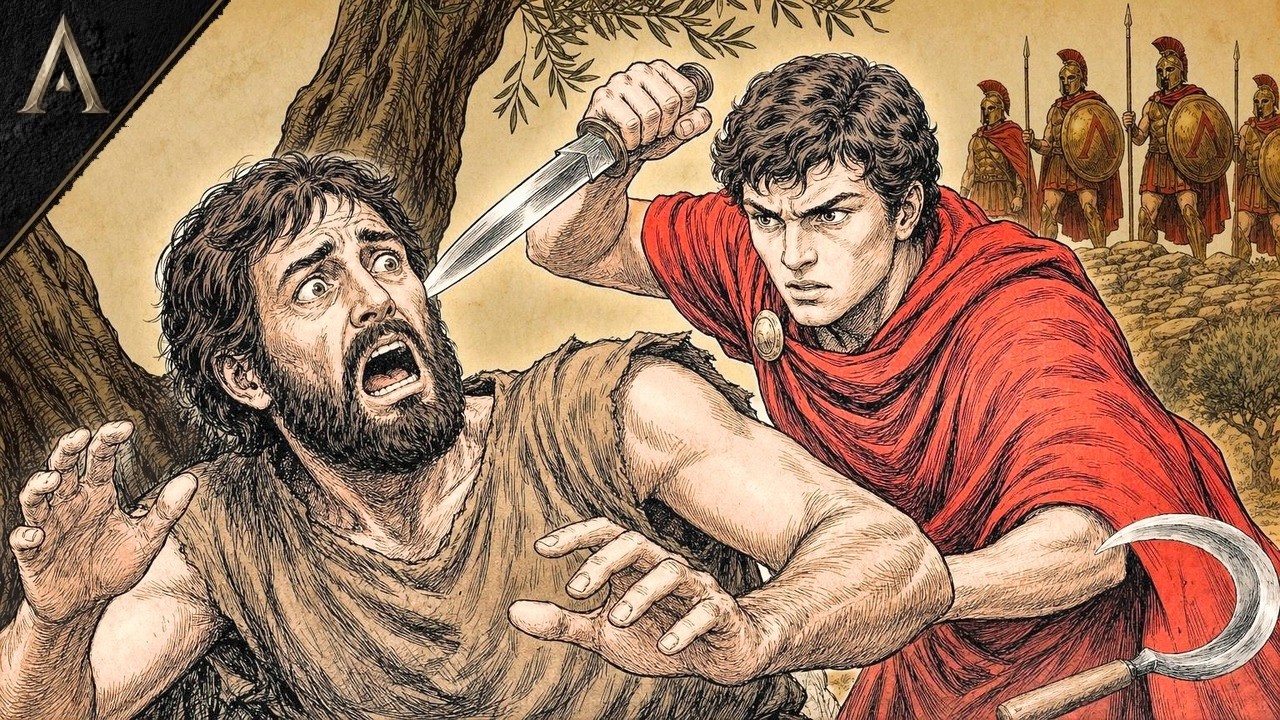
From that foundation grew the Krypteia, the secret police. The state selected its sharpest graduates, boys of eighteen or nineteen, and sent them into the countryside with a knife and nothing else. Smearing soot on their faces, they slept in caves and ditches, and at night they entered the helot villages. Their targets were always the same: the strongest, the cleverest, the ones the others looked to.
The brightest stocks were cut down before they could seed. Thucydides preserved one incident that was too large to bury. In 404 BC, the Spartan state announced that any helot who had served bravely in war could come forward and be granted freedom. Two thousand stepped up, were crowned with garlands, and led around the temples in a procession of thanks.
Then, Thucydides wrote with cold precision, they vanished. The Krypteia worked through them one by one. The men who carried out this work were made in the agoge, the state raising system that pulled boys from their mothers at age seven into barracks where they would live until thirty. They were kept hungry and forced to steal for food, beaten not for theft but for being caught.
Their beds were reeds torn from the frozen river by their bare hands. The trainers whipped them constantly. The economy of the entire society required that the Spartan warrior spend his days on the drill field while a helot bent in the field beside him. Every quality that made a person recognizably human was deliberately burned out by design.
Into this furnace went a boy named Leonidas, born around 540 BC, the third son of King Anaxandridas II. He was not the heir. His half-brother Cleomenes took the throne and crushed Argos in 494 BC, burning the survivors alive inside a sacred grove. Another brother, Dorieus, died on a doomed colonial expedition in Sicily.
Leonidas was the only Spartan king of his era to pass through the full agoge from start to finish, thirteen years of it. He married Gorgo, his own niece, the daughter of the half-brother who would later go mad and cut himself to pieces in wooden stocks. When Cleomenes died, the throne fell sideways onto Leonidas around 489 BC. Then Xerxes came.
His army was the largest the ancient world had assembled, drawn from forty-six nations, with a fleet of twelve hundred warships and a bridge of boats lashed across the Hellespont. When the storm destroyed his first bridge, Xerxes had the sea itself flogged with three hundred lashes. He cut a canal through the peninsula of Mount Athos and planted supply depots along the Thracian coast. The Persians did not enslave entire peoples.
They taxed them and left them their gods. For the helots, who knew the stories of Cyrus freeing the Jews from Babylon, the question moved silently through the slave quarters: was this the army the world finally sent to break the prison? The gods seemed to lock the door for Sparta at the worst possible moment. The Persian fleet reached northern Greece in late summer of 480 BC, the same weeks the Olympic truce was in force and the festival of the Carnea, sacred to Apollo, forbade the Spartan main army from marching.
The Pythia at Delphi delivered an oracle that gave no comfort: either the city falls, or a king from the line of Heracles must die. Leonidas read the law and found his loophole. The main army could not march, but the king was free to move with his personal bodyguard of three hundred men. He chose his men by a single rule: each had to have a living son, so that their family lines would survive them.
He was not picking soldiers. He was picking martyrs. The pass at Thermopylae was a strip of beach less than fifty feet wide between the cliff of Callidromus and the Malian Gulf, with a low ruined wall built by the Phocians at its narrowest point. Leonidas ordered it rebuilt.
Behind the three hundred marched their helot attendants, seven for every Spartan, two thousand one hundred men carrying waterskins, salted barley, and the gear of their jailers. The allied contingents came from the Thespians, the Thebans, the Mycenaeans, the Locrians, the Phocians. The Persians attacked on the first day with the Medes and Cissians, packed into the narrow ground where their numbers meant nothing. The Spartans used a tactic Herodotus describes precisely: they would turn and run as if breaking, draw the Persian line forward, then wheel around in formation and cut them down.
The Immortals, Xerxes’ ten thousand personal guards, went in at evening and came out broken. Watching from his throne, Xerxes is said to have leaped from his seat three times in fear for his army. On the second night, a local shepherd named Ephialtes, son of Eurydemus, went to the Persian command tent and offered to guide them along the Anopaea path, the goat track that climbed over the shoulder of the mountain and came down behind the pass. The Immortals climbed all night through the oak woods.
At dawn, they came over the ridge. The thousand Phocians posted to guard the path scrambled for their weapons and then ran uphill, thinking they were the target. Hydarnes glanced at them and kept going. On the morning of the third day, the lookouts came running down with the news.
Leonidas dismissed most of the allied contingents. The seven hundred Thespians chose to stay. The four hundred Thebans were kept as hostages, their loyalty no longer trusted. The Spartans remained because they had been chosen never to leave.
Megistias, the seer, read the morning sacrifices and announced that death would come before evening. Leonidas told him to leave. Megistias refused, but sent his only son home. The men moved out from behind the wall into open ground, where their corpses would block the Persian line for longer.
They fought until their spears broke, then with swords, then with hands and teeth. Leonidas fell, and the battle for his body was so vicious that two of Xerxes’ own half-brothers were killed in the struggle. The Spartans pulled their king back behind a small rise and made their final stand. The last men were killed by archery, shot down from a distance.
Xerxes walked the field afterward, ordered Leonidas’ head cut off and the body crucified, an act Herodotus calls the anger of a king whose judgment had finally broken. The news traveled south. The helots heard it the way the dying hear a verdict. The wardens were mortal.
The legend of the unkillable Spartan had been killed. In the slave villages, men looked at the knives in their kitchens and the iron tools in their sheds, and the question moved between them without being said aloud. Now, or wait. They waited for the Persians to finish the work.
They had no leaders left. The Krypteia had been culling them for two centuries, and in the only moment when leadership might have changed history, the men who would have led the rising were already buried in their own fields. The Persians did not come. Xerxes burned Athens, watched the acropolis go up in smoke, and then his fleet was broken in the narrow strait at Salamis.
He turned and went home, leaving his general Mardonius to finish the job the next summer. At the plain of Plataea in August 479 BC, the combined Greek army met the Persians in open battle. Pausanias, the regent for Leonidas’ young son, commanded. He brought five thousand full Spartan citizens, the main army the Carnea had pinned down the previous year, and marching behind them, thirty-five thousand helots.
They fought for the system that owned them because their families were in the valley and the families of men who refused would not survive the next Krypteia season. Mardonius was killed, his camp overrun, the Persian army destroyed. The window that had been open for one summer had closed forever. The Spartans came home as the saviors of Greece.
Leonidas became the symbol of the war, and the other Greeks who had actually won it were written out of the story. Simonides of Ceos composed the epitaph carved on the stone above the burial mound at Thermopylae: Go tell the Spartans, stranger passing by, that here, obedient to their laws, we lie. Forty years later, Leonidas’ bones were brought back to Sparta and reburied in a tomb opposite the theater, where funeral games were held every year and new generations of boys fresh out of the agoge learned what they were meant to become. The agoge was no longer a brutal furnace.
It had become the holy mechanism that produced men like Leonidas. The Krypteia was no longer a death squad. It was the training ground for the nation’s protectors. The helots in the fields were no longer victims of an old conquest.
They were the necessary foundation under the warriors who had saved the West. The helots would rise eventually. In 464 BC, a massive earthquake shattered Sparta, killing thousands of citizens and an entire class of young Spartans when the training ground collapsed on top of them. The Messenian helots took their chance and held out on Mount Ithome for nearly a decade, ending in exile at Naupactus.
The system cracked for good at Leuctra in 371 BC, when the Theban general Epaminondas broke the Spartan army in pitched battle on a single afternoon, killing four hundred citizens and the king. The next year, Epaminondas marched south into Messenia, freed the helots after three and a half centuries, and built them a new walled capital at Messene on the slopes of Mount Ithome. The walls still stand today, twenty-six feet thick at the base. But by then the legend had already escaped.
It crossed the Mediterranean and fed Roman generals, medieval kings, eighteenth-century revolutionaries, twentieth-century propagandists. Frederick the Great invoked it. Napoleon invoked it. Hitler ordered it taught in every German school after Stalingrad.
Every man who wanted a clean myth of a few brave standing against a tide of Eastern barbarians could reach back and find Leonidas waiting for him on the wall at Thermopylae, clean and bronze and untroubled by the thirty-five thousand slaves who had marched behind his nephew at Plataea. The chains were not broken by the battle at the hot gates. They were polished.
They were gilded by a story written by men who had never spent a day in a field, and they held for three hundred more years until a Theban army, not a Persian one, finally struck them off.
