The shot came from behind him, and Silus Ror died before he could draw his pistol. The sound of the rifle struck the cabin wall and broke across the black water of the channel, splitting into an echo that sent the two patrolmen running east toward a bank where no one stood. They fired blindly into the trees, shouted at shadows, and never once looked across the water. By the time they returned to the cabin, the shooter had vanished into the cypress line without leaving a bootprint, a cartridge case, or a broken reed.
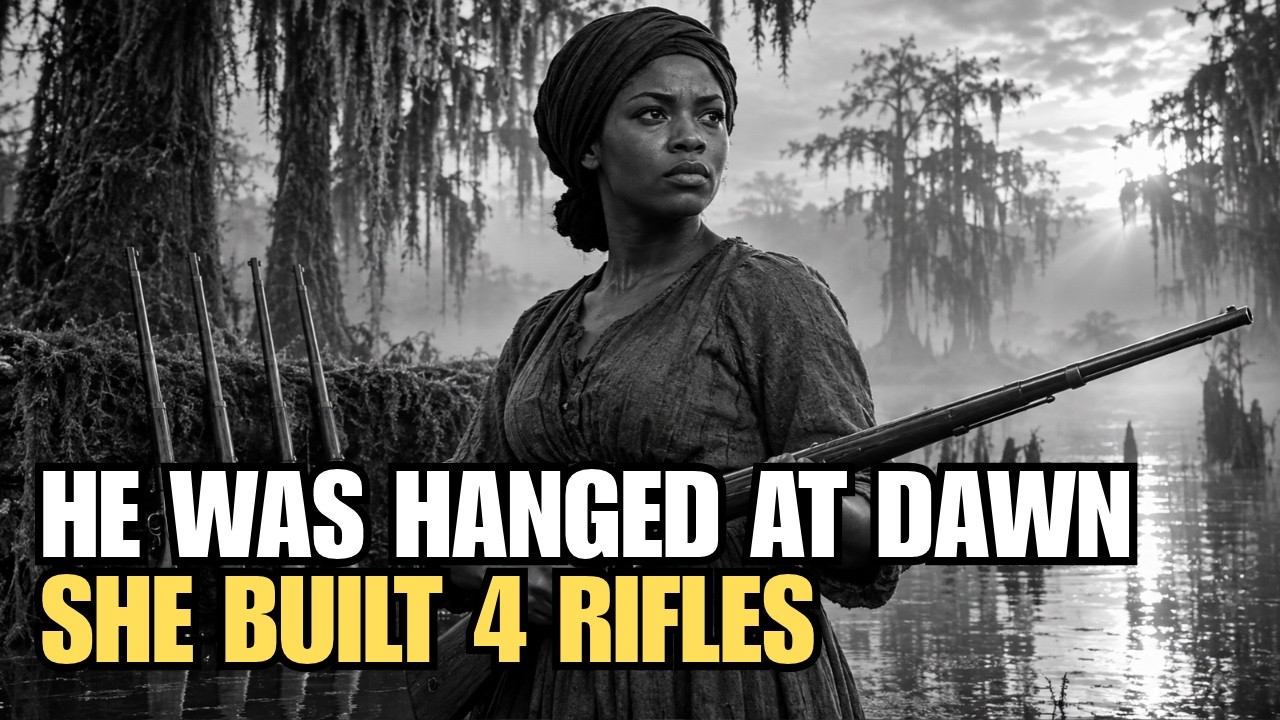
The only deliberate mark was a single vertical cut carved into the cabin frame, one line, one name removed. In 1856, in the bayou country of southern Louisiana, the men who ruled that country believed fear belonged to them. They hunted fugitives, broke families, and displayed punishment as public law. The most feared of these men called themselves the Iron Riders, a name that appeared in no court register and no state charter.
That absence protected them. Plantation owners paid them privately. Local officials ignored their methods. When a captive returned injured, the records described resistance.
When someone disappeared during questioning, the explanation was escape, accident, or swamp fever. The violence was organized. The paperwork was designed to make it look accidental. At the center of the network stood Gideon Varic, a senior overseer who had turned punishment into public administration.
Varic understood that controlling hundreds of enslaved people required more than physical force. It required witnesses. He staged interrogations near workyards. He captured fugitives where others would see them.
He separated husbands from wives, not only for sale, but as a warning to anyone considering resistance. He rewarded informants publicly and removed them quietly once they stopped being useful. The message was consistent. No route was secret.
No loyalty was safe. No person was beyond his reach. Darius Bland had watched that system operate for years. He was forty-one years old, lean, controlled, and valued by men who refused to recognize his humanity.
He hunted game for the plantation table, repaired damaged rifles, cleaned firing mechanisms, and guided patrols through water that could drown an unfamiliar horse within minutes. The Iron Riders trusted his hands with their weapons because they believed skill did not equal power. That was their first mistake. Darius understood the bayou as a physical system.
He knew where water absorbed sound and where it carried it. He knew that a rifle fired beside an open channel could seem closer than it was. He knew that hollow cypress trunks could redirect noise. He knew which mud preserved a bootprint and which current erased one before sunrise.
The knowledge had been forced into him through labor. He had learned to hunt because his owner demanded meat. He had learned firearms because overseers needed repairs. He had learned the swamp because patrolmen required a guide.
Every skill used to strengthen their control would later be turned against them. For years, Darius practiced restraint. He refused careless plans. He warned others that one failed escape could produce punishment across several plantations.
He understood the mathematics of retaliation. One missing worker could mean twenty cabins searched. One hidden boat could mean an entire landing burned. Survival required discipline.
His wife, Nerissa Cade, understood another part of the system. She was thirty-eight and worked in the plantation medicine storehouse. Men entered that room after fights, accidents, punishments, and drunken patrols. They spoke freely because they did not consider her dangerous.
She heard names. She heard which overseer had struck a man until he could no longer work. She heard which tracker accepted money to accuse innocent people. She heard which patrol captain arranged illegal sales across parish lines.
She heard guards complain about routes, schedules, and weaknesses. Nerissa remembered everything beneath a loose floorboard. She kept a ledger assembled from scraps of paper, medicine labels, and discarded account sheets. The pages did not contain emotional accusations.
They contained evidence: names, dates, locations, habits, crimes. A black circle marked a man who commanded patrols. A broken line marked someone who could be bribed. A cypress symbol identified a route into the marsh.
A red thread pressed between two pages marked direct responsibility for a death. The ledger was not a list of enemies. It was a map of the enforcement system. Darius knew it existed, but he resisted what it implied.
“You write too much,” he told her once. Nerissa closed the book. “They do too much. ”
There was no argument after that.
The breaking point came through Darius’s younger brother, Corin Bland. Corin was an adult field hand known for carrying food to sick workers and repairing small boats after dark. The Iron Riders accused him of helping two men disappear into the marsh. They had no witness.
They had no recovered boat. They had no confession. They had suspicion, and within the plantation system, suspicion was often treated as sufficient evidence when the accused was black and the accuser carried a weapon. Varic ordered the questioning to take place near the workyard.
The location mattered. This was not an investigation. It was a demonstration. Workers were forced to remain within sight.
Corin was asked for the route used by the two fugitives. He said he did not know. Varic asked who had supplied them with food. Corin gave the same answer.
The questions continued after the information no longer mattered. By then, Varic was not trying to locate anyone. He was protecting his reputation. If Corin refused him publicly and survived, others might understand that refusal was possible.
That could not be permitted. The next morning, Corin was found near the bayou edge. The official explanation claimed he had attempted to escape custody. No report explained why he had been left where plantation workers would pass him on the way to the fields.
No report needed to. Darius approached after the guards moved away. He did not speak. He examined the ground, the damaged reeds, and his brother’s closed hand.
Inside it was a metal button. Darius recognized the black and brass and the engraved edge. He had repaired the clasp on Gideon Varic’s coat two weeks earlier. The evidence was small, but it was enough.
That evening, Darius returned to his cabin without eating. Nerissa waited until the plantation quieted, then removed the loose floorboard. She opened the ledger to Gideon Varic’s name. Darius placed the button beside it.
For several seconds, neither moved. The decision made in that room was not sudden revenge. It was the end of failed restraint. Darius had spent years believing caution might protect the people around him.
Corin’s death proved the limits of that belief. The Iron Riders did not require rebellion before they used violence. They required only the possibility of disobedience. Nerissa studied the button, then looked at Darius.
“They believe fear belongs to them,” she said. Darius reached beneath the bed frame and removed a wrapped bundle. Inside was an old rifle assembled from discarded components: a repaired stock, a shortened barrel, a firing mechanism taken from a weapon an overseer had declared useless. No single part could be traced to him because each had once belonged to the men he served.
He had built it slowly without explaining why. Now the reason was clear. Darius cleaned the mechanism, checked the sight, and wrapped the rifle in oilcloth. He took no extra clothing.
He carried no lantern. He left through the rear of the cabin and crossed into the cypress line before the patrol changed shifts. The bayou received him without sound. Hours later, an Iron Rider stationed near an abandoned trapping road heard a branch move across the water.
He raised his lantern. Nothing stood there. Farther back, concealed between cypress roots, Darius watched the flame and measured the distance. He studied the wind.
He listened to the water. He did not fire. Not that night. The first shot would need to do more than kill a man.
It would need to prove that the system had a weakness. It would need to create an opening. It would need to make armed men question the darkness they had controlled for years. Corin’s death had not created a reckless avenger.
It had created a patient one. And patience in the hands of a man who knew every weapon, every patrol route, and every acoustic deception of the swamp was far more dangerous than rage. Silus Ror entered the swamp believing the danger had already passed. Corin Bland was dead.
The two fugitives connected to him had not been found, but Ror considered that a temporary failure. He had broken men before. He had tracked people through flooded cane fields, river mud, and pine barren. He had trained patrol dogs to follow scent across shallow water, and taught younger guards to punish anyone who confused silence with defiance.
Among the Iron Riders, Ror’s reputation rested on certainty. He did not negotiate. He did not wait. He assumed that every person could be forced to reveal something useful.
That confidence made him predictable. Three days after Darius first entered the cypress line with the repaired rifle, word reached Ror that a plantation boatman wanted to sell information. The message claimed that several fugitives were moving through an abandoned trapping road east of the main channel. The informant would meet him beside an old cabin after midnight.
The message had passed through two people before reaching him. Neither knew where it began. Ror did not question it. Men who rule through fear often mistake obedience for accuracy.
They become accustomed to others responding quickly, lowering their eyes, and providing answers. Over time, that habit destroys caution. They stop asking whether the information is true. They ask only how soon it can be used.
Ror left with two patrolmen. He took no dogs. The ground near the trapping road was flooded, and he did not want barking to warn the supposed fugitives. He carried a pistol, a short rifle, and a lantern covered on three sides.
The three men entered the swamp in single file. Darius watched them from a raised section of roots across the channel. He had chosen the location because the water divided the sound. A shot fired from his position would travel across the open surface, strike the cabin wall, and return toward the eastern bank.
Anyone unfamiliar with the effect would look in the wrong direction. The trap depended on more than marksmanship. It depended on Ror behaving exactly as Nerissa predicted. She had learned that he never allowed another man to speak to informants first.
He considered that a privilege of rank. He would approach the cabin alone, order the others to remain back, and attempt to control the exchange before anyone else heard what was being offered. At twelve minutes past midnight, Ror raised one hand. The patrolmen stopped.
He moved toward the cabin. Darius waited. The lantern passed between two cypress trunks. Ror’s shoulder became visible, then his chest, then the side of his face.
Still, Darius did not fire. A random shot would have been vengeance. This was an operation. Beyond the trapping road, ten enslaved adults were waiting beside a drainage canal.
Two women, six men, and an older couple who had been separated from their relatives and scheduled for sale within the week. A narrow boat was hidden beneath cut reeds. The route could be used only while the eastern patrol was absent. Ror’s death mattered because his patrol had to remain confused long enough for that boat to leave.
Darius moved the rifle into position. Ror reached the cabin door. He called once for the informant. No one answered.
He turned toward the eastern bank. The shot came from behind him. The sound struck the cabin wall and broke across the channel. Ror fell before he could draw his pistol.
The two patrolmen reacted exactly as expected. Both ran east toward the false echo. One fired blindly into the trees. The other dropped his lantern, recovered it, and continued moving away from the cabin.
Neither looked across the water. Darius lowered the rifle. He did not rush. He remained still while the patrolmen searched the wrong bank, shouting at shadows and firing into undergrowth.
Then he withdrew through waist-deep water using a submerged log path known only to hunters and timber workers. He left no bootprints. He left no cartridge case. He had wrapped the rifle mechanism in cloth to prevent oil from touching nearby bark.
He carried the spent primer with him. The only deliberate mark was the single vertical cut made earlier in the cabin frame. While the patrolmen searched for the shooter, the escape boat entered the drainage canal. Nerissa was not aboard.
Her role was to remain inside the plantation system and make the departure appear ordinary for as long as possible. Before sunset, she had altered the medicine store inventory to account for two missing workers. One was listed as ill. Another was listed as transferred temporarily to a field station.
The entries would not survive close inspection, but they did not need to. They needed to delay the alarm until morning. The others left through separate cabins, never gathering in one place. At the canal, a boatman named Ephraim Quill counted them twice.
Ten adults, no children, no baggage beyond food, cloth, and one iron cooking pot wrapped to prevent noise. The boat moved south without lanterns. By the time Ror’s patrolmen returned to the cabin, it had already passed beneath the first bridge. They found him on the ground with his weapon still holstered.
The position of the wound told them the shot had not come from the eastern bank. But the sound had. That contradiction unsettled them more than the death itself. One searched the cabin.
He found the carved line. The other crossed the channel and discovered nothing. No path, no broken reeds, no drag marks, no sign of a boat. They carried Ror back before dawn.
The official response began immediately. Riders were sent to surrounding plantations. Cabins were searched. Boat landings were closed.
Armed men questioned workers who had been in the fields all night and could not possibly have witnessed the shooting. The investigation did not begin with evidence. It began with punishment. When authority failed, it redirected its embarrassment downward.
The men responsible for security did not admit that they had been deceived. They accused the enslaved population of collective guilt and treated fear as a substitute for competence. Darius returned to the gunshed before sunrise. He washed the rifle mud from his hands in a bucket used for cooling metal.
Then he opened the workshop shutters and began repairing a damaged trigger assembly. Within an hour, two Iron Riders arrived carrying Ror’s short rifle. One placed it on the bench. “Check it.
”
Darius examined the weapon. The firing mechanism was clean. The barrel had not been discharged. Ror had died without firing once.
Darius said nothing. The patrolman leaned closer. “The shot came from the wrong side. ”
Darius continued working.
“Sound crosses water. ” He said the answer was true. That made it more dangerous. The patrolman watched him for several seconds, then looked away.
To suspect Darius would have required seeing him as capable of planning the attack. The man could not do that. His prejudice protected the person standing directly in front of him. By noon, Gideon Varic arrived.
He inspected the rifle, questioned both patrolmen, and ordered Darius to explain how a shooter could fire from one bank while the sound appeared to come from another. Darius placed two pieces of metal on the bench. He struck one against the other. The noise bounced from the rear wall.
“Hard surfaces return sound,” he said. “Water carries it. ”
Varic studied him. “Could a man plan that?
”
“Yes. ”
The room went quiet. Darius did not lower his eyes. Varic’s attention remained on him longer than usual, but suspicion did not become recognition.
He saw a skilled worker answering a technical question. He did not see the man who had designed the scene. That blindness was not accidental. It had been trained into him by the institution he served.
That evening, Nerissa removed the ledger from beneath the floor. She crossed out Silus Ror’s name. Darius watched her. “Ten?
” he asked. “All ten reached the lower channel. ”
He nodded once. There was no celebration.
A man was dead. Ten people were moving toward uncertain safety. Patrols would tighten. Cabins would be searched again.
Every success created new danger. Nerissa turned the page. Ror was not the only purpose. She pointed to a route marked beside his name.
The eastern patrol had been pulled away for nearly three hours. That gap allowed the escape boat to pass. The shot had not simply removed one violent man. It had opened a corridor through the enforcement network.
That was the method. The target would not be chosen only for what he had done. He would be chosen for what his absence made possible. Over the next two days, rumors spread through the quarters.
Some said a hidden hunter had returned from the dead. Others claimed the swamp itself had turned against the Iron Riders. A few said Corin’s spirit had fired the shot. Darius rejected all of it.
Superstition could attract attention. Legends could encourage reckless behavior. He wanted discipline, not worship. Nerissa understood the rumors differently.
The truth was useful to the resistance. The myth was useful against the patrols. Men who trusted weapons more than evidence had begun to fear something they could not locate. They now entered the swamp looking over both shoulders.
They argued about echoes. They questioned one another’s reports. They hesitated before separating. Fear had not defeated them, but it had entered their ranks.
At the trapping cabin, Gideon Varic examined the vertical cut in the frame. He ran one finger across it. This was not a hunter’s mark. It did not indicate direction, water depth, or ownership.
It was too deliberate, too simple. A record. Varic looked toward the dark channel and understood the first part of the threat. The shooter had not acted in panic.
He had selected Ror, controlled the patrol’s reaction, and disappeared without leaving usable evidence. Someone had begun a count, and Silus Ror was only the first name. Ror’s death did not weaken the Iron Riders immediately. It changed the way they moved.
Patrols that had once crossed the plantation roads in pairs began traveling in groups of five. Lanterns stayed covered. Horses were kept away from open water. Men who had mocked the idea of resistance now refused to enter the swamp without dogs.
The first shot had produced no uprising, no public declaration, and no visible army. It produced hesitation. That was more useful. Darius understood that the next operation could not repeat the first.
Another isolated body beside another abandoned structure would establish a pattern too simple to anticipate. Varic was already studying the terrain, interviewing hunters, and comparing patrol reports. The method had to expand before the authorities learned how to contain it. The next target was Amos Thorne.
Thorne was not an overseer. He was a tracker hired across parish lines whenever plantation owners wanted fugitives recovered quickly. He trained dogs to follow scent through flooded fields and taught patrolmen how to use torn clothing, bedding, and hair taken from cabins. His reputation came from patience.
He could follow a trail for days. He could also pretend to offer mercy. Captured fugitives were told that cooperation would spare the people who helped them. Once they provided names, Thorne delivered both the captive and the informants to the plantation owners.
His promises existed only to extract information. Several disappearances in Nerissa’s memory began with his arrival. He had to be removed for a practical reason. Eighteen enslaved adults were scheduled to be transported south within four days.
The sale would scatter them across several plantations and destroy the escape network they had helped maintain. A wagon would carry them to a river landing before dawn. Thorne’s dogs were assigned to follow the transport and track anyone who attempted to flee. The operation required more than killing him.
The dogs had to be scattered. The wagon had to be diverted. The guards had to believe the greater threat was inside the swamp. Nerissa organized the movement from within the plantation without gathering the participants in one place.
Instructions passed through ordinary tasks. A folded cloth placed on the wrong shelf meant the departure remained on schedule. A medicine bottle left uncorked meant patrol numbers had increased. A strip of white thread tied around a tool handle meant the river route was compromised.
No one carried a complete plan, which prevented one arrest from exposing everyone. Darius handled only the diversion. He spent two nights studying the kennel compound Thorne used near the edge of a timber tract. The structure had one main gate, a storage shed, and six narrow pens facing an open yard.
Two guards slept inside the shed. Thorne inspected the dogs personally before any major transport. The compound had no water channel close enough to distort a rifle shot. Darius needed another method.
He found it in the trees. Behind the kennels stood a row of cypress trunks damaged by lightning and rot. Several were hollow. When struck, they carried sound along the line like crude wooden drums.
Darius tested them without a weapon. One knock against the western trunk returned from the north. A second produced an echo near the road. The environment could still be used.
It simply required a different signal. On the night before the transport, Thorne arrived after sunset. He came with four men and ordered the dogs released into the yard. The animals were restless.
They pulled against their leads and turned repeatedly toward the trees. Thorne noticed. He raised one hand. The guards stopped speaking.
Something struck a hollow trunk behind the compound. The sound returned from the road. Two men moved toward it. A second strike came from the opposite side.
Thorne ordered them back. He understood that someone was testing their reaction. That made him dangerous. He did not rush toward the first sound.
He stayed near the center of the yard and forced the guards to remain together. Darius changed the sequence. A rifle cracked from the tree line. The shot did not strike Thorne.
It shattered the lantern above the kennel gate. Darkness covered half the yard. The dogs surged against their restraints. The guards fired toward the trees without a target.
Their muzzle flashes revealed their positions, then disappeared. A second shot struck the iron latch holding the main kennel gate. The weakened metal tore free under the pressure of the animals. Six dogs broke into the yard.
Two ran toward the gunfire. The others scattered through the open gate and disappeared into the timber. Thorne shouted for the guards to recover them. No one obeyed immediately.
The men had been trained to follow orders when they could see the danger. In darkness, with shots returning from different directions, authority became less convincing. Darius moved before they recovered. He struck another hollow trunk and crossed behind the compound while the echo pulled the guards north.
He left a visible trail through soft ground, then stepped onto a line of timber supports raised above the mud. Thorne found the prints. He followed alone. That decision was not bravery.
It was professional pride. The dogs had escaped. His men had panicked. And an unseen opponent had entered his ground.
If Thorne returned without a capture, every plantation owner who paid him would hear of the failure. He moved into the trees with a pistol drawn. Darius allowed him to see movement twice, a shoulder between trunks, a figure crossing a narrow clearing, enough to keep him pursuing. Behind them, the kennel guards remained divided.
Two searched for the dogs. One returned to the shed for lantern oil. The fourth stayed at the gate, firing whenever a branch moved. The compound was no longer functional.
That was the point. Miles away, the transport wagon left the plantation road. It carried eighteen adults with their wrists restrained in pairs. Two armed guards rode beside the driver.
A third followed on horseback. At the first fork, a fallen tree blocked the southern route. The obstruction had been placed there shortly before the wagon arrived. The driver took the eastern road.
That road narrowed beside an abandoned cane field. Ephraim Quill waited in the drainage ditch with four other members of the network. They did not fire. A gunshot near the wagon would have endangered everyone inside.
Instead, a rope was pulled across the road behind the lead horses. The animals stopped abruptly. The mounted guard fell when his horse struck the line. Before the others understood what had happened, the driver was pulled from the seat.
One guard fled into the field. The other was disarmed after a short struggle. The operation lasted less than two minutes. The wagon restraints were opened with a key taken from the driver.
The eighteen adults divided into three groups and left in different directions. One entered the drainage canal. Another moved toward the timber line. The third took the empty wagon north to create a false trail.
By sunrise, the road contained tracks leading everywhere. No single pursuit could follow them all. Thorne never returned to the kennel compound. His pistol was found beside a flooded depression nearly half a mile from the yard.
One bootprint faced the water. Several others led away, but rain destroyed them before the patrols arrived. No body was recovered. That absence strengthened the rumor more than a corpse would have.
The enslaved workers heard that the tracker who could follow anyone had vanished while following the wrong man. The Iron Riders heard a different version. Some claimed Thorne had deserted. Others believed his own dogs had turned on him.
Two guards insisted that several shooters had surrounded the kennel. All were wrong. There had been one rifleman and a coordinated network operating elsewhere. Varic recognized the connection by noon.
Thorne disappeared on the same night the transport wagon was taken. The kennel attack had not been an act of revenge. It had been a diversion designed to remove the dogs and pull armed men away from the road. That meant the marksman had information from inside the plantations.
It also meant he was not working alone. Varic responded by making the story larger. He ordered patrol captains to tell workers that the killer practiced swamp magic and would bring punishment on anyone who sheltered him. The claim was intended to isolate Darius.
Nerissa turned it against them. She allowed different versions to circulate. One said the marksman could hear horses through the water. Another said bullets curved around cypress trunks.
A third claimed he marked violent men before they disappeared. The stories were false. Their effect was real. Iron Riders began refusing solitary assignments.
Guards argued over who would carry the rear lantern. Men who had entered cabins without warning now paused before crossing open ground. Darius disliked the myth. “It will make people careless,” he told Nerissa.
“It is making them afraid,” she answered. “Fear is not discipline. ”
“No, but they used it for years because it works. ”
The disagreement marked a change between them.
Darius still thought like a hunter. Every movement had to be controlled, every risk measured. Nerissa thought like an organizer. She understood that the enemy’s imagination could be used as efficiently as a weapon.
Neither was entirely wrong. That night, she entered the medicine storehouse after the final patrol passed. Nothing appeared disturbed. The shelves remained aligned.
The door lock showed no damage. The bottles were in place. Then she crossed to the loose floorboard. The edge had shifted less than the width of a fingernail.
Someone had lifted it. Someone had replaced it carefully. Nerissa did not reach for the ledger. She stood still and listened.
For the first time, the network had not merely struck the Iron Riders. The Iron Riders had reached back. She crossed the storehouse, opened a bottle of camphor, and left it uncorked on the central table. That was the emergency signal.
Anyone connected to the network who entered before dawn would understand that the medicine room had been compromised. No written warning was needed. No meeting would be called. The routes, signals, and storage points associated with the building were no longer safe.
She left the ledger beneath the floor. Removing it immediately would confirm that she knew someone had searched for it. Instead, she returned to the quarters and told Darius only what mattered. “They found the hiding place.
”
“Did they take anything? ”
“I did not check. ”
Darius understood the decision. A missing ledger would expose the intruder.
An untouched one might expose Nerissa. For the next two days, they acted as if nothing had changed. Then Gideon Varic closed the parish roads. He assembled the Iron Riders, plantation guards, private mercenaries, and a militia detachment borrowed through political favors.
More than forty armed men entered the operation. They brought dogs from outside the region, shallow boats, chains, axes, lantern oil, and survey maps. It was not a search for one man. It was an occupation.
Varic divided the bayou into sectors and ordered each unit to remain within sight of another. No patrol was permitted to separate. No man was allowed to investigate a sound alone. Boats were tied together in pairs so that one could not disappear without the other noticing.
He had studied the earlier failures. Darius changed the battlefield. The marksman did not fire during the first day of the manhunt. He allowed the searchers to move deeper into the swamp without resistance.
Then the false trails began. A set of bootprints appeared beside a northern mudbank. The prints were deep, uneven, and marked by what looked like an injured right leg. A patrol followed them for nearly a mile before discovering that the trail ended in open water.
The prints had been made using a carved wooden sole attached to a pole. Farther west, guards found strips of cloth caught on thorn bushes. The fabric was stained dark and appeared to come from a torn shirt. They assumed the marksman was wounded.
The cloth belonged to no one in the network. It had been soaked in animal blood and placed hours earlier. The searchers accelerated. That was the reaction Darius wanted.
Men who believed they were close stopped reading the terrain carefully. They forced boats through shallow passages. They ignored changing water levels. They followed signs because signs promised an ending.
By midday, two boats had grounded in mud. A third overturned when mercenaries crowded one side to examine movement in the reeds. No one died, but ammunition, food, and lantern oil were lost. The men blamed one another.
Plantation guards accused the militia of incompetence. The militia accused the Iron Riders of exaggerating the marksman’s abilities to secure more money. Varic responded with threats. Threats could force men forward.
They could not restore trust. Darius remained ahead of them. He traveled through flooded timber, stepping on submerged roots and fallen trunks. When he used a canoe, he tied reeds behind it to smooth the wake.
When he crossed mud, he entered water before leaving the bank again farther downstream. He did not attempt to hide every movement. He created too many movements to follow. A bird call sounded from the eastern trees.
Three patrols turned toward it. The same call came from the south. Then a rifle fired once from the west. The bullet struck no one.
It hit a dead trunk above the water line. The sound broke across several channels. Within minutes, four units were moving in different directions. The manhunt had become a machine receiving contradictory commands.
Darius was not defeating forty men through force. He was controlling their attention. While the patrols moved west, Nerissa led twelve adults toward an abandoned sugar drainage tunnel beneath the old cane road. The tunnel had been built to control floodwater decades earlier.
Plantation owners stopped maintaining it after the surrounding fields became unusable. The opening was partly blocked by roots and collapsed earth, but the central passage remained clear enough for a person to crawl through. The group entered one at a time. Nerissa went last.
Above them, horses approached. The patrol stopped directly over the tunnel. Mud fell from the ceiling as one rider dismounted. A dog moved near the drainage opening and began pulling against its lead.
Inside, no one spoke. Nerissa pressed one hand against the wall and waited. The patrol leader looked at the collapsed entrance, decided no group could have passed through it, and ordered the search to continue north. The riders moved on.
The dog resisted until its handler struck the leash and dragged it away. That decision saved twelve people. It was not proof that the patrolman lacked intelligence. It showed the deeper failure of the system.
They believed enslaved people could not understand, repair, or repurpose the structures built around them. They saw a ruined tunnel. Nerissa saw a route. By nightfall, the twelve adults reached a cypress platform where Ephraim Quill waited with two boats.
The patrols never knew they had passed directly above them. Varic’s frustration shifted toward the plantations. He ordered cabins searched without regard for evidence. Food stores were emptied.
Tools were confiscated. Workers were pulled from the fields and questioned about men they had never seen. The punishment was not intended to produce accurate information. It was collective pressure.
Varic believed pain would cause the network to break itself. Instead, the plantation owners began complaining about the cost. Fieldwork slowed. Timber crews could not operate while guards searched the swamp.
Boats carrying sugar and lumber were delayed at improvised checkpoints. Owners who had once paid the Iron Riders without question began demanding results. At a roadside station, Darius heard two patrolmen arguing. “Bollier stopped payment.
”
“For how long? ”
“Until Varic brings him a body. ”
Another plantation had refused to supply horses. A third demanded that its guards be returned to the fields.
The Iron Riders were built on violence, but violence still required wages, animals, food, and political protection. Once the patrols failed to protect property, the men financing them began treating them as another expense. The system had not collapsed. It had begun to fracture.
Varic understood the danger. He needed a name. His men began arresting anyone caught near the waterways after dark. Most knew nothing.
Several invented stories to stop the questioning. Every false answer sent patrols toward another empty cabin, another abandoned landing, another section of swamp. Then they captured Malachi Senate. Malachi was carrying a sack of dried corn toward a concealed supply point.
He dropped it when the patrol appeared and ran, but the open cane ground gave him no cover. He was taken alive. Malachi had joined Nerissa’s network after the Iron Riders killed his wife during a search for a fugitive she had never met. He was disciplined, cautious, and useful because he rarely asked for more information than his task required.
He knew Darius’s identity. He also knew one location Darius used when patrol pressure became heavy: an abandoned fishing platform near the eastern channel. Varic questioned him personally. He did not begin with violence.
He began with calculation. He told Malachi that the network had already been exposed. He claimed Nerissa had fled. He claimed the maroon settlement had been found.
He claimed Darius was using others as shields while preparing his own escape. Each statement was false. Together they created doubt. Varic then offered freedom, money, and passage north in exchange for one location.
Malachi refused. The offer remained. Hours passed. Varic returned with a document bearing an official seal.
He placed it where Malachi could see it and said the promise would be honored. The seal was real. The promise was not. Men like Varic treated law as a tool of appearance.
A signed paper could make betrayal seem like a transaction between equals, even when one side controlled the prison, the witnesses, and the outcome. By the second night, Malachi no longer knew which members of the network were alive. By the third morning, he gave Varic the fishing platform. The confession was brief.
Varic asked whether Darius used it alone. Malachi said yes. That was all the Iron Riders needed. Malachi was taken from the room before noon.
He never received freedom. Varic could not risk allowing him to tell others what had been promised, what had been said, or how easily the Iron Riders discarded those who cooperated. The betrayal was useful. The betrayer was not.
Darius knew none of this when he approached the eastern channel that evening. The manhunt had withdrawn from the area several hours earlier. No lanterns were visible. No boats crossed the water.
The fishing platform appeared abandoned. He stopped before stepping onto it. The air was wrong. No frogs called from the reeds.
No insects moved near the water. Even the birds had left the low branches. Silence in the bayou was never empty. It was a warning produced by movement, disturbance, and men trying too hard not to be heard.
Darius lowered his rifle and studied the tree line. A shadow shifted behind a cypress trunk. Then another. The Iron Riders were positioned along the water, the raised trail, and the southern escape route.
They had not found the platform by tracking him. Someone had given it to them. Darius remained still as the circle closed. For the first time, the danger was not somewhere ahead of the resistance.
It had come from inside it. He did not move toward the fishing platform. The trap was too complete. Men were posted along the raised trail, the water line, and the southern cut through the reeds.
Their positions were disciplined. No lanterns burned, no voices carried. Varic had learned enough from the earlier failures to stop chasing sounds and begin controlling exits. Darius counted at least twelve men.
There were likely more behind them. Under ordinary circumstances, he would have withdrawn before the circle closed. He knew two submerged routes that could carry him away from the platform without exposing his position. He could disappear into the western channel and force the patrols to search empty water until morning.
But this was not an ordinary night. Behind the Iron Riders, beyond a narrow bend in the channel, more than thirty enslaved adults were preparing to leave in two boats. The movement had been planned before Malachi’s capture. It involved people from several plantations, each arriving by a different route.
Some had worked in the fields. Others came from kitchens, timber crews, workshops, and river landings. All were adults. Several had been separated from spouses who had already reached the hidden settlement.
Others were marked for sale. The boats could not remain in place. Once the tide shifted, the current would expose the crossing. Darius understood the geometry immediately.
If he escaped west, the Iron Riders would spread out and discover the boats. If he fled south, he would lead them directly toward the channel. If he remained, he could hold their attention. There was no time to warn Nerissa.
He raised the rifle and fired into the fishing platform. The shot split the quiet. Wood burst from the support beam. The patrols turned toward the structure.
Two men fired back before Varic ordered them to stop. Darius moved thirty yards east and fired again. The second shot came from a different angle. The Iron Riders reacted as if two shooters were present.
That was the opening he needed. Varic sent one unit toward the platform and another along the water line. Darius withdrew between them, crossed a strip of dry ground, and reached the first of three firing positions prepared months earlier. The locations had been intended for retreat.
Now they became a sequence. He fired at lanterns, boat ropes, and exposed equipment. He avoided the center of the patrol formation. Killing one man would not hold the others in place.
Confusion would. A lantern broke near the northern trail. A horse reared and pulled free. A boat drifted from its mooring after a rope snapped.
The patrol line widened. Varic shouted for the men to close it again. They could not see Darius, but they could hear him moving from one side of the channel to the other. Each shot suggested another escape route.
Each pause forced them to wait for the next direction. The swamp was no longer hiding him. He was using it to make himself seem larger. Beyond the bend, Nerissa waited beside the first boat.
Ephraim Quill had already loaded sixteen people. The second vessel held seventeen. Both sat low in the water. The agreed signal was three short bird calls from the north.
Instead, a rifle fired, then another, then a third from farther east. Nerissa recognized the spacing. Darius was not retreating. He was drawing the patrols away from the boats.
Ephraim looked toward the sound. He changed the signal. Nerissa did not answer. She knew what that meant.
The boats had to leave. If they waited for Darius, the tide would turn and the patrols would hear the oars striking against the current. If Nerissa went back for him, she would expose the route and waste the sacrifice he had already chosen. The decision was not heroic.
It was operational. That made it more brutal. Nerissa pushed the first boat into the current. No one spoke.
The second followed. The channel narrowed beneath low branches, hiding them from the open water. Ephraim guided the lead boat with a short paddle wrapped in cloth. Nerissa remained at the rear of the second vessel, watching the bend until the gunfire disappeared behind the trees.
Darius reached the second firing position with four cartridges left. Varic’s men had begun to understand the movement. They stopped chasing the sound and advanced in a broad line. Darius fired once at a tree above them.
The bullet cut loose a heavy branch. It fell across the raised trail and divided the formation. He used the delay to move toward the abandoned hunting blind near the eastern bank. The blind offered no escape.
It had one narrow entrance and a collapsed rear wall opening onto deep water. Darius had selected it because anyone approaching from the trail would believe he was cornered there. He wanted them to believe it. The patrols converged.
Darius fired again from the blind, then shifted to the rear opening and fired across the water. The sound returned from the southern bank. Several men turned. Varic did not.
He kept moving toward the blind. By then, Darius had two cartridges left. He looked through the reeds. Far beyond the patrol line, barely visible between two trunks, the rear of the second boat crossed the open channel.
It was moving away. The thirty-three people aboard had passed beyond the nearest patrol position. Darius fired one cartridge into the mud beside the trail. The men stopped.
His final cartridge remained. Varic ordered the patrol to surround the blind. Darius could hear boots in the shallow water, wood striking against roots, and men forcing themselves forward despite the fear built during the previous weeks. He did not aim at them.
He fired the last shot into the air. The report carried over the channel and into the cypress line. To the patrols, it sounded like another attack. To Nerissa, farther south, it was confirmation.
Darius had no ammunition left. The boats continued. When the Iron Riders rushed the blind, they found him holding an empty rifle. He struck the first man with the stock and drove another into the wall.
He did not fight to escape. He fought to create more time. A patrolman seized his coat. Darius tore free long enough to reach inside it.
He removed a folded piece of cloth containing a hand-drawn route map and pushed it into the small fire burning in the blind. The lines blackened before Varic crossed the entrance. One guard attempted to pull the paper from the flames. There was nothing left to recover.
Darius was forced to the ground. Varic took the rifle from him and examined the repaired stock, shortened barrel, and mixed components. Recognition came slowly. The weapon contained pieces Varic had seen in the plantation gunshed.
Metal discarded from broken patrol rifles. A firing mechanism once marked unusable. A stock Darius had claimed was too damaged to restore. Varic looked down at him.
“You built this. ”
Darius said nothing. The silence answered enough. The man who had repaired the Iron Riders’ weapons had used their discarded parts to construct the rifle that dismantled their patrols.
The discovery should have exposed the larger truth. The entire plantation system depended on black labor, black skill, and black knowledge, while insisting that those who possessed them were incapable of strategy. Varic understood only the insult. He struck Darius across the face with the rifle stock.
Then he ordered him taken alive. The capture was carried from plantation to plantation as proof that the manhunt had succeeded. Darius was tied to the rear of a patrol wagon and displayed at road crossings, workyards, and river stations. Varic wanted witnesses.
He needed the same public theater that had sustained the Iron Riders before the first shot. At every stop he announced that the marksman had been identified, that the escape routes would be found, and that everyone who had helped him would be punished. Darius refused to speak. He was asked for the location of the maroon settlement.
He gave no answer. He was asked who selected the targets. He remained silent. He was shown names of suspected boatmen, field workers, and domestic workers.
He confirmed none of them. The Iron Riders treated that silence as stubbornness. In reality, it was the final layer of the operation. Every hour they spent questioning him was another hour the boats moved farther away.
Nerissa returned to the plantation before dawn. She entered through the medicine storehouse, changed into her work clothes, and began preparing bandages for the injured patrolmen brought back from the swamp. Two of them described the capture while she cleaned their cuts. They called Darius a coward for refusing to answer.
They claimed he had begged before being taken. Nerissa listened without reacting. The lies were not intended for her. They were intended to restore the patrolmen’s dignity after weeks of fear.
She finished the bandages and waited until the building was empty. Then she lifted the loose floorboard. The ledger remained, but several pages were gone. The missing sections contained patrol routes, storage locations, and references to people near the eastern channel.
Someone had searched the room before Darius was captured. The betrayal had reached further than Malachi. Varic had taken enough information to identify the next layer of the network. Nerissa closed the floorboard.
Outside, a bell sounded from the workyard. Gideon Varic stood before the assembled laborers with Darius’s rifle in his hands. He announced that the bayou marksman would be executed at dawn three days later. Representatives from every plantation protected by the Iron Riders would be required to attend.
The purpose was not justice. The system had never offered Darius justice. The execution was designed as a correction to public memory. Varic intended to reduce weeks of coordinated resistance to the death of one captured man.
He wanted the region to believe that the network had been a single rifle, a single shooter, and a single body that could be displayed. Nerissa stood in the crowd and watched him raise the weapon as a trophy. She already knew what Varic did not. The rifle in his hands was not the only one Darius had built.
The execution was arranged as a public correction. Gideon Varic did not merely want Darius dead. He wanted the region to see him reduced from a threat into a warning. Plantation owners were invited.
Patrol captains were ordered to attend. Enslaved adults from surrounding properties were forced into the workyard before sunrise. The Iron Riders understood spectacle. Their authority had always depended on making punishment visible and resistance appear temporary.
Darius was brought out under armed guard. Three days of confinement had left him exhausted, but not confused. He knew why the crowd had been assembled. He knew Varic intended to use his body to restore confidence in a system that had failed repeatedly in the swamp.
Varic stood on a raised platform holding the captured rifle. He described Darius as a criminal acting alone. He blamed him for disrupted transport, damaged property, vanished patrolmen, and the escape of dozens of enslaved adults. He did not mention Corin.
He did not mention Silus Ror’s record of violence. He did not mention Amos Thorne’s false promises or the people he had delivered back into punishment. The Iron Riders presented consequences without causes because the causes exposed them. Varic demanded the names of Darius’s accomplices.
Darius remained silent. He asked for the location of the hidden settlement. No answer. He asked who had supplied information about patrol routes and transport schedules.
Darius looked beyond him toward the cypress line. Varic stepped closer. “You chose the wrong men. ”
Darius turned his attention back to him.
“No,” he said. “I chose the men who believed they could never be reached. ”
The answer was brief. It was also an indictment.
The Iron Riders had defended their actions as law, discipline, and property protection. Darius reduced that language to its real purpose. Their power depended on distance from consequence. They harmed others because they believed no one could answer them.
For several weeks, that belief had failed. Varic moved away before the exchange became more dangerous than he intended. He wanted confession, fear, or regret. Darius gave him a definition of the entire enforcement system.
Nerissa stood near the rear of the crowd. She kept her expression controlled. Any public sign of grief could expose her. Any movement toward Darius could reveal the connection Varic had failed to prove.
She had spent years surviving by allowing armed men to underestimate what she saw and understood. That discipline now required her to watch without reacting. Darius searched the crowd until he found her. He did not smile.
He did not speak. His eyes shifted once toward the southern tree line. The question was clear. Had the boats escaped?
Nerissa lowered her gaze once. Yes. The movement lasted less than a second. It was enough.
Darius understood that thirty-three adults had passed beyond the nearest patrol boundary. The trap at the fishing platform had succeeded. His capture had purchased distance. His silence had purchased more.
Whatever followed belonged to those who remained. The execution took place at dawn. There was no final confession. No names were given.
Varic ordered the body displayed near the road leading into the plantation. Guards were posted beside it so no one could remove it before the following day. The Iron Riders declared the matter finished. By mid-morning, patrolmen were drinking at the hunting lodge outside the main settlement.
Plantation owners sent bottles, tobacco, and payment. Riders who had refused to enter the swamp alone now described Darius as an ordinary fugitive with a repaired rifle. Fear was being rewritten into ridicule. This was another function of the system.
Once a threat was contained, the men who had feared it changed the story. Their panic became strategy. Their failures became temporary confusion. The dead opponent became smaller in memory than he had been in life.
Nerissa returned to the medicine storehouse. She was ordered to prepare supplies for the gathering at Varic’s lodge. Several patrolmen had minor injuries from the fishing platform operation, and the Iron Riders expected the plantation to treat them while they celebrated. Nerissa packed bandages, spirits, and salves into a wooden case.
She used the work as cover. The lodge stood on raised ground beside a narrow bayou channel. It contained weapons, patrol maps, payment records, and supplies for extended searches. Varic used it because he could gather men away from plantation owners while still controlling access to the water.
When Nerissa arrived, the celebration had already become planning. The Iron Riders were not satisfied with Darius’s death. They wanted to destroy the network before it reorganized. Nerissa moved between the injured men, listening as she worked.
Their conversation was careless. They believed the only strategist had been executed hours earlier. A patrol captain described the stolen pages from the ledger. He did not know whose ledger it was.
He knew only that the pages contained symbols, route markings, and references to the eastern channel. Varic had compared the marks to survey maps. He believed he had identified the approximate location of the hidden maroon settlement. The attack would begin before sunset.
The plan was simple. Two units would enter by boat. A third would block the dry ridge. The settlement would be surrounded before anyone inside understood Darius had been captured.
No prisoners were expected. Nerissa continued wrapping a guard’s hand while Varic ordered lantern oil loaded onto the boats. The execution had never been the final act. It had been a diversion.
Varic intended to use public confidence as cover while striking the settlement immediately. He assumed Darius’s death had left the resistance leaderless and disorganized. Again, he mistook the visible man for the entire structure. Nerissa closed the medicine case and left without attracting notice.
She did not return to the plantation. At the edge of the timber tract, she entered a drainage path concealed beneath cut brush. The route led to an abandoned workshop used years earlier by a cypress crew. Inside, beneath the collapsed bench, Darius had hidden another rifle.
It was not identical to the weapon Varic displayed. The barrel was longer. The stock had been reinforced with iron pins. Its parts came from hunting weapons, broken patrol guns, and metal shaped in secret by Saurin Pike.
Nerissa lifted it carefully. She had fired it before. Darius had trained her beyond the plantation boundaries, never on the same day, never along the same route. He taught her to control breathing, read wind over water, and distinguish the true direction of a sound from its echo.
He had also trained others. Ephraim Quill understood the channels better than any patrol boatman. He could predict which current would carry a vessel into open water and which would leave it trapped against roots. Saurin Pike, the blacksmith, could disable a firearm by altering a single internal piece.
He had built tools and rifle components while overseers stood within yards of his forge. Vesta Morant worked among the cypress crews. She knew the dry ridges, submerged logs, and abandoned timber paths no official survey recorded. Darius had not selected replacements after his campaign began.
He had prepared them before the first shot. Nerissa found the three waiting near an old logging platform. No speeches were made. The situation required decisions, not grief.
She explained the attack plan. Ephraim would cut the patrol boats loose once they entered the narrow channel. Saurin would reach the lodge storage wall and disable the weapons kept inside. Vesta would block the dry ridge with a controlled collapse of stacked timber.
Nerissa would take the elevated position north of the lodge. Their objective was not indiscriminate revenge. The hidden settlement had to be protected. The Iron Riders’ command structure had to be broken before the boats launched.
Lower-ranking men would be given a path to retreat if they abandoned the attack. The four separated before noon. At the lodge, Varic gathered the remaining Iron Riders outside. Darius’s rifle rested across a table as proof of victory.
Behind Varic, men loaded ammunition and oil into two shallow boats. A patrol captain unfolded a partial map. Another checked the horses assigned to the ridge route. Varic announced that the swamp would be cleared before nightfall.
He raised the captured rifle. The first shot struck him before the men around him identified the direction. Varic fell beside the table. For one second, no one moved.
Darius Bland had been executed at dawn in front of hundreds of witnesses. Yet at noon, the rifle fire had returned. A second shot broke the rope securing the patrol boats. A third struck the lodge door and drove the men away from the weapons inside.
Then a fourth came from the dry ridge. The reports reached them from separate directions. The Iron Riders looked toward the trees, the water, and the timber road. There was no single position to attack, no single shooter to capture.
The execution had removed Darius from the battlefield. It had not removed what he had built. By noon, the men who celebrated the death of the bayou marksman understood the error too late. They had executed one man.
The method had survived him. The Iron Riders broke formation within seconds. Some turned toward the northern trees where Nerissa had fired. Others moved toward the drifting patrol boats.
Two ran for the lodge door, believing the stored weapons would give them control of the ground. Saurin Pike had reached the building first. Hours earlier, he had entered through the rear storage wall and removed the firing pins from several rifles. He weakened the hinges on the ammunition cabinet and spilled water into the powder reserve.
The weapons still appeared usable. That illusion mattered. The first patrolman seized a rifle, aimed toward the ridge, and pulled the trigger. Nothing happened.
A second man tried another. The result was the same. Panic replaced discipline. Outside, Ephraim Quill cut the final rope holding the two shallow boats.
The current took them into the narrow channel. One struck a submerged trunk and turned sideways. The other drifted beyond the men gathered near the landing. The planned assault on the maroon settlement lost its transport before it began.
Vesta Morant moved along the dry ridge. She had loosened the supports beneath a stack of timber left by a cypress crew. When the first group of riders attempted to use the ridge as an escape route, she released the retaining line. The logs collapsed across the path.
No one was crushed. That was not the objective. The road was blocked. The horses refused to cross.
The Iron Riders were now trapped between the lodge, the water, and four shooters they could not locate. Nerissa fired again. The bullet struck the table beside Darius’s captured rifle. The weapon fell into the mud.
The message was deliberate. The rifle was not the source of the threat. The knowledge behind it had already passed into other hands. Varic remained on the ground beside the table.
His command ended before the men around him could decide whether he was alive. Without him, the patrol captains issued competing orders. One shouted for the men to take the lodge. Another demanded that they cross the ridge.
A third ordered a withdrawal toward the boats that were no longer there. No one obeyed all three. For years, the Iron Riders had imposed order on others through weapons, public punishment, and the expectation of obedience. Once their own command structure failed, they discovered how little held them together beyond fear and payment.
Nerissa understood that killing every man at the lodge would serve no strategic purpose. It would also allow plantation owners to describe the event as a massacre and erase the crimes that had led to it. The command ranks were the target. The assault had to collapse.
The evidence inside the lodge had to survive. She shifted her aim toward a patrol captain reaching for Darius’s rifle. The shot struck the ground in front of his hand. He stopped.
Another rifle fired from the ridge and broke the buckle of his ammunition belt. Cartridges scattered across the mud. The man raised both hands. Others saw him surrender.
That image traveled through the group faster than any order. Several lower-ranking guards dropped their weapons and moved toward the open water line. Ephraim allowed them to pass. Those who abandoned the attack were not pursued.
The remaining commanders tried to force them back. One patrol captain raised his pistol at a retreating guard. Saurin fired from behind the lodge. The pistol left the captain’s hand.
He fell against the wall, more shocked than injured. The hierarchy was exposed for what it had always been: a small number of violent men forcing others to carry out their decisions. Once those men lost control, the organization collapsed quickly. Within twenty minutes, the lodge yard was almost empty.
Some fled into the marsh. Some surrendered. Others remained behind the overturned tables, too afraid to move. Nerissa descended from the northern position only after Ephraim signaled that the channel was clear.
She approached the lodge carrying the rifle low. No one challenged her. The surviving Iron Riders had expected the bayou marksman to emerge as a single man. Instead, they saw Nerissa, Ephraim, Saurin, and Vesta entering from different directions.
The truth was more damaging than the legend. Darius had not been an isolated avenger. He had been part of an organized resistance built from the same people the plantations considered incapable of command. Nerissa entered Varic’s office.
The room contained maps, payment ledgers, sealed letters, weapon inventories, and lists of suspected helpers. She did not waste time reading everything. She searched for the stolen pages from her own ledger. They were inside a leather folder beside Varic’s desk.
Several symbols had been copied onto a parish map. Some had been interpreted incorrectly. Others had led Varic close to the hidden settlement. The attack had been hours from succeeding.
Nerissa took the pages and continued searching. She found records of private payments from plantation owners to the Iron Riders. The amounts increased after every escape, punishment, and sale. One document listed compensation for special enforcement without naming the people harmed.
Another recorded payments to local officials for ignoring illegal transfers across parish boundaries. The evidence showed that the violence was not the work of unstable individuals acting without supervision. It was financed, scheduled, protected. The same men who publicly described the Iron Riders as necessary security had privately paid them to operate beyond even the limited laws of the period.
Saurin entered carrying a metal lockbox. Inside were letters arranged by date. One contained Malachi Senate’s name. Nerissa read it once.
Varic had promised Malachi freedom in exchange for the location of the fishing platform. A later note ordered that he be removed before he could repeat the terms of the agreement. Malachi had betrayed Darius. The betrayal was real.
So was the pressure that produced it. The Iron Riders had taken a grieving man, isolated him, lied about the destruction of the network, and offered freedom they never intended to grant. Then they killed him after the information became useful. The system did not reward cooperation.
It consumed it. Nerissa placed the letter with the payment records. The final document was written in Varic’s hand. It referred directly to her.
He had suspected for months that information was moving through the medicine storehouse. He noted Nerissa’s access to injured guards, transport schedules, and plantation records. He believed she was gathering intelligence. Yet he had delayed arresting her.
The reason appeared in one sentence: she could not be the principal organizer because no woman in her position could direct armed operations across several plantations. Varic had recognized the evidence and rejected its meaning. He captured Darius because Darius fit the enemy. He expected to see a man with a rifle, visible and direct.
He dismissed Nerissa because the system had trained him to confuse social position with capacity. That error destroyed him. The documents left the lodge that afternoon. Ephraim carried copies toward Black River communities.
Vesta delivered names and payment records to workers on neighboring plantations. Saurin passed letters to a free carpenter connected to abolitionist printers farther north. No single messenger carried the entire collection. If one was intercepted, the evidence would survive elsewhere.
Plantation owners denied everything. Several claimed Varic had acted without authority. Others accused rival landowners of forging the records. Local officials refused to investigate payments that implicated them.
Their denials did not restore the Iron Riders. Patrol captains disappeared from the region. Guards refused unpaid work. Plantation owners withdrew support from an organization that could no longer guarantee control.
The hidden settlement survived. Escape routes reopened. More adults reached the swamp in the months that followed. Nerissa never adopted Darius’s title.
She did not stand before the settlement and declare herself his successor. She continued the work that mattered. She taught others how to read patrol patterns, use water to conceal movement, and distinguish useful targets from reckless revenge. Saurin trained gunsmiths.
Ephraim organized boats. Vesta mapped routes no official survey contained. The rifle became only one instrument among many. Years later, reports described shooters in distant parishes.
Enforcers claimed the same marksman had returned. Some witnesses insisted the shooter was a man. Others described a woman. Several heard rifle fire from two places at once.
The contradictions protected the network. Official records reduced Darius Bland to a captured criminal executed at dawn. They did not record the thirty-three adults who escaped because he remained behind. They did not record the four rifles prepared before his death.
They did not record the documents taken from Varic’s lodge or the patrol system that fractured afterward. That silence was deliberate. History written by the institutions responsible for the crime rarely preserves the full architecture of resistance. But the bayou retained another version.
Darius proved that the enforcers could be reached. Nerissa proved that his death could not end the strategy. The bayou marksman was never one man hidden among the trees. It was a network built from stolen knowledge, disciplined action, and people the plantation system had trained itself not to see.
The Iron Riders believed they had executed the legend at dawn. At noon, the legend answered from four directions.
