She was twenty-four years old, engaged to the second in line to the British throne, and suddenly a widow before she had ever become a wife. Six weeks after the engagement was announced to the court and the public, Prince Albert Victor, Duke of Clarence, was dead of pneumonia, carried off in the worst of an influenza epidemic. Mary of Teck now stood in a position no young woman of the Victorian court would have wished for: publicly mourned, privately devastated, and watched by the entire monarchy. She wrote to a friend in the weeks that followed, “I have learned that grief cannot break me, and that I must carry on, not for myself, but for others.
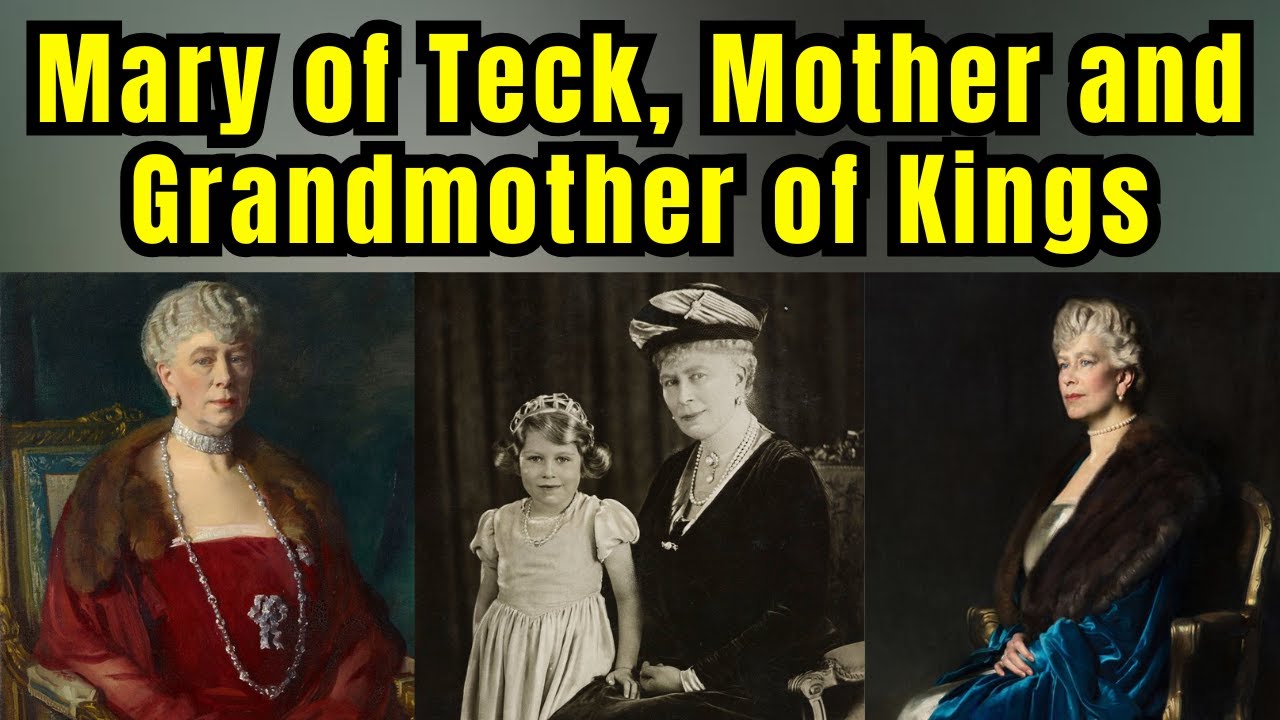
”
It was that refusal to retreat from the royal family in her moment of grief that set her on a path no one had foreseen at her birth. Mary was born on May 26, 1867, at Kensington Palace in London, into circumstances that announced her place in the royal world with great clarity and considerable complication. She was not a royal princess. She was the daughter of Duke Francis of Teck, a member of a minor German noble house with no territorial sovereignty, whose title meant more in dignity than in substance.
Her mother, Princess Mary Adelaide of Cambridge, was a granddaughter of King George III, and through her Mary possessed genuine royal lineage. But in the eyes of the British court, the title of Princess of Teck carried nothing like the weight of a monarch’s daughter or granddaughter. She belonged to the nobility, yet remained secondary in the royal hierarchy. Her full baptismal name—Victoria Mary Augusta Louise Olga Pauline Claudine Agnes—reflected the noble custom of honoring multiple relatives and dynastic allies.
Within the family, however, she was simply called May, a nickname drawn from the month of her birth, and it stuck for life. The duality of formal name and familiar nickname mirrored a tension she would carry throughout her years: a private identity and a public role that sometimes pulled in different directions. Her father’s finances were limited, and the family lived far more modestly than was typical in royal circles. There were extended stays in Italy and Germany, undertaken to cut costs and escape social scrutiny.
From these experiences Mary gained an early awareness of the importance of duty, discretion, and restraint. Her education, supervised by a mother who chose her governesses with care, was rigorous: several languages, music, history, and religion, all built around discipline, punctuality, self-control, and an Anglican worldview that reinforced an orderly and structured sense of life. By the late 1880s, that upbringing had formed a young woman whom Queen Victoria considered an ideal match for her grandson, Prince Albert Victor, Duke of Clarence and Avondale. The queen believed May possessed both the proper lineage and the right character to strengthen dynastic stability.
The engagement was announced in December 1891 and was received with enthusiasm at court. A modest but elegant ceremony was arranged. The public saw in her a promising figure for the monarchy’s future. Then came January 1892, the pneumonia, the death, and the discovery that grief could not break her.
In the period of shared mourning, a closeness developed between Mary and Albert Victor’s younger brother, Prince George, Duke of York. United by grief and the weight of family expectations, they forged a bond built on mutual understanding and respect. In 1893, just a year after the tragedy, their engagement was announced with the cautious consensus of the royal family. George, more reserved and formal than his brother, found in Mary a companion who balanced his seriousness with a firm grasp of public life.
Theirs did not begin with passionate romance, but genuine affection grew between them over time. Queen Victoria and the government welcomed the union as a symbol of stability and continuity. They were married on July 6, 1893, in the Chapel Royal at St. James’s Palace, before the entire royal family, European nobility, and thousands gathered in the streets of London.
Mary wore a gown of white silk embroidered with silver, and Queen Victoria lent her a tiara—a clear sign of the sovereign’s full trust. It was the beginning of a union that would secure the line of succession and mark more than four decades of shared reign. Between 1894 and 1905, Mary gave birth to six children: Edward, Albert, Mary, Henry, George, and John. Her role as a mother was shaped by the expectations of royal life.
The children were raised under strict discipline, typical of aristocratic norms of the time, and Mary appeared emotionally distant, as was customary among the upper classes, though her concern for their physical and moral well-being was constant. Her eldest son, Edward, was groomed to be king. The second, Albert, showed a more reserved temperament and struggled with health issues, including a stammer that would later affect his public life. The youngest, John, was diagnosed with epilepsy and lived isolated from official life.
Mary oversaw the education of all her children with meticulous attention and maintained a close relationship with them within the formal boundaries of her royal role. During the reign of King Edward VII, from 1901 to 1910, Mary held the title of Duchess of York. She took part in tours, inaugurations, military ceremonies, and charitable events, displaying a notable ability to carry out public responsibilities without seeking personal attention. Her composure, strict adherence to protocol, and punctuality were highly valued by the royal household and the press.
She was known for a sober style of dress and manner of speaking that projected solidity and formality, fitting for a country undergoing political, technological, and social transitions. When Queen Victoria died on January 22, 1901, Prince George became heir to the throne, and Mary was invested as Princess of Wales. The new title brought a significant increase in public responsibilities. She accompanied her husband more frequently on official engagements across the United Kingdom and abroad.
They visited colonies and dominions, including India, where they participated in ceremonies aimed at reinforcing imperial authority. Mary understood that her image had to reflect stability, dignity, and decorum at a time when the monarchy faced growing scrutiny from reformist sectors. She maintained closer contact with charitable institutions and social organizations, becoming a constant presence in British public life, regarded by many as the embodiment of the values the monarchy was expected to preserve into the twentieth century. On May 6, 1910, following the death of Edward VII, George ascended the throne as George V.
The coronation took place on June 22, 1911, at Westminster Abbey, where Mary was anointed Queen Consort. That December, the royal couple traveled to India for the historic Delhi Durbar, a solemn ceremony in which they were formally proclaimed Emperor and Empress of India before thousands of dignitaries, Indian princes, and colonial officials. No religious coronation was held, since the Church of England did not permit such rites outside British soil, but the event carried deep symbolic and political significance. As consort, Mary took on a fully institutional role: a demanding schedule of engagements, careful review of official events, and extreme punctuality.
Her conduct during ceremonies and public receptions earned her the respect of politicians, diplomats, and the aristocracy. The First World War tested the stability of Europe’s monarchies. Anti-German sentiment reached intense levels in Britain, and the royal family was directly affected by its German heritage. Mary, born to a British mother and a German father, understood the urgency of adapting to the new political and social realities.
Alongside King George V, she took part in the symbolic restructuring of the crown, culminating in 1917 with the abandonment of the House of Saxe-Coburg and Gotha and the adoption of Windsor as the name of the royal house. Mary supported the move, aware that the emotional bond between the crown and the British people had to be strengthened. During the war she regularly visited military hospitals, munitions factories, and charitable organizations. She dressed modestly, avoided ostentation, and maintained a calm demeanor in the face of adversity.
Her role was not political leadership, but her constant presence helped legitimize the monarchy at a time when many royal houses across Europe were collapsing. In 1919, Mary faced one of the most painful moments of her life: the death of her youngest son, Prince John. Diagnosed with epilepsy at age four, John also began to show signs of atypical cognitive development. Over time, his public appearances became increasingly rare, and in 1916 it was decided that he would live more permanently at Wood Farm, a modest and secluded residence within the Sandringham estate.
There he was cared for with devotion by his nurse, Lalla, with whom he formed a deep emotional bond. Queen Mary visited him regularly and maintained constant contact with his caretakers, though the decision to keep him away from public life drew criticism, interpreted by some as an attempt to hide him. Her private correspondence contradicts that image. After John died on January 18, 1919, following a violent epileptic seizure, Mary wrote with restrained grief: “The loss of our dear boy has been a terrible blow.
Although we knew the end might come at any time, he was a pure soul. ” He was thirteen years old. His mother preserved his portraits, drawings, and personal belongings with great care, storing them in private chests and remembering him in the intimacy of the home as a fragile but deeply loved child. The war years had also confronted the royal family with a decision whose consequences would never fully leave the queen.
In 1917, the Russian Revolution overthrew Tsar Nicholas II, George V’s first cousin. Chaos gripped Petrograd. In this climate of uncertainty, the tsar, along with his wife Alexandra and their children, requested asylum in the United Kingdom, appealing to the family ties between the British and Russian royal houses. The internal situation in Britain was delicate.
Labor unrest was rising, and the specter of Bolshevism alarmed the ruling classes. King George V, fearing that offering refuge to a deposed monarch might spark a political crisis, chose to deny asylum. The decision was made in coordination with Prime Minister David Lloyd George, but the moral responsibility fell primarily on the crown. Queen Mary supported her husband, understanding the political consequences, although with deep sorrow.
Her letters and private diaries reveal the distress she felt at abandoning their relatives in such a vulnerable moment. In July 1918, Nicholas II, Alexandra, and their five children were executed by the Bolsheviks in Yekaterinburg. In her diary, Mary wrote: “I cannot get the fate of Alex and her children out of my mind. What sort of world is this in which such barbarity is permitted?
” The decision, made under the weight of circumstances, became a burden she never fully let go of. She never spoke publicly about it, but her correspondence reveals a persistent sorrow, as if that refusal had been a silent betrayal that would follow her for the rest of her life. King George V died on January 20, 1936, at Sandringham House, surrounded by close family, after several years of fragile health worsened by chronic bronchitis and emphysema. In his final days his condition deteriorated sharply, and doctors considered the end imminent.
It has been documented that his personal physician, Lord Dawson of Penn, administered a lethal dose of morphine and cocaine to hasten his death, reportedly to spare him further suffering and so the news could appear in the morning edition of the Times. The act, revealed decades later, remains a subject of historical controversy. Queen Mary was deeply affected by the loss. But she did not retire from public life.
Nor did she officially adopt the title of Queen Mother, despite her son Edward VIII inheriting the crown. She retained the style of Her Majesty Queen Mary and continued living at Marlborough House, where she remained active in official engagements, religious ceremonies, and family matters. Despite the emotional blow, she resumed her commitments with strength, showing the same discipline that had defined her for decades. Her eldest son, King Edward VIII, ascended the throne but reigned for less than a year.
George V had harbored deep doubts about his son’s ability to rule. Edward, even in his youth, had shown an independent and defiant attitude toward royal norms. He disregarded protocol and preferred the company of celebrities, military figures, and prominent socialites. During the 1920s and 1930s he engaged in numerous romantic affairs with married or divorced women, scandalizing the conservative sectors of the court.
It was in this context that he met Wallis Simpson, a twice-divorced American woman, and formed a relationship that would trigger a constitutional crisis. George V, aware of the risks posed by his son’s behavior, privately expressed grave concern about the monarchy’s future. According to biographers and those close to the court, he said bitterly: “I pray to God that my eldest son will never marry and have children so that nothing may come between Bertie, Lilibet, and the throne. ” The words reflected not only his mistrust of Edward, but his affection for his second son, the Duke of York, and his granddaughter, Princess Elizabeth, whom he saw as more stable and responsible heirs.
In the months that followed, Queen Mary maintained a watchful and cautious stance as the situation unfolded. On December 11, 1936, just eleven months after his accession, Edward VIII formally abdicated the throne. His decision, driven by the desire to marry Wallis Simpson, sparked an unprecedented constitutional crisis. The Church of England, of which the king was supreme governor, forbade marriage to a divorcee while her former spouse was still alive.
The conflict divided the government and parliament, shaking the foundations of the British monarchy in a fragile interwar period. For Queen Mary, her son’s abdication was a profound rupture with the principles she held sacred. She did not see it as a romantic gesture, but as a betrayal of the solemn oath made before God and the duty entrusted to the crown. For years she had watched with growing concern his love of frivolous social life, his disregard for institutional conventions, and his emotional dependence on Wallis Simpson.
She never accepted the relationship. When Edward announced his intention to marry, the queen responded with deep sorrow. She refused to attend the wedding in France and declined any future visit to the Duke and Duchess of Windsor. The relationship between mother and son became distant, limited to occasional correspondence of a restrained tone.
In one letter, she wrote firmly: “I do not believe you have understood the impact your attitude has had on your family and on the whole nation. It is inconceivable to those who made far greater sacrifices during the war that you, as their king, refused to make a lesser one. ” Yet she also revealed her personal pain: “My feelings for you as your mother remain the same, and our separation and the cause of it grieve me beyond words. After all, I have put my country before everything else all my life, and I simply cannot change now.
”
The abdication represented an irreversible breach of dynastic commitment, a wound that never truly healed. In a letter to her second son, George VI, proclaimed king after the abdication, Mary expressed her view of monarchical duty: “God has called you to a great task. May he strengthen and sustain you as he did your dear father. ” It was not merely a show of support, but a reaffirmation of the model of sovereign she had upheld all her life: disciplined, reserved, and conscious of public role.
George VI faced a delicate situation. His reserved nature and difficulty with speech made him vulnerable to public opinion. His mother became a constant presence, helping him consolidate his role as head of state. Through private meetings, letters, and discreet advice, she reinforced the idea of the monarch as a symbol of national unity.
Her influence was not visible to the public, but it carried considerable weight in the early years of the new reign. During the Second World War, Mary resided at Badminton House as a guest of the Duke and Duchess of Beaufort. Unlike her son George VI and Queen Elizabeth, who remained in London during the Blitz, Mary stayed away from the capital. The decision was based on safety due to her advanced age, but she remained attentive to the course of the conflict.
From her retreat she continued to be a respected figure and maintained her role in ceremonial matters. After the war she returned to London and resumed certain official activities, albeit in the background. Mary’s relationship with her granddaughter Elizabeth was close from the princess’s early years. The queen grandmother oversaw essential aspects of her education: constitutional history, Anglican values, and court ceremonial.
She firmly believed that the preparation of heirs must begin in childhood, with an education that instilled the concept of duty before privilege. Elizabeth spent time with her grandmother, who instructed her with sternness, though never with cruelty. Through her example, Mary instilled the importance of political neutrality, emotional restraint, and institutional stability. Her influence left a lasting mark on the future queen.
On February 6, 1952, King George VI died from complications related to lung cancer. The removal of one lung months earlier had not stopped the progressive decline in his health. The news shocked the country and plunged the royal family into mourning. For Mary, it meant the loss of her closest son.
Although she no longer took part in public engagements, she closely observed Elizabeth’s succession, knowing that this transition was part of the legacy she had helped uphold. George VI’s funeral was held with solemnity at St. George’s Chapel, Windsor, a ceremony Mary attended with serenity and composure. Mary of Teck passed away on March 24, 1953, at the age of eighty-five, at Marlborough House.
Her health had deteriorated significantly due to a hemorrhage and rapidly advancing heart failure in her final days. The final medical report stated she was resting peacefully, and she died in her sleep at 10:20 p. m. , accompanied by her daughter, Princess Mary.
Anticipating the possibility, she had made it clear that the coronation of Elizabeth II, scheduled for June, must not be postponed under any circumstance. Her wish was respected as a tribute to the principle of institutional continuity. After her death, her body lay in state at the Queen’s Chapel at Marlborough House. It was then taken in solemn procession to Westminster Hall, where over 119,000 people came to pay their respects during the lying in state from March 29 to 31.
The state funeral was held that same day at St. George’s Chapel, Windsor Castle. She was buried beside her husband, King George V, closing a life that spanned the reigns of six monarchs and an entire era of transformation.
Her legacy was etched into history as that of a woman who, through constancy and silence, upheld the pillars of the modern monarchy.
