The telephone sat on the desk, heavy and black, and Omar Bradley’s hand was already reaching for it. His face had gone red while he read. The newspapers had arrived that morning from Belgium, and every line of them burned. Around him in the Luxembourg City headquarters, the men could see something was wrong.
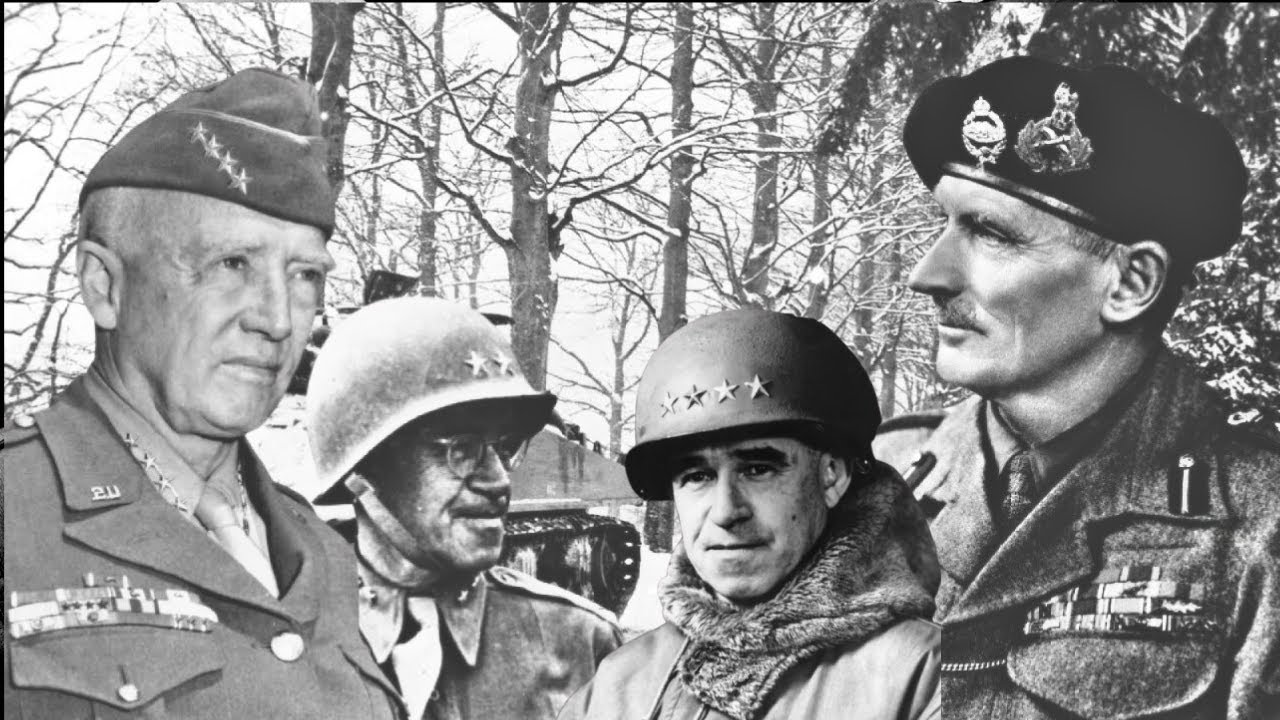
According to people who were there, they had never seen Bradley angrier. He was a man known for calm, for careful words, but now his hands tightened around the paper. The day before, British Field Marshal Bernard Montgomery had held a press conference, and the newspapers were full of what he had said. Montgomery had spoken about the Battle of the Bulge, and he had made it sound as though he had cleaned up the mess and given proper leadership to the American soldiers.
As if he were the main reason the Allies had won. Bradley had been commanding American armies for months. Those same armies had just fought the largest battle in United States military history, and nearly eighty thousand American soldiers had become casualties. They had fought hard.
They had stopped the German attack. And now Montgomery was taking the credit. Bradley snapped. He grabbed the telephone and demanded the Supreme Commander, General Dwight D.
Eisenhower. The words he spoke into that phone shocked Eisenhower. They were so strong that they nearly tore apart the Allied command. About fifty miles south, another American general heard the same news that day.
George S. Patton, commanding the Third Army, learned of Montgomery’s press conference. His reaction was instant. In his diary entry for January 8th, 1945, he recorded his response, and it was fast, angry, and so full of profanity that it could not be fully repeated in polite company.
This is the story of what Bradley and Patton said after Montgomery took credit for the Battle of the Bulge. Their documented reactions show how close the Allied leadership came to breaking apart, not because of the enemy, but because of pride, credit, and wounded honor. To understand why Montgomery’s words were so insulting, it is necessary to look at what actually happened in the Ardennes. On December 16th, 1944, German forces launched a massive surprise attack.
Official military records say twenty-eight German divisions pushed through the Ardennes Forest, creating a large bulge in the Allied front line. That bulge gave the battle its name. The attack fell mainly on American forces. The US First Army, under General Courtney Hodges, took the hardest blow at the start.
American soldiers fought desperate defensive battles in Bastogne, St. Vith, and dozens of other towns and villages. Bradley commanded the 12th Army Group, which included the American armies under attack. His headquarters was in Luxembourg City, and from there he coordinated the American response, organizing resistance and counterattacks during one of the most dangerous moments of the war.
To Bradley and Patton, that was the reality. Montgomery’s claim that he had tidied up the mess ignored the courage, leadership, and sacrifice of the American soldiers and commanders who had stopped the German advance at a terrible cost. Patton commanded the Third Army, positioned south of the main German attack. When the Germans struck, he reacted with remarkable speed.
He turned his whole army north to strike the German southern flank. Entire divisions had to change direction by ninety degrees and be ready to attack within days. Historians often describe the movement as a logistical miracle. It required perfect planning, fast communication, and great discipline.
Then, on December 20th, 1944, Eisenhower made a controversial decision. According to official records, he temporarily moved the US First Army and the US Ninth Army out of Bradley’s command and placed them under Montgomery. Eisenhower explained his reasoning in his memoir, Crusade in Europe. It was practical, not political.
The German attack had cut communication lines between Bradley’s headquarters in Luxembourg and the First Army units fighting in Belgium. Montgomery’s headquarters was closer to the battlefield and could communicate more easily. From Eisenhower’s point of view, the change would help the Allies respond faster. It deeply hurt Bradley.
In his memoir, A Soldier’s Story, he wrote that he felt humiliated. American armies were being placed under British command because German forces had attacked American positions. He protested strongly, but in the end he accepted the decision, understanding it was temporary and tactical, not a judgement on American leadership. Patton reacted just as strongly.
His diary entry for December 20th recorded sympathy for his friend. Bradley had called him, Patton wrote, and he was heartbroken. Patton described the decision as one of the worst things he had ever heard. His language was angry and emotional.
Still, both men accepted the change. They understood the danger and the need for quick decisions. Over the next two weeks, American forces stopped the German attack and then pushed the Germans back. According to official casualty records, about nineteen thousand American soldiers were killed.
In total, around eighty thousand were killed, wounded, missing, or captured. British losses were far smaller, about fourteen hundred casualties. Montgomery, commanding Allied forces north of the Bulge, did play a role. According to British military records, he positioned reserve units and helped organize defensive lines.
But the heaviest fighting was done by American troops. By early January 1945, the German offensive was defeated. American forces were launching counterattacks, pushing the enemy back. The crisis was over.
On January 7th, 1945, Montgomery held his press conference in Belgium. Many reporters were present. According to the official transcript and contemporary newspaper reports, he spoke at length about the battle. He explained how he had taken control of the situation in the north, organized the defense, and made the important decisions.
In his own recorded words, he said that as soon as he understood what was happening, he personally took action to stop the Germans. If the German army reached the Meuse River, he said, they would not be allowed to cross it. He described the battle as very interesting and extremely difficult, one of the most tricky battles he had ever handled. Then came the sentence that caused the fury.
Montgomery said that the first thing he did was to tidy up the battle area and clear up the mess. He did praise American soldiers, calling them brave and capable fighters. But then he added that American soldiers were good fighting men when they were given proper leadership. Many people understood that to mean that American forces had been confused and poorly led until Montgomery arrived.
The message seemed to be that he had saved the situation by bringing order and leadership. The press conference was reported widely on January 8th. British newspapers presented Montgomery as the man who had taken control and stopped the German attack. American newspapers soon picked up the story.
That is how Bradley and Patton learned what he had said. Bradley was sitting in his headquarters reading the paper when his anger grew. He later wrote in his memoir that Montgomery’s claims were arrogant and insulting. He was so furious that he immediately called Eisenhower.
According to Bradley’s own account and the accounts of officers present, he spoke with extraordinary force. He told Eisenhower that Montgomery could not continue commanding American troops. He said that if Montgomery was not immediately removed from command of American forces, he would resign. Eisenhower was shocked.
Harry Butcher, Eisenhower’s naval aide, recorded in his diary that the Supreme Commander was deeply surprised by how angry Bradley was. The call was intense and emotional. Bradley was not finished. In his memoir he wrote that he told Eisenhower something even stronger.
After what had happened, he could not serve under Montgomery. If Montgomery remained in command of American forces, then Eisenhower would have to send Bradley home. Bradley later wrote that he had never been so angry in his entire military career. He believed Montgomery’s public statements were a complete distortion of the truth, an insult to every American soldier who had fought and died in the Ardennes.
His anger had several sources. Montgomery had taken credit for a battle fought mainly by American forces. He had suggested American armies were disorganized until he arrived. He had implied American soldiers needed British leadership to fight properly.
For three weeks, Bradley had watched his men fight desperately against overwhelming German forces in freezing weather. He had seen their courage, their suffering, their sacrifice. Montgomery’s words erased that reality. Patton was having his own reaction.
His diary entry for January 8th survives in the Patton papers. His language was harsh, angry, and full of profanity, much of it impossible to quote directly. The meaning was clear. He believed Montgomery was lying and trying to steal credit for an American victory.
He wrote insults about Montgomery, calling him weak and dishonest. He accused him of trying once again to claim he had saved the American army in the Ardennes. Bradley had called him, furious, and Patton agreed completely. Montgomery wanted people to believe he had rescued American forces, and Patton found the idea sickening.
He went further. In his opinion, the British had done very little fighting compared to the Americans. American soldiers had done almost all of the dying, and now Montgomery claimed the victory for himself. Patton described it as typical arrogance.
He did not keep his anger private. According to several accounts, he telephoned other American commanders to talk about Montgomery’s statements. Everyone he spoke to was furious. Outrage spread through the senior American officer corps.
On January 9th, Patton wrote again. He had spoken with Bradley, who was still considering resignation. Patton wrote that he did not blame Bradley at all. Montgomery’s statements were lies, completely unacceptable.
The Allied command was under enormous strain. The enemy had been beaten, but the alliance itself was in danger of breaking apart over pride, credit, and wounded honor. In Washington, the War Department began receiving angry messages. According to official records, members of Congress complained, questioning why American armies were serving under British command after suffering such heavy losses.
Eisenhower understood the danger. According to his memoir, published in 1958, he acted quickly to limit the damage. On January 9th, 1945, according to official records, he returned operational command of the US First Army and the US Ninth Army to Bradley. The temporary arrangement that had allowed Montgomery to command American forces was over.
This removed the main basis for Montgomery’s claim that he controlled the battle. Eisenhower later wrote that he told Bradley the temporary change was finished, but he admitted the damage to Allied relations was serious. According to multiple accounts, many American generals never fully trusted Montgomery again. On January 10th, according to official records, Eisenhower sent Montgomery a message expressing concern about the press conference.
The full text is not preserved in available sources, but later accounts suggest Eisenhower told him that his public statements had created serious problems within the Allied command. Montgomery’s reaction was surprising. In his own memoir, published in 1958, he said he had meant to praise American soldiers. He believed the controversy was exaggerated and unnecessary.
He never truly understood why his words had offended American commanders so deeply. Bradley’s anger did not fade. In his memoir he wrote that even after regaining command of his armies, he remained furious. He called Montgomery’s press conference the most arrogant and infuriating act he witnessed during the entire war.
He believed Montgomery had tried to steal credit from American soldiers who had bled and died in the Ardennes. Patton never let the matter rest. His diary entries from mid-January continued to mention Montgomery with contempt. On January 15th, he wrote that Montgomery was still claiming credit for the Battle of the Bulge and accused him of lying.
The crisis reached its highest point when Prime Minister Winston Churchill was forced to intervene. On January 18th, 1945, according to the official parliamentary record, Churchill spoke in the House of Commons. His words were carefully chosen. He clearly understood that Montgomery’s press conference had damaged Allied unity, and he wanted to repair it.
He openly praised American forces. He stated that United States troops had done almost all of the fighting during the Battle of the Bulge and suffered almost all of the losses. He warned that Britain must be careful not to exaggerate its role. The British Army, he said, should not claim more credit than it deserved in what was clearly the greatest American battle of the war.
With those words, Churchill publicly rejected Montgomery’s claims. The victory belonged mainly to American soldiers and American leadership. According to several accounts, both Bradley and Patton were satisfied with the speech. It supported their position and corrected the story Montgomery had told the press.
The damage, however, was not fully repaired. In their later writings, both men made clear they never forgave Montgomery. Bradley wrote years later that the press conference convinced him Montgomery was not only personally arrogant but also dangerous to Allied unity, that his behavior threatened cooperation between American and British forces. Patton’s reaction was even stronger.
For the rest of the war, his diary continued to include regular, contemptuous references to Montgomery. He never forgot the incident and never let it go. The recorded statements show how deep the anger ran. Bradley, normally calm and careful, threatened to give up one of the most important commands in Europe.
Patton, already hostile toward Montgomery, became openly aggressive. The enemy had been defeated on the battlefield, but pride, credit, and public words had nearly broken the Allied leadership from within. From Montgomery’s point of view, he was the superior commander, the man who had stepped in, organized the situation, and helped create a successful defense. In his mind, his leadership had been decisive.
Bradley and Patton saw something else: an arrogant British general taking credit for a battle fought almost entirely by American soldiers, men who had done the hardest fighting and suffered the greatest losses. The clash also exposed deep differences in personality. Montgomery often could not resist talking about his own importance, presenting himself as the key figure in any success. Bradley and Patton, despite their differences from each other, shared one powerful trait: fierce loyalty to American soldiers.
They could accept criticism of themselves, but they could not tolerate anyone diminishing the courage, sacrifice, or achievements of the men who fought and died under their command. Churchill’s intervention stopped the crisis from destroying the alliance at the political level. His speech corrected the public story and restored balance between Britain and the United States. But at the level of military command, the damage was done.
Bradley and Patton never trusted Montgomery again, and many American generals shared their feelings. Among American commanders, contempt for Montgomery became widespread and lasting. Montgomery, for his part, never understood the problem. In memoirs published years later, he insisted his press conference had been misunderstood.
He argued that the Americans were too sensitive and had overreacted. It was a deep blindness to how others perceived him, a trait that caused problems throughout his military career. What Bradley and Patton said when Montgomery took credit for the Battle of the Bulge was clear, united, and full of anger. They said he was dishonest and arrogant.
They said he was trying to steal credit from American soldiers. They said they could not serve under his command. Their words were strong, emotional, and fully documented in historical records. Those words nearly broke the Allied command structure, and the situation became so serious that it required the personal intervention of Winston Churchill to repair the damage.
It was one of the defining moments in Anglo-American relations during World War II, a moment when two powerful American generals stood together against what they saw as British arrogance and dishonesty, revealing how fragile unity can be even among allies fighting the same enemy.






