In the late 1930s, a striking Russian woman began appearing in the same elite circles that Albert Einstein frequented—at concerts, in salons, at summer houses near Princeton. Her name was Margarita Konenkova, elegant and highly educated, and she was married to the renowned sculptor Sergei Konenkoff, who had been commissioned to sculpt a bust of Einstein. On the surface, she was just another émigré moving among the artistic elites of New York and New Jersey. In reality, according to later accounts and multiple Soviet records, she was something else as well: an agent for Stalin’s intelligence apparatus, tasked with getting close to influential American scientists during the era of the Manhattan Project.
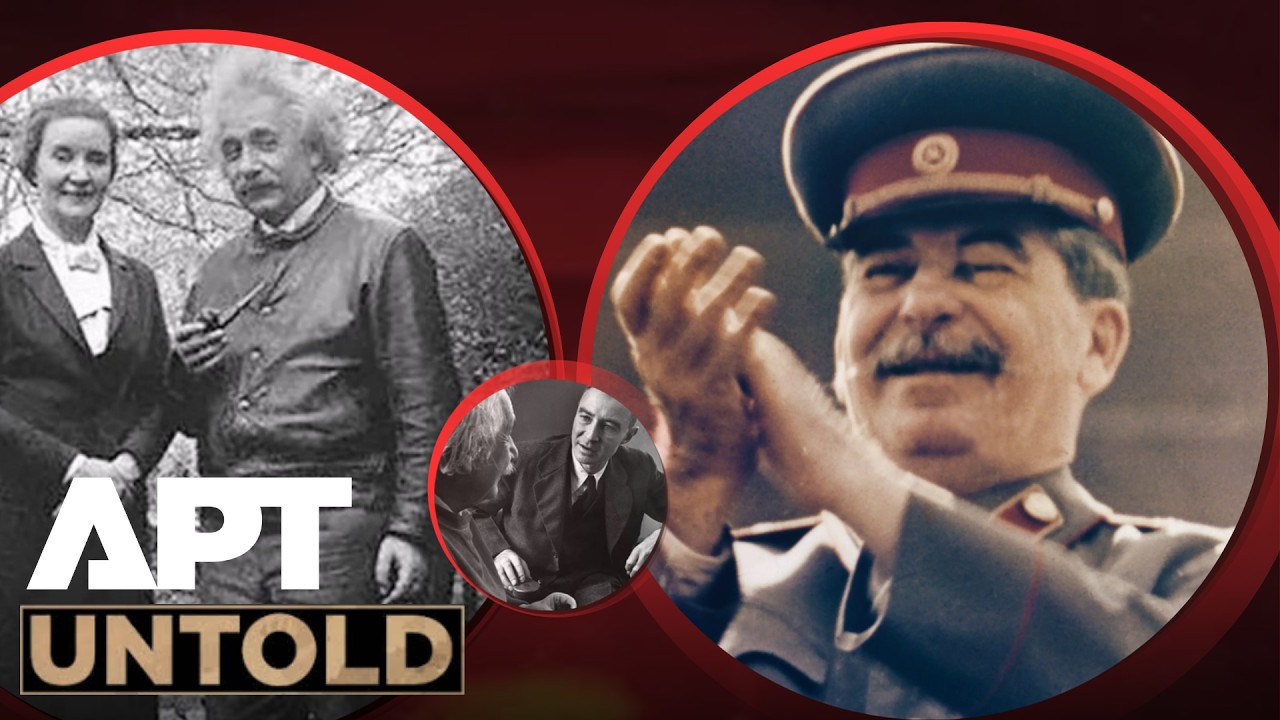
Einstein, recently widowed and emotionally isolated, fell deeply in love with her. The letters he wrote to her in 1944–1945, discovered in the 1990s and now held in the Library of Congress, are filled with open affection. The two shared a private name for themselves, “Almar”—a fusion of Albert and Margarita—and he wrote to her of missing her, of their time together, of how he washed his own hair, though never as carefully as she did. Friends later hinted at a secret affair between the world’s most famous physicist and the beautiful Russian woman in his orbit.
One acquaintance simply said: “I certainly hope so. They were two lonely people. ” What Einstein did not know, at least according to most historians, was that the woman he called his Russian sweetheart appears in Soviet and Western sources under a very different label: agent. By the late 1930s, the Soviet Union was already reaching into the highest levels of Western science.
Stalin’s intelligence services understood that the next great war might be decided in the laboratory, and they wanted eyes inside the American physics community. Margarita Konenkova—referred to primarily by her maiden name, Voronkova, in the memoirs of Soviet spy Pavel Sudoplatov—was positioned for exactly that purpose. Her mission, as Sudoplatov described it in his memoirs *Special Tasks*, was simple and ambitious: penetrate the world of American physics at the very moment the Manhattan Project was taking shape. Under the direction of NKVD agents in New York, she was reportedly ordered to build relationships with the leading scientists at Princeton—not only Einstein but J.
Robert Oppenheimer and others whose students and colleagues were heading off to work on secret wartime projects. The Konenkovs’ social life provided the perfect cover. Sudoplatov claimed that Margarita approached the influential physicists Einstein and Oppenheimer, pushed Oppenheimer toward hiring specialists with left-wing sympathies, and used the Konenkoff household as a meeting point where Soviet agents could quietly identify who was involved in America’s new superweapon. She was, in this telling, a kind of social engineer, weaving herself into the lives of men who held the keys to the atomic future.
What is known with greater certainty is this: Margarita Konenkova did succeed in using Einstein to reach Soviet intelligence. In November 1945, Einstein wrote to her referring to a meeting with a Soviet consul, according to the program. That consul, Pavel Mikhailov, was in fact a senior Soviet military intelligence officer operating under diplomatic cover in New York. Multiple accounts and pieces of evidence indicate that Konenkova pressured Einstein to meet Mikhailov, emphasizing that her future in the Soviet Union might depend on it.
He agreed. Einstein seems to have met the Soviet official more than once, and later wrote to Margarita that he had done everything he could. Then, shortly afterward, in 1945–1946, the Konenkovs were suddenly ordered home. Upon their arrival in Moscow, they enjoyed quiet patronage from the state—a sign that someone in Stalin’s system considered Margarita’s work a success.
Here the story shifts from fact to controversy. Sudoplatov and some Russian writers have portrayed Konenkova as a kind of Soviet Mata Hari of the atomic age, suggesting that through Einstein and his circle she helped Moscow gather key intelligence that fed the Soviet nuclear program. Others have gone further, proposing that Einstein—tormented by the idea of an American nuclear monopoly—may have quietly shared information out of love for Margarita and a conviction that no single nation should control such a weapon alone. But many Western historians are deeply skeptical of that claim.
They point out that Einstein never held a security clearance for the Manhattan Project, that he was deliberately kept away from Los Alamos, and that there is no evidence he ever passed any valuable information to Konenkova or anyone else. The Library of Congress, which holds his love letters to her, notes that they confirm an affair but contain no atomic secrets. Numerous researchers have dismissed the idea that she was a major Manhattan Project spy as implausible or unproven. What can be said with confidence is narrower.
Margarita Konenkova was very likely an agent of Soviet intelligence. She did have a genuine romantic relationship with Albert Einstein. And she did introduce him to a Soviet spy posing as a consul. Whether she personally stole the bomb is far less clear.
The Soviet Union obtained most of its crucial atomic data from fully planted spies like Klaus Fuchs and Theodore Hall, men working inside the project itself—not from pillow talk in Princeton. But as an untold story, her life stands at that uncomfortable boundary where romance, loneliness, and great-power espionage overlap. A genius physicist believed he had found love late in life.
A woman may have returned that love while quietly helping Stalin’s intelligence services close the nuclear gap that would define the shape of the Cold War.






