In 1786, Sir William Jones, a British jurist working in Calcutta, stood before the Asiatic Society and delivered an observation that would detonate through the academic world for the next two centuries. Sanskrit, he noted, bore a structural resemblance to Greek and Latin, too precise to be accidental. The verbs conjugated the same way. The root words aligned too consistently.
The correspondence, he concluded, was stronger than chance could produce. All three languages must have descended from a common source, one that perhaps no longer existed. Jones was not the first to notice. Mikhail Lomonosov had made similar observations about Latin, Greek, German, and Russian decades earlier.
But Jones framed it with enough precision that the academic world could not look away. The investigation that followed would eventually encompass Sanskrit, Persian, Gothic, Old Irish, Armenian, Albanian, and dozens of others. Every language examined added more weight to the same conclusion: there had been a proto-language, a single ancestral tongue spoken by a single ancestral population. A language that, for reasons that remain genuinely mysterious, spread across more of the Earth’s surface than any empire in the ancient world ever managed to conquer.
The distribution is the first thing that demands explanation. Indo-European languages do not cluster in one region the way a locally developed language family should. They span from Iceland to Sri Lanka. They appear in Central Asia, in the Caucasus, in isolated pockets of the Balkans.
Languages separated by thousands of miles and thousands of years of independent development still share core vocabulary that cannot be attributed to borrowing. The word for father in English, Greek, Persian, and Hindi does not sound similar because these cultures traded with each other. It sounds similar because all four languages inherited it from the same source, spoken by the same people before any of those cultures existed. That is the mystery in its simplest form.
Someone, somewhere, speaking a language we cannot directly recover, produced every tongue that 3 billion people speak today. The question is who. The question is where. And after two centuries of searching, the answer remains incomplete.
The search for the Proto-Indo-European homeland did not begin with genetics. It began with horses. In the late 19th century, German philologist Otto Schrader undertook a systematic analysis of the vocabulary shared across Indo-European languages. His method was straightforward: if a word for a specific animal, plant, or technology appears in consistent form across multiple branches of the language family, that word almost certainly existed in the proto-language.
And if the proto-language had a word for something, the people who spoke it knew that thing existed. What Schrader found was a language saturated with horses. Cognate words for horse, for riding, for harness gear, for the act of breaking an animal to human control, appeared across Sanskrit, Greek, Latin, Celtic, and Germanic with a consistency that pointed to a single origin. The Proto-Indo-Europeans did not encounter horses after they dispersed.
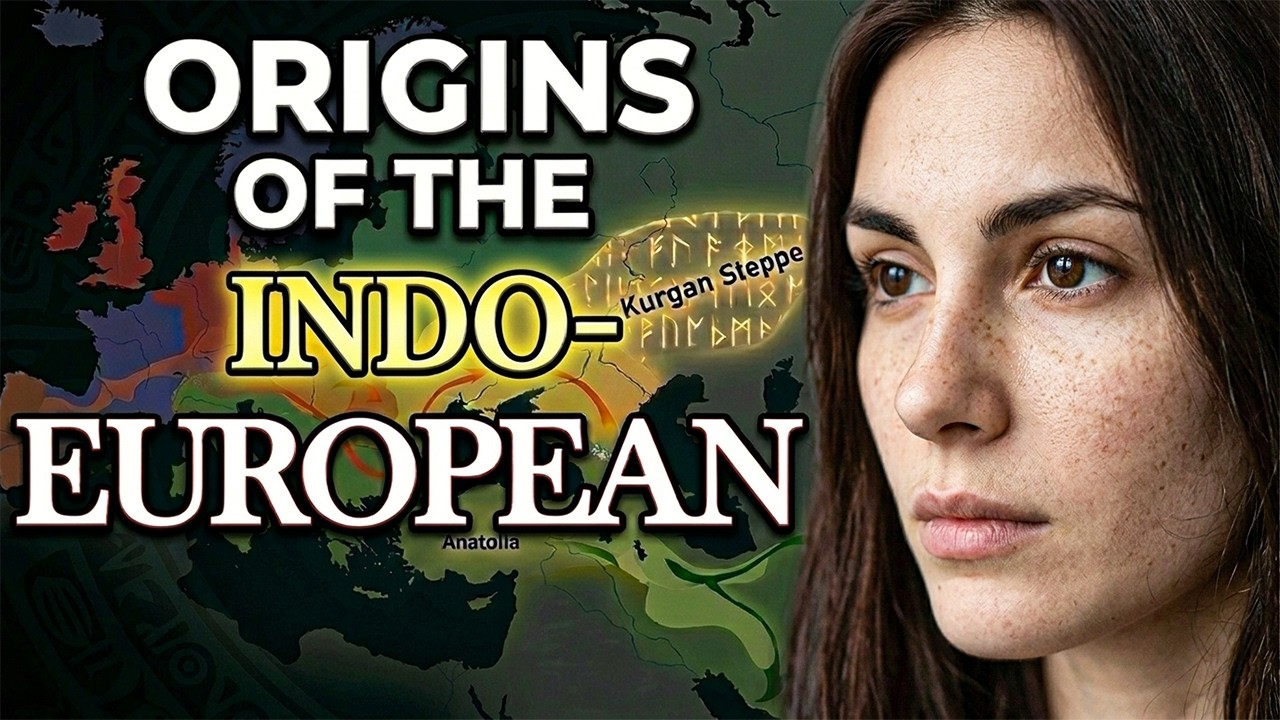
They brought the horse with them, which meant their homeland had to be somewhere horses were native. That pointed to the Pontic-Caspian Steppe, the vast belt of flat grasslands stretching from modern Ukraine east through Russia and Kazakhstan. Lithuanian archaeologist Marija Gimbutas spent decades building the case. The steppe cultures she identified—mobile, pastoral, organized around cattle and horses, burying their honored dead beneath earthen mounds called kurgans—matched the profile the linguistic evidence predicted.
These were the people. This was the place. The case strengthened further when researchers identified wheel and wagon technology as another shared Indo-European inheritance. Cognate words for wheel, axle, and wagon appear across nearly every branch of the language family, with one significant exception: the Anatolian branch, the oldest attested branch, lacks them entirely.
The implication is precise. The Anatolian branch split from Proto-Indo-European before the wheel was invented. Every other branch inherited wheel vocabulary because they descended from a population that invented it on the steppe, after Anatolian had already departed. For most of the 20th century, the Indo-European origin debate was conducted without the one category of evidence that could settle it.
Linguists had reconstructed the vocabulary. Archaeologists had mapped the cultures. But nobody could look directly at the people. That changed in 2015.
Two landmark studies published simultaneously in Nature extracted and sequenced ancient DNA from skeletal remains across prehistoric Europe and the Eurasian Steppe. What they found was not subtle. Around 3000 BCE, the genetic composition of Central and Western Europe changed dramatically. A new ancestry component—one that had not been present in European populations before—appeared suddenly and in large quantities.
It was steppe ancestry, and it came from the East. The Yamnaya were the population carrying it: a pastoral culture occupying the Pontic-Caspian Steppe between roughly 3300 and 2600 BCE. The Yamnaya buried their dead beneath earthen mounds, kept vast herds of cattle and horses, and appeared to have lived a significant portion of their lives in wagons. They were physically large, genetically distinct from the farming populations already established across Europe, and they moved.
Within centuries of their emergence, their genetic signature was appearing in populations thousands of miles from the steppe. The mechanism appears to have been the Corded Ware culture, a complex that spread across northern and central Europe around 2900 BCE. Corded Ware individuals carry steppe ancestry at levels between 40 and 75 percent. The archaeological transformation is matched precisely by the genetic one: new burial practices, new material culture, new people, all arriving from the same direction at the same time.
The conventional interpretation consolidated quickly. The Yamnaya, or a closely related steppe population, had expanded into Europe carrying their language with them. The genetic signal confirmed what the linguistic reconstruction had long predicted. The steppe hypothesis appeared vindicated.
Then researchers looked more carefully at where the Yamnaya’s own ancestry had come from, and the picture that had seemed settled cracked open again. The Yamnaya were not a simple population. Early analysis had assumed they descended primarily from the Eastern Hunter-Gatherers who had inhabited the northeastern fringes of Europe since the Mesolithic. That ancestry was present, dominant even, accounting for more than half their genetic profile.
But when researchers broke the composition down further, they found something that did not fit the standard model. Roughly 35 percent of Yamnaya ancestry did not come from the steppe at all. It came from the south, from a population genetically associated with the Caucasus Mountains and the regions below them—a group researchers labeled Caucasus Hunter-Gatherers, largely unknown, poorly sampled, and until that moment entirely absent from the Indo-European origin story. This was not a marginal signal.
It was a structural component of the population credited with spreading Indo-European languages across half the world. And it raised a question the steppe hypothesis had no ready answer for. Where had this southern ancestry come from? When had it entered the steppe population?
And what, if anything, did it mean for the origin of the language itself? In July 2023, a study led by Paul Hegarty and published in Science attempted to answer that question directly. Using phylogenetic analysis of Indo-European languages, the research team proposed that Proto-Indo-European had not originated on the steppe at all. It had originated south of the Caucasus, possibly in the region of modern Iran or Armenia, around 6000 BCE.
From there, the theory goes, it moved north, carried by Caucasus hunter-gatherer populations who mixed with Eastern hunter-gatherers on the steppe and passed their language to them. The steppe populations then carried a derived dialect outward into Europe and Asia. The steppe was not the origin. It was the launchpad.
The Hegarty study landed in the academic community like a stone into still water. The ripples have not settled. Of all the problems in Indo-European origins research, the Anatolian branch is the one that refuses to be tidied away. Hittite, Luwian, Lydian, and the other Anatolian languages represent the oldest directly attested branch of the Indo-European family.
Hittite texts survive from around 1650 BCE, centuries older than the earliest Vedic Sanskrit, centuries older than Mycenaean Greek. When linguists analyze the Anatolian branch structurally, it appears to have split from Proto-Indo-European earlier than any other branch. It lacks the wheel vocabulary. It preserves archaic features that all other branches lost.
By the internal logic of the language family, Anatolian departed first. The timing creates a problem. If Anatolian split from Proto-Indo-European before the wheel was invented, and wheel technology appears to have developed on the steppe around 3500 BCE, then Proto-Indo-European must have existed as a unified language before that date. Which means the language is older than the Yamnaya, older than the Corded Ware expansion, older than the steppe migrations that the genetics confirm delivered Indo-European ancestry into Europe.
Something does not align. The genetics make the problem harder, not easier. When researchers analyzed ancient DNA from Hittite-associated populations in Anatolia, they found minimal steppe ancestry. The genetic signature that appears so clearly in Corded Ware Europe, so clearly in Bronze Age India, is largely absent in the population speaking the oldest branch of the language.
If the steppe expansion carried Indo-European languages, why does the oldest branch show almost none of the steppe genetic signal? Several explanations have been proposed. The Anatolian branch may have entered the region from the Balkans at an earlier date, carried by populations related to the Sredny Stog culture, whose steppe-adjacent ancestry appears in Bulgaria as early as 4500 BCE. The language may have spread through prestige and elite adoption rather than mass population replacement, leaving a linguistic trace without a proportional genetic one.
History offers precedents: the Hungarian language survived complete genetic absorption into surrounding European populations; the Etruscan language persisted in a population carrying substantial Indo-European ancestry. None of these explanations fully closes the gap. The Anatolian branch remains the oldest and most awkward piece of the puzzle. Setting aside where the Proto-Indo-Europeans came from, the evidence for who they were is remarkably consistent.
The linguistic reconstruction paints a precise picture. They were pastoralists. Cattle were central to their economy, their mythology, and their conception of wealth. The Proto-Indo-European word for cattle is among the most securely reconstructed terms in the entire language, and it carries a weight that goes beyond livestock management.
In the earliest attested Indo-European mythologies, from Vedic Sanskrit to Old Irish, cattle are not merely property. They are sacred. Raiding them from enemies is a heroic act. Winning them back from cosmic adversaries is the deed of gods.
Horses occupied a different category entirely: not food, not purely transport, but cult objects. Horse sacrifice appears in both Vedic and early Irish ritual contexts in forms so structurally similar that the practice must predate the separation of those branches by thousands of years. A recent genetic study confirmed that the ancestor of every domestic horse alive today was first broken on the Volga-Don Steppe by populations ancestral to the Yamnaya. The Proto-Indo-Europeans were not merely among the first to ride horses.
They built a religion around them. Their social organization was patrilineal, hierarchical, and explicitly martial. A tribal leader—the *rēx*—held authority confirmed through ritual and genealogical claim reaching back to divine ancestors. Beneath him, a class of priests upheld cosmic order.
Poets memorized and recited the sacred histories. And at the volatile edge of the social structure, bands of young men, landless and expelled in times of resource pressure, operated as wolves—literally. They took the wolf as their totem, dressed in pelts, and conducted raids that the culture simultaneously condemned and glorified. This wolf warrior complex appears in Vedic texts, in Roman foundation mythology, in Germanic and Celtic traditions.
Its distribution across branches separated by 5,000 years and 5,000 miles of geography points to a single origin. These were not separate inventions of similar ideas. This was one culture remembered in fragments scattered across half the world. The evidence has never been more detailed.
The mystery has never been more precisely defined. That combination is exactly what makes the Proto-Indo-European origin problem so resistant to resolution. Ancient DNA has confirmed mass migration from the steppe into Europe around 3000 BCE. That much is no longer seriously disputed.
What remains disputed is everything upstream of that event. Where did the steppe populations themselves acquire their language? Was it developed indigenously by Eastern hunter-gatherers across millennia of steppe life? Was it introduced from the south by Caucasus hunter-gatherer populations mixing into the ancestral Yamnaya gene pool?
Did it originate even earlier in some pre-steppe population whose direct descendants have not yet been identified and sampled? Each model explains some of the evidence and fails against another portion of it. The standard steppe model accounts for the genetic signal in Europe but struggles with Anatolian. The Caucasus origin model accounts for Anatolian’s early split but cannot fully explain why the language shows such deep steppe cultural signatures—the horse vocabulary, the wheel terminology, the pastoral worldview baked into its very grammar.
The out-of-India theories periodically revived collapse against the genetic data entirely. The sampling problem compounds everything. Ancient DNA analysis depends on bones surviving in recoverable condition in excavated sites in regions where archaeological work has been conducted. Vast stretches of the Caucasus, Central Asia, and the ancient Near East remain severely under-sampled.
Every significant new data set has shifted the picture. There is no reason to believe the current picture is final. What the competing models agree on is more significant than what divides them. A real population existed.
They spoke a real language. They expanded with a speed and completeness that reshaped the genetics and cultures of Eurasia in ways still measurable today. The disagreement is about the precise mechanism and location of an origin event that occurred before writing, before cities, before any of the record-keeping systems humans later developed to track such things. The case is not cold.
It is incomplete. And every year, the ground gives up more evidence. 3 billion people today speak a language whose roots trace back to a population that left no cities, no inscriptions, no monuments with their name carved into them. The Proto-Indo-Europeans existed below the threshold of the historical record.
And yet their language is everywhere: in the conjugation of an English verb, in the Sanskrit of a Hindu ceremony, in the Persian of a poem written a thousand years ago, in the Gaelic of a song older than any nation-state that currently exists. The genetics confirm they were real. The linguistics confirm they were unified. The archaeology confirms they moved.
What remains unresolved is the precise origin point of a cultural and demographic expansion that shaped more of the human world than any empire, any religion, or any political movement in recorded history. That unresolved quality is not a failure of the science. It is a measure of the depth of the roots. The event in question occurred at least 5,000 years ago, possibly closer to 8,000, among people who had no system for recording what they were doing or why.
The traces they left are molecular, structural, linguistic—recoverable only through technologies that did not exist a generation ago and are still being refined. What the evidence shows is a population of extraordinary consequence operating in a period of extraordinary obscurity. Pastoralists on a vast grassland, warriors organized around horses and cattle and sacred kingship, moving outward across a continent and beyond, carrying a language that would eventually become the primary medium of human thought across half the earth. The mystery is not that we cannot fully explain them.
The mystery is that they happened at all. That a nameless people on a prehistoric steppe produced the tongue that billions of human beings still use every day without knowing whose voice they are carrying forward. The roots go deeper than history.
The question of where they begin has not yet found its final answer.






