In February 2009, the sound that had defined American childhood for three decades went silent forever. Cox model engines, the screaming little two-stroke powerplants that had sold for $3. 95 and taught generations of boys what a real machine demanded, were no longer being made. The company that built them had been sold, drained, and shut down.
Bernard, a Canadian hobbyist known online simply as Bernie, still had boxes and boxes of the parts. But the production lines were done. If you were a child in the nineteen-sixties or seventies, you knew that sound. A Cox gasoline car wasn’t just a toy.
It had a real internal combustion engine running on toxic nitro fuel, spinning at 30,000 revolutions per minute, all in a package the size of your palm. You remember the smell — burning castor oil and methanol, the scent of a racetrack mixed with a chemistry lab. You remember the sting when the propeller cut your finger, how you bled onto the asphalt and pretended it didn’t hurt. And you remember the price: $3.
95 for an engine that sounded like a broken dentist’s drill. Cox gas cars were the loudest, messiest, most dangerous toys ever sold to American kids. And kids adored them. They weren’t just playthings.
They were machines you had to earn. They demanded respect before they gave you anything in return. Today, selling one of these cars to a ten-year-old is completely illegal. The story begins with a man who wasn’t an engineer at all.
Leroy Cox was a businessman with a machine shop, a garage, and a fierce passion for making things right. In 1945, he was handcrafting wooden toy guns in his Santa Ana garage. The war had created a metal shortage, and wood was all he had. Local housewives came by to assemble them.
The work wasn’t profitable, but it kept the lights on. Then the war ended, metals returned to the market, and cheaper competitors undercut him on toy guns almost immediately. Cox needed a new product, fast. In August 1946, his garage burned down.
For most people, that would have been the end of the story. For Leroy Cox, it was the beginning. He moved into a larger facility and made a decision that changed American childhood. He started building metal cars that ran tethered to a string.
In 1947, Cox introduced the Thimble Drome Champion race car. It had no engine — just a beautifully machined metal race car spun in a circle at high speed by a rope. It sold for $19. 95 and brought in $200,000 in its first year.
But Leroy Cox noticed something interesting. Collectors were mounting model airplane engines onto his cars. They wanted power, sound, and realism. Cox hired two brothers to build a small engine for him, but their design wasn’t good enough.
He wanted airplane-grade precision in something you could hold between two fingers. So he built his own. In 1949, he released his first engine, the . 049.
Then, in October 1951, Cox introduced the Space Bug Contest engine, with a steel piston, aluminum crankcase, and a built-in glow head of his own design. The manufacturing precision was so fine that it drove competing engine makers out of the market almost overnight. In 1956, engineer Bill Selzer designed an engine that put all of this within every kid’s reach for just $3. 95 — an extruded aluminum crankcase manufactured with precision competitors couldn’t match, at a fraction of the cost.
Any child capable of mowing three lawns could afford one. And that changed everything. The Cox . 049 was a true two-stroke internal combustion engine running at 18,000 to 30,000 RPM.
No spark plug, no electrical system. Instead, it used a glow plug — a platinum element in the cylinder head. You touched a 1. 5-volt battery to it until the element glowed bright orange.
You spun the propeller. The engine started. You pulled the battery away, and the engine ran on its own from that moment on. Thirty thousand RPM in your hands.
That was a Cox engine. In the summer of 1958, Cox achieved something that seemed impossible. He opened a full working exhibit inside Tomorrowland at Disneyland. They called it the Flight Circle.
Cox employees flew tethered airplanes and raced cars in the heart of the park, amidst hot castor oil spray and the roar of two-stroke engines at full throttle — all with the personal approval of Walt Disney himself. Disney, known for his love of hobbies, backed the project personally. Cox got the space for free in exchange for the entertainment. Think about that for a moment.
In today’s world, you can’t bring outside food into Disneyland. In 1958, Cox was spraying exhaust fumes and running gas-powered machines over tourists’ heads in Tomorrowland. A different time, different rules, and frankly, the sight was spectacular. The Flight Circle ran from 1958 to 1965.
Hundreds of thousands of families watched Cox machines in action. Children went home begging for one. By 1963, Cox had moved into a 225,000-square-foot facility. Three major expansions in just a few years.
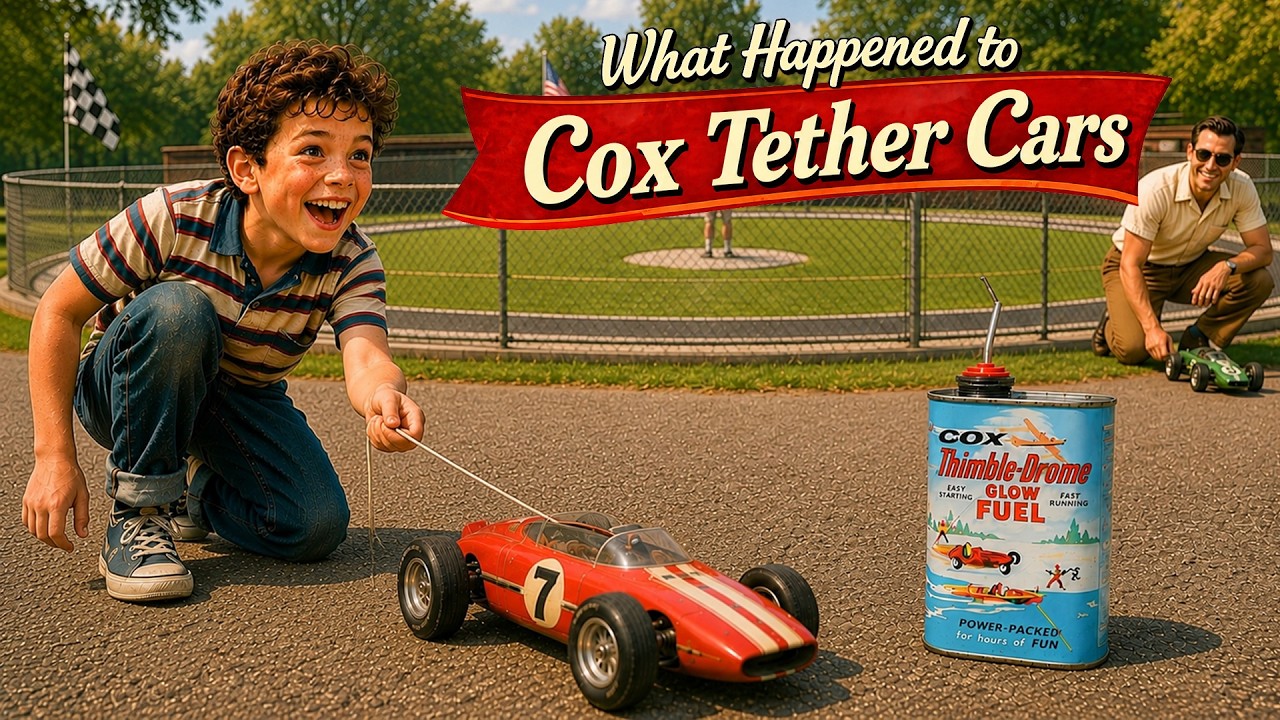
The cars kept coming: the AMC Matador police car tied to the TV show Adam-12, the Coxdune buggy, the Baja Bug, the funny Pinto, and tethered race cars that circled asphalt so fast the car was just a blur on a wire. The tethered car scene was genuinely impressive. You hammered a stake into the ground, ran out a steel cable maybe twelve feet long, and clipped the car to the end. You started the engine, flipped the propeller, and stepped back quickly because the car would swing around and come at you.
It screamed in tight circles while you stood in the middle like a confident kid who was never afraid. An ordinary Saturday felt like the Indianapolis Motor Speedway in miniature, right there in your driveway. But none of it worked without fuel. And here is where things got interesting.
Here’s what kids in the sixties and seventies faced every time they wanted to start a Cox car. The can warned: danger, poison, harmful vapors, flammable, irritant to the eyes, may be fatal or cause blindness if swallowed — contains methanol and nitromethane. Cannot be made non-toxic. Burns with an almost invisible flame.
This warning was printed on the toy’s box, sold at Kmart. Cox glow fuel was a three-part blend. Methanol provided the primary combustion. Nitromethane acted like a chemical turbocharger — it broke down under heat and released extra oxygen for more power.
Castor oil handled the lubrication, because a two-stroke engine has no oil reservoir. The smell was part moonshine, part racetrack. Every kid who ever started a Cox engine knew that scent by heart. And the sound, up close — a Cox .
049 at full speed wasn’t just loud; it was physically uncomfortable and magnificent at the same time. A sharp mechanical scream that cut right through you. Neighbors two houses away would step outside to see what was dying in your driveway. But the fuel was only part of the ritual.
Starting the engine was the real test. You wound the spring starter backwards until you heard a click under your thumb. You adjusted the needle valve, a small brass screw you turned with greasy fingers to set the fuel mixture. You held the car with your knee on the asphalt.
You flipped the propeller. Sometimes it fired on the first try. Sometimes it took twenty attempts and a vocabulary your parents didn’t know you had. But you didn’t give up.
That was the point. A ten-year-old today with a dead remote-control battery calls it a day. A ten-year-old with a Cox engine that wouldn’t start had to figure something out. The needle valve was off.
The fuel line had a bubble. The glow plug was fouled. You diagnosed it. You fixed it.
And when it finally fired, the heat of the little cylinder block could raise blisters in seconds if you weren’t careful. Every scar, every burn, every propeller cut was a lesson in respect for machinery. You learned what the engine needed. You learned to be careful because the machine itself taught you.
That was Cox’s genius. The danger was in the curriculum. But while the engines whined, the company was making a losing bet. In the early sixties, miniature slot cars were the next big craze.
Cox poured enormous money into them — huge manufacturing investments, beautifully detailed 1/124-scale cars. Then came 1967, and the slot car fad collapsed almost overnight. Cox found itself with warehouses full of products nobody wanted. Cash flow dried up.
The company that had dominated the hobby world was suddenly bleeding losses. Then things got personal. Leroy Cox’s wife Myrtle died, and his own health declined. In 1969, twenty-four years after building his empire from a burned-out garage, Leroy Cox left the company and sold it to L.
M. Cox Manufacturing’s new owner, Leisure Dynamics. Leisure Dynamics expanded the brand erratically — kites, yo-yos, trains, walkie-talkies. They weren’t building on Cox’s legacy; they were spending it.
In 1980, Leisure Dynamics went bankrupt. Bill Selzer, the engineer who had designed the $3. 95 engine that made it all possible, had watched others squander his creation for years. In 1983, he partnered with a local businessman and bought the brand out of bankruptcy.
He renamed it Cox Hobbies, moved manufacturing back to California, and returned to the fundamentals that had made the engines legendary. When it had fallen apart, he came back and fixed it. For a few years, it looked like a genuine success story. But the world outside the factory had changed radically, and Cox was about to face something no engine could outrun.
In 1984, Associated Electrics in California launched the RC10 electric off-road car. Around the same time, Japan’s Tamiya released the Frog and the Hornet. These weren’t just new toys; they were a completely different way of thinking about remote-controlled vehicles. Electric cars had proportional steering — you could turn a little or a lot.
Cox’s R/C cars turned in circles and you watched them. Electric cars ran quietly — no more neighbor complaints about a screaming . 049 at eleven o’clock on a Saturday morning. They ran on rechargeable nickel-cadmium batteries — plug in, charge, squeeze the trigger, and go.
No tuning, no burns, no propeller cuts, no toxic fuel, no extended starting ritual. The difference in ease of use was enormous, and families noticed. Not just parents — kids noticed too. The electric cars were better at being toys.
They were controllable, predictable, and worked whenever you wanted. The Cox experience was better educationally. But education wasn’t what the toy aisle was selling anymore. And here’s the second killer: the suburbs themselves.
People forget something important about Cox gas cars. They needed space. Real space. Tethered cars required a driveway, a parking lot, or a vacant lot at the end of the street — wide-open asphalt with room for a full circle.
Free-running cars needed somewhere to go and a neighborhood that tolerated noise. In the sixties, all of that existed. Kids disappeared outside for entire afternoons. Vacant lots were a given.
Patient neighbors were part of the deal. By the nineteen-nineties, that world was gone. Neighborhoods got denser. Helicopter parenting replaced free-range childhood.
And when the Consumer Product Safety Commission and the ASTM F963 toy safety standard made it legally impossible to sell toxic, flammable liquids as children’s toys, Cox had already lost the physical space the product needed to survive. It wasn’t the regulators alone that killed Cox. It wasn’t the battery alone. It wasn’t even the slot car gamble alone.
But combined, Cox didn’t stand a chance. In January 1996, Estes Industries, the model rocket company, bought Cox Hobbies and moved production to Penrose, Colorado. It was supposed to be a rescue. It wasn’t.
Estes steered hard toward cheap electric planes and heavy discount-store distribution. Then they did something Cox enthusiasts still talk about today. They started mixing remaining engine parts together — mismatched components from different model years assembled into barely-running hybrids. The precision engineering that had defined Cox for forty years was replaced by bargain-bin shortcuts.
Collector forums from that period are full of the same complaint written a thousand different ways: the engine doesn’t run right. The tolerances aren’t precise. This isn’t the Cox engine I know. A generation of hobbyists who had trusted the brand completely felt like they’d received counterfeit products.
In 2008, Bernard — a Canadian hobbyist known simply as Bernie online — walked into an Estes warehouse and found something remarkable. More than 35,000 complete classic Cox engines. Over half a million spare parts abandoned in the dark, worth over a million dollars on the market, about to be destroyed. Bernie bought it all and moved everything to Williams Lake, British Columbia.
He started shipping parts to collectors and engine restorers around the world. He still sells those parts today. Bernie is still there. The Cox Engines website is still up, operating out of Williams Lake.
On February 7, 2009, Estes Industries officially ended production of Cox internal combustion engines. After sixty years, the . 049 went silent. Ten years later, in 2019, MECOA — the Model Engine Corporation of America — stepped in.
The company bought the entire Cox brand, including all the original molds, tooling, and engineering drawings. They moved everything from Colorado to California. Today, MECOA produces limited runs of . 049 parts and engines.
Not for children. For collectors and adults who never stopped loving the machines they grew up with. And this is the part that’s hard to explain to someone who didn’t live it. Cox wasn’t just a toy brand.
It was an experience. The first time you figured out something mechanical on your own. The world got safer. The toys got quieter.
The kids who grew up with Cox engines are now grandparents watching lithium-ion cars race across their smartphone screens. And somewhere in a garage, on a shelf, in a box that hasn’t been opened in twenty years, there’s a little metal car with a glow plug, and next to it a half-empty can of nitro fuel. The smell of burned castor oil doesn’t go away easily.
Neither does the memory.






