The stranger in the general store knew Jeremiah Eldridge’s name. That much was certain, because Harold McCreary had used it when he handed over the ammunition, and the man in the fine city clothes had not let it pass. He had approached the counter, asked if Eldridge was from the settlement at Hollow Creek, and when Jeremiah confirmed it, the questions turned to the limestone depression on his property. The conversation stayed low, almost inaudible above the creaking floorboards, but McCreary caught fragments.
“The survey was quite clear about what was found. ” And Eldridge’s reply: “Nothing was found because nothing was there to find. ” Then the stranger said something about the department still having an interest, and Jeremiah Eldridge left the store earlier than he ever had before, skipping the meal he usually took at the hotel. That was September 14th, 1895, in Harrison, Arkansas.
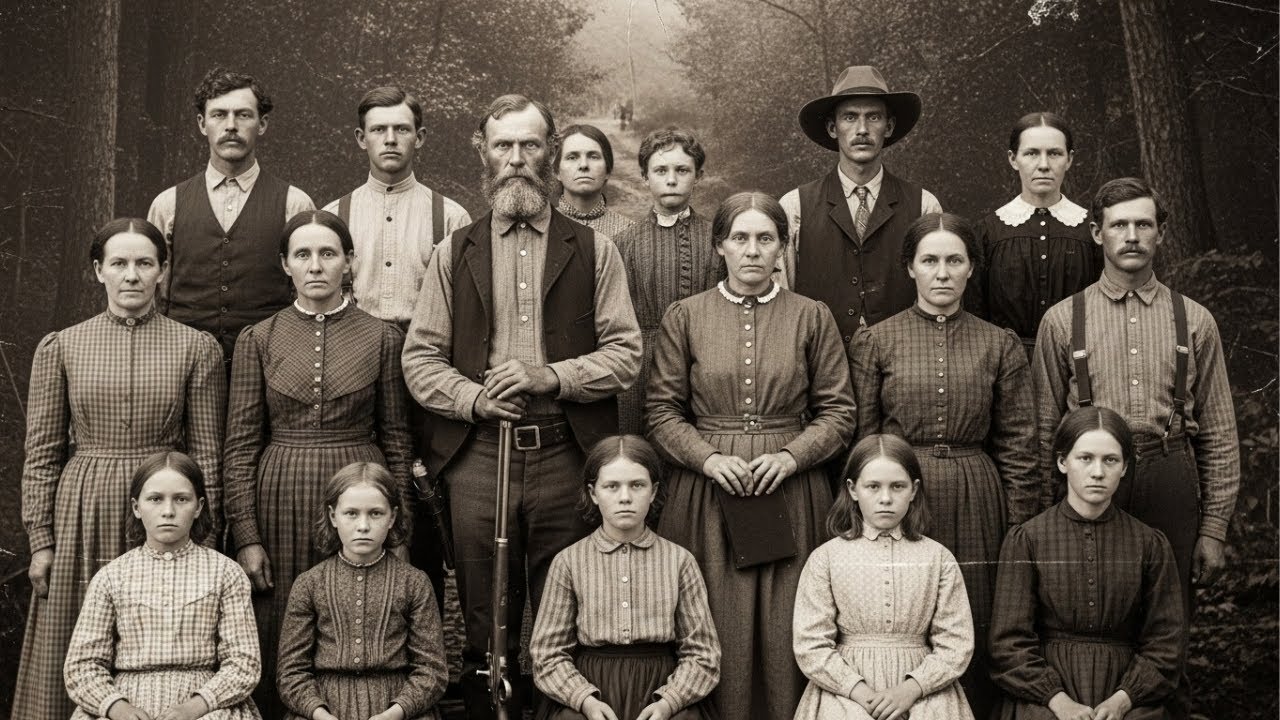
Within a month, the entire settlement of Hollow Creek would cease to exist. Seventeen people—men, women, and children—would vanish without a trace, leaving behind cold hearths, a half-prepared meal, and a silence so complete that the trapper who found the place swore the very air was holding its breath. To understand what happened in those autumn days, one has to go back to the beginning. Hollow Creek sat in a narrow valley between Mount Judea and what is now Compton, in Newton County, Arkansas, reachable only by a treacherous mountain path that became impassable in winter.
It was that isolation that kept the disappearance unnoticed for nearly three weeks. When Sheriff Thomas Leighton of Harrison finally arrived with his deputies on December 3rd, 1895, he found a settlement that looked like its people had simply stepped away for a moment and never returned. The livestock were gone from the pens, though feed remained in the troughs. The cabins showed no sign of struggle.
Clothing and heirlooms sat in place. In the main house, a table was set for an evening meal, the food half-prepared, a pot of stew boiled dry on the hearth. A child’s doll propped against a rocking chair. A Bible open on a side table with reading spectacles folded neatly on top.
The community hearth held cold ashes estimated to be three weeks old. No bodies. No graves. No trail.
The first snow had covered whatever tracks might have existed, literally and figuratively. The roots of the mystery lay in the life of Jeremiah Eldridge. Born in 1842 in eastern Tennessee, the third son of a tobacco farmer, he had shown an early interest in geology and caves, often disappearing for hours to explore the limestone hollows near his family’s land. When the Civil War came, he enlisted in the Confederate Army and served under General Nathan Bedford Forrest, including at the Battle of Shiloh.
He was detained briefly after the war, then released under amnesty. But there was a gap in his military record: from June 1863 to February 1864, his whereabouts were undocumented. A letter from his commanding officer referenced “special duties of a confidential nature,” the details never specified. That period would haunt researchers for decades.
After the war, Jeremiah returned to Tennessee to find the family farm burned and his parents dead. Both brothers had fallen in battle, one at Gettysburg, one at Nashville. Alone, he worked as a laborer and trapper before building a modest fur trading business. In 1868 he married Rebecca Hollister, a schoolteacher whose family had also suffered in the war.
Her diary, recovered from the settlement years later, caught the change in him. “There is a quietness to him now, a watchfulness,” she wrote. “Sometimes at night I hear him talking in his sleep about what they found and the voices from below. When I ask him come morning, he claims no memory of such dreams.
”
By 1870, Jeremiah was buying land in the remote Ozarks—a 120-acre parcel in what would become Newton County, described in the deed as mountainous terrain with limited agricultural potential, including a notable circular depression of limestone formation roughly half a mile east of the proposed homestead. Rebecca’s diary shows she was reluctant. “Jay insists this place has been waiting for us,” she wrote. When she worried about the children growing up far from society, he told her “some knowledge is better gained away from the influences of the changing world.
”
The family arrived in September 1870, living in a temporary shelter while building their permanent cabin. Jeremiah spent his days exploring the hollow east of camp, returning with strange rocks and sketches Rebecca could not make sense of. By 1875 the settlement had grown to three cabins. Rebecca’s sister Catherine and her husband William joined in 1872; William’s brother Thomas arrived with his wife Eleanor two years later.
A letter from William to his parents in Tennessee, dated June 1873, noted that Jeremiah knew the mountains better than men who had lived there their whole lives, despite never having set foot in the Ozarks before. He kept detailed maps and spent days at a time in the hollow. The children were forbidden from playing there. “Which suits us fine,” William wrote, “as the place has an unwelcoming atmosphere.
”
By 1895, Hollow Creek had five cabins arranged in a semicircle around a central clearing. Jeremiah and Rebecca had four adult children. Isaac had married Sarah Collins and had two children, Joseph and Ruth. Martha had married Richard Thornton and had a daughter, Elizabeth.
Samuel remained unmarried but would later marry Victoria Thornton. Ezekiel, the youngest at twenty, was described in Rebecca’s journal as troubled in mind and spirit. The fifth cabin belonged to the senior Thorntons, Albert and Constance. Rebecca’s journal gives the most complete picture of daily life.
The settlement was largely self-sufficient, growing corn, beans, squash, and potatoes, raising chickens and hogs, hunting deer and small game. Sundays were observed with Bible readings led by Jeremiah, as no minister ever visited. The isolation was near complete and apparently deliberate. Her final entry, dated October 12th, 1895, reads: “Frost came early this year.
Samuel returned from the hunt with two deer, which should see us through until spring bartering. Ezekiel still troubled by the dreams. Martha says the children heard voices from the hollow again last night. Jeremiah insists it’s just wind.
I’m not so certain. The look in his eyes betrays his words. He knows more than he says. Jay has called for a family council tomorrow after Sunday reading.
Says there’s a matter that can no longer be delayed. ”
The hollow she referred to was known locally as Echo Hollow, a near-perfect circular depression in the limestone, approximately 150 feet in diameter and 65 feet deep. A surveyor’s report from 1872 noted its remarkable acoustic properties: even whispered words carried clearly from one side to the other. Local guides refused to enter it, citing superstitious beliefs.
The months before the disappearance show subtle signs of mounting tension. From July onward, Ezekiel’s night terrors grew more frequent. From August, references to unusual sounds from the direction of the hollow appear with growing regularity in Rebecca’s journal. A letter from Martha Eldridge to her friend Emma Cartwright in Springfield, postmarked September 28th, 1895, and found among Emma’s possessions after her death in 1932, lays it out plainly.
“Father’s behavior grows more peculiar by the day,” Martha wrote. “Since returning from his last trip to Harrison, he speaks of little besides the need for vigilance. He has taken to carrying his rifle even to family meals. Mother locks the cabin door now even during daylight hours.
” Little Elizabeth had woken crying, claiming someone called her name from the darkness beyond the window. Ezekiel barely slept, and when he did, he woke screaming about those who wait beneath. Jeremiah had found him at dawn sitting at the center of the hollow, staring, claiming he was listening to the instructions. Then came the stranger in the general store.
After that encounter, the settlement changed. Rebecca’s journal notes increased hunting expeditions, extra food preserved, cabins repaired with what she called uncommon urgency. An entry from October 1st records that Jeremiah called the men together; they spoke in low voices at the edge of the clearing for nearly two hours. Richard would tell her nothing, only that Jeremiah had concerns about strangers possibly coming to the valley before winter.
The hollow was now forbidden to all. Then the record falls silent until November 2nd, when Jacob Turner, a trapper from Jasper, stumbled on the settlement while seeking shelter from an early snowstorm. The cabins stood open, no smoke from the chimneys. Inside, he found the meal abandoned mid-preparation, the pot boiled dry.
He checked each cabin, finding ordinary life interrupted: a half-mended shirt with needles still in the fabric, a checkers game abandoned midplay. The root cellar was well stocked. The barns held hay and feed, but no livestock, except a few feral chickens. The horses and mules were gone, but most of the tack still hung in the stable.
Most disturbing was the silence. “Anyone who spent time in the mountains knows they’re never truly quiet,” he later told Sheriff Leighton. That evening, as he moved among the cabins calling out, the silence felt complete. Turner spent an uneasy night in the main cabin, barring the door.
In the morning he set out for Harrison as soon as the snow allowed. He reported no signs of violence, no blood, no struggle. The settlers’ possessions remained, including Rebecca’s silver hairbrush and Jeremiah’s prized pocket watch, found on the mantle. Sheriff Leighton’s investigation found nothing.
The search extended three miles in every direction, with particular attention to the limestone depression. There, investigators found a single set of footprints partially filled with snow, leading to the center of the hollow and then returning to the settlement. The age of the tracks could not be determined. Leighton’s report concluded the settlement had relocated for unknown reasons, citing the absence of evidence of criminal activity.
The case was suspended. The Harrison Daily Times ran the headline “Entire Settlement Vanishes Without a Trace” on November 10th, 1895, speculating about Indian trouble despite decades of peaceful relations. A follow-up piece on November 17th quoted an elderly Cherokee man living near Jasper: “That hollow has been known to our people for many generations. We call it the place where the earth listens.
Our hunters avoided it. Those who camped nearby reported dreams of voices calling them to dig deeper into the ground. Your white settlers were not the first to disappear from that valley. They will not be the last.
” Later archaeological surveys found evidence of indigenous settlements centuries old in the region but noted a curious absence of artifacts within several miles of Echo Hollow. The settlement stood empty through the winter. In 1897 the county auctioned the land and possessions. The cabins were dismantled for lumber, and Hollow Creek began to fade from memory.
Hunters and trappers avoided the area, claiming it felt unwelcoming, or that they had unusual dreams when camping nearby. A surveyor’s assistant reportedly went missing briefly in 1908, found two days later wandering disoriented with no memory of where he had been. The story might have stayed a local legend had it not been for Walter Eldridge, a distant cousin of Jeremiah’s, who learned of the disappearance in 1923. A professor of American history at Washington University in St.
Louis, Walter was intrigued by this lost branch of his family. His research began with county records. The breakthrough came when he located Emma Cartwright, the recipient of Martha’s final letter. Though elderly, Emma remembered the correspondence clearly and showed Walter earlier letters that had never been part of the official investigation.
A letter dated July 1895 described Ezekiel’s worsening night terrors and his talk of “the watchers in the hollow. ” Even more striking, the Thornton boy now reported identical visions, though he and Ezekiel had never discussed them with each other. Walter traveled to Newton County in April 1924. Local guides refused to take him to the hollow.
One old-timer in Jasper told him the Cherokee called it the place where the ground listens. When he inquired at the general store about hiring a guide, the conversation stopped. He was firmly but politely discouraged. He went anyway.
His journal describes the hollow as a perfectly circular depression about fifty yards across and twenty feet deep, the limestone walls creating strange acoustic effects. At the center stood a single dead oak tree, its branches twisted into shapes that seemed almost deliberate. On his second visit, he pried a metal object from the trunk: a button from a Confederate uniform. On his third visit, on May 17th, 1924, he brought digging tools.
His final journal entry reads: “Returned to the hollow today. The weather is clear, though unusually cold for May. I’ve brought digging tools to investigate the area around the oak tree. The soil there appears to have been disturbed in the past, though not recently.
The vegetation pattern is unnatural—a circular area approximately 6 feet in diameter where nothing grows. The silence remains the hollow’s most unnerving feature. I’ve set up camp at the hollow’s rim rather than returning to Jasper. I want to observe the acoustic properties at night.
” Then, later: “Midday now. I’ve begun excavation around the base of the oak. The soil is loose and appears to have been previously dug up and replaced. Approximately 8 inches down, I’ve encountered a layer of flat stones arranged in what appears to be a deliberate pattern.
I’ll continue carefully. ” Then: “Afternoon. Beneath the stone layer, I found a small 6×4 metal box. Military issue by the look of it.
It’s locked, but the lock is rusted. I should be able to open it with my tools back at camp. ” Then, as a final line: “The sound is back today. Not wind, not an echo, something else.
”
The journal ends there. Three days later, Walter’s rented room in Jasper was found vacant, his belongings still in place. His journal lay open on the nightstand. His excavation tools and camping equipment remained at the hollow.
Of Walter Eldridge or the metal box, there was no sign. The case was closed with the presumption of an accident in rugged terrain. Walter’s research notes, preserved in university archives, revealed his theory. He believed Jeremiah had selected the valley deliberately, based on knowledge gained during the 1863-64 gap in his service record.
Walter had found a reference to a special detachment led by Colonel Hargrove in 1863, which included a Corporal J. Eldridge. The detachment was dispatched to investigate unusual geological formations in Tennessee that might yield strategic minerals for the Confederacy. The expedition’s reports were lost or destroyed in the war’s final days.
The mystery lay dormant until 1952, when Dr. Margaret Winters, a folklorist from the University of Arkansas, began collecting oral histories of the Ozarks. Several interviews mentioned the Hollow Creek disappearance, by then a regional legend. Thomas McCreary, the elderly son of the general store proprietor, revealed that his father had not told the sheriff everything.
The stranger had not been passing through; he had been asking about Eldridge for days before they met. He had shown the elder McCreary papers identifying him as a representative of the Department of the Interior Geological Survey Division, interested in limestone formations with unusual acoustic properties. He asked if Eldridge ever mentioned finding anything in the hollow—artifacts, unusual rocks, openings in the limestone. Before leaving, the stranger told McCreary: “That man and his kin are sitting on something they don’t understand.
It won’t end well. ” About a week after the disappearance was reported, the same stranger returned to Harrison and joined the sheriff’s follow-up search party. When McCreary mentioned this to Sheriff Leighton, he was told to keep such thoughts to himself. The stranger never appeared in any official report.
Esther Turner, daughter of the trapper Jacob Turner, added more. Her father had not been entirely forthcoming. He had found something in the hollow that he didn’t report—a circle of stones that hadn’t been there before, and inside the circle, disturbed ground, as if something had been buried and then dug up. He also spent two nights at the settlement, not one as he claimed.
On the second night, he heard what he described as voices coming from the direction of the hollow, but not normal voices. “Something that spoke directly into his mind,” Esther said. He left at first light and never returned to the valley. For years after, he would wake in the night claiming he could still hear those voices calling him back.
Driven by these accounts, Dr. Winters visited Echo Hollow in the summer of 1953 with a graduate student, Raymond Carter. They found the fallen, decomposed oak. Around its base, they discovered a small metal box containing journal pages written in a tight, cramped script.
Water damage had made most of it illegible, but certain phrases survived: repeated references to “those who watch from below” and “the voices that are not voices. ”
The legible fragments told a story. “Arrived at the hollow as instructed. The formation matches the description from the Tennessee expedition.
The acoustic properties are identical. Colonel H believes these formations are not natural, but constructed for a specific purpose. ” Another: “The excavation reached 30 feet below the surface today. The limestone gives way to a different material unlike any rock formation documented in geological literature.
It absorbs sound completely, creating a sensation of pressure on the eardrums. Three men refused to continue the excavation after the dreams began. ” Another: “Found the opening today. It extends downward at a sharp angle.
The air emerging from it is cold and carries a faint odor of metal and something organic yet unfamiliar. Colonel H plans to descend tomorrow. ” Then: “Colonel H is not among them. The expedition is officially terminated.
We sealed the entrance as best we could and disguised the excavation site. ” And finally: “Dreams persist despite distance from the site. The voices know my name now. They speak of future sites where their kind can be found.
One is in the Ozark range. I will investigate when the war ends to ensure it remains sealed. Some things must stay buried. ”
The handwriting matched samples of Jeremiah Eldridge’s script from county records.
Winters and Carter also found evidence of excavation along the hollow’s eastern rim—not recent work, but something done decades earlier and overgrown. They uncovered a shaft dug into the limestone, roughly six feet in diameter, lined with timber supports in advanced decay, extending at least twelve feet vertically before angling east toward the center of the hollow. Winters’s field notes recorded the geological anomalies: the depression seemed almost too perfect to be natural; the acoustic properties were remarkable; both she and Carter independently experienced a subtle but persistent sense of being watched while within the depression. She planned a return expedition with university backing.
The proposal was approved for summer 1954. Then, in December 1953, she abruptly withdrew it. She took a leave of absence. When she returned six months later, she refused to discuss Hollow Creek.
When Carter attempted to publish their findings, she threatened legal action. In a private letter that surfaced after his death in 1986, Carter wrote that Winters went back to the hollow alone in November 1953, against his strong objections, to verify certain measurements before winter. She was gone three days. When she returned, she burned her field notes and photographs.
She told him only that some things should remain buried, and that she would not be responsible for what might follow if their findings became public. She had found evidence of recent activity at the shaft site—someone else had been excavating there. When Carter objected to destroying the journal fragments, she became uncharacteristically emotional. “They’re still there, Raymond.
Whatever happened to the Eldridges, to Walter? It’s still there, waiting in the dark, and it knows we’ve been looking for it. ”
Winters never published her folklore collection. She requested that her recordings related to Hollow Creek be sealed for fifty years after her death.
She passed away in 1968; the recordings were made available in 2018. The reel containing the McCreary and Turner interviews was missing from the collection. The final chapter began in 1964, when James Thornton, a graduate student researching frontier communities, discovered overlooked county records. Among them was the 1872 land survey, which noted the circular depression and mentioned that local indigenous guides refused to enter the area.
More intriguingly, the survey noted evidence of prior excavation work of unknown purpose or origin, meaning the hollow had attracted interest before the Eldridges arrived. Thornton also found a partial inventory of items from the abandoned settlement that listed something never mentioned before: “One leatherbound journal, pages removed, cover marked with unknown symbols, found beneath floorboards in main cabin. ” The journal was never logged into evidence, and Sheriff Leighton never mentioned it. Most significantly, Thornton found a death certificate for Harold McCreary.
The store proprietor died on December 12th, 1895, just days after giving his statement. The cause of death was listed as apoplexy, but the attending physician noted unusual symptoms: auditory hallucinations and extreme agitation in the twenty-four hours preceding death. Thornton visited Newton County in the spring of 1964. In his last letter to his thesis adviser, dated June 12th, he wrote: “I’ve found something that may explain everything.
A narrow crevice in the eastern wall, hidden behind vegetation. It extends deep into the limestone. I’ve acquired climbing equipment and plan to explore it tomorrow. If my theory is correct, the Eldridges didn’t leave Hollow Creek.
They went deeper into it. ”
Thornton was reported missing three days later. A search party found his camping equipment and notes at Echo Hollow, but no sign of him. The crevice he mentioned was located but deemed too narrow for adult human passage beyond a certain point.
The search was abandoned after a week. His unfinished thesis drew connections to similar incidents elsewhere: an 1834 surveying party in eastern Tennessee that documented a perfect circular depression in limestone with remarkable acoustics, where the lead surveyor heard voices unlike any human speech and three members vanished; an 1851 mining operation in southern Kentucky abandoned after workers reported voices from the rock face and three miners disappeared overnight; and the 1863 Confederate expedition to eastern Tennessee matching Jeremiah’s fragmented journal. Of the twelve men who set out on that expedition, only five returned. Official records said they encountered Union forces.
Personal correspondence from survivors mentioned something in the hollow and voices that drove men to madness. Thornton’s research materials were archived until 1968, then transferred to microfilm. During a reorganization in 1969, the microfilm went missing and was never recovered. In 1977, a hiker reported finding a child’s shoe near where Echo Hollow was believed to be located.
Weathered but identifiable as late nineteenth-century manufacture, it likely belonged to a girl of about seven years old—the same age Martha’s daughter Elizabeth would have been in 1895. The shoe was stored as evidence. When researchers requested access in 1983, they were informed it had been mistakenly disposed of during a cleanup. Dr.
Eleanor Blackwood, a geologist who examined Echo Hollow during an unrelated karst survey in 1992, noted in her report that the depression exhibited several anomalous features suggesting it might not be entirely natural in origin. The perfect circularity was unusual for karst formations. Ground penetrating radar revealed unusual density patterns beneath the surface that did not match typical limestone compositions. Most notably, sound measurements confirmed the exceptional acoustic properties reported historically, including frequency amplification of certain low tones that fall just at the threshold of human hearing.
“These properties could potentially create auditory phenomena that might be interpreted as voices under certain conditions,” she wrote. The report was filed with the United States Geological Survey but classified as restricted access in 1994 for reasons not specified. In 1998, a local historian named Robert Jenkins attempted to compile everything into a book on Ozark mysteries. The manuscript was never published.
According to his widow, Jenkins abandoned the project after visiting Newton County in late 1998. He returned visibly shaken, destroyed his notes, and refused to discuss what he had discovered. When pressed, he would only say some things should stay buried. He died of a stroke in 2002.
Among his personal effects were a small metal button from a Confederate uniform and a fragment of limestone with unusual markings that his widow described as not natural, as if something had carved symbols into it. The items disappeared from his study before they could be examined. The mystery of the Lost Hollow Clan remains unsolved. An entire community of seventeen people vanished without trace from a remote Ozark valley in 1895.
Those who investigated over the decades met obstacles, silence, or disappeared themselves. What remains are fragments: journal entries, letters, testimonies, survey notes hinting at something outside common experience. The limestone hollow with its perfect acoustics and evidence of excavation. The references to watchers and voices.
The disturbed soil Jacob Turner found and never reported. What is most disturbing is not what is known, but what has been systematically removed from the record: destroyed notes, missing recordings, vanished microfilm, a journal with unknown symbols lost from evidence. It suggests not just a mystery, but a concerted effort to keep that mystery buried. Echo Hollow still exists, now on private property, inaccessible to the public.
Satellite imagery shows the circular depression just as described. The forest has reclaimed the land where the settlement stood. No archaeological excavation has ever been conducted at the site. Local residents remain reluctant to discuss it.
As one elderly man in Jasper told a journalist in 1957: “Some places just don’t want to be known. That hollow, it keeps its secrets, and those who try to dig them up, well, the ground might just decide to keep them, too. ”






