On a Friday in late April 2026, police arrived at the door of a 64-year-old man in Bullhead City, Arizona. He had been living a quiet life there for years, a desert town on the Colorado River. He kept to himself. He drew no attention.
He was the kind of neighbor you would struggle to describe to a stranger because there was nothing about him that stood out. The first thing worth telling you about him was not what he had done. It was that he had never existed. There was no such man.
Vincent Reynolds was an invention, a clean, ordinary, forgettable name built on top of someone else’s life. The person answering to it for more than two decades had spent those years making certain that the man he used to be could never be found. He had been found anyway. In 1991, Cindy Warner, a married mother of two, was kidnapped in the middle of the day.
She disappeared from the face of the earth. Her body was found three weeks later. For 34 years, no one was charged. The man who took her had been out of prison for less than a year when he did it.
And then, more than a decade after the murder, he disappeared so completely that investigators could not say whether he had assumed a new name, fled the country, or died. When they finally pulled his mask off, it took two different technologies to do it. DNA gave him a name. A facial recognition system found the face he had hidden behind a borrowed one.
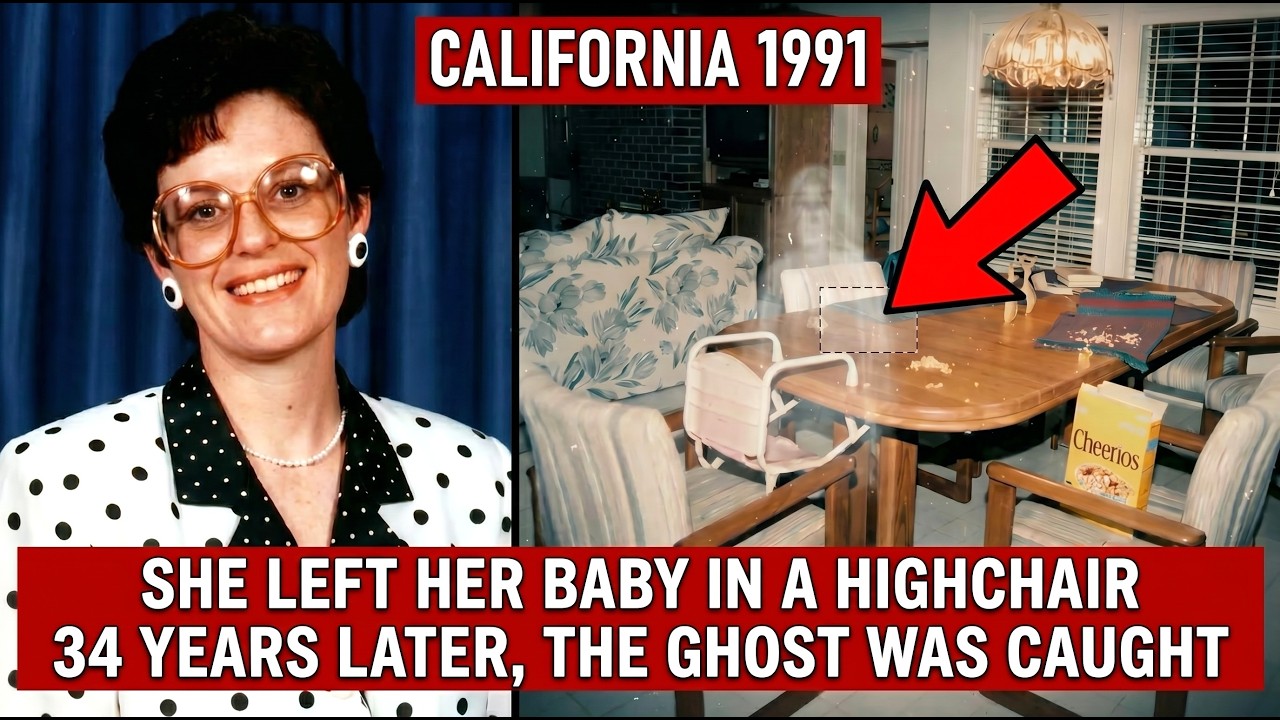
Cindy Warner was 35 years old, a Sacramento native, a mother of two: an 11-month-old baby and a 4-year-old daughter. On the morning of November 25th, 1991, she took her infant with her to her sister’s home in Granite Bay, a suburb northeast of Sacramento, to clean the house. It was the kind of ordinary errand that fills an ordinary life, a mother with her baby, a quiet morning, a task to get done before the holiday. Hours later, Cindy’s husband arrived at the house with their 4-year-old daughter.
Inside, the 11-month-old was still strapped into a high chair, crying. Cindy was nowhere in the house. Her shoes were there. Her coat was there.
Her car was still parked outside. Everything a person needs to leave was exactly where she had left it, and she was gone. The search stretched across three weeks. It ended in a remote wooded area near Foresthill, roughly 40 miles from where she had been taken, when her body was finally found.
The detail that has defined this case ever since came from the pathologists who examined her. They believed she had been kept alive for at least several days after she was taken before she was killed. Whatever happened to Cindy Warner did not happen quickly. That is the weight this case has carried for 34 years.
Her disappearance rattled Granite Bay and the wider Sacramento area. A woman had been taken in broad daylight from inside a house with her infant a few feet away, and nobody had seen anything that led anywhere. There was nothing for investigators to grip: no witness, no vehicle, no motive that pointed at anyone in her life. She had no enemies anyone could name.
The randomness of it was its own kind of terror. If Cindy Warner could be taken from her sister’s living room on an ordinary weekday morning, the logic of safety that most people rely on simply did not hold. To understand who took her, you have to go back to the beginning of that same year. James Lawhead Jr.
was 30 years old in 1991. He was a convicted sex offender. He had been sentenced to 19 years in prison for sex crimes against a young child. He served 11 of them.
He was released in early 1991, roughly 10 months before Cindy Warner was taken from her sister’s home. A man convicted of crimes against a child, sentenced to 19 years, walked free after 11. And within the same calendar year, a mother of two was abducted, held, and murdered. At the time, no one connected him to the crime.
His name was not in the file. He moved through the years that followed as a free man with a record nobody was reading against an open murder case. His own trail, though, began to fray. After the murder, he was arrested for failing to register as a sex offender in Placer County.
Then, in 2005, he was arrested again on an outstanding weapons charge in the town of Lincoln, California. Before that case could reach trial, he vanished. He did not show up. He did not resurface.
After 2005, there was no record of him anywhere. No address, no employment, no documented sign that James Lawhead Jr. was still alive. Investigators who would later search for him said plainly that they could not tell whether he had taken a new identity, left the country, or died.
The answer was the first of those. Somewhere in that disappearance, James Lawhead Jr. became Vincent Reynolds. He took the name to Bullhead City, Arizona, and built a life around it.
A residence, a routine, a face the neighbors recognized, and a name none of them had any reason to doubt. For 21 years, the man who had killed Cindy Warner did not exist on paper. The murder file in California had a victim and a crime scene and a question mark where the killer’s name should be. The killer himself had erased the line connecting him to his own past.
For decades, the Placer County Cold Case Unit kept returning to the evidence. Items from the original investigation were submitted for testing as forensic methods improved, and time after time the results came back with nothing usable. The case had a reputation in the county as one of its most notorious, the kind every detective knew and none could close. Placer County Sheriff Wayne Woo would later describe it as arguably one of the most heinous and notorious cold cases the county had ever carried.
That reputation is part of why it was never shelved for good. Across more than three decades, the file moved from detective to detective, each inheriting a murder that the science of their era could not solve and refusing to treat it as permanently closed. The evidence sat preserved, waiting for a forensic method capable of reading what earlier testing could not. Then detectives sent one final piece of original evidence to the Contra Costa County Sheriff’s Office Forensic Lab.
Advanced DNA analysis on that single item produced what 34 years of investigation had not: a name. The DNA belonged to James Lawhead Jr. After three and a half decades, the cold case had a suspect with a face and a history and a prior record that made him a chillingly plausible match. But naming him and finding him were two entirely separate problems.
The name the DNA produced belonged to a man who had not appeared in any record since 2005. Detectives had identified their killer and discovered, in the same moment, that he had spent 21 years making sure that name led nowhere. They prepared a public appeal, a video asking for the public’s help in locating James Lawhead Jr. , ready to be released to the press.
Before that video went out, the break came from an unexpected direction. The Scottsdale Police Department ran Lawhead’s image through the Arizona Department of Transportation’s facial recognition system. That system exists for a specific mundane purpose. It is built to catch fraudulent state IDs, to flag the same face appearing under two different names.
It returned a match. The face that belonged to James Lawhead Jr. was, according to the state of Arizona, also the face of a licensed driver named Vincent Reynolds. Consider the precise shape of that irony.
Lawhead had built his new identity the way anyone builds one in modern America, with documents, with a driver’s license, with a face attached to a fabricated name in a government database. The system designed to catch exactly that kind of fabrication is what undid him. The disguise required a license. The license required his face.
And his face, sitting in a database meant to detect fakes, is what finally connected Vincent Reynolds back to the man he had buried in 2005. The margin was narrow. The facial recognition match did not come from the murder investigation in California. It came from Arizona, from a department running an image through a state transportation database that exists to protect the integrity of driver’s licenses.
Lawhead had lived undetected for 21 years precisely because nobody had a reason to connect the quiet man on the Colorado River to a decades-old California homicide. The thing that broke that wall was not a detective in Placer County knocking on the right door. It was an algorithm comparing two faces and noticing they were the same. Without that match, the public appeal might have gone out and produced nothing.
And Vincent Reynolds might have simply moved on. Which, given the bag he kept packed, is exactly what he was prepared to do. On Friday, April 24th, 2026, police arrived at the Bullhead City home. When they searched it, they found multiple loaded firearms staged throughout the house, positioned ready.
And they found a bag. Inside it were his clothes, $15,000 in cash, and a burner phone. A go bag. After 21 years of a settled, invented life, James Lawhead Jr.
had kept a packed bag and the means to run within reach. Some part of the quiet man named Vincent Reynolds had never stopped expecting this day. He simply did not get the chance to use what he had prepared for it. He built a fake name, and the system that catches fake names found him.
He kept cash and a burner phone packed to vanish again, and never reached for them. There is one more person in this story, someone who helped him stay hidden for two decades. A man cannot erase himself alone. Someone has to not ask questions.
Someone has to look away. In this case, someone did more than look away. When investigators traced the life of Vincent Reynolds, they found that the Bullhead City home he had been living in was owned by Lawhead’s own sister, 71-year-old Terry Lawhead. They determined she had stayed in contact with her brother across the very years she had spent telling authorities she had no idea where he was.
She was arrested as an accessory. The man disappeared in 2005, but he stayed disappeared because family chose to keep the secret. Lawhead was booked into an Arizona jail on charges of kidnapping and murder, and as a wanted sex offender, then extradited to Placer County, where he is being held in the city of Auburn to face prosecution. The Placer County District Attorney, Morgan Gear, charged him with one count of murder with the special circumstances of rape and kidnapping committed during the murder, along with a separate count of kidnapping.
This family has suffered in anguish for 35 years, Gear said. They deserve some accountability. He framed the arrest as a reminder that time does not erase responsibility. There is one more reason this case may not be finished.
When the sheriff’s office announced the arrest, they did something pointed. They asked law enforcement agencies across the West Coast to look at their own unsolved cases for any similarities to Cindy Warner’s murder. Investigators are openly exploring whether James Lawhead Jr. may be responsible for other crimes.
A man who killed within a year of leaving prison, who then lived for two decades under a name that did not exist, is not a man whose history investigators are willing to assume they have fully mapped. Whatever else is in those 21 years is a question that is only now being asked. Place that next to the family on the other side of this story. When Cindy Warner was taken, her children were 11 months and 4 years old.
The baby in the high chair and the little girl who walked in with her father are now in their 30s and late 30s. They have lived their entire conscious lives inside the same 34 years that James Lawhead Jr. spent becoming someone else, building a second existence in the Arizona desert, protected by a sister’s silence, while two children grew up around the space where their mother should have been. That is the asymmetry this case leaves behind.
One man got a whole second life, a new name, a new town, a quiet routine beside a river, more than two decades of ordinary mornings. The family he stole from got the years he took and nothing to fill them. The DNA on a single piece of evidence gave James Lawhead Jr. back his real name.
A facial recognition system meant to catch liars caught the lie he had been living inside. That is what the science could return: the truth of who he is and where he had been hiding. The rest of what was lost is not the kind of thing any technology gives back.






