In April of 1868, on a granite shoulder in the Wyoming high country, Grenville Dodge watched his crews drive the last spike of a grade that climbed to 8,247 feet. That summit, named Sherman, was the highest point any railroad anywhere in the world had ever reached. The man who chose the line stood 37 years old, hollowed out by Civil War wounds, directing a moving city of men strung across two states. The man who built it on the ground, Samuel Reed, lived in the dirt with the crews, sleeping in a rail car that moved with the end of track.
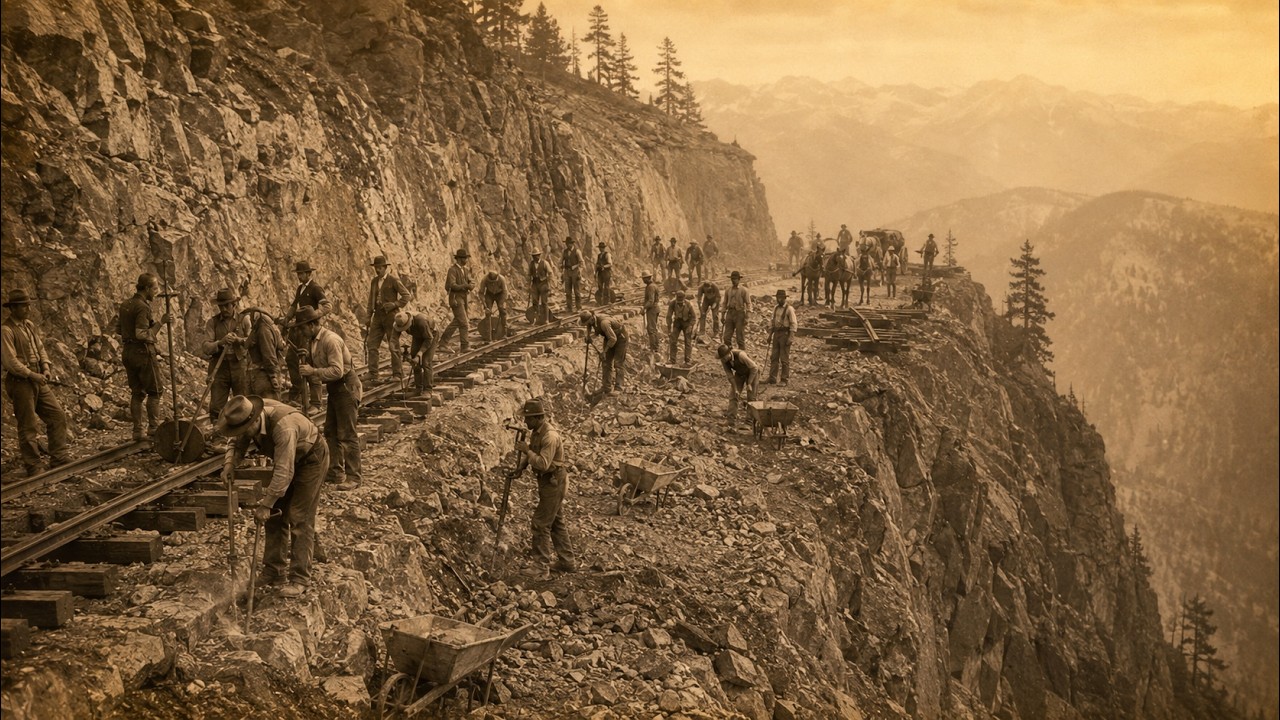
They had 10,000 men, mules, handheld drill steel, black powder, and one winter. The Eastern bankers said the Rockies would stop them. The Rockies did not stop them. Dodge had served as a Union general under Grant.
He had surveyed for the Illinois Central as a young axman, then for the Rock Island. He took the chief engineer post in May of 1866 on one condition: that Thomas Durant let him run the line without interference. The contract was a race. Every mile of track the Union Pacific laid west of Cheyenne paid the company $48,000 in federal bonds, three times the prairie rate.
Every week of delay meant a week of payroll with no track to show for it. To collect that money, Dodge had to take a line up out of Cheyenne, climb roughly 2,000 vertical feet in about 30 miles, cross a granite plateau the locals called the Black Hills of Wyoming, drop across Dale Creek, and keep going west to Laramie before winter shut the work down. Sherman Hill rises west of Cheyenne in two big stair steps. The first step climbs through prairie that turns to scrub, then to short pine.
The second step is granite. The Black Hills of Wyoming, which Dodge called the Black Hills in his reports to distinguish them from the better-known Dakota range, are an exposed shoulder of the Laramie Batholith, a body of pink and gray rock that pushed up out of the crust hundreds of millions of years ago and never went back down. To put a railroad across that shoulder, the company had to shave the top off it. There was no other way.
A grade in railroad work is not the track. It is what the track sits on: the prepared bed, a strip of earth or rock built to a particular width and a particular slope, called the ruling grade, that the locomotives can pull a loaded train up without stalling. The ruling grade on Sherman Hill, as the line was originally built, was 1 and 92/100 of 1 percent. That meant for every 100 feet a train moved forward, it climbed 1 foot and 92/100 of a foot.
It does not sound like much. It is enormous. A loaded westbound freight on Sherman Hill in 1868 needed two or three locomotives to climb it, and the Union Pacific had to station helper engines at the foot of the hill for the next 80 years. To get that grade, Dodge’s surveyors first picked the line.
They did this with a transit, a compass, a level, a rod, and a chain. They walked the country in twos and threes, drove stakes, took elevations off known benchmarks, and ran level loops back to make sure their numbers closed. Then the locating engineers laid out the cuts and fills. A cut is where the grade had to be lower than the natural ground, so the men had to remove material.
A fill is where the grade had to be higher than the natural ground, so the men had to add material. On Sherman Hill, the cuts were rock. The fills were rock, too, because there was nothing else on top of that mountain to fill with. The old grade is abandoned now, but the cuts are clean.
The granite is dressed almost vertical. You can put your hand in the drill marks. They are about an inch wide and about an inch and a quarter apart, set in rows up the face of the rock. A man made each one of those marks with a hammer and a piece of steel.
Two men, usually. One held the steel and turned it a quarter of a turn between every blow. The other man swung. They called the first man the shaker and the second man the striker.
They worked in pairs, sometimes three to a hole if the rock was hard, with the third man standing by to swap in when an arm tired. A two-man team on good granite could drill a hole 1 inch in diameter to a depth of about 2 feet in roughly a day. The depth depended on the rock. Sherman Hill granite is hard.
Once the hole was in, a powderman tamped a paper cartridge of black blasting powder down to the bottom, laid a fuse, packed the rest of the hole with clay or sand, and lit it. The blast broke loose a piece of the cut face. Other men, called muckers, came in with picks and shovels and two-wheeled dump carts pulled by mules, and they hauled the broken rock out of the cut and into the fill on the other side. Then the drillers came back and drilled the next round of holes.
That is how the line went forward. Drill, blast, muck, drill, blast, muck. In bad granite, a crew might gain less than 2 feet of cut per day. In easier ground, maybe 10 or 12.
The fills got built at the same time. A fill was just a long pyramid of rock and dirt and packed earth, sloped 1 and 1/2 to 1 or 2 to 1 on each side, with the grade running along the flat top. The graders, the men whose job title gives the work its name, were the ones who walked behind the muckers and shaped that pyramid. They cut the slopes with picks.
They tamped the top flat with mauls. They dressed the edges with shovels. They were the last hands on every foot of road before the track layers arrived. The pay for that work on the Union Pacific in 1868 ran about $3 a day for a grader.
A teamster who drove the mules made about the same. A hammer and steel man, if he was good, could earn slightly more. A foreman might make four. $3 a day in 1868 money is, in real purchasing power, somewhere around 80 to $90 a day in modern terms, before you account for the fact that the company kept the men in a moving camp where it sold them their tobacco, their boots, and their whiskey at company prices.
A man could work the grade for an entire season and finish with $30 in his pocket. The crews were Irish, mostly. Many were Civil War veterans, Union and Confederate both, working side by side under foremen who, four years earlier, had been trying to kill each other. There were also about 300 black laborers, freedmen, scattered across the grading gangs.
And there were native-born Americans from the Western states, and Mormons working under contract out of Utah Territory, and Germans, and a smaller number of Scandinavians. Most of them, the ledger gives no name, only a number. The Casement brothers ran the track laying. John Stephen Casement, born 1829 in Geneva, New York, was the older brother, the brigadier general who had commanded the 103rd Ohio Volunteer Infantry during the war.
His nickname was Jack. He was 5 feet 4 inches tall in his boots, and ran the track crew the way he had run his brigade, with a leather whip in his hand and a Henry repeating rifle on a peg in his rail car. His younger brother Daniel, born 1834, handled the financing, which meant Dan spent most of his time fighting the New York office for the cash to make the payroll. The Casements were contractors, not Union Pacific employees.
Doc Durant paid them by the mile of completed track. They were paid by results. The graders, under Reed, went out front. The track layers, under the Casements, came up behind.
Then came the dressing crews, the bridge gangs, the telegraph crews, the supply trains. At the end of track sat the Casements’ rolling town: boarding cars, mess cars, tool cars, a blacksmith’s car, a car for the bookkeeper, and, hanging off the end and following the work like flies follow cattle, the Hell on Wheels camps, where the men spent their $3 on whiskey, faro, and women. One day on the Sherman Hill grade in February of 1868 shows what the legend leaves out. The crew rose in the dark.
The cook had the fires going since 3:00 in the morning. Breakfast was beans, bacon, biscuit, and coffee served on tin plates at long pine boards laid over barrels. The men ate fast. They wore wool shirts under heavy canvas coats, wool pants, leather boots with hobnails, knit caps under battered felt hats, and gloves cut from horsehide if they could get them.
They walked out to the cut in the dark carrying their hammers and their lunch tins with the foreman at the front and the powderman bringing up the rear with a wooden case of black powder cartridges in a covered cart. The drilling crews paired up at the rock face. The shaker squatted with the drill steel braced against his hip, holding the steel against the granite in the position the foreman had marked with a piece of yellow chalk. The striker stood beside him, swung a 12-pound hammer in a long looping arc, and hit the back of the steel square.
The blow drove the steel an eighth of an inch into the rock. The shaker turned the steel a quarter turn. The striker swung again. Strike.
Turn. Strike. Turn. The rhythm went on for 12 minutes, sometimes longer, until the steel needed sharpening or the hole reached drilling depth.
A good two-man team could put down 40 hammer strokes per minute without missing. A missed swing cracked a wrist or worse. The drill steel itself was a slim octagonal bar of high carbon steel about 3 and 1/2 feet long, forged with a chisel point on one end. A working crew kept 20 or 30 steels in rotation.
When a point went dull, the shaker handed it off to a runner. The runner carried the dull steel back to the blacksmith’s car, where the smith reheated the point in a coal fire, hammered a new edge on it, tempered it in a slack tub of oil and water, and sent it back up the cut on the next runner’s trip. A grading camp kept two blacksmiths on the steel and never let the smithing fall behind, because the drilling crews could not work without sharp steel. The powderman handled the explosives.
Black blasting powder in the 1860s came in paper-wrapped cartridges about an inch across and 8 inches long, packed in wooden kegs of 25 pounds. The powder had to be kept dry. A keg that got wet was useless. The powdermen built small wooden lean-tos at the working face, covered with oilcloth, and kept the powder under those covers until the moment they were ready to load.
They unrolled the cartridges into the drilled holes, tamped them gently with a wooden rod, set a fuse, packed the rest of the hole with crushed stone and clay, and lit the fuse with a friction lighter or a match in a cupped hand. The shout went up. “Fire in the hole! ” The crew scattered behind a rock outcrop or a timber screen and waited for the report.
Then they walked back and the muckers went in. A typical round of drilling and blasting on a cut face produced between 5 and 20 cubic yards of broken granite. The muckers loaded it into the dump carts, the teamsters drove the carts along narrow plank ramps to the fill ahead, and the graders behind the muckers shaped the new fill as it grew. Every yard of rock the muckers moved was a yard of cut that came open for the next round of drilling.
The work was a chain. Drilling fed blasting. Blasting fed mucking. Mucking fed grading.
Grading fed track laying. If any link slowed, the whole line slowed. Reed on the ground walked the cuts in person. He had a notebook he carried in his coat.
He sketched the shape of each problem section on the rock face, took elevations with a hand level, and gave orders by name to the foremen. He kept a daily log of feet of cut, cubic yards of rock moved, and kegs of powder used, and he sent that log back to Cheyenne every evening on the supply train. The log went to the Casements, to the company office, and to Dodge, wherever Dodge happened to be. If a cut was behind schedule, Reed knew it.
If a crew was short of powder, Reed knew it. If a foreman was drinking on the job, Reed found out within a day, and he fired the man on the spot. The crews of February 1868 were also dealing with the cold. Wyoming at 8,000 feet in February is one of the coldest places in North America.
Daytime temperatures hovered between 0 and 20 degrees Fahrenheit. At night, the thermometer routinely dropped to 20 or 30 below. The wind off the Laramie plain made it worse. The men slept 12 to a tent on canvas cots over pine bow mats, blankets piled three or four deep, and even then there were mornings when a man woke up with frost on his beard and his blanket frozen to the ground.
The cook started the breakfast fires at 3:00 in the morning to thaw the food in the water barrel before the crews woke. Sickness took its toll. Pneumonia ran through the camps. Frostbite cost men fingers and toes.
A grader who lost two fingers from his swinging hand was finished as a grader. He could mucker, maybe, or work the camp kitchen, but he could not drill. The records do not preserve a clear count of how many men were sent home that winter for cold injuries. The local newspapers in Cheyenne and Laramie carried occasional notes about a man from the construction line dying in town of pneumonia or exposure, but the corporate ledger lumped those men into the catch-all line item of casual labor.
The ledger gives no name, only a number. The worst piece of the line was the place where Sherman Hill almost broke the Union Pacific: Dale Creek. Dale Creek is a stream, not a river. It barely runs in late summer.
But it has cut a steep, narrow, rock-walled gorge across the line of the railroad, a gorge about 700 feet wide at the top and 126 feet deep. Dodge’s survey put the bridge site near the top of the gorge where the walls were granite and the floor was a thin ribbon of grass. To get the railroad across, the company had to do two things: build a trestle in the air on stone piers that spanned the gap, and cut the approaches on both sides, a mile of rock cut on the east and another mile of rock cut on the west, because the natural slope of the ground was steeper than the ruling grade allowed. The masonry piers went in first.
The work started in December of 1867. Reed brought his crews out from Cheyenne in wagons, set up a stone camp on the gorge floor, and began quarrying the local granite for piers. The men cut the stone with hammers and steel. They lifted it with block and tackle.
They set it without mortar, dry laid, fitted so tight a knife blade would not pass between two stones. Those piers are still there. You can stand on them. They are squat, square pillars of pink Sherman granite set into the floor of the gorge like teeth.
While the piers went up, the rock cuts on the approaches went forward. Two separate gangs, one on the east side and one on the west, drilled and blasted into the granite shoulder. Each cut was about a mile long. The east cut was deeper.
In places it ran 50 or 60 feet below the natural ground level with vertical or near-vertical walls. A grader working the bottom of a cut like that in February with the wind coming off the Laramie plain at 50 miles an hour was working in a refrigerated trench. Men froze. Men got pneumonia.
Men were killed when an unfinished face slumped and dropped a ton of rock onto a crew below. The records do not preserve their names. The ledger gives no name, only a number. The trestle itself was built in 85 days: 650 feet long, 126 feet high, 13 spans, each 40 feet center to center.
The framing was double truss timber, mountain pine cut on the eastern slope of the Laramie range and Chicago-imported pine for the upper members. The bridge crew assembled it on the ground, lifted the bends into place with ropes and block and tackle, and pinned them with iron drift bolts. The first train crossed on April 23rd, 1868. When that first train crossed, the bridge swayed.
It swayed because the Wyoming wind, which can run a steady 70 miles an hour across the gorge for days at a time, hit the upper deck broadside and put a sideways load on the timber that the engineers had not properly accounted for. Reed was there. He watched the trestle move and understood, in about three seconds, that the bridge as built was not safe. He ordered ropes brought out, and the bridge carpenters tied the top of the trestle to anchors set into the gorge walls on both sides to hold the bridge against the wind while better solutions were arranged.
During that emergency repair work, in the rushed mad scramble to keep the bridge open while heavier reinforcement arrived, two of the bridge carpenters fell from the top of the trestle into the gorge below. They were killed on the rocks at the bottom. The ledger gives no name, only a number. Reed had cables shipped out from Omaha by rail as fast as the supply trains could move them, and the ropes were replaced with steel cable.
Then, over the next year, the bridge was reinforced with iron bracing. The wooden trestle stood for about a decade and a half. It was replaced with an iron deck truss in 1876. The iron bridge stood until 1901, when the Union Pacific abandoned the entire Dale Creek line and built a new route a few miles to the south on a lower, easier grade.
But the original piers, the dry-laid granite teeth from December of 1867, are still on the floor of the gorge. Roughly 10,000 men were on the Union Pacific’s grading and construction gangs across Wyoming in the summer of 1868, strung out along 300 miles of unfinished line, moving rock by hand. The pace, when the weather cooperated, was extraordinary. The crews learned to lay track at a clip nobody had ever managed before.
In 1867, the company laid 240 miles of completed road. In 1868, it laid more than 350. The graders had to be a year ahead, because you cannot lay track on a grade that does not exist. Reed had two grading divisions working west of the railhead, sometimes 100 miles out front, sometimes more.
The cost of mountain grade compared to prairie grade ran roughly three to one. Out on the Nebraska plains, west of Omaha, the Union Pacific had built complete grade and track for an average somewhere around $20,000 a mile. In the Black Hills of Wyoming, the same mile cost the company about $60,000 in 1868 money. The bond subsidy from the federal government was higher in the mountains for exactly that reason: $48,000 a mile in bonds for the mountain stretch, $16,000 on the prairie.
The math on paper looked like it would work. In practice, the work was so much harder than anyone had projected that the company was always, always behind on its bills. The graders worked from sunup to sundown in the long summer days, sometimes 14 hours. In winter, the days were short, six or seven hours of usable light, and the cold kept the mules in their stables and the powder from drying properly after a snowstorm.
The crews kept going anyway. They built fires of pine and sagebrush at the edge of the cut to warm the powder. They wrapped their hands in cloth and rubbed them with bear grease to keep the skin from cracking. They slept eight or 12 to a tent on bedrolls laid over pine boughs, and they ate beans and salt beef and pilot bread and drank coffee out of tin cups by the cook fire.
The mules were the only machines on the grade. Each mule could pull a two-wheel dump cart with about half a ton of broken rock or earth in it. A typical grading crew of 50 men had eight or 10 mules and the same number of carts. The mules worked harder than the men, and they died at a higher rate.
Sherman Hill, in the winter of 1867 into 1868, killed mules by the dozen. The carcasses were pulled off to the side of the grade and left for the coyotes. There were two kinds of fills on Sherman Hill. There were short fills where a small dip in the ground had to be crossed, and these were just piles of rock and dirt dumped from the carts and tamped.
And there was the long fill near the summit, the one Dodge himself called the highest and longest earthwork on the line. That fill was about a third of a mile long and about 30 feet high at its deepest. The crews built it in the winter months, dumping cart after cart of broken granite and frozen earth, packing it as they went with horse-drawn rollers and hand mauls. When the spring thaw came, the fill held.
The grade across the top of it was true and level. The ruling grade across the summit dropped slightly on the west side and then climbed again before falling away toward Laramie. The supply chain feeding all this work was, in some ways, the harder engineering problem. Every rail, every tie, every spike, every keg of powder, every pound of flour, every horseshoe, every nail, every bolt of canvas, every length of hemp rope, every blacksmith’s coal, every barrel of pork, every pair of boots had to be hauled by rail from the Missouri River across more than 500 miles of completed track to reach the end of line, and then by wagon or sled out to the grading camps beyond the railhead.
Dodge calculated that it took about 40 railcars of supplies to put 1 mile of track on the ground. Those 40 cars carried roughly 200 tons of material, and they had to keep coming day after day, week after week. The ties were a problem of their own. Sherman Hill had pine on its lower slopes, but not enough to tie the line.
Most of the ties for Wyoming construction came from contracts with woodcutters in the Laramie Range and the Medicine Bow, and from millers in Michigan and Wisconsin who shipped finished ties west by rail. A standard tie was about 8 feet long, 8 inches wide, and 7 inches thick. The Union Pacific needed roughly 2,600 ties to lay 1 mile of track. Reed kept a tie inventory at every supply siding from Cheyenne to the end of line, and the company had standing contracts for tens of thousands of ties at any given time.
The price ran around $1 a tie, delivered. The rails came from Pennsylvania. They were rolled at the Cambria Iron Works in Johnstown, and at the Pennsylvania Steel Company in Steelton, loaded onto freight cars on the Eastern Railroads, and shipped through Chicago and Omaha to the end of track. A standard rail in 1868 was 30 feet long and weighed about 56 pounds per yard, which works out to roughly 560 pounds per rail.
The Casement track gang laid the rails in pairs, with four to six men per pair, and spiked the rails to the ties with iron spikes driven through a steel base plate, or directly through the rail flange, four spikes per tie per rail. The track gang, on a good day on level prairie, could lay between one and three miles of track. On the Sherman Hill grade, with the curves and the gradient and the rough rock cut floor, the gang did well to make 1 mile in a day. Sherman Hill required curves.
A railroad cannot bend itself sharply, because long iron rails cannot follow a tight radius without binding the wheels. The minimum curve radius the Union Pacific accepted on the main line was about 10 degrees, which corresponds to a radius of approximately 573 feet. The original Sherman Hill line had several 10-degree curves on the climb out of Cheyenne, threading the grade around granite outcrops that the engineers chose not to blast through because the cost of the rock cut would have been more than the cost of the curve. The locating engineers, with Dodge supervising, walked each one of those curves with a transit and a chain, drove stakes at every 100-foot station, and shaped the grade to match.
Reed had two grading divisions on Sherman Hill in the winter of 1867 into 1868, working in parallel. The eastern division climbed the hill from Cheyenne. The western division worked down from the summit toward Dale Creek and Laramie. Each division had between 1,500 and 2,000 men on its rolls at peak, broken into smaller gangs of 50 to 100 under individual foremen.
Each gang had its own cook, its own teamsters, its own blacksmith, its own powderman. The whole thing functioned like a slow-moving army. Reed himself functioned like a brigadier. In the spring of 1868, with the Dale Creek bridge finished and the rock cuts on either side of it open, the Union Pacific’s track laying crews under Jack Casement crested Sherman Summit.
Track laying reached the summit in early April. By May 4th, 1868, the rails were down all the way to Laramie. The company crossed the Continental Divide a year later at Creston in 1869, and met the Central Pacific at Promontory Summit in Utah Territory on May 10th, 1869. The whole line from Omaha to the Sacramento Valley took six years to build, 1863 to 1869.
Sherman Hill was, in that span, the highest point any railroad had ever reached on Earth. The old grade is abandoned now. The Union Pacific built two newer alignments, the second in 1901, and a third, the Harriman Cutoff, in 1953. Modern trains take the easier line, but the original cut is still there.
What is left of it, after a century and a half, is a long bench of granite, dressed almost vertically on both sides, running roughly east and west along the spine of the hill. The drill marks are still visible. Sagebrush has taken root in the cracks. In some places the cut is 12 feet wide, in others it opens out to 30.
The track is long gone. The ties have been salvaged. The rails were pulled in the early 1900s. But the rock cut itself, the actual shape of the ground that Reed’s crews carved into the mountain in the winter of 1867 into 1868, is permanent.
It will be there when the rest of us are gone. A few miles west of the original summit, the Dale Creek piers are still standing on the floor of the gorge. They look smaller in person than the photographs suggest. You expect a monument.
What you find is a row of squat granite stumps, weathered, lichen grown, set with a fitter’s eye into the rock. The wind comes through the gorge the same way it came through in 1868. It is the kind of wind that takes the heat out of your hands in seconds. Grenville Dodge went back to Iowa after the line was finished.
He built more railroads, served a term in Congress, ran a consulting practice, and died in Council Bluffs, Iowa on January 3rd, 1916, 84 years old. He is buried there. Samuel Reed went back to Illinois. He had a monument raised to him in Joliet in 1922, 31 years after his death in 1891.
It bears his name and the dates, and a short legend that reads chief engineer of construction, Union Pacific Railroad. Jack Casement died in Painesville, Ohio on December 13th, 1909, 80 years old. His brother Dan died in Manhattan in 1881. The Casements’ rail pass for the Union Pacific, the one Jack used on the work train from 1866 to 1869, is in private hands now.
The graders, the rock crewmen, the muckers, the powdermen, the carpenters who fell at Dale Creek, the teamsters who drove the mules, the mess cooks who fed them, the blacksmiths who sharpened the steel: almost none of them are remembered by name. They were paid in cash at the end of each pay period, and the payroll books were not always kept, and when they were kept, they were kept by number. The ledger gives no name, only a number. The company kept its books on miles and dollars.
It did not, in any consistent way, keep the books on the men. That is not a fault to lay at any one office. It is just the way the work was done at the time. But the line is still there.
Most of the original rails are pulled, most of the original ties are rotted, but the rock cut is permanent. The fill is permanent. The Dale Creek piers are permanent.
And every train that climbs out of Cheyenne today, on the modern alignment a few ridges south of the old summit, is climbing a problem that two engineers and 10,000 mostly forgotten men solved by hand in one winter at 8,000 feet.






