The humid July night pressed down on Waywright Hall like a hand trying to smother it. Margaret Waywright sat in the drawing room, her needle moving through white linen with mechanical precision, embroidering flowers onto a pillowcase she would never use. Outside, the cicadas screamed their endless song, and from the quarters came the low, mournful singing that rose every evening when the work was done. She was thirty-two years old.
She had been married to Colonel James Waywright for fourteen years, and she had given him no children. She had stopped believing, years ago, that marriage was anything other than a transaction recorded in a ledger. The house around her was a monument to wealth, the mahogany shipped from Charleston, the crystal chandelier from France, the Persian rugs worth more than most families in New Orleans earned in five years. Every bit of it had been purchased with the labor of people who would never own anything at all.
Margaret had learned not to think about such things. Thinking led to questions, and questions led to a kind of madness that southern ladies were not permitted to indulge. Tonight, something felt different. The Colonel had excused himself after supper, claiming he needed to inspect the quarters because illness was spreading among the field hands.
Margaret had nodded as she always did and watched him walk out into the thick darkness with his riding crop tucked under his arm like a gentleman’s walking stick. Two hours passed, then three. Margaret’s hands stilled on her embroidery. The house felt too quiet.
She told herself she was being foolish. The Colonel often spent hours on plantation business. But her heart beat too fast, and her hands felt cold despite the heat. She lit a lantern and stepped onto the front porch.
The moon hung low and bloated, casting everything in silver and shadow. The live oaks lining the drive looked ancient and sinister, their Spanish moss swaying like the hair of drowned women. She should go back inside. A lady did not wander the grounds at night.
But Margaret found her feet carrying her down the steps, across the lawn, past the garden where jasmine grew wild, toward the dirt path that led to the slave quarters. The singing had stopped. That was what she noticed first. The quarters were never silent at this hour.
There was always a baby crying, a couple arguing in hushed tones, an old woman praying. Tonight the silence was absolute and wrong. Margaret’s lantern cast dancing shadows as she walked, her heart hammering against her corset stays. She told herself she would simply check that the illness was being managed, then return to the house and forget this foolish midnight walk.
The quarters consisted of two long rows of poorly constructed wooden cabins housing over a hundred souls. Margaret had been inside them only once, shortly after her marriage, when she had brought blankets and medicine to a woman who had just given birth. The memory of the dirt floors, the gaps in the walls, the eyes of children old before their time had haunted her for weeks afterward. She approached the first cabin, noting that several doors stood slightly ajar.
Strange. The mosquitoes alone should have kept everyone sealed inside. Then she heard it. A woman’s voice, low and pleading.
The Colonel’s voice in response, sharp and commanding. Margaret’s blood turned to ice. The sounds came from the third cabin on the left. Her feet moved of their own accord, carrying her closer even as her mind screamed at her to turn back, to preserve the illusion, to remain the good wife who asked no questions and saw no evil.
The door stood open perhaps six inches. Through the gap, lamplight flickered. Margaret raised her lantern and looked inside. Her husband, the distinguished Colonel James Waywright, respected throughout the parish, a deacon of the First Baptist Church, stood with his trousers around his ankles.
Before him, pressed against the rough wooden wall, was a young woman Margaret recognized as Sarah, who worked in the laundry. The girl could not have been more than seventeen. Her face was turned away, but Margaret could see her shoulders shaking, her hands braced against the wall as if she might collapse without its support. The Colonel grunted like an animal, one hand twisted in Sarah’s hair.
Margaret made a sound, something between a gasp and a sob. The Colonel’s head snapped around. For a long moment they stared at each other across that threshold, across the chasm that had just opened between them. Then his face twisted into something ugly and defensive.
“Margaret, go back to the house. This is not your concern. ”
She could not speak, could not move. The lantern trembled in her hand, making the shadows leap and writhe.
“Did you hear me? ” His voice rose, taking on the tone he used with field hands who worked too slowly. “This is plantation business. You have no place here.
”
Sarah had pulled away from him, trying to cover herself with a torn shift, her eyes downcast, her whole body shaking. Margaret could see bruises blooming on her dark skin, tear tracks on her face. “How long? ” Margaret’s voice emerged as a whisper.
“That is none of your affair. ” The Colonel was buttoning his trousers, his movements jerky and angry. “Now go before you make a fool of yourself and of me. ”
But Margaret had already noticed something else.
In the corner of the cabin, partially hidden in shadow, sat another young woman, Rose, who worked in the kitchen house. She was perhaps nineteen, cradling her swollen belly with both hands, rocking back and forth, her eyes empty of everything except a kind of ancient, exhausted sorrow. Margaret’s gaze moved between the two women, then back to her husband. “How many?
” she asked, and this time her voice was steady, cold as January frost. “How many have there been, James? ”
He laughed. Actually laughed.
The sound was harsh and contemptuous. “You foolish woman, this is how the world works. This is how it has always worked. Your father did the same.
Every man in this parish does the same. Did you think your precious society was built on prayer and good intentions? ”
Margaret felt something crack inside her chest, like ice breaking on a frozen pond. The Colonel strode toward her and grabbed her arm roughly, pulling her away from the cabin.
“Go back to your embroidery,” he said, “and forget what you saw here tonight. Women of your station don’t involve themselves in such matters. ”
She let him drag her back toward the house. She said nothing as he deposited her at the front door with a final warning to speak of this to no one.
She stood on the porch and watched him disappear back into the darkness, returning to finish what she had interrupted. The cicadas had started singing again. The world continued as if nothing had changed. But Margaret Waywright knew better.
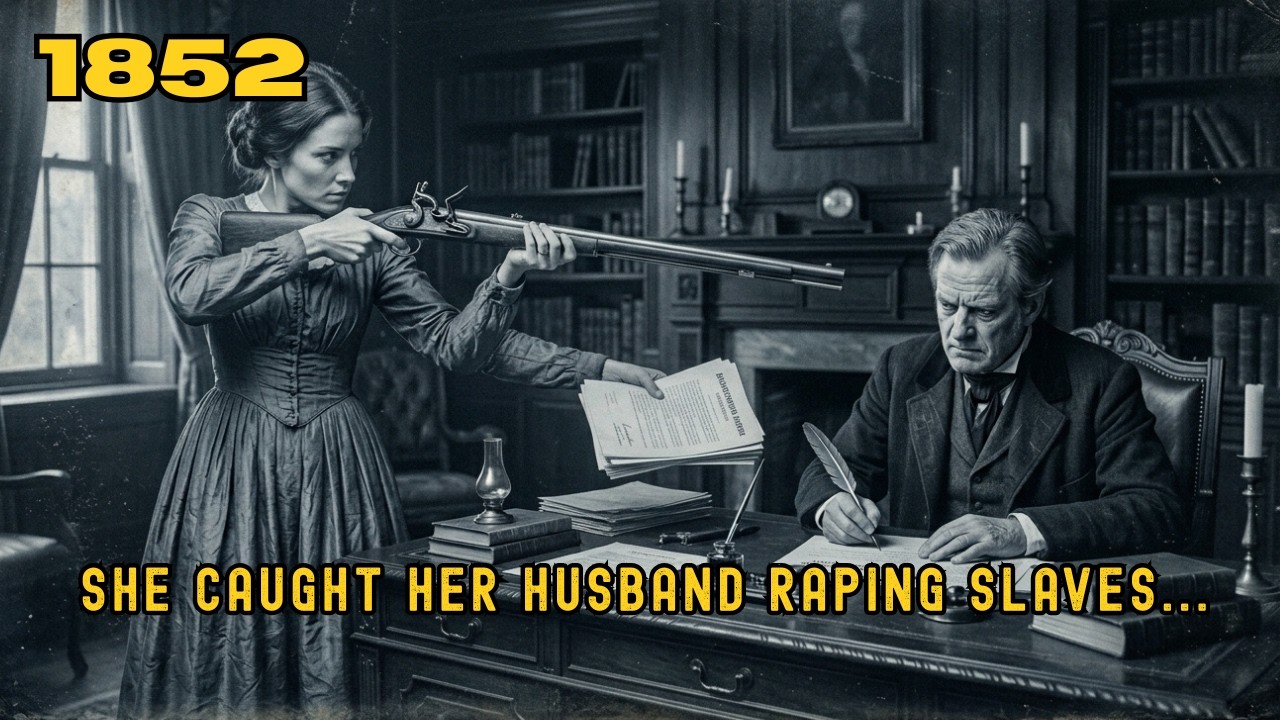
She walked through the silent house to her husband’s study, her green dress whispering accusations with every step. She stood in the center of the room surrounded by leather-bound books and hunting trophies, by maps of property lines and ledgers recording human beings as assets. On the wall hung his collection of rifles. She walked to them slowly, reached up, and took down the Howden hunting rifle, the one he had used to kill a black bear three winters ago, the one he had bragged about at dinner parties for months afterward.
She checked to make sure it was loaded. It was. Then she carried the rifle upstairs to her bedroom, laid it carefully on the bed, and sat in the rocking chair by the window to wait for dawn. Outside, the moon sank toward the horizon.
In the slave quarters, two young women wept without making a sound because they had learned long ago that tears changed nothing, and screaming only made it worse. Margaret did not sleep. She did not cry. She simply sat and waited, her hands folded in her lap, her face expressionless as marble.
By the time the first pink light touched the eastern sky, she had made her decision. The Colonel returned to the house expecting breakfast, expecting his wife to have forgotten, to have accepted, to have resumed her proper place in the order of things. He would be disappointed. Margaret heard the heavy tread of boots on the front porch, the careless bang of the door.
She rose from the rocking chair, her green silk dress wrinkled from the long night, her hair loose from its pins. She picked up the rifle and walked to the top of the stairs. The Colonel was in the entrance hall removing his hat. He looked up and saw her standing there, wild-haired and armed, and for just a moment something like fear flickered across his face before it hardened into anger.
“Margaret, put that down before you hurt yourself. ”
She descended the stairs slowly, the rifle held steady. Her hands did not shake. That surprised her.
She had always been the nervous type, prone to trembling at loud noises. But now, with the weight of the weapon in her grip and the memory of what she had witnessed burning in her mind, she felt nothing but a terrible, crystalline clarity. “Go into your study,” she said quietly. “I will do no such thing.
You’re hysterical. Women get these notions. ”
Margaret raised the rifle and pointed it directly at his chest. “Go into your study.
”
The Colonel’s face went white, then red with rage, but he saw something in her eyes that made him reconsider whatever he had been about to say. He turned and walked down the hallway, his shoulders rigid with fury. Margaret followed, keeping the rifle trained on his back. They entered the study, and she kicked the door closed behind them.
“Sit at your desk. ”
“Margaret, you’re making a terrible mistake. ”
“Sit down. ”
The force in her voice startled them both.
The Colonel sank into his leather chair, his hands gripping the armrests, his jaw clenched so tight she could see the muscles jumping beneath his skin. Margaret moved to the corner of the room where she had hidden the documents she had spent the night preparing. She had found them in his files: blank property transfer forms, emancipation papers that wealthy planters sometimes used when they wanted to free a favored house servant in their wills. She had pulled out every single one.
She dropped the stack on his desk with a heavy thud. “You’re going to sign these,” she said. The Colonel stared at the documents, then at her, then back at the documents. “Have you lost your mind?
These are emancipation papers, transfer of property deeds. What in God’s name do you think you’re doing? ”
“You will free every enslaved person on this plantation,” Margaret said, her voice steady as stone. “And you will transfer full ownership of the land to them, all of it.
Every acre, every building, everything. ”
The Colonel laughed, a harsh, ugly sound that filled the room. “You truly have gone mad. Do you have any idea what you’re asking?
This plantation is worth over two hundred thousand dollars. Those slaves represent another eight hundred thousand in assets. You’re asking me to give away my entire fortune, my entire life’s work, to a bunch of—”
“Say it. ” Margaret interrupted, her finger tightening slightly on the trigger.
“Say what you were about to say. I want to hear the words you use to describe the women you rape in the darkness, the children you beat, the men you work to death in your fields. ”
The Colonel’s face contorted with rage. “They are property, legally recognized property under the laws of Louisiana and the United States of America.
You cannot simply free them on a whim. The bank holds liens on half of them. Other planters have breeding contracts. ”
“I saw you last night,” Margaret said, and her voice cracked just slightly.
“I saw what you did to Sarah. I saw Rose carrying your child. How many more are there, James? How many women have you forced yourself upon?
How many children bearing your features work your fields while your legitimate heirs remain unborn? ”
The Colonel stood up abruptly, his chair scraping against the floor. “Every man in this parish does the same. Your own father—”
“My father was a monster, too,” Margaret said coldly.
“I simply didn’t have the courage to see it until now. Sit down. ”
“I will not. ”
Margaret cocked the rifle.
The sound was unnaturally loud in the quiet study. “Sit down. ”
The Colonel sat. “You will sign these papers,” Margaret continued, “or I will kill you where you sit.
Then I will tell everyone—the sheriff, the neighbors, the entire parish—exactly what you’ve been doing. I will name names. I will bring Sarah and Rose forward to testify. I will make sure that your reputation, the only thing you’ve ever truly cared about, is destroyed so completely that people will spit on your grave.
”
“No one would believe them,” the Colonel sneered. “The word of slaves against a white man, against a Colonel. You’re delusional. ”
“Perhaps,” Margaret acknowledged.
“But I’m also a Beaumont. My family has been in Louisiana since the French still owned it. My uncle is a federal judge. My cousin is a senator.
And I am a white woman of quality, a church-going lady who has never given anyone cause to doubt her word. When I tell them what I saw, when I describe in detail what you did to those girls, when I produce the children who look just like you, people will listen. They may not punish you legally, but they will whisper. They will exclude you.
Your business partners will quietly withdraw. Your friends will stop calling. You will become a pariah, Colonel. A joke.
The man whose wife exposed him for a rapist and a brute. ”
The Colonel’s face had gone ashen. “You wouldn’t. The scandal would destroy you, too.
”
“I no longer care,” Margaret said simply. “I’ve been dead inside this marriage for years. You killed whatever part of me that wanted to live according to society’s rules. Last night, when I saw what you really are, the last piece of my soul that cared about reputation and status died.
I have nothing left to lose. But you—you have everything to lose. ”
She pushed the papers toward him across the desk. “Sign them, all of them, and I’ll keep your secret.
I’ll tell everyone you had a change of heart, that you experienced a religious conversion, that you decided to do the Christian thing. Your friends will think you’ve gone soft, but they’ll admire your principles, at least publicly. You can live out your days knowing you did one decent thing in your miserable life. ”
“And if I refuse?
”
Margaret’s finger rested lightly on the trigger. “Then I’ll send you to the hell you’ve built here, and I’ll face the consequences. But either way, those people will be free. Either you sign these papers or I shoot you and sign them myself as your widow.
Louisiana law gives me that right. ”
The silence that followed was absolute. Outside, the first birds had begun their morning songs. Somewhere in the house, old Dalene was probably starting breakfast, unaware that the world as she knew it was ending.
The Colonel stared at the papers for a long moment. Then slowly, he reached for the pen in its silver holder on his desk. “You will regret this,” he said quietly. “You have no idea what you’re unleashing.
Those people don’t know how to run a plantation. They don’t know how to manage land or negotiate with merchants or deal with the realities of agriculture. Within a year, they’ll have squandered everything and they’ll all starve. Their blood will be on your hands.
”
“Better starvation than slavery,” Margaret replied. “Better death than what you’ve been doing to them. Now sign. ”
The Colonel dipped his pen in the ink and began to write his name on the first document, then the second, then the third.
His hand shook with rage, and he had to pause several times to keep from tearing the paper. Margaret watched him sign away his empire, document by document. Every enslaved person on the Waywright plantation—137 souls—would be free by the end of this morning. The land would be theirs, divided equally among the families who had worked it for generations without compensation.
It took nearly an hour. When the Colonel signed the last paper, his hand was cramping and his face had gone from red to a sickly gray. “I need witnesses,” Margaret said. “These documents must be legally binding.
”
She walked to the door and called out. Three men appeared within minutes: the plantation overseer, Harold Whitfield, and his two assistants, Marcus Kellogg and Joseph Crane. They were rough men accustomed to enforcing the Colonel’s will with whips and chains, and they looked confused at being summoned to the study so early in the morning. “The Colonel has made an important decision,” Margaret announced, still holding the rifle casually in her hands.
“He has decided to free all the slaves on this plantation and transfer ownership of the land to them. He needs you to witness these documents. ”
The three men stared at her as if she had begun speaking in tongues. “Ma’am,” Whitfield said carefully, “perhaps you should sit down.
Maybe you’ve had a spell of some kind. ”
“I’ve had a spell of sanity,” Margaret snapped. “My husband has signed these papers of his own free will. Haven’t you, James?
”
The Colonel’s eyes met hers across the desk, and in them she saw pure, undiluted hatred. But he nodded slowly. “It’s true,” he said, his voice hollow. “Witness my signature.
”
The three overseers looked at each other, clearly uncertain whether they were witnessing a legal proceeding or some kind of domestic madness, but they had been employed by the Waywrights for years, and they knew better than to question direct orders. One by one, they signed their names beneath the Colonel’s signature on every document. When it was done, Margaret gathered the papers carefully and placed them in a leather document case. “Gentlemen,” she said, “you’re dismissed.
And you should probably start looking for new employment. I imagine the new owners of this land won’t be needing overseers. ”
The three men fled the room, their boots thundering on the floorboards as they rushed to spread the impossible news. Margaret turned back to her husband.
He sat slumped in his chair, staring at nothing, his face the color of cold ashes. “You may stay in this house for now,” she said quietly. “I won’t put you out with nothing. But understand this.
If you ever touch another woman without her consent, if you ever raise a hand to anyone on this property, if you ever attempt to reverse what we’ve done here today, I will kill you. I will walk into whatever room you’re in and shoot you dead. Do you understand me? ”
The Colonel said nothing.
He simply sat there, a broken man in his own study, surrounded by the trappings of a power that had just evaporated like morning dew. Margaret walked to the door, then paused and looked back at him one last time. “I loved you once,” she said softly. “When we were young and I still believed in fairy tales, I thought you were a good man.
I thought our life together would mean something. But you taught me that monsters are real, and sometimes they sleep in your bed and eat at your table and go to church on Sunday mornings. You taught me that evil doesn’t always announce itself with thunder and lightning. Sometimes it just whispers in the darkness and destroys everything it touches.
”
She left him there and walked out into the morning light. The sun had fully risen by the time Margaret made her way down the path to the quarters, the document case clutched against her chest like a shield. Her heart pounded so hard she thought it might burst through her ribs, but her steps never faltered. People were beginning to emerge from the cabins, women building cooking fires, children playing in the dirt, men preparing for another day in the fields.
The overseer’s bell hadn’t rung yet, but they were already stirring, conditioned by years of brutality to anticipate it. Margaret stopped in the center of the clearing between the two rows of cabins and set down her document case. Then she simply stood there waiting. It didn’t take long for people to notice her.
A white woman, the master’s wife, standing alone in the quarters. It was unprecedented, dangerous. People stopped what they were doing and stared. An old man named Isaiah was the first to approach.
His back was bent from decades of labor, his face a map of suffering. He removed his tattered hat and held it against his chest. “Mrs. Waywright, ma’am,” he said carefully, his eyes downcast.
“Is something wrong? Can we help you with something? ”
Margaret’s throat felt tight. She had rehearsed this moment during the long night, but now that it was here, the words seemed inadequate to the enormity of what she needed to say.
“I need everyone to gather here,” she said. “All of you, now. ”
Isaiah looked uncertain, but he nodded and began calling out to the others. Within minutes people had gathered, men and women, elders and children, everyone who lived in the quarters.
They stood in a loose semicircle around her, silent and weary. They had learned to be careful around white people, to anticipate moods and read expressions, to make themselves small and unthreatening. Margaret saw Sarah and Rose standing together near the back of the crowd. Sarah’s eyes were swollen from crying.
Rose held her pregnant belly and would not look up. “My name is Margaret Waywright,” she began, though of course they all knew who she was. “I was born Margaret Beaumont. I have lived in this parish my entire life.
I have been mistress of this plantation for fourteen years. ”
She paused, looking at all the faces turned toward her, seeing the weariness there, the carefully maintained blankness that was the only safe expression for enslaved people to wear around their owners. “Last night,” Margaret continued, her voice growing stronger, “I discovered that my husband, Colonel Waywright, has been committing acts of violence against the women who live here. Terrible acts, criminal acts, acts that no man should commit and no woman should have to endure.
”
A ripple of shock ran through the crowd. This was not something white people discussed openly, especially not white women in front of enslaved people. “I saw what he did,” Margaret said, looking directly at Sarah now. The young woman’s eyes widened in fear.
“I saw it with my own eyes, and I understood that I had been living a lie. That this entire plantation, this entire way of life, is built on lies and violence and suffering. ”
“Ma’am,” Isaiah interrupted gently, “you shouldn’t be speaking of such things. If the master hears—”
“The master is finished,” Margaret said flatly.
She knelt and opened the document case, pulling out the stack of papers. “These are legal documents signed by my husband and witnessed by three white men of this parish. Emancipation papers. Every single one of you is free.
As of this moment, you are no longer enslaved. You are free men, women, and children. ”
The silence that followed was so complete that Margaret could hear her own heartbeat, could hear the wind rustling through the sugarcane fields, could hear a rooster crowing somewhere in the distance. “That ain’t possible,” someone whispered.
“It is,” Margaret said. She held up the papers, showing them the signatures, the official seals. “You are free, all of you. And more than that, this land is yours.
The plantation, the fields, the buildings—everything except the main house. My husband has signed over full ownership to you. This property belongs to all of you now, to do with as you see fit. ”
“This is a trick,” an old woman named Dinah said sharply.
“Some kind of cruel game. Tomorrow they’ll say we tried to run off and hunt us down. ”
“It’s not a trick,” Margaret insisted. “I swear to you on my life, on everything I hold sacred, this is real.
You are free. ”
A young man named Moses pushed forward. He was perhaps twenty years old, tall and strong with scars on his back from a whipping he’d received for accidentally breaking a plow blade. “Why?
” he demanded. “Why would he do this? White folks don’t just give away their property. ”
“He didn’t want to,” Margaret admitted.
“I forced him. I threatened to expose what he’s been doing, to ruin his reputation, to destroy everything he cares about. And I told him that if he didn’t sign these papers, I would kill him. ”
More shocked silence.
This was beyond anything they could have imagined. A white woman threatening to murder her husband over what happened to enslaved women in the quarters. “Show us the papers,” Isaiah said quietly. Margaret handed them to him.
He couldn’t read—none of them could, for it was illegal to teach enslaved people to read in Louisiana—but he examined the signatures, the seals, the official stamps. He passed them to others who did the same. “These look real,” Isaiah finally said, his voice shaking. “They are real,” Margaret confirmed.
“I’ll take them into St. Landry this afternoon and file them with the courthouse. By tonight, they’ll be a matter of public record. Legally, as of this moment, you are all free citizens, and this land belongs to you.
”
A woman began to cry, then another. A man fell to his knees, his whole body shaking. Children clung to their mothers, not understanding what was happening but sensing that something enormous had shifted in their world. “What do we do?
” someone asked. “Where do we go? ”
“You don’t have to go anywhere,” Margaret said. “This is your land now.
You can stay here. You can build lives here. You can plant crops and keep the profits. You can build better houses.
You can send your children to school. You can do whatever free people do. ”
“The Colonel won’t let us,” Moses said. “He’ll find a way to take it back.
White folks always do. ”
“He won’t,” Margaret said firmly. “I’ll make sure of it. And if he tries, I’ll kill him.
I mean that. I will put a bullet through his heart and face the consequences. ”
They stared at her, this wild-haired white woman in her wrinkled silk dress, and slowly, gradually, they began to believe. Sarah stepped forward.
“Why? ” she asked, her voice barely above a whisper. “Why did you do this for us? ”
Margaret looked at her, this young woman whose suffering had finally opened her eyes, and felt tears burning in her throat.
“Because I saw what he did to you. And I realized that I had been complicit, that my silence was permission, that every day I spent pretending not to know was another day of your suffering. I can’t undo what’s been done. I can’t give you back the years that were stolen from you.
But I can do this. I can give you your freedom and your future. ”
Sarah’s face crumpled, and she began to sob. Rose moved to her side, and the two young women held each other, crying with a mixture of relief and grief and disbelief.
One by one, people began to move. Someone started singing an old spiritual that had been sung in the quarters for generations, but now the words meant something different. The chains of bondage were breaking. Freedom was coming.
The promised land was here now, in this place of suffering, transformed by one woman’s rage into something new. By noon, word had spread beyond the plantation. Other enslaved people from neighboring properties heard the news and came to see if it was true. The overseers, realizing they had no future here, had already packed their belongings and ridden off toward town, no doubt to spread the story of the mad Mrs.
Waywright, who had given away her husband’s fortune. Margaret spent the day helping to organize the transition. She explained to Isaiah and the other elders how property ownership worked, how they would need to form some kind of cooperative or association to manage the land legally. She promised to help them find lawyers and accountants.
“You’ll need a new name for this place,” she said as the sun began to set. “Something that belongs to you, not to the Waywrights. ”
The people gathered in the clearing discussed among themselves. Finally, Isaiah spoke.
“We’ll call it Eden’s Rest,” he said, “because this is where our suffering ended. This is where we can finally rest. This is the Eden we thought we’d never see. ”
Margaret nodded, tears streaming down her face.
“Eden’s Rest. It’s perfect. ”
That night, for the first time in generations, the quarters were filled with laughter instead of weeping. People sang and danced and held their children close, hardly daring to believe that they would wake up the next morning still free.
Margaret returned to the main house as darkness fell. The Colonel was not in his study. She found him in the parlor, a bottle of whiskey already half empty beside him, staring at nothing. “It’s done,” she said quietly.
“The papers are filed. Eden’s Rest is born. ”
He didn’t respond, didn’t even look at her. Margaret went upstairs to her bedroom, locked the door, and finally allowed herself to collapse onto the bed and weep.
The news of what Margaret Waywright had done spread through St. Landry Parish like a fever. By the end of the first week, everyone from New Orleans to Baton Rouge had heard some version of the story, though the details varied wildly depending on who was telling it. In the white churches and parlors, Margaret was either a saint or a madwoman.
Some said she had experienced a genuine religious conversion, that God had spoken to her and commanded her to free her slaves. Others whispered that she had gone insane with grief over her childlessness and had destroyed her husband’s life’s work in a fit of feminine hysteria. The more malicious gossip suggested that she had taken a black lover and freed the slaves to spite her husband. In the black churches and freedmen’s communities, Margaret was already becoming a legend.
They called her the angel of Eden’s Rest and told stories about how she had held a gun to her husband’s head and forced him to sign away his evil empire. They said she was braver than any man, that she had risked everything to do what was right. The truth, as always, was more complicated than either version. Margaret spent those first weeks in a kind of fog, helping the people of Eden’s Rest establish their new community while watching her old life crumble around her.
Her friends stopped calling. The ladies who had once invited her to tea parties now crossed the street to avoid her. The pastor of their church came to the house and suggested politely but firmly that perhaps she should worship elsewhere for a while until the scandal died down. Her uncle the federal judge wrote her a letter so full of rage and disappointment that she could barely bring herself to read it.
Her cousin the senator sent word that she was no longer welcome at the family estate in New Orleans. Only her younger sister Pauline stood by her. Pauline arrived at Waywright Hall three weeks after the emancipation, her carriage loaded with trunks and traveling cases. “I’ve left my husband,” Pauline announced as she swept into the house.
“Or rather, he asked me to leave when I told him I supported what you did. So here I am. I hope you have room for a refugee from respectable society. ”
Margaret hugged her sister and wept with relief.
She hadn’t realized how desperately she needed an ally until Pauline arrived. The Colonel, meanwhile, was deteriorating. He had not left the house since the day he signed the papers. He drank from morning until night, sitting in his study or wandering the empty halls like a ghost.
He had stopped bathing, stopped shaving, stopped caring about his appearance at all. His friends had abandoned him, not because they disapproved of what he’d been doing in the quarters, but because he’d been weak enough to let his wife force his hand. “You destroyed him,” Pauline observed one evening as they sat in the drawing room. The Colonel could be heard upstairs, stumbling around his bedroom, mumbling to himself.
“He destroyed himself,” Margaret replied. “I just held up a mirror. ”
“The other planters are terrified,” Pauline said. “Do you know what they’re saying?
They’re saying that if one woman can do what you did, others might follow. They’re worried about their own wives discovering the truth about what happens in the quarters. You’ve become a threat to the entire system. ”
“Good,” Margaret said coldly.
“The entire system deserves to burn. ”
But she knew Pauline was right to be concerned. In the months since the emancipation, there had been three attempts to challenge the legality of the documents. Other planters, claiming that the Colonel had been coerced or was mentally unfit, had tried to get a judge to void the transfers.
Each time Margaret had appeared in court with her lawyers and testified clearly and firmly that her husband had signed the papers of his own free will. She had prevailed. But the legal battles were exhausting and expensive, and they were making powerful enemies. One night in early September, Margaret was awakened by the sound of breaking glass.
She grabbed the rifle she now kept beside her bed, having learned to sleep with it close, and crept downstairs. Someone had thrown a brick through the front window. Tied to it was a note written in crude block letters: “Lover, your time is coming. ”
Pauline appeared at the top of the stairs in her nightgown, her face pale.
“What was that? ”
Margaret showed her the brick and the note. “We need to leave,” Pauline said immediately. “This isn’t safe.
”
“If they’re threatening you, I’m not leaving,” Margaret said flatly. “They want to scare me away so they can claim the Colonel was incompetent and void the transfers. I won’t give them the satisfaction. ”
But the threats continued.
Dead animals left on the porch, anonymous letters describing in graphic detail what certain men wanted to do to her. Once someone shot out the lamps on either side of the front door. The sheriff, when Margaret reported these incidents, was sympathetic but unhelpful. “Folks are upset, Mrs.
Waywright. You’ve disrupted the natural order of things. Maybe if you went to stay with family for a while, let tempers cool down. ”
“The natural order?
” Margaret repeated slowly. “Involved my husband raping enslaved women. If people are upset that I stopped that, then they deserve to be upset. ”
The sheriff left without promising to investigate.
Meanwhile, Eden’s Rest was thriving in ways that made Margaret’s heart swell with hope. The freed families had organized themselves into a cooperative, with Isaiah serving as the leader of a council of elders. They had begun repairing the cabins, building new ones, establishing a school where children could learn to read and write. They had planted their own crops and were negotiating with merchants in town, though many white business owners refused to deal with them.
Margaret helped however she could. She used what remained of her personal fortune to buy supplies and equipment. She connected them with the few sympathetic white people she could find: Quaker merchants from the north, a Methodist minister who believed slavery was sinful, a lawyer who agreed to represent them in legal matters. And she visited often, much to the scandal of everyone who still cared about such things.
“You shouldn’t come here so much,” Isaiah told her one day as they stood in the fields watching children play. “People already think you’re too friendly with us. It makes things harder for you. ”
“I don’t care what people think anymore,” Margaret said.
“This is the only place I feel like I’m doing something worthwhile. ”
Sarah and Rose had both given birth now: Sarah to a daughter she named Hope, Rose to a son she called Freedom. Both children were healthy and beautiful. Both bore a resemblance to Colonel Waywright that made Margaret’s stomach turn every time she saw them, but she said nothing.
The past could not be changed. Only the future mattered now. In October, the Colonel finally left his room for the first time in weeks. Margaret found him in his study, surprisingly sober, staring at a map of the parish on the wall.
“I’m leaving,” he announced without preamble. “Going west. California maybe, or Mexico. Somewhere I can start over.
”
“Good,” Margaret said. “You should. ”
He turned to look at her, and she was shocked by how much he had aged. He looked like an old man now, his face gaunt, his eyes hollow.
“I hope you’re satisfied,” he said bitterly. “You’ve destroyed everything I built, everything I worked for, everything I was. ”
“Everything you were was built on suffering,” Margaret replied. “I have no regrets about destroying that.
”
“Those people will fail,” the Colonel said. “They don’t know how to manage land or run a business. Within two years, Eden’s Rest will be bankrupt, and they’ll all be starving, and it will be your fault. ”
“If they fail, they’ll fail as free people,” Margaret said.
“That’s better than succeeding as slaves. But I don’t think they’ll fail. I think they’re stronger and more capable than you ever gave them credit for. ”
The Colonel laughed bitterly.
“You’re a fool. A naive, idealistic fool. You’ve thrown away wealth and status and respect for a cause that will be forgotten in a generation. ”
“Perhaps,” Margaret acknowledged.
“But at least I’ll be able to sleep at night. ”
He left two days later, taking only what he could fit in a single trunk. Margaret stood on the porch and watched his carriage disappear down the oak-lined drive and felt nothing but relief. Winter came to Louisiana that year like a promise of redemption.
The oppressive heat that had made summer unbearable gave way to cool, clear days and crisp nights. At Eden’s Rest, the freed community celebrated their first Christmas as free people with a joy that echoed across the fields. Margaret and Pauline attended the celebration, the only white faces in a crowd of several hundred. They sang hymns and shared food and watched children perform a nativity play.
When Isaiah asked Margaret to say a few words, she declined, feeling that this moment belonged to them, not to her. But as she stood at the edge of the gathering, watching families laugh together without fear, watching children play without the shadow of bondage hanging over them, she felt something she hadn’t experienced in years: a sense of purpose. The legal challenges had finally ended. The parish court had upheld the emancipation and property transfers as legitimate.
The other planters, recognizing that they couldn’t win in court, had moved on to new strategies of harassment and intimidation. But Eden’s Rest endured. The community had developed its own economy, its own systems of governance, its own culture. They grew vegetables and raised animals.
They made crafts and sold them at markets in town, though they often had to deal with white merchants who tried to cheat them or refused to do business with them at all. They educated their children and cared for their elderly and built something that hadn’t existed before: a place where black families could live in dignity and peace. It wasn’t perfect. There were disputes and arguments, failures and setbacks.
Some families left, deciding to try their luck in cities like New Orleans or Memphis. Others stayed and put down roots, literally and figuratively, transforming the land that had once been their prison into their home. Margaret had moved out of the main house and into a small cabin at the edge of the property. The grand mansion felt too large, too empty, too full of ghosts.
She gave most of the furniture to the people of Eden’s Rest and kept only what she needed to live simply. Pauline had returned to New Orleans after a few months, reconciled with her husband, who had decided that his wife’s eccentric sister was less embarrassing than a messy divorce. But Pauline wrote often and visited when she could. The isolation didn’t bother Margaret as much as she had thought it would.
She discovered that she preferred the company of the families at Eden’s Rest to the suffocating social obligations of her former life. She taught children to read and write. She helped mothers with medical care using knowledge she’d gained from books and from older women who knew traditional remedies. She worked in the gardens and the fields alongside everyone else, her hands becoming calloused and strong.
“You’ve become one of us,” Rose told her one day as they worked together in the communal garden, pulling weeds from between rows of beans. “I’ll never be one of you,” Margaret said gently. “I’m white. I benefit from systems of oppression even when I try to reject them.
But I can be an ally. I can be a friend. ”
Rose smiled and went back to work, her son, Freedom, playing nearby in the dirt. In the spring of 1854, a journalist from Boston arrived at Eden’s Rest.
He was writing a book about resistance to slavery and had heard about Margaret’s story from abolitionist circles in the north. “You’ve become famous,” he told her as they sat on the porch of her cabin. “People are calling you a hero. They say you proved that white southerners can reject slavery, that individual action matters.
”
“I’m not a hero,” Margaret said firmly. “I did what anyone with a conscience should do, and I did it far too late. I spent fourteen years turning a blind eye to suffering. One moment of action doesn’t make me a saint.
”
“But it makes you an example,” the journalist insisted. “Your story gives people hope. It shows that change is possible. ”
Margaret thought about that for a long time after he left.
Was change possible? Could other plantations follow Eden’s Rest’s example? Could the entire system of slavery be dismantled by individual acts of conscience? She wanted to believe it, but she knew the reality was more complicated.
For every Margaret Waywright, there were a hundred other plantation wives who chose silence. For every Eden’s Rest, there were a thousand plantations where the suffering continued unabated. Still, what they had built here mattered. It mattered to Isaiah and his grandchildren.
It mattered to Sarah and her daughter Hope. It mattered to Rose and her son Freedom. It mattered to every person who woke up each morning as a free human being instead of as someone else’s property. In the summer of 1855, word reached Margaret that her husband had died in San Francisco.
The Colonel had apparently drunk himself to death in a boarding house, alone and unmourned. There would be no funeral, no grave marker, no legacy except for the children he had fathered through violence and the empire he had built on suffering. Margaret felt nothing when she heard the news. No grief, no relief, just a vast emptiness where her marriage had once been.
She was a widow now officially, though she had been emotionally widowed for years. What surprised her was what came next. The Colonel had written a will shortly before his death, and in it he had left everything that remained of his personal fortune—some twenty thousand dollars in bank accounts and investments—to Margaret. “I suppose even in death he wanted to control me,” Margaret told Pauline when her sister came to visit after the will was read.
“He knew I would use the money to help Eden’s Rest. Perhaps that was his final revenge, making me depend on his generosity even after he was gone. ”
“Or perhaps,” Pauline suggested gently, “it was his way of apologizing. Of admitting at the very end that you were right.
”
Margaret used the inheritance to establish a trust fund for Eden’s Rest, ensuring that the community would have resources for years to come. She hired teachers from the north to staff the school. She bought equipment to help modernize farming techniques. She funded a small medical clinic.
And she watched the community flourish. By 1856, Eden’s Rest had become a beacon for freed people throughout Louisiana. Former slaves who had purchased their freedom or escaped from other plantations made their way there, drawn by stories of a place where black families could own land and live in peace. The population grew to nearly three hundred people.
With growth came new challenges. Some white neighbors became increasingly hostile, angry that Eden’s Rest’s success made their own plantation system look brutal and inefficient by comparison. There were incidents: crops vandalized, buildings burned, people threatened when they went into town. Margaret worked with Isaiah and the council to establish a militia of sorts, men who would patrol the boundaries of Eden’s Rest and protect the community from night riders and arsonists.
She also used her remaining connections to petition the state government for official recognition and protection, though those efforts largely failed. The political climate was worsening. Tensions between north and south over slavery were reaching a breaking point. In Kansas, pro-slavery and anti-slavery settlers were literally fighting each other in what newspapers were calling Bleeding Kansas.
In Washington, southern congressmen were becoming more aggressive in defending their peculiar institution. “War is coming,” Isaiah told Margaret one evening as they sat on the porch of the communal hall, watching the sun set over the fields. “You can feel it in the air. The whole country is pulling apart at the seams.
”
“What will you do if it comes? ” Margaret asked. “We’ll protect what’s ours,” Isaiah said firmly. “This land is ours.
These lives are ours. We won’t let anyone take that away. Not even if armies march through Louisiana. ”
Margaret squeezed his hand.
“I’ll stand with you, whatever comes. ”
In the autumn of 1856, Sarah’s daughter Hope started school. She was four years old, bright-eyed and curious, completely unaware that she had been born into slavery and freed before she could even walk. To her, Eden’s Rest was simply home, and freedom was simply life.
Watching Hope play with other children, learning her letters, laughing without fear, Margaret felt a profound sense of peace. This was what she had fought for. This was what mattered. “Do you ever regret it?
” Rose asked her one day. “Giving up your old life, your status, your wealth, your place in society. ”
Margaret thought about the question carefully. Did she miss the big house with its crystal chandeliers and imported furniture?
Did she miss the parties and the social calls? Did she miss being Mrs. Waywright, respected plantation wife? “No,” she said finally.
“That life was beautiful on the surface, but it was built on an ugly foundation. I would rather live in a cabin with a clear conscience than in a mansion built on suffering. I would rather be lonely and right than comfortable and complicit. ”
“You’re not lonely,” Rose said gently.
“You have all of us. ”
And it was true. Margaret had found a new family at Eden’s Rest. A community that had accepted her despite her whiteness, despite her past, despite everything.
They had seen her try to make amends, had seen her put her body and her resources on the line for their freedom. And they had welcomed her. Not as their savior—they had saved themselves, had built this community with their own hands and minds and determination—but as their ally, their friend, their sister in the ongoing struggle for justice. The years passed like water flowing downstream, inevitable and constant.
Margaret watched seasons change, children grow, and the community of Eden’s Rest transform from an impossible dream into a thriving reality. The Civil War came in 1861, just as Isaiah had predicted. Louisiana seceded from the Union, and young white men marched off to fight for the Confederacy, to defend their way of life, which meant defending slavery. The people of Eden’s Rest watched the war from a distance at first, praying that Union victory would bring freedom to the millions still enslaved across the South.
When Union troops finally arrived in Louisiana in 1863, Eden’s Rest was already free, and the soldiers were stunned to find a community of black landowners operating independently. Some officers wanted to confiscate the land to redistribute it to white settlers. But Margaret, now in her mid-forties, stood before the Union commanders and produced all the legal documents, properly filed and witnessed, proving that the land belonged to the people of Eden’s Rest. “This is what emancipation looks like,” she told them.
“This is what freedom looks like. You can either support it or destroy it. But if you destroy it, you’ll prove that the war was never about freedom at all. ”
The Union officers, impressed by her fierce advocacy and the obvious success of the community, decided to leave Eden’s Rest alone.
In fact, they held it up as an example of what could be achieved when enslaved people were given their freedom and their dignity. During Reconstruction, Eden’s Rest became even more important. While much of the South was in chaos, while freed people across the region struggled with the sudden transition from slavery to freedom without resources or land, Eden’s Rest stood as proof that black Americans could build prosperous, self-sustaining communities when given the opportunity. Isaiah lived to see the end of the war and the constitutional amendments that finally officially abolished slavery across the United States.
He died in 1867 at the age of seventy-three, surrounded by his children, grandchildren, and great-grandchildren. Margaret stood at his funeral and wept like she had lost her own father. “You gave us hope when we had none,” she told him in her eulogy. “You took the freedom we gave you and built something magnificent with it.
You showed the world what was possible. ”
Afterward, the younger generation took over leadership of Eden’s Rest: Sarah’s daughter Hope, now a young woman studying to be a teacher; Rose’s son Freedom, who had a gift for farming and business; Moses, who had become a powerful voice for black political rights in Louisiana. Margaret stepped back, content to watch from the margins as the community she had helped birth came fully into its own. But the backlash was coming.
Reconstruction ended, and white southerners moved quickly to reassert control through terror, intimidation, and laws designed to recreate slavery under different names. The Ku Klux Klan rode through the night, burning and killing. Black voters were systematically disenfranchised. Jim Crow laws began to appear, codifying racial segregation and oppression.
Eden’s Rest, with its success and its defiance of racial hierarchies, became a target. In 1877, night riders attacked. They came in white hoods and burned three homes on the edge of the property. They killed two men who tried to defend their families.
They left a message: “This is white man’s land. Give it back or we’ll take it in blood. ”
The community was terrified but defiant. They armed themselves and organized patrols.
They reached out to Republican officials, to federal troops still stationed in Louisiana, to anyone who might help protect them. Margaret, now fifty-seven years old, her hair gone white, her face lined with age and worry, walked through the community with a rifle over her shoulder, helping to stand guard. “You should leave,” Hope told her. “You’re a white woman.
They won’t hurt you. You don’t have to stay here and risk your life for us. ”
“This is my home,” Margaret said simply. “These are my people.
I’m not going anywhere. ”
The attacks continued sporadically for months. Then, as abruptly as they had started, they stopped. Later, Margaret learned that Moses and some of the other leaders had made a deal with the local Democratic Party boss.
Eden’s Rest would not participate in Republican politics, would not encourage other black people to vote, would keep their heads down and their mouths shut. In exchange, they would be left alone. It was a devil’s bargain, and everyone knew it. But it was survival.
“We can’t fight the whole world,” Moses told Margaret when she objected. “We have to choose our battles. Staying alive, keeping this land, protecting our families—that’s what matters now. ”
Margaret understood, even as her heart broke for what had been lost.
The hope of reconstruction, the promise of true equality, was dying. The dream of a multi-racial democracy was being strangled by white supremacy reasserting itself across the South. But Eden’s Rest endured. By 1890, Margaret was seventy years old, frail and slowed by age but still sharp-minded.
She lived in her small cabin, tended by Rose, whose son Freedom had taken over management of the cooperative. The community had grown to over five hundred people, spanning three generations of families who had never known slavery. They called her Mama Margaret now. The children who had grown up with her presence knew her as the white woman who had always been there, who had stood with them through everything.
One warm spring evening, Margaret asked Freedom to help her walk to the oldest oak tree on the property, a massive live oak that had stood for centuries, its branches spreading like protective arms over a clearing where the community often gathered. “I want to sit here for a while,” she told him. “You can go. I’ll be fine.
”
Freedom was reluctant to leave her, but Margaret insisted. She sat with her back against the rough bark of the ancient tree and looked out over the fields of Eden’s Rest. The sun was setting, painting the sky in shades of gold and pink and purple. In the distance she could hear children playing, women calling their families to supper, men laughing as they finished the day’s work: the sounds of a community at peace.
She thought about the girl she had been, the plantation wife embroidering meaningless flowers on pillowcases, living in willful ignorance of the suffering that surrounded her. She thought about the night she had walked into those quarters with a lantern, about what she had seen, about the moment her soul had cracked open and forced her to see the truth. She thought about the Colonel, dead these many years, and wondered if he had ever understood what he had done, if he had ever felt remorse. She hoped so.
She hoped he had suffered for it. She thought about Sarah and Rose, about all the women who had endured the Colonel’s violence, about the children born from that violence who had nevertheless grown into strong, free adults. She thought about Isaiah and Dinah and all the others who had taken the freedom she had helped give them and built something beautiful with it. Had it been enough?
Had one moment of courage, one act of defiance, truly made a difference? Looking out over Eden’s Rest, hearing the sounds of life and laughter and freedom, Margaret knew the answer. Yes, it had mattered. Not because she was special or heroic, but because she had seen injustice and refused to look away.
Because she had used what power she had to break chains instead of forging them. Because she had chosen human dignity over social approval. The world beyond Eden’s Rest was still broken. Slavery had ended, but oppression continued under new names.
Black Americans were still fighting for basic rights, still struggling against a system designed to keep them subordinated and powerless. But here, in this place, in this community built on land stolen from a slaver and given back to the enslaved, freedom was real. Here, families owned their own land, educated their own children, governed their own lives. It wasn’t paradise.
It wasn’t perfect. But it was theirs. Margaret closed her eyes, feeling the rough bark of the oak against her back, feeling the warm breeze on her face, hearing the sounds of Eden’s Rest settling in for the evening. She never opened them again.
They found her the next morning sitting peacefully beneath the oak, her face calm, a slight smile on her lips. She had died exactly where she wanted to die, surrounded by the community she had helped birth, on the land she had helped liberate. The people of Eden’s Rest mourned her deeply. They held a funeral that lasted three days, with people traveling from across Louisiana to pay their respects to the white woman who had stood with them when no one else would.
They wanted to build her a grand memorial, a marble headstone with elaborate inscriptions. But Hope, now a teacher and community elder, remembered something Margaret had once said. “She told me,” Hope said at the council meeting, “that she didn’t want to be remembered as a savior. She said the true heroes were the people who survived slavery and built Eden’s Rest with their own hands.
She said she was just someone who finally did the right thing, after years of doing the wrong thing. ”
So instead of a marble monument, they buried her beneath the oak where she had died, in a simple grave with no headstone. But they carved something into the bark of the tree, high up where it would last for generations: “She gave back what blood had stolen. ”
Years turned into decades.
The twentieth century arrived, bringing new struggles and new hopes. Eden’s Rest survived Jim Crow, survived the depression, survived wars and economic upheavals. The community changed and evolved, but it never forgot its origins. Historians eventually discovered Margaret’s story and wrote books about her.
Filmmakers tried to option the rights to tell her tale. Activists held her up as an example of white allyship, of someone who had risked everything to fight injustice. But the people of Eden’s Rest knew the fuller truth. Margaret had been neither saint nor savior.
She had been a flawed woman who had spent years in complicity with evil before finally finding the courage to act. She had made one bold choice that changed everything, but she had spent the rest of her life trying to make up for the years she had wasted in silence. And in the end, that was perhaps the real lesson: that redemption is possible, that it’s never too late to choose justice over comfort, that individual actions, even when they can’t change the whole system, can change someone’s world completely. The oak tree where Margaret was buried lived for another century before lightning struck it in a storm and split it down the middle.
By then, Eden’s Rest had grown into a town of several thousand people, a testament to what had been built from the ashes of slavery. They saved a piece of the oak when they had to cut it down, preserving the section of bark with the carved words. It sits now in the Eden’s Rest Historical Museum, beside the original emancipation papers, beside photographs of Margaret and Isaiah and Sarah and Rose and all the others who had been there at the beginning. “She gave back what blood had stolen.
” Seven words carved into a tree, marking the grave of a woman who had finally, belatedly, chosen to see the truth and act on it. Seven words that told a story of horror and hope, of violence and redemption, of one woman’s rage transforming into an entire community’s freedom. Seven words that still echo more than a century later, asking each person who reads them the same questions Margaret had been forced to answer: What injustice are you choosing not to see? What power do you have to make things right?
What are you willing to risk for someone else’s freedom? And when will you finally act? The questions remain. The answers are still being written.
But in a small town in Louisiana that was once a plantation called Waywright Hall and is now a community called Eden’s Rest, the descendants of enslaved people still live on land their ancestors were given by a white woman who saw what her husband was and decided that silence was no longer an option. They remember her not as perfect but as real, not as a white savior but as an imperfect ally who used the power she had when it mattered most. And they teach their children about the night in 1852 when a plantation lady walked into the quarters with a lantern, saw the truth she had been avoiding for years, and made a choice that changed everything. Some women are born saints.
Others are forged in fire. Margaret Waywright became something else entirely. She became someone who chose freedom over comfort, justice over security, and truth over the lies that make oppression possible. And that, in the end, was enough to build Eden’s Rest.
That was enough to give hope to people who had none. That was enough to prove that change, while never easy and never complete, is always possible when someone finally decides that silence is no longer acceptable.






