The soldiers of the burial detail climbed the hill on the morning of June 27th, two days after the guns fell silent, and they still did not know what they were walking into. They had come with General Alfred Terry and Colonel John Gibbon, expecting to meet up with Custer and celebrate a victory. Instead, the stench of death reached them long before the first body came into view, and the crows circling overhead told them everything they needed to know. When they reached the summit of the barren rise that would soon be known as Last Stand Hill, they found hundreds of swollen, blackened corpses, horse and man alike, baking beneath the scorching summer sun.
And there, in the middle of a makeshift barricade formed by dead horses, they found the body of George Armstrong Custer, strangely intact, shot once in the left chest and once in the left temple, but not scalped, not mutilated. Just a few steps away lay another body, and this one froze the blood of every soldier who looked at it. It was so destroyed, so ruthlessly butchered, that at first glance it was difficult to tell it had ever been human. The skull had been crushed, practically flattened.
The face was gone, completely mashed beyond recognition. The scalp had been torn off not once, but repeatedly, with terrifying fury. The body was riddled with countless arrow and knife wounds. The soldiers spent hours trying to identify this horrific wreckage, stripped as it was of clothes, ranks, and even facial features.
Then one of them noticed a faded ink mark beneath the blood and dust on the corpse’s right arm. When they carefully cleaned it, a tattoo appeared: a figure of the goddess of liberty draped in the American flag, and just beneath it, three intertwined letters. T. W.
C. Thomas Ward Custer. America’s two-time Medal of Honor hero. The most reckless officer in the 7th Cavalry.
The loyal brother who never left George’s side. This mass of flesh was him. Captain Frederick Benteen, one of the soldiers who found the body, would later struggle to put into words the nausea and terror he felt when he saw what had been done to Tom Custer. In a letter to his wife, he confessed that although he had fought for years and seen hundreds of dead bodies, he would never forget this for the rest of his life.
The violence inflicted on Tom Custer had gone far beyond any standard warfare ritual. It was as if the men who did this had wanted to erase him from the face of the earth entirely. And this raised a question that would haunt historians and soldiers alike for generations. Why him?
Why, while George Custer lay relatively untouched, had his younger brother been subjected to the darkest tortures of hell? To understand this, we have to understand who Tom Custer was. He was not merely a younger brother living in the shadow of a famous general. He was a military legend in his own right.
During the Civil War, his extraordinary courage had earned him the Medal of Honor, not once, but twice. He received his first medal in April 1865 at the Battle of Namozine Church, throwing himself into the middle of enemy fire to capture a Confederate flag. Only a few days later, at the Battle of Sailor’s Creek, he charged his horse into enemy lines, and despite being shot in the face and covered in blood, he continued to fight and returned after capturing a second flag. He was the first American soldier to receive the Medal of Honor twice.
Tom Custer was a warrior who knew no fear, who fed on the chaos of war, who was accustomed to the smell of blood and gunpowder. But his devotion to his older brother George was perhaps even greater than his courage. He was the most key figure of the group known as the Custer clan, the core of the 7th Cavalry Regiment. Whatever George said went, and Tom would execute every order his brother gave without a second thought, even knowing the result would be death.
In that hot June of 1876, as the 7th Cavalry Regiment advanced through the rugged terrain of Montana toward the Little Bighorn Valley, the air was filled not only with dust and heat, but also with intense arrogance and overconfidence. The Custer brothers had completely underestimated the massive Native American alliance they were facing, and how leaders like Sitting Bull and Crazy Horse had managed to unite thousands of warriors. Tom was the commander of Company C. During the march that day, the soldiers were exhausted and the horses were spent.
But believing victory was very close, George Custer made a fatal tactical error by dividing his regiment into three. While the bulk of the regiment prepared to attack from different points in the valley, five companies, including those of George and Tom, began to advance along the ridges on the eastern bank of the river. The sight they encountered must have struck momentary terror into their hearts. Before them stood the largest Native American encampment ever seen on the American continent.
Thousands of Lakota, Cheyenne, and Arapaho teepees stretched for miles along the valley. But retreating was never an option for Custer. The initial moments when the battle broke out were a storm of chaos and panic. Like an angry swarm erupting from a massive beehive, Native American warriors crossed the river and began climbing the hills.
Outnumbered, low on ammunition, and at a positional disadvantage, the hopes of survival for the soldiers of the 7th Cavalry vanished within minutes. Although Tom Custer and his company initially tried to descend toward the river for an assault, the overwhelming firepower and numerical superiority they faced quickly forced them into a retreat. The circle was closing. The neighing of horses, the screams of wounded soldiers, the bloodcurdling war cries of thousands of warriors, and the ceaseless gunfire turned those dusty hills into sheer hell.
The soldiers were pushed toward that barren elevation that would go down in history as Last Stand Hill. It is impossible to know exactly what Tom Custer felt in those final moments, but considering his military discipline and character, it is very clear that he chose to fight rather than panic. This was a man who had been shot in the face during the Civil War and still hadn’t fallen from his horse. In the most intense, most desperate moment of the clash, as the soldiers around him fell one by one to arrows and bullets, Tom was right by his brother George’s side.
Dust clouds had reduced visibility to zero. The gunpowder smoke made breathing impossible. Their single-shot Springfield carbines frequently jammed under heavy fire, and soldiers were drawing their knives and revolvers, fighting hand-to-hand in a desperate struggle for survival. But the force against them was unstoppable.
At the end of this short but incredibly violent clash, which lasted just over an hour, not a single American soldier remained alive on the hill. The Custer brothers, along with a few dozen loyal soldiers around them, breathed their last at the summit of that dusty hill. The heavy, bloodcurdling silence that descended on the valley after the conflict ended was the harbinger not only of a massacre, but also of a horrific ritual. In the ruthless frontier wars of the 19th century, the treatment of an enemy’s corpse on the battlefield was not just an act of brutality, but a cultural and psychological one.
According to Native American beliefs, mutilating the body of an enemy meant ensuring he would remain crippled in the afterlife and preventing his spirit from seeking revenge. Furthermore, the adrenaline rush following a massive battle, the desire for vengeance for lost loved ones, and the rage born from years of oppression were unleashed upon the corpses on the battlefield in horrifying ways. Women, children, and the elderly descended onto the battlefield, taking the weapons, clothing, and valuables of the dead and dying soldiers, and then inflicting indescribable damage upon their bodies. The destruction to Tom Custer’s body went far beyond a standard scalping.
His skull had been almost completely crushed, practically flattened like a pancake, likely struck repeatedly with tomahawks, heavy stones, or rifle butts. His facial features were completely obliterated. His nose, jaw, and cheekbones were reduced to dust, leaving behind only an unrecognizable tissue mixed with blood and dirt. The scalp had been torn off not just from the crown, but from the entire haired area, from behind the ears all the way to the nape of the neck, not hastily, but with extremely deep and savage cuts.
His rib cage had been slashed open lengthwise, his ribs broken, and severe damage inflicted on his internal organs. Some witnesses and subsequent military reports suggested that his chest had been opened with knives and his heart removed, or at the very least, his chest cavity had been entirely obliterated. Such a practice was a known ritual employed among Plains Indians to destroy the courage of a great warrior, break his spiritual power, or prevent the enemy’s warrior spirit from being reincarnated after death. His throat was also deeply slit, which in the Native American belief system served the purpose of preventing the deceased from breathing and making a sound in the afterlife, ensuring the enemy ceased to be a threat even in the spirit realm.
His arms, legs, and especially his fingers had been severed with deep cuts, deliberately butchered at the joints. His abdomen had been sliced open end to end, and his intestines pulled out. Dozens of arrows were lodged in his body, many of them shot not at the moment of death, but immediately after, almost as a release of rage or a ritual of striking a symbolic collective blow. In Native American warfare tradition, it was a common custom for every warrior to strike a blow, shoot an arrow, or make a cut on the body of an important enemy who had been killed, symbolizing that everyone who participated in the battle shared in the defeat of that enemy.
Tom Custer’s body had practically been turned into a target board. Not a single square centimeter of intact skin remained on him. Lieutenant Edward Maguire, Captain Benteen, and Dr. Henry Porter stood frozen for a long time around the spot where Tom Custer lay as they tried to record the bodies one by one under that scorching sun.
They understood very well that this was no ordinary war casualty. The acts of vengeance carried out by Cheyenne and Lakota women, children, and the elderly arriving at the field immediately after the battle were well known. Yet the violence upon Tom didn’t look like a random attack done purely out of rage. It bore the marks of a highly meticulous, deep, and seemingly personalized fury.
The opening of his chest, the complete crushing of his skull, the scraping of his face, and the butchering of his flesh indicated that those who did this wanted to send a specific message. The arrogant, reckless, and ruthless military identity he carried in life had been violently ripped away from his body piece by piece by his enemies after his death. The most talked about claim on this subject, which made headlines in the newspapers of the era and froze the blood of the American public, was that dark history between the legendary Lakota warrior Rain-in-the-Face and Tom Custer. The roots of the incident traced back to 1874, two years before Little Bighorn.
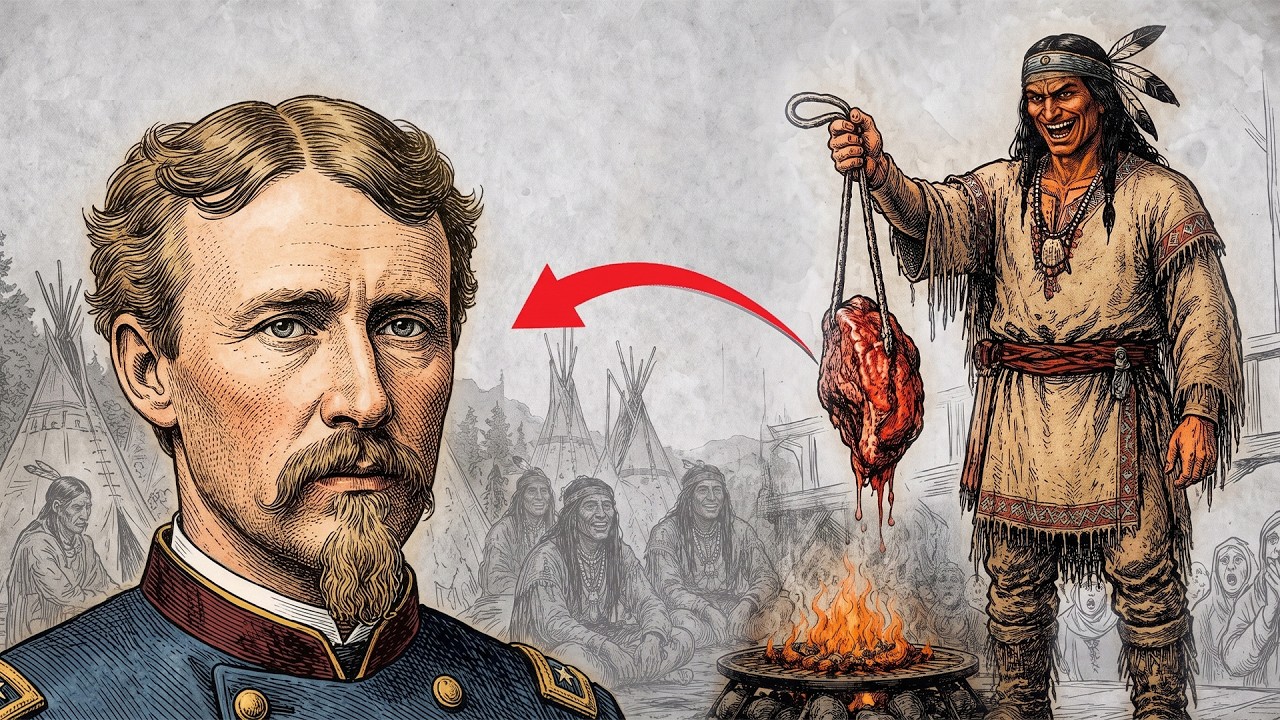
Rain-in-the-Face, held responsible for the murder of two white civilians during the Yellowstone expedition, was arrested on the orders of George Custer, and this arrest was carried out personally by Tom Custer in a very harsh and degrading manner. The proud warrior, kept in prison and chained for a while, swore revenge when he somehow managed to escape. According to rumors, Rain-in-the-Face had sworn before his tribe that he would cut out and eat alive the heart of that arrogant captain who had humiliated him by toying with his honor. So on that bloody June day in 1876, when Tom Custer’s corpse was found mutilated on the battlefield, his chest allegedly slashed open and his heart removed, the first name that naturally came to everyone’s mind was Rain-in-the-Face.
The press of the time practically jumped on this story, and newspapers covered this tale of revenge for weeks. Even the famous poet Henry Wadsworth Longfellow wrote a poem titled The Revenge of Rain-in-the-Face, cementing this dark legend as a permanent part of American culture. Years later, Rain-in-the-Face would deny these claims, stating that in the chaos of the battle, he didn’t recognize the Custer brothers and didn’t eat anyone’s heart, claiming it was just a fairy tale made up by white people. However, that massive deliberate wound in Tom’s chest and the absence of his heart ensured that this personal revenge theory remained one of the most shocking anecdotes in history.
Another strong theory was directly related to a crisis of identity, a fatal illusion created by the horrific dust and smoke on the battlefield. Today, we always picture George Armstrong Custer as a legendary figure fitting his nickname “Son of the Morning Star” with his long wavy blond hair and flamboyant outfits. However, right before setting out on the Little Bighorn campaign, George Custer had his famously long hair cut very short to ward off lice and protect against the summer heat, and he had even started balding slightly. Furthermore, that day, both George and his brother Tom were wearing very similar, specially embroidered, fringed buckskin jackets typical of the frontier region.
These two brothers, whose facial features already resembled each other greatly, became indistinguishable from a distance and through the dusty view of the battlefield once their hair was cut short. The Native American warriors didn’t know exactly who the soldiers they were facing were. To them, they were all uniformed enemies invading their lands and attacking their villages. But killing the leader of the enemy army, the great chief, with one’s own hands was the greatest spiritual and social honor a warrior could achieve.
George Custer might have been shot and fallen early or midway through the battle, losing his leadership role prematurely. But Tom Custer, with his stubborn and fearless nature left over from the Civil War, continued to fight, yell, and give orders. Perhaps he was trying to rally his soldiers until his last moments, putting up a desperate but fierce resistance with his revolver. Because of his buckskin jacket, short hair, and the uncompromising aggressive aura of a commander he projected, the native warriors might have thought the actual commander, the legendary Yellow Hair, was Tom.
If they believed he was the commander who brought the army there and ordered the attack on their villages, focusing the greatest rage, the most ruthless rituals, and the heaviest mutilation on his body completely aligned with the merciless logic inherent in Native American warrior culture. We also cannot ignore Tom Custer’s personal fighting style and his ferocious stance on the battlefield. He was not the kind of man to shoot from a distance and hide behind a trench. He was a soldier who knew no fear, who had spent his life in the toughest, bloodiest, and closest contact moments of war, winning two medals of honor through hand-to-hand combat.
It is highly probable that even when his ammunition ran out on that hill at Little Bighorn, and all he had left was his knife or the butt of an empty rifle, he inflicted fatal damage on the warriors around him. According to what Cheyenne and Lakota natives told anthropology researchers years after the battle, most of the soldiers panicked out of fear when the circle closed in. Some sped up the end by committing suicide with their own weapons, while others fell to their knees in despair, crying and begging for mercy. But among them, there were also soldiers who fought like wild animals until their last breath, landing heavy blows on every approaching warrior, fighting even as they died.
If Tom Custer killed a few native warriors in those final moments, then in the eyes of the rest of the tribe, he ceased to be an ordinary enemy soldier and transformed into a demonic dark force that absolutely had to be destroyed. When Plains Indians killed a stubborn enemy who caused them heavy losses or inflicted too much damage, they would resort to completely destroying the body physically to prevent his spirit from haunting them in the afterlife. The severing of Tom’s fingers was to prevent him from holding a weapon again in the next world. The crushing of his eyes and face was so he couldn’t find and see them in the spirit realm.
The deep slashing of his leg muscles served an entirely spiritual purpose, such as preventing him from walking after them for revenge. Every arrow shot into that body, every stone strike to his face, was a bloody confirmation given by the natives of just how dangerous a man Tom Custer was in life. The officers at the scene made a massive effort to hide the condition of Tom’s body from the public, and especially from the surviving members of the Custer family, primarily George Custer’s widow, Elizabeth. Knowing the truth in all its nakedness would not only devastate the family, but would also profoundly shake the morale of the army and the American public’s view of the frontier wars.
In the strict, moralistic, and sensitive structure of the Victorian era, it was deemed that the American public was not ready to read about such savagery, the dismemberment of the human body in such a horrific way. While the telegrams commanders sent to Washington contained cold, ordinary, and official phrases stating merely that Tom’s corpse was severely damaged, the bloodcurdling, uncensored details of the truth would only emerge years later. The newspapers only settled for writing that, “Unfortunately, some damage was done to the bodies of the soldiers on the battlefield. ” No columnist, no reporter mentioned Tom’s completely crushed skull, his chest sliced open end to end, his ripped-out heart, or that unrecognizable, flayed face.
A soldier wrote in his diary years later, “When we found him, there was nothing human left. He was just a mound of hatred mixed with blood, dust, and dirt. ”
At Fort Lincoln, waiting for her husband and brothers-in-law to return victoriously to the sound of marches, Elizabeth Libby Custer’s world literally came crashing down when she received that dark news. In one day, Libby had lost her beloved husband, her brothers-in-law Tom and Boston, her other brother-in-law James Calhoun, and her young nephew Henry Reed.
Five male members of one family vanished on the same barren hill in a single hot afternoon. As army commanders delivered the news of the deaths to tearful Libby Custer and Tom’s devastated elderly parents, they only said that the soldiers fought extremely heroically, honorably, and died instantly. Tom Custer’s painful final moments and the horrific degrading condition his body was found in were carefully kept from the family forever, sealed by vows sworn among the officers. Even though Captain Benteen and other surviving officers told the truth in all its nakedness and horror in intimate letters they exchanged among themselves, when they faced Libby Custer, they always told that memorized clean and heroic story.
While Libby devoted the rest of her life to defending her husband’s legend, she remained forever unaware of the savagery inflicted upon Tom’s body. Exactly a year later, in the hot summer months of 1877, the American army returned to that cursed hill to properly exhume their dead and hand over the remains of the commanders to their families. Recovering his brother George’s remains was the army’s top priority. When a special detail commanded by Captain Michael Sheridan reached the Little Bighorn Valley, the scene they encountered was as horrifying and nauseating as that very first day a year prior.
The harsh Montana winter conditions, severe spring rains, and the region’s wild animals and wolf packs had scavenged the shallow graves, eroded the soil, and scattered the bones of many soldiers over a wide area of the valley. Human bones bleached white by the sun, shattered skulls, rusted buttons, and rotted uniform pieces were scattered in the wind. George Armstrong Custer’s grave was carefully searched, and when found, his remains were gathered with great care. His bones were placed in a specially prepared coffin to be sent to the military academy at West Point for his ostentatious and ceremonial final journey.
But when it came to the grave of his brother Tom Custer, who died right beside him, things were much more complicated and heartbreaking. When Tom’s grave was opened, all that remained were mixed, broken, and scattered bones. Because body integrity was completely lost and bones had been scattered by animals, it was incredibly difficult to distinguish his remains from the mixed bones of other soldiers with absolute certainty. His famous TWC tattoo on his right arm had long since blended into the soil.
His skin and muscles had rotted away. All that was left were the deep hatchet scratches and fractures left by that merciless hatred on the bones. Tom Custer’s remains were not sent to West Point with a grandiose state ceremony in front of massive crowds like his brother George. Instead, they were sent to the military national cemetery in Fort Leavenworth, Kansas.
Just as in life, even in death, he remained under his older brother’s massive shadow and great fame. While George Custer became the subject of hundreds of books, countless paintings, and Hollywood movies as one of the most controversial but grandest legends in American history, his Medal of Honor winning brother Tom, who stood right by his side and perhaps fought far more bravely, was placed in that cold Kansas earth silently, without ceremony. Tom’s gravestone was exceedingly plain and unpretentious, conforming to military regulations. Only his name, rank, and date of death were written on the white marble.
There was no trace, no mark on that stone to indicate what a two-time American Medal of Honor hero actually went through on that dark Montana hill, or how his body fell victim to unprecedented rage. To grasp the true meaning of this unprecedented savagery, we need to look at the historical background of the era and the horrific desperation the Plains Indians found themselves in. This was not just a momentary frenzy of a few angry warriors. This was the final, deadliest, and most desperate cry of a people who had been subjected to decades of lies, broken treaties, and having their lands taken away.
With the 1868 Fort Laramie Treaty, the Black Hills were declared sacred and untouchable for the Lakota, and whites were strictly forbidden from entering these lands. But when George Armstrong announced he had found gold in this region with his troops, the American government tore up the treaty like a piece of paper and turned a blind eye as thousands of gold prospectors flooded into native lands. For these people, prevented from hunting on their own lands, their sacred mountains invaded, forced into reservations, and meant to be assimilated, the 7th Cavalry Regiment was not a simple military unit. It was a direct symbol of death, starvation, and cultural extinction.
And Tom Custer, with those two medals on his chest, was one of the most loyal, most aggressive, and most visible cogs of this ruthless occupation machine. The memory of the Native Americans was extremely sharp, and the massacres of the past were passed down from generation to generation around campfires without ever being forgotten. How innocent women and children were butchered by American soldiers at Sand Creek, how Black Kettle’s peaceful camp on the banks of the Washita River was raided and destroyed in the freezing cold of winter personally by the Custer brothers, were still bleeding, fresh wounds in the memory. Tom Custer had been on the front lines in the Washita massacre, playing a major role in the burning of the villages and the mass slaughter of the native horses.
To the natives, he was not just an enemy officer. He was the flesh-and-blood embodiment of that cruel power that tore their families apart, burned their tipis, and dried up their sources of life. But the cruel irony of history would show itself once again in the aftermath of the Battle of Little Bighorn. That crushing victory won in that valley that day for the Lakota, Cheyenne, and Arapaho alliance was actually the most certain and swiftest beginning of their own end.
The native problem, which the American army had seen only as an annoying frontier issue until that day, turned into a total war of annihilation when the news of the horrific mutilated corpses of Custer, and especially officers like Tom, reached the East. The government and the public were utterly convinced that showing mercy to these savages was a massive mistake. Tom Custer’s unrecognizable body was turned into endless fuel for the American army’s fire of revenge. Tens of thousands of new soldiers were deployed to the region, winter camps were mercilessly raided, and bison herds were systematically and methodically slaughtered by the state to starve the Native Americans.
Just a few months after the victory, that great native alliance was forced to scatter and struggle with starvation and disease. Sitting Bull would seek refuge in Canada, while Crazy Horse would be forced to surrender, and shortly afterward be killed under suspicious circumstances by a bayonet. The silent, but bloodcurdling cry rising from Tom Custer’s corpse had actually signed the death warrant for all Plains Indians. Today, if you go to the Little Bighorn battlefield, as you walk along those barren and windy Montana hills, you hear nothing but the whisper of the wind.
The valley today has a very peaceful, silent, and almost melancholic atmosphere. Visitors look at the white marble markers around them to feel the violence of the battle. Those stones represent the spots where the soldiers who died that day were first found. Near the summit, in an area surrounded by an iron fence, George Armstrong Custer’s marker is highlighted in black letters.
Thousands of tourists come every year, look at that stone, and try to visualize the legendary commander’s last stand. But most visitors don’t even notice one of the hundreds of white stones lying just a few steps away from that marker, bearing no distinguishing features, looking exactly identical to the rest. Under one of those stones lies Captain Tom Custer, who walked in his brother’s shadow all his life, plunged into hell without a second thought for the sake of his orders, and fell victim to one of the darkest mutilation rituals in American history. Visitors pass that stone by because legends are always more appealing than the bloody disturbing nature of reality.
While George Custer lives on as a myth, Tom’s body was pushed into the dark corners of history as the most savage and ugliest face of reality that people want to forget and fear facing. On June 25th, 1876, as the sun slowly set behind the Little Bighorn Valley, there was no army, no commander, and no songs of victory left on that hill. All that remained was gunpowder smoke, earth painted crimson, the last death rattles of horses, and an endless deafening silence. While George Armstrong Custer took his first step on the path to history books, oil paintings, and American legends on that hill that day, his brother Tom Custer faded into eternity as a ghost, stripped of his identity, his body destroyed, and left out of the legends.
He became one of those unknown heroes who paid the heaviest price on the battlefield, yet whose story is always spoken in whispers behind the names of others. Today, the wind continues to blow on those barren hills of Montana. And if you listen closely enough, you can still hear the sorrowful story of a century-old grief, shattered lives, and that unending bloody clash of civilizations within that wind.






