The diary was wrapped in oilcloth, tied with a length of dressing tape, and hidden behind the wainscoting of room 12. The workman who found it, a careful Presbyterian named Lester Vermeer, was stripping the last of the paneling from a corridor on the north side of the old Otterbein Retreat in the deep pocket of Bath County, Virginia. The retreat had closed nine years before, and the building was coming down to make room for a fire road. Lester was working alone that morning in a hallway where the ceilings were low and the plaster smelled of something that had gotten into the walls a long time before and never left.
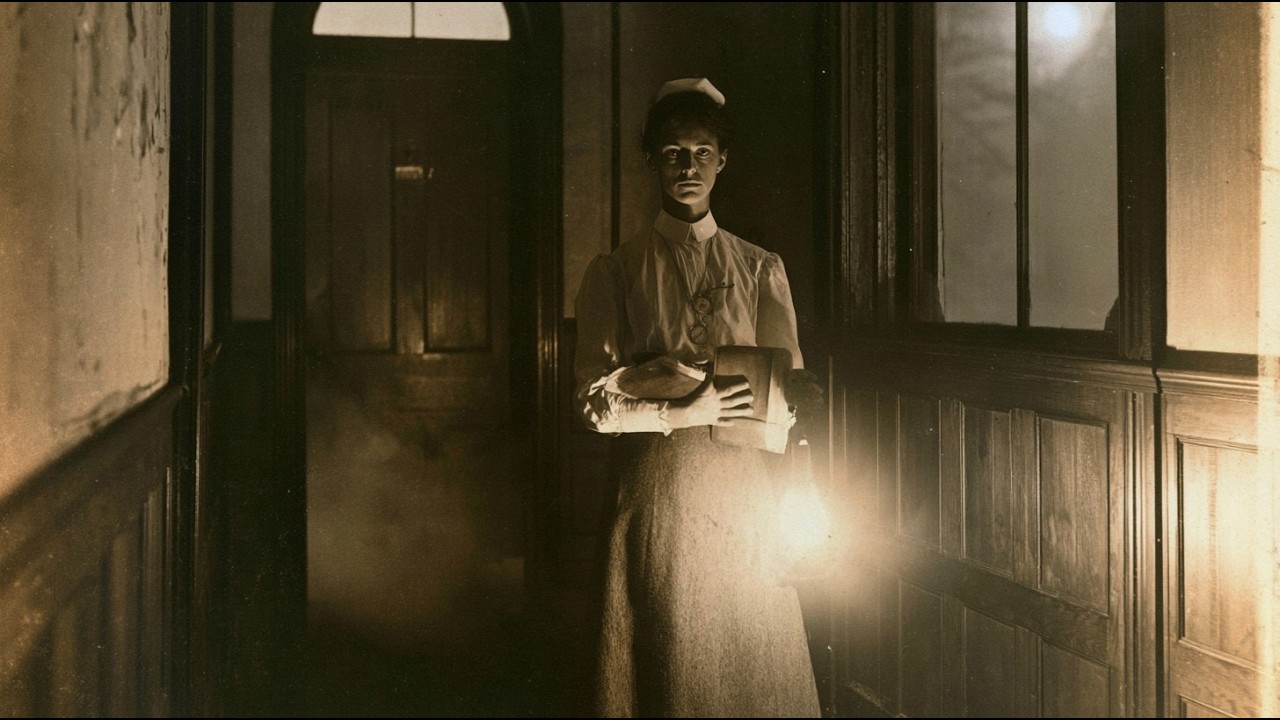
The diary was leather, blackened at the edges from age, not from fire. The first entry was dated the 11th of October, 1911. The last one, which stopped in the middle of a sentence, was written on the 23rd of December of that same year. The woman who kept it was named Marguerite Prevost.
She had disappeared from the retreat on the night of Christmas Eve, 1911. There was no body, no note, no final letter home. Only the diary, and the room, and what the diary said had been coming to the room every midnight. Every single one.
Marguerite Prevost was 28 years old the autumn she came to the retreat. She was tall for a woman of her generation, near five foot nine, with a thin frame that had gotten thinner in the years since her husband died. Her hair was dark, and she pinned it back so severely that the woman at the depot in Covington thought at first she was in mourning dress, which she was, though the black had faded into gray. Her eyes were pale gray, a color people called colorless when what they meant was tired.
She had a way of listening that made men lower their voices without meaning to. Her mother had been French, a midwife who worked the river town south of New Orleans. Her father was a country doctor from up near Charlottesville who had died the year Marguerite turned 20. She trained as a nurse in Baltimore at a hospital that took women who had no other place to go, and she had stayed on there through the death of her husband, a printer named Reuben Fenway, in the spring of 1910.
He had been 31 and healthy on a Wednesday and gone by Sunday. Marguerite had held his hand and read to him from Longfellow and watched the color leave his fingernails one at a time. After that, the corridors of the hospital where she and Reuben had first met began to feel like corridors she was walking already dead in. So when a placement notice came through the Nurses Association in September of 1911 for a night post at a private retreat in the mountains of Bath County, Virginia, she wrote her application the same evening.
She had never been further west than Charlottesville. She did not know what kind of place a retreat was. She only knew that it was far, and far was what she needed. She rode the train to Covington on the 8th of October, and from Covington a driver picked her up in a dark green coach that had been polished and repolished until it caught the sun like water.
His name was Odell Fan. He was 53 years old, a widower, and he had driven the road up to Otterbein for 19 years. He carried her trunk one-handed and asked her twice if she was sure. Marguerite thought the second time was a joke and answered with a small laugh, but Odell did not laugh back.
He asked her where she was from. She said Baltimore. He asked her if she had people. She said only her mother’s sister in Louisiana.
He said, “Well, that’s a piece. ” He did not explain what he meant. She wrote about that later. She said, “At the time, I thought he meant it was a long way for a woman to come alone.
Now I think he meant it was a long way to be able to walk back. ”
The road out of Covington ran west into a valley they call Warm Water Draw, where the water comes up hot from the ground even in winter and the fog stays past ten in the morning. There is a stretch of that road about six miles in where the mountain closes in on both sides and you cannot see the sky if you look straight up, only leaves. Marguerite would later write about that stretch.
She said it was the first place she felt she had gone under. That was her word. Under. Like a person going under the surface of a river she had chosen to walk into.
She said the horses knew the road better than Odell did. She said the horses moved a little slower on that stretch and Odell did not correct them. She said halfway through, a bird in the trees to the left of the coach called, and a bird in the trees to the right answered it, and the two calls were the same call, and neither one was a call she had heard before. She wrote in her diary three weeks later that when she thought back on the trip up, she remembered the smell of the horses and the sound of the coach wheels on the packed dirt, and a soft low sound underneath all of it that she had not thought about at the time but could not stop thinking about now.
A sound like a person humming a tune with their mouth closed. It had come from nowhere in the coach. It had not come from Odell. It had not come from her.
She had heard it for maybe 20 minutes that first afternoon, and then it had stopped, and she had forgotten it. She wrote, “I think that was the first time she heard me coming. I think she started learning me before I ever got there. ”
Otterbein Retreat sat at the end of the draw in a bowl of land that got the sun for maybe four hours a day in October and less than three by December.
It had been built in 1878 by a doctor from Philadelphia named Wenzel Otterbein on the foundation of an older lodge that had burned in the 1850s. The main building was two stories of white clapboard with a wraparound porch and a bell above the entrance, and a north wing that had been added on in 1891. The north wing was where the long-term residents lived, and the north wing was where Marguerite was assigned. She met the head physician the afternoon she arrived.
His name was Dr. Ambrose Halcott. He was 47, sandy-haired, with a soft way of speaking that Marguerite trusted immediately and then, in a way she could not explain to herself, unlearned trusting a few days later. He was kind.
She wrote about that in her second entry. He was kind and he laughed easily, and there was something about the way he watched her when she was not looking at him that made her think of a man who was trying to remember whether he had done a thing before and could not decide. The matron of the retreat was named Adelphine Croner. She was 61, German by birth, and she had been at Otterbein since 1892, which meant she had come during the expansion when the north wing was still new.
Adelphine was a small woman and severe. She wore her hair in a knot that Marguerite would later describe as too tight to be honest. She met Marguerite at the door of the nurses’ quarters and gave her the orientation in the corridor rather than in a sitting room. And the orientation was mostly what not to do.
Do not walk the north corridor after 11:00 at night. Do not open the door of room 12 for any reason between 11:45 and 12:15. Do not answer the door of room 12 if anyone inside asks you to. Do not speak to the occupant of room 12 about anyone else on the ward.
Do not answer questions the occupant asks about your family, your childhood, your husband, or the town you grew up in. Do not give the occupant your first name. Do not go into the linen room at the far end of the corridor after 10. Do not stand at the window at the end of the corridor at all, at any hour.
Marguerite waited for a smile, or a wink, or some sign that the matron was making a joke about the peculiarities of a long-standing patient. Adelphine did not smile. She said, “We lost a nurse three winters back who thought the rules were suggestions, and we did not find enough of her to send home. So.
Please. ” And then she gave Marguerite a copy of the same rules on a piece of paper folded twice, and a key, and a lamp, and the number of her room, which was seven, on the same corridor as room 12, five doors down. The first night, Marguerite walked the corridor at 10:00 to check the residents. There were 12 doors in the north wing.
Rooms 1 through 11 held long-term residents, whose names she had been given on a list, along with their ages and their conditions, most of which were described in the language physicians used in 1911, which is to say, vaguely. Melancholia. Nervous exhaustion. Chronic anxiety of the female kind.
Rheumatic irritability. Ambulatory apoplexy. None of them were violent. Most of them were quiet.
Some had been at the retreat for so long that the nurses who cared for them had grown old and been replaced twice. The resident in room one was a man named Ferdinand Auger, 71, who had been a piano tuner in Richmond before something went wrong with him at 40 and he stopped being able to bear the sound of any struck note. He kept his ears stuffed with cotton wool at all hours, and he wrote letters to the composer Chopin, who had been dead for over 60 years. He was cheerful in his own way, and asked Marguerite that first night what her Christian name was.
Marguerite, remembering the matron’s rule, told him her mother’s name instead. “Odile,” she said. He said, “That is a name for a woman who watches the swans go by. ” He said it kindly.
She wrote about that later. She wrote, “The rule about first names is not only about room 12. The rule is because they take. They cannot help it.
If you leave your first name in the corridor, someone will pick it up and wear it. ”
The resident in room four was a woman named Constance Odd, 62, whose file said melancholia, but who Marguerite quickly understood had been placed there by a brother who wanted her share of the family firm in Baltimore. Constance was clear-headed at least half the time. She asked softly on the first night whether the new nurse could post a letter for her.
Marguerite said yes. The letter never went out. The matron intercepted it at breakfast the next morning and returned it to Constance’s file without comment. Marguerite noted this.
She noted that the retreat was not only what it said it was. It was also a place where certain people were kept on the paperwork of certain other people for certain reasons that did not involve rest. But those were the ordinary sins, the sins Marguerite had already met in Baltimore in every hospital that took women. The sin at the end of the corridor was the one she had never met.
Room 12 on the list was not given a name. It said only occupant 12. Duration of residence: since founding. Age not disclosed.
Condition not disclosed. Instructions: refer to matron. Marguerite paused at that line for a long time, and then she walked to the door of room 12, and she pressed her ear to the wood. There was nothing at first, then she heard the sound of a woman breathing.
Slow, even. The kind of breathing that belongs to someone who is not asleep, but is trying to be. Marguerite stepped back from the door and walked to her own room and lay down in her clothes because she was cold, and she watched the ceiling, and she waited for midnight. Nothing happened, or nothing she could see.
She fell asleep at some point after 1:00. Around 3:00, she woke briefly because a moth was against the window. She got up and opened the window and let it out. When she opened the window, she noticed on the sill outside that a small circle of frost had formed in October on the outside of the glass.
She closed the window. She got back into bed. She did not sleep again. The next morning, she wrote her first entry.
It was short. “Reuben,” she wrote. She wrote to him in the diary as if writing letters, the way she had written to him during the summer they were engaged, when he had gone home to Wilmington to help his father. “Reuben, I have arrived at the place.
It is a house in a bowl of land with the mountains around it. There is a bell over the door. The matron has rules I do not understand and cannot decide whether to laugh at. There is a patient in a room at the end of my corridor whose name no one will tell me, and whose age no one will disclose.
I heard her breathing tonight through the door. She did not sound sick. She sounded like she was listening for me. ”
That was the first entry.
Marguerite did not write again for four days. By the fifth night, she had started to hear the other sound. It began at 11:40 on the dot. It was a voice.
Not from the door of room 12, but from somewhere just past it, in the wall between 12 and the linen room. A woman’s voice, low, saying a word Marguerite could not make out. Then a pause. Then the voice would say the word again.
Marguerite counted on that fifth night, and the voice said the word 32 times before it stopped at 11:45, five minutes before the beginning of the interval the matron had told her not to open the door in. Marguerite wrote about it that morning. “Reuben, the wall between 12 and the linen room is talking. It is a woman.
She says the same word 32 times, or she said it 32 times last night. I cannot make out the word. It might not be a word. It might be a name.
Tomorrow night, I will bring the drinking glass from the sideboard and press it to the wall. If it is a language, I will know it. ”
And that is how the diary really begins. The way a river begins as a spring and only later admits it is going somewhere.
The next night, she brought the glass. She pressed the open end to the wall and her ear to the closed end and waited. At 11:40 on the dot, the voice began. It was clearer through the glass.
It was not a word. It was a name. It was Marguerite’s own name. Marguerite.
Marguerite. Marguerite. Thirty-one times that night. She wrote to Reuben the next morning with a hand that would not stay steady.
She wrote, “It knows me. ” She underlined the two words twice. By the second week of October, she had stopped sleeping in her own room. She had moved a chair into the linen closet across the corridor from room 12, and she sat there from ten in the evening until three in the morning with the diary on her lap and a small lantern turned so low it barely showed the page.
She wanted to see whether the door of room 12 opened in that half hour between 11:45 and 12:15, and whether anything walked in or out. On the night of October 18th, she saw it, or she wrote that she saw it. She wrote that at 11:42 the voice in the wall stopped, earlier than usual. She wrote that the corridor smelled for the first time of wet stone, cold wet stone, the way a well smells when you crank the bucket up in November.
She wrote that she heard footsteps in the corridor, but they were not walking. She used that phrase. They were not walking. They were placing themselves.
As if a person did not know what walking was and was trying to construct it out of the sounds they had heard other people make. Left foot. Pause. Right foot.
Pause. Left foot again, but heavier, as if the second attempt had corrected the first. And then those steps went to the door of room 12. And the door of room 12 was opened from the inside at 11:49.
And then it closed. And then it did not open again until 12:17, when it opened from the inside again, and the steps came back out and went back the way they had come, past the linen closet where Marguerite was sitting with the lantern turned so low it did not show her, and continued on to the window at the end of the corridor. The window Adelphine had told her never to stand at. And whatever it was went into the window.
She wrote that phrase too. Went into the window. And she wrote the sky on the other side of the glass moved to let it through. She did not write again for two days.
When she did, she wrote about the matron. She had gone on the morning of October 20th to Adelphine’s office and closed the door behind her and asked plainly what was in room 12. Adelphine had been at her desk. She put down her pen.
She looked at Marguerite for what Marguerite described as a long time, and then she said one word. “Company. ” Marguerite asked whose company. Adelphine said, “Ours.
” And that was the end of that conversation. Marguerite left the office and went back to her corridor and did not sit in the linen closet again for four nights. She was afraid. That is her word.
Afraid. She wrote it plainly. But she was also, and this is her word too, curious. She was curious the way a person is curious about the wound they have not yet looked at.
So on the 25th, she opened the door of the retreat’s records room, which was on the ground floor near the kitchen, and she started to read. The records went back to 1878. Marguerite began with the founding. Wenzel Otterbein had bought the property from a family named Meshut for a price so low that even for the 1870s it must have been a favor or a hurry.
The Meshuts had run the lodge that stood on the property before the fire. And the fire, according to the county sheriff’s inquest at the time, had killed everyone inside on the night of the 3rd of February, 1852. Everyone, that is, except the lodge’s night matron, a woman whose name in the inquest was given only as Ismene. No last name.
No age. No place of birth. Ismene had been found the morning after the fire sitting on the front steps of the burned lodge in a wool coat that was not scorched, drinking a cup of water she had drawn from the pump. The inquest asked her how she had gotten out.
She said she had been let out. It asked her by whom. She said, by the guests. The inquest did not know how to write that down, so it wrote, subject unresponsive to further questioning.
Ismene was taken to the county poorhouse. She was recorded as leaving the poorhouse in the spring of 1853. She was not recorded as arriving anywhere else. She simply stopped being written about, the way people did sometimes when they went into a country as broken as western Virginia in the years before the war.
But Marguerite kept reading. She read the inquest testimony from the fire itself. It was strange testimony. The volunteer fire brigade that had ridden up from Warm Springs on the morning of the 3rd had reported that the fire had already been out for hours when they arrived, but that the lodge was warm as an oven, warmer than any burnt house had a right to be after a night that had gone down below freezing.
They had reported that there had been 11 bodies in the wreckage, which matched the guest register. Nine guests, the Meshut couple, and no one else. And that all 11 bodies had been in the same room on the second floor, in what had been the lodge’s small chapel. The chapel had a single narrow window and a door that opened outward.
The door was still standing when the brigade arrived. It had not burned. It was, in fact, open. The bodies were arranged in the room in a way the sheriff at the time had refused to describe in the ledger, using instead the phrase, “in a manner suggestive of prayer.
” Which is a phrase people used in that century when they had seen something that was not prayer, but did not know what else to call. Marguerite read that line three times. She read further. She found in the Meshut family papers that had been left with the property a small booklet of parish records from a church that had once stood there before the lodge was built.
The church had been Moravian. It had been abandoned in 1831 after a series of what the parish clerk had called, “difficulties of a kind we cannot commit to writing. ” The last minister of the parish had left a note in the register dated the 21st of December, 1831, that said only, “Whatever this valley kept before we came, it is still keeping. God forgive our building over it.
” The minister’s name was Hermann Wesendorf. He was 39 years old when he wrote that note. He is not recorded anywhere in the parish papers after that date either. And Marguerite would have closed the file there, except that on the last page, tucked in as a note from a clerk who probably had not thought about it in decades, there was a slip of paper that said, “Ismene readmitted Otterbein Retreat, October 14th, 1878, at the request of Dr.
Wenzel Otterbein, room 12. ”
Marguerite stared at that slip of paper for a long time. Then she went upstairs. She counted in her head the years.
1878 to 1911. Thirty-three years. If Ismene had been 30 when she went into room 12, she would be 63 by now. If she had been 40, she would be 73.
Marguerite had heard the woman in room 12 breathe. She had heard the woman speak her name. She had not heard the voice of an old woman. She had heard the voice of a woman her own age.
She wrote that in the diary. She said, “Either Ismene never left, or Ismene was never Ismene, or both. ” And then, in the margin, in a smaller hand, she wrote, “Or the person in the room is not the one who came in. ”
On the 28th of October, Marguerite began meeting the occupant of room 12 in the daytime.
This is where the diary begins to get careful, the way handwriting gets careful when the person writing knows the handwriting will be evidence someday. The matron had not forbidden her from opening the door in the daytime. She had only forbidden the half hour around midnight. So on the 28th at 10:00 in the morning, Marguerite knocked on the door of room 12.
There was no answer. She turned the knob. The door was unlocked. She opened it.
Inside was a small room. There was a bed against the far wall made up with a wool blanket the color of dry mustard. There was a chair by the window. There was a small table with a pitcher and a basin on it.
And there was a woman in the chair by the window. She was Marguerite’s age. She had dark hair pinned back. She had gray eyes.
Marguerite wrote plainly in the diary that evening. “She looked like me. Not similar to me. Like me.
As if a person had described me to a stranger and asked her to sit for the portrait. ” She was thinner. She was paler. Her lips were a color Marguerite had only seen once before, on Reuben on the Sunday afternoon he died.
And she was reading a book. The book, Marguerite noted, was Longfellow. The same volume Marguerite had read to Reuben. Not the same edition.
The same volume, page for page, in a copy that had been read so many times the spine was gone. The woman looked up from the book. She smiled. She said, “Marguerite, won’t you sit?
” She said it the way a friend would. She said it the way Reuben had said it when Marguerite would come home from her shift and he would put down the paper. Marguerite did not sit. She backed out of the room.
She closed the door. She went to her room and she wrote and she wrote and she wrote. The next day she went back. She went every day for the next four weeks.
She wrote about those visits carefully, in an unadorned way that made them worse to read. The woman in room 12 did not eat. Marguerite watched. She never saw the woman take a meal.
The tray was brought in the morning by a kitchen girl named Winifred Chase, who was 22 and quiet and did not like the north wing. The tray was left on the small table by the pitcher. In the evening Winifred took the tray back, and the food was gone. But Marguerite had watched the tray for an entire day from 10:00 to 5:00, sitting in the chair the woman usually sat in, having asked her to trade for a while, which the woman had agreed to with a small polite nod.
The woman had stood by the window during those seven hours. She had not moved. The tray had not moved. The food had not gone anywhere.
Marguerite had brought her own lunch and had not eaten it either. When Winifred came back at 5:00, the tray was empty. Marguerite had not looked away for more than a blink. She wrote to Reuben that night.
“Reuben, the food does not go into her. It goes somewhere. She is a place, not a person. A room, not a woman.
And I look like her. I do not know which of us is the copy. ”
She began to ask the woman questions, careful ones. Whose birthday is today?
What year is it? Where were you born? What was your mother’s name? The woman answered all of them.
She said her birthday was August the 2nd. That was Marguerite’s birthday. She said the year was 1911. She said she was born in a river town south of New Orleans.
She said her mother’s name was Odile. Odile had been Marguerite’s mother’s name. Marguerite had not told the woman any of these things. She had not told the matron.
She had not told the doctor. She had not written the answers in the diary in advance. She wrote them in the diary afterwards. In the diary, the answers were correct.
Every single one. She began to ask questions she did not know the answers to. What was your husband’s last purchase before he died? The woman said, “A Latin dictionary from a bookseller on Charles Street, for $2.
50. ” Marguerite did not know the answer. She wrote to Reuben’s brother in Wilmington and asked him if he remembered. He wrote back a week later that yes, Reuben had bought a Latin dictionary in the last week of April from a shop on Charles Street, for a price he thought was too high.
The brother did not remember the exact figure. $2. 50 seemed about right. On the 9th of November, Marguerite asked the woman something more careful still.
She asked, “What did he say on the Sunday? ”
The woman was quiet for a moment. Then she said, “He said, ‘Don’t sit up with me tonight, please. Go home and sleep.
‘”
And Marguerite had not written that down in any letter. Marguerite had not spoken those words aloud to anyone since the day Reuben died. Marguerite had not thought about those words on purpose in a year and a half. But he had said them, those exact words, on the Sunday afternoon before he died.
He had held her hand and said, “Don’t sit up with me tonight, please. Go home and sleep. ” And Marguerite had not gone home. She had sat up.
He had died at four in the morning. He had died holding her hand. She had thought since that if she had listened to him and gone home, he would have died alone, and she would have been spared it. She had never decided whether she was glad she had stayed.
She had never asked anyone else to weigh in. She had never written the sentence down. The woman in room 12 knew it word for word. Marguerite left the room that day without saying goodbye.
She wrote in the diary that night, “Reuben, she can hear me thinking, or she is thinking with me, or she is the room I do my thinking in, and I have been renting from her for a month without knowing it, and the rent is what I am. ”
She sat for a long time with the diary open, and then she wrote a small line at the bottom of the page in a hand smaller than her usual. “I want to hate her. I do not.
That is what will kill me. ”
By the middle of November, Marguerite had begun to go into the linen room. She had been told not to, but her fear had reversed direction. She was no longer afraid of what was in the corridor.
She was afraid of what was in her own head, and she wanted to know whether it was leaking. In the linen room on the 3rd of November, she found a shoe box on the top shelf behind the spare sheets. The shoe box held nine diaries. Nine.
Each one belonged to a nurse who had worked the north wing. The oldest was dated 1893. It had been kept by a woman named Odell Marsh, who had been 29, from a mill town in Massachusetts, and who had come to Otterbein after her only sister had died in childbirth. Odell’s diary described a man in room 12, not a woman.
A man who looked, Odell wrote, exactly like her father, who had been dead 19 years. A man who read the King James Bible in the same worn edition her father had read from at the kitchen table when Odell was a girl. Odell wrote that the man had asked her on the 17th of December whether she would come and sit for a while. He had said her father missed her.
He had said her father was tired of being alone. Odell wrote to someone whose name she did not put down, only the initial F. “F, I do not know if I can hold out much longer because he is very kind and I have been very alone. ”
Odell disappeared on the 28th of December, 1893.
Her body was never found. The second diary in the box belonged to a woman named Petruska Val, 31, from a Dutch settlement in Michigan, and it was dated the winter of 1896. Petruska had lost a fiance to typhoid two years earlier. Her diary described a woman in room 12 who looked like Petruska’s mother at 30 and who spoke Dutch.
Petruska had not spoken Dutch in 10 years and had almost forgotten it. The woman in the room spoke it fluently, and spoke it in her mother’s dialect, which had come from a specific coastal village that Petruska’s mother had left as a child and that no one in Virginia could possibly have known. Petruska disappeared on the 22nd of December, 1896. The other seven diaries were similar.
Every nurse had lost someone. Every visitor to room 12 had worn the shape of that lost person. Every one of them had been called by name. Every one of them had been given something the nurse thought no one else could have known.
And every one of them had disappeared in the last three weeks of December. Marguerite counted the years. 1893, ’96, ’98, 1900, ’02, ’03, ’05, ’06, ’08. There were gaps.
The retreat had not lost a nurse every year, but it had lost one every year that a certain kind of woman had worked the north wing. The most recent was from the winter of 1908, kept by a woman named Barbara Klim, 33, who had been at Otterbein six months. Barbara’s diary ended on the 19th of December, and it ended in the middle of a sentence, exactly the way Marguerite’s would end four years later. The sentence Barbara was writing was, “I think I am going to walk in tonight, because if I do not walk in, then he will keep walking.
”
Every one of the diaries ended in the same way. The last entry was written on the eve of a departure that never happened. Every one of those women had disappeared from the retreat between the middle and the end of December of the year the diary covered. Not one had been found.
Not one had left a note. Not one had left a body. And every one of them in the final entries described the same thing. They described a person in room 12 who looked like their own grief, who knew things about them, who called them by name, who read the same book they had once loved.
Not the same author. Not the same subject. The exact book. Marguerite sat on the floor of the linen room with the nine diaries in her lap and understood for the first time why the matron had told her not to give the occupant her first name.
Because giving your first name was the beginning of an exchange. And the exchange was already underway. The occupant of room 12 had already learned her, not from her, but through her. The way a mold learns the shape of what has been pressed into it.
And Marguerite, who was already thin, who had already thinned further since Reuben died, was becoming the softer of the two shapes. She wrote her plan on the 20th of November. It was a short plan. She would leave the retreat in the second week of December.
She would go by coach to Covington, by train to Baltimore, and then farther. She would not tell anyone at the retreat where she was going. She would take her diary. She would leave the matron a letter.
She would give the occupant nothing. She would not knock on the door of room 12 again. She would not answer if the occupant called through the wall. She would seal the linen room with a nail and a plank.
She would do all of this by the 10th of December. She wrote the plan out. She read it three times. She put the diary under her pillow.
She went to sleep at 11:00. She woke at 11:40. The voice was in the wall. It was saying her name.
And underneath her name, quieter, almost fond, it was saying Reuben’s. She did not sleep after that. She did not leave on the 10th of December either. Or the 12th.
Or the 15th. She wrote in the diary that she had tried to pack her trunk on the 10th and had found, when she opened it, that it was already packed, and packed better than she would have packed it, and packed in a way she did not remember. Her clothes were folded in a manner she had not learned. Her diary, which she had never left in the trunk, was in the trunk on top, as if someone had wanted her to see that it had been read.
She took it out. She checked the last several pages. They were the pages she had written, her handwriting, her words. But the trunk had been packed by someone who did not want her to have to think about packing it.
Marguerite could not decide whether that someone was Adelphine trying to help her leave, or someone else making sure she could leave the moment she chose to, so that leaving would feel possible right up until the moment it wasn’t. She wrote that on the 12th she had gone to the coach house to ask Odell to drive her to Covington. Odell had looked at her the way he had looked at her the day she arrived, and said, “Ma’am, I’ll drive you any day you want except today. ” And had not explained.
He had, however, given her a piece of bread wrapped in cloth. He had said, “In case. ”
Marguerite had put the bread in her pocket. She ate a piece of it that evening.
It was fresh. It was not from the retreat’s kitchen. It tasted like a bread her grandmother had made in Louisiana when Marguerite was small. Marguerite had not eaten that bread in 20 years.
Marguerite had never told anyone at the retreat that her grandmother had baked. She wrote in the diary that night, “Either Odell knows things he should not know, or Odell is trying to remind me of the parts of me she does not have yet. I cannot tell which. I do not know if he is a warning or a gift.
And I do not know who from. ”
She wrote that on the 15th she had walked to the road and gone about a mile down it and had turned around because she could not remember, when she reached the mile marker, why she had been walking. She turned around and walked back to the retreat. On the way back she passed a woman going in the other direction on the road.
A woman walking with the small determined stride of a person leaving somewhere for good. The woman was Marguerite, or a woman who looked like her. Or the woman from room 12. Marguerite wrote, “And I do not know how to say this, Reuben, but I nodded to her as we passed, and she nodded back, and the two of us went the way we were going, and I do not know which of us was going home.
”
That night back at the retreat, Marguerite went to her room and looked in the small mirror over the washstand. She said to the mirror in a low voice, “Tell me something Reuben told you that he never told me. ” The mirror did not answer. Marguerite wrote in her diary that she was almost disappointed.
On the 16th of December, she wrote that she was going to open the door at midnight. On the 23rd of December, she wrote her last entry. It was written in the early evening. “Reuben.
I’m going to open the door tonight. I know I was told not to. I know what happened to the others. I have read every one of their diaries, and I know that not one of them opened the door, and not one of them lived to write the next morning.
So I do not know what I hope will happen. I do not think anything good will. But I have understood in the last several days a thing that the other nurses did not understand, or did not write down if they did. And I want to write it here in case you are the one who finds this after me.
The occupant of room 12 does not visit us. We visit her. She has been in that room since ’78, and before that in a room in the lodge that burned. And before that, I think, in this valley, in some kind of room the mountain kept for her since before people came here to build lodges at all.
She does not come out. She has never come out. What comes out of room 12 at midnight is us. It is the shape she has learned to make using the piece of us she has been given.
My piece this fall has been Reuben. She has learned him through my grief, the way a spider learns the shape of a room by touching every part of it in the dark. And when I opened the door of room 12 in October and saw a woman who looked like me, I was not looking at Ismene. I was looking at the shape she had already learned to make of me, waiting to be worn.
Tonight, I am going to walk in. I am going to sit down in the chair by the window. I am going to open the copy of Longfellow and read to her the way I read to you. Because I would rather she wear my kindness than she wear my fear.
If I am wrong, and there is nothing kind in her, then at least I will have gone in on my own feet. But I do not think she is only cruel. I think she is lonely. I think she has been lonely in that room since before the county had a name.
And I think the sentence stops there. ”
There is no more writing in the diary. No signature. No next page filled in.
Lester Vermeer, who found the diary in 1963, took it directly to the county sheriff’s office in Warm Springs. The sheriff on duty was a man named Malachi Core, 68 years old, who had grown up in Bath County and had been a boy of 16 when Marguerite Prevost was reported missing. He remembered the case. He remembered the coach driver, Odell Fan, long since dead, saying at the time that the matron of the retreat had asked him to drive up to the north wing on Christmas morning and stand outside the door of room 12, and knock, and open the door if there was no answer.
He had done it. He had opened the door. The room had been empty. There had been a bed made up with a mustard-colored blanket.
A chair by the window. A small table with a pitcher. A copy of Longfellow on the chair. No woman.
No Marguerite. No Ismene. No sign that either woman had ever been in the room. Except Odell had said that when he stood in the room for a while listening, he heard someone breathing behind the wall between 12 and the linen room.
Slow, even. The way a person breathes who is not asleep, but is trying to be. He closed the door. He told the matron the room was empty.
The matron nodded, thanked him, and asked him please, please never speak of that morning to another living person, because there was a nurse coming in the new year, and the nurse would need not to know. Marguerite Prevost was declared missing in January of 1912. The sheriff at the time closed the case in April of that year with a single line in the ledger. “Subject presumed to have left the retreat of her own accord.
”
That was the wrong word. That is always the wrong word. Otterbein Retreat continued to operate for another 43 years, and every one of those years the north wing had a night nurse. And every one of those nurses was young and grieving and thin.
And in the boxes that the county took away when the retreat closed in 1954, there were more diaries. There were 19 of them. Sheriff Corr counted. He did not read them.
He put them in an envelope, sealed it, and put it in the back of a filing cabinet that his successor eventually took to the county archive without opening. As far as anyone knows, it is still there. No one has opened it since. Lester Vermeer quit the demolition job the day after he found the diary.
He told his foreman he had a bad ankle. He did not have a bad ankle. He went home to his wife and told her he was not going back up into Warm Water Draw. She asked why.
He said, “Because I stood in the doorway of room 12 for about a minute after I pried the wood loose. And while I was standing there, I heard someone behind me say my name. My name, not my last name, my given name, which nobody in that valley knew. ”
She was quiet.
Then she said, “Well, then we won’t go back. ” And they didn’t. Lester lived another 22 years in a house in Buena Vista. He never went back into Bath County.
He never told anyone else the story until his last week, when he told his son, and his son told his son, and eventually one of them told this story. The bell over the door of Otterbein Retreat was taken down in the summer of 1955 and installed in a church in Millboro Springs, where it still rings on Sundays. The rest of the building came down in 1964, the year after Lester found the diary, and the fire road went in over the north wing, and the road is still there. If you drive it on a night in late December, near the middle of the draw there is a stretch where the fog does not move even when the wind is blowing.
If you stop your car, and roll the window down, and listen, some people say they can hear a voice from the trees, not from any one direction, from the trees. The voice is saying a name. It is not always the same name. It is your name.
And that, as far as anyone has been willing to write down, is where Marguerite Prevost went, and where the woman in room 12 still is, and where whatever the mountain has kept in that bowl of land since before there were nurses and doctors and lodges and coach drivers is still keeping itself, waiting for the next thin, tired, grieving woman to walk into the draw and say yes.






