In the early spring of 1813, a shipbuilder from New York City stood at the edge of a Pennsylvania forest on the shore of Lake Erie and looked at the standing timber, and decided that those trees were going to become a fleet. Not one boat, not one gunboat, but a fleet of nine warships, including two 110-foot brigs of war, each carrying twenty guns, built from trees that were still standing when the orders went out in late winter. The man carrying the orders was twenty-seven years old. The man carrying the tools was in his fifties.
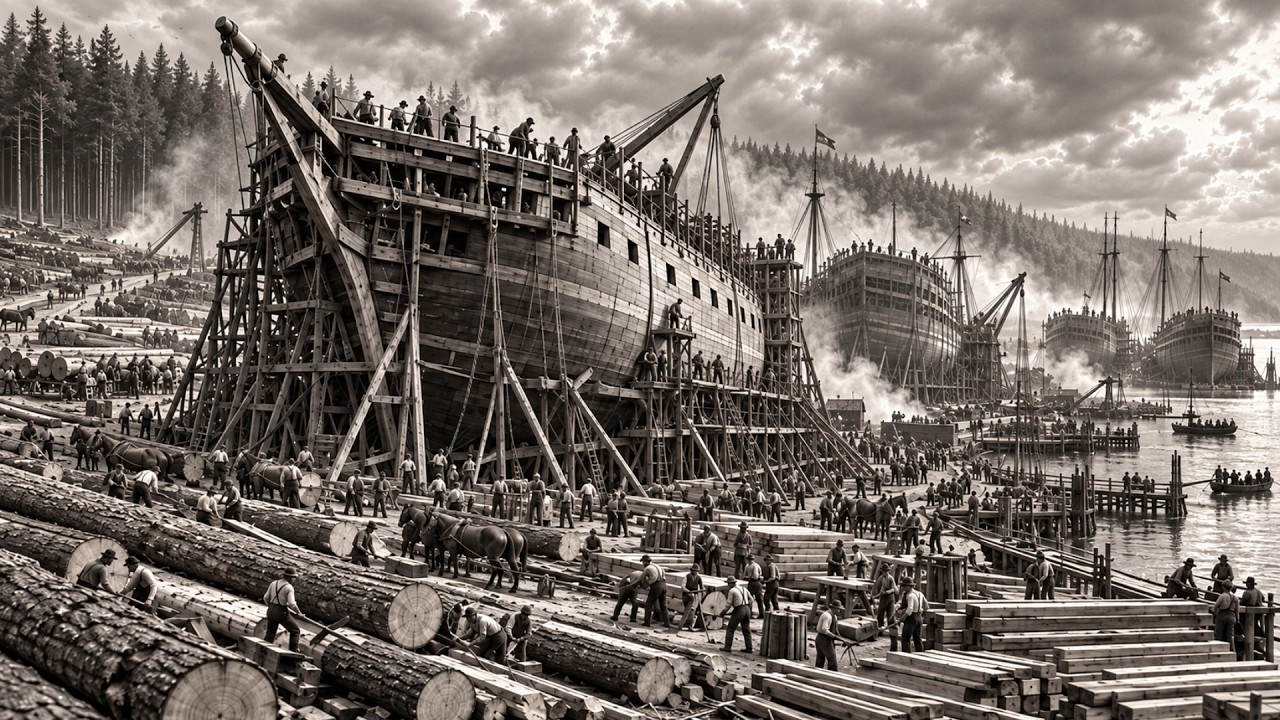
Over nearly four months of ice and mud and sickness and missing iron, the two of them did something that had never been done in this way before: they built a fighting fleet out of the wilderness. That is the story, the five months before the first shot was fired, and the question of how you get from standing trees to a warship in the time it takes a river to flood and recede. Two men carry most of this story. One is Oliver Hazard Perry, a commander in the United States Navy, twenty-seven years old when he arrived at Presque Isle in late March 1813.
The other is Noah Brown, the senior shipbuilder from New York, fifty years old and experienced enough to look at the work required and tell you within ten days how long it would take. The lake resisted them in order. First there was no dried, prepared timber. Then the iron, rope, and guns were 300 miles away across roads that could barely be called roads.
Then the men began to fall sick. Then the British appeared off the coast. And finally, the sandbar at the harbor mouth was about to ruin everything within two days. This is where it almost ended before it began: the geography of the problem.
Presque Isle is a curved peninsula of sand and gravel that reaches out from Lake Erie’s southern shore and encloses a shallow bay about three miles long. In 1813 it was one of the few natural harbors on the American side of the lake. The town of Erie sits at the land base of the peninsula, a small community with a sawmill and a few hundred residents, located on one of the most strategically important bodies of water in North America. Lake Erie is not an inland pond.
It stretches 241 miles from west to east, 57 miles at its widest point, connecting the western and eastern Great Lakes. It lies directly between the American states of Ohio, Pennsylvania, and New York on its southern shore, and the British colony of Upper Canada on its northern shore. In the summer of 1812, a British army had captured Detroit at the western end of the lake under circumstances so embarrassing for the American side that the officer in charge was later court-martialed. To retake Detroit, the American army had to move west along the lake’s southern shore or cross the water directly.
Either way, British warships could cut their supply lines. The Americans needed the lake. They needed warships. To get warships in the middle of a war, they needed a place to build them that was protected and accessible, and Presque Isle was the best they had.
Here is the problem with that solution. At the entrance to the bay, where the peninsula curves back toward the mainland, a sandbar stretches across the opening in most places at a depth of about four feet below the surface. A rowboat could cross it without noticing. A heavily laden warship could not.
The British commander on Lake Erie, Captain Robert Barclay, knew the sandbar was there. He knew it from his charts and from his army’s scouts. Any ship built inside Presque Isle Bay would have to cross the bar to fight, and crossing it meant lightening the ship until the hull rose enough to float over four feet of water. A ship in that condition, with her guns on the wharf and her ammunition unloaded and her crew busy at the pumps, was not a fighting ship.
She was a target. Barclay held a blockade off the shore. He did not always man it. That decision cost him the lake.
Before Perry arrived, the American presence on Lake Erie amounted to a few armed schooners, two gunboats, and one prize. The prize was the Caledonia, a British vessel captured in a daring night raid in October 1812 by a lieutenant named Jesse Elliott. Elliott rowed out to the Caledonia with a small crew, cut her cable in the dark, and brought her to the American shore under enemy fire. Two guns, one captured brig.
That was the strength of the American fleet on Lake Erie at the beginning of the winter of 1812. The military buildup actually began in the fall of that year, driven by a shipmaster from Erie named Daniel Dobbins. Dobbins had witnessed the fall of Detroit, gone to Washington, and told the Navy Department what he had seen and what the lake needed. The Navy gave him the authorization, a modest sum of money, and sent him back to Presque Isle to begin building.
By the time Perry arrived in late March 1813, Dobbins had partially raised the hulls of one brig and laid the keel of a second. He had cut some timber. But he had no guns, no iron, no rope, no sails, and not enough skilled shipwrights to finish the work at a useful speed. Perry looked at what existed and wrote to the Secretary of the Navy.
He needed a master shipbuilder. He needed supplies. He needed men. He needed all of it faster than the Navy Department’s usual channels could provide.
The Secretary sent Noah Brown. Noah Brown had been building ships in New York City since before the turn of the century. He and his brother Adam ran a shipyard at Corlears Hook on the East River, and their reputation with the Navy was tied entirely to the type of work Perry needed: fast, solid construction finished on the schedule they promised. During the Quasi-War with France, the Brown brothers had built gunboats for the Navy on contract.
They understood naval construction, naval requirements, and naval impatience. Brown left New York in March 1813 with a crew of ship carpenters, somewhere between fifty and one hundred men, depending on which account you believe, all from the New York yards. He traveled overland by whatever combination of roads and rivers the season allowed, and reached Presque Isle in late March. He spent his first day inspecting what Dobbins had started, walking the timber yards to assess what was there and what was missing.
He gave Perry an estimate: ninety days to fit out the two brigs, put the smaller vessels in order, and launch. It took 120 days, which was close enough. The two brigs were the Lawrence and the Niagara. Each was 110 feet long along the deck, 30 feet across the beam.
Each was designed to carry twenty guns, ten on a side, with two additional pivot guns mounted on swivels amidships. At combat displacement, each weighed roughly 480 tons. Start from nothing and think about the sequence. The keel is laid first, the ship’s backbone, a continuous piece of timber running the length of the hull.
For a 110-foot ship, it might measure eight by twelve inches and weigh several tons on its own. It must be set absolutely straight on a foundation of blocks. The curved ribs that give the hull its shape are raised from the keel one at a time. Each must be braced until the frame can hold itself.
Then the planking goes on, layer after layer of oak over the outside of the frame. Each plank is driven tight against the one below it and sealed with tar-soaked oakum, pounded into the seams with an iron tool and mallet. Then the deck is laid. Gunports are cut through the sides.
The masts are stepped into their sockets. The rigging is stretched. The guns are hoisted by tackles and set on their carriages. Every one of those steps happened by hand at Presque Isle in the spring of 1813.
Brown had no steam sawmill. Logs were converted into planks with a pit saw, a long blade worked by two men, one standing above the log and one in a trench below it. A skilled pair of pit sawyers in a good day could produce two or three hundred board feet of planking. Brown needed thousands.
He had his New York carpenters working the pits from first light until dark, and he hired whatever local men he could recruit from Erie and the surrounding settlements to work beside them. The wood was green, every piece of it. Seasoned lumber, the kind you build a ship with when you have two years and a covered storage yard, has dried since it was cut. As it dries it loses moisture and settles.
A seasoned oak plank will not shrink further or twist once it goes into service. A green oak plank will do both while it dries, which means the caulking will loosen, the seams will open, and the fastening holes will loosen around the wooden treenails and bolts that hold everything together. Brown knew this. Perry knew it.
The Navy Department knew it. A ship built of green timber had an operational life measured in seasons, not decades. What it had was the next six months, and the next six months was all anyone was asking of it. A warship of that era required iron in quantities no local source could supply.
Anchors, iron chains, bolts and spikes by the hundreds, cannon and their shot and powder, gun carriages, block-and-tackle systems by the dozens, miles of rope for standing and running rigging, sailcloth. None of it was made at Presque Isle. The nearest ironworks of any adequate size was in Pittsburgh, 120 miles south across sparsely settled country with no paved roads, turning to mud with the spring thaw. The route ran through Meadville down to Pittsburgh by whatever combination of tracks and trails the wagons could manage.
In April and May of 1813, the roads on that route were in the condition you would expect after a winter of freezing and thawing: hub-deep in mud in the lowlands, cut by streams at the valley crossings, and in places washed out entirely. The guns were the most urgent matter. The Lawrence and Niagara together needed forty guns, and the Navy was gathering them from wherever it could find them. Some came from Philadelphia, some from Sackets Harbor on Lake Ontario, some were fresh castings from the Pittsburgh foundries.
Getting any of them to Erie meant loading them on wagons and hauling them over those roads, gun by gun. One naval officer, writing about the supply effort in a letter that summer, described part of the road south of Erie where a gun had to be lifted off its carriage, the carriage dragged out of the mud on the shoulders of the drivers and whatever soldiers were nearby, then the gun reloaded and the march resumed. He did not describe this as an unusual event. He described it as a typical day on that road that spring.
The first gun did not reach Presque Isle until June, though construction had started in March. Perry wrote to the Secretary of the Navy in June that of the forty guns allotted to the brigs, he had received only twenty. He was not restrained in his opinion of the matter. The rope situation was nearly as bad.
A ship’s rigging was measured in miles, and it had to be laid from hemp fibers at a ropewalk, a long narrow building where the fibers were spun and twisted into cordage in successive passes. There was no ropewalk at Erie. Whatever rope arrived came in coils by wagon from Pittsburgh or anywhere else it could be obtained. What did not arrive in time was improvised or substituted, and Perry’s correspondence from the period mentions arrangements for rigging that did not quite match what the ship designs called for.
By midsummer, malaria was spreading through the camp at Presque Isle. The Pennsylvania shore of Lake Erie sits in low, marshy country, and in July and August the wetlands at the head of the bay produced mosquitoes in numbers the workmen and sailors could not understand or avoid. The illness was called lake fever in the records of the period, which tells you what people observed without identifying the true cause. The real cause would not be established medically for another half century.
Perry wrote to the Secretary of the Navy in July telling him that his force, which by then had grown to several hundred men between shipyard workers, sailors from other stations, and soldiers detached to help, had more than a hundred sick and unable to work at any one time. The number varied from day to day. On bad days it grew. Perry himself was ill for parts of July and August, writing his dispatches from a sickbed and continuing to push the work forward through letters and whatever hours he could stand.
Brown kept his New York carpenters at it. They were professionals with a contract and a reputation to protect, so they kept working without stopping. It was harder to keep the soldiers and sailors assigned as general laborers at work when they were sick and being paid only in rations, and the Navy’s supply of replacement men was not keeping pace with the losses. The last major ship was launched on the fourth of July.
The choice of date was not accidental. The Lawrence and the Niagara lay in Presque Isle Bay through the final weeks of July, fitted out, armed, and ready, except that they could not leave. The sandbar at the harbor mouth stood between them and the lake. The Lawrence, with her guns, stores, and crew aboard, needed nine feet of water.
The sandbar at its shallowest crossing sat about four feet below the surface. The gap was five feet, and there was no natural way across it. Brown had thought about this in advance. The answer was camels.
A camel in the terminology of the period was a watertight wooden box that could be flooded to sink it, then pumped out to create lifting force from below. The principle is the same one rescue teams use to refloat a sunken ship today. Remove enough water around the hull and the hull rises. Brown built the camels at Presque Isle from the same timber and with the same labor that built the schooners, and two of them were large enough to lift a 500-ton warship several feet out of the water.
The operation began on the first of August. The Lawrence’s guns were removed and landed on the wharf, reducing her displacement. The camels were flooded and brought up alongside the hull. Cables were passed under the keel and secured to the camels on both sides.
Then the pumps began. And while the pumps worked, Barclay’s fleet was visible to the north. This is the detail in this story that is hardest to get past. Robert Barclay had built his entire strategy around the sandbar at the entrance to Presque Isle harbor.
He knew the American brigs could not cross it under normal circumstances. He had been patrolling offshore for months on the assumption that when the Americans tried to cross, his ships would be there to destroy them in the attempt. On the first of August 1813, when the Lawrence was floating high without her guns, the pumping just begun, and the camels being positioned alongside her hull, Barclay was in exactly the position his strategy had been designed to put him in. He did not attack.
The reasons he gave afterward, at the court-martial that followed his defeat, were varied. He cited the state of his own ships. He cited orders from his superiors not to risk an engagement before he was fully provisioned. He cited the timing of wind and weather.
The court-martial acquitted him honorably under the circumstances, which is what happens when a commander loses a battle that looked unwinnable on paper. What the records cannot deny is the operational result. The Lawrence sat without her guns for two full days while the camels lifted her over the sandbar. The Niagara followed.
The smaller vessels crossed by themselves. At no point during any of it did Barclay bring in his fleet. On the morning of the second of August 1813, the American fleet on Lake Erie existed for the first time. What Brown had built was nine ships: the two brigs, four schooners, one sloop, one captured British vessel taken into American service, and one gunboat.
The total armament among the nine came to about fifty-four guns, with the two big brigs carrying the fleet’s main weight. The flagship Lawrence carried the battle flag that Perry had ordered sewn before the campaign. On a blue field in white letters it read: Don’t Give Up the Ship. The words were attributed to Captain James Lawrence of the USS Chesapeake, who had said something much like them as he was carried below dying after a fight with a British frigate off Boston harbor in June 1813.
Perry had named his flagship after the dead captain and taken his words as his own motto. The fleet trained on the lake through August. Perry had never commanded a fleet action before. Most of his officers had not either.
The men who crewed the ships came from every direction. Some were navy sailors transferred from other stations. Some were soldiers detached from Harrison’s army on the Ohio shore. Some were volunteers from the lake towns.
A significant number were free Black sailors, a fact that appears plainly in the records of the period and disappears from many later celebrations of the battle. Perry complained about his crews in letters that lacked diplomatic tact. He wrote to Commodore Isaac Chauncey, the commander on Lake Ontario, that the men sent to him were generally unfit for service. Chauncey replied sharply.
The Navy Department had to step in. Perry had requested Jesse Elliott from Sackets Harbor. Elliott arrived in time for the battle. What Elliott did during the battle remained a subject of dispute for the next forty years.
The battle, September 10, 1813. The British fleet came out of Amherstburg at the western end of the lake in the early morning, visible from the American anchorage, and the two fleets closed on each other in light winds west of the Bass Islands. Perry’s plan was to close the distance quickly and fight at close range for the carronades. The carronade was a short, wide-bore gun that threw a heavy ball at close range but had neither the range nor the velocity of the long gun.
The American brigs were armed mostly with carronades. The British ships were armed mostly with long guns. At long range, the British could pound the American ships and the Americans could not reply effectively. Perry had to get inside that range.
The wind was light and shifting. The approach took hours. As the distance closed, Barclay concentrated the fire of his two largest ships, the Detroit and the Queen Charlotte, on the Lawrence. She was the flagship and the biggest target.
The fight between the Lawrence and the British line lasted about two and a half hours. The Lawrence replied with her carronades when they bore. The British long guns controlled the range the entire time. What was happening to the Lawrence during those hours is documented in the casualty reports and in the accounts of the few men who came through unhurt.
Of 103 men aboard the Lawrence that morning, 83 were killed or wounded by the time Perry moved. He did not surrender. He lowered the battle flag and rolled it up, then went down into a small boat with a midshipman named Hambleton and four seamen, and ordered them to row him across the open water between the Lawrence and the Niagara. The distance was about half a mile.
The British ships fired at the boat as it moved through the water between the fleets. No shot hit it. Perry reached the Niagara. The Niagara had stayed back during the battle under Captain Jesse Elliott.
The reasons for that were argued in official proceedings for decades and never fully settled. What mattered on September 10 was that the Niagara was nearly untouched and fully armed when Perry came aboard her, took command, and pointed her straight at the British line. He broke the line between two British ships at close range, firing both broadsides at once. The British ships, already damaged after two hours of exchanging fire with the Lawrence, could not maneuver away.
The smaller American vessels came up from behind and around the flanks. Within fifteen minutes of the Niagara breaking the line, every British ship had struck her colors. Perry wrote his message to General Harrison on the back of an old envelope in pencil. We have met the enemy and they are ours.
Two ships, two brigs, one schooner, and one sloop. The cost of the battle. The Lawrence was destroyed as a fighting ship. Twenty-two of her crew were killed.
Sixty-one more were wounded. Of the 103 men who fought on her that morning, 83 did not come through unhurt. The gun deck of the Lawrence, when British officers came aboard after the battle to inspect her, was not something they described in any detail that reached the official records. What they noted was that she had fought until she had almost nothing left to fight with.
Perry was untouched. He had been under fire for most of the three hours and not a scratch. Barclay was wounded severely enough to be carried below from the deck of the Detroit before the battle ended. He was taken prisoner with his officers and surviving men and brought to Erie for medical treatment.
He recovered from his wounds. He faced his court-martial and was acquitted honorably under the circumstances. He spent the rest of his life petitioning the British government for adequate compensation for the wounds he had suffered in the battle, which his admiralty could not fully explain even then. The British surrender was complete.
All six of Barclay’s ships were captured intact, which is so unusual in fleet battles that it is worth noting. Both sides had taken damage. Neither had the will or the means to sink what they had beaten. What the battle achieved was command of Lake Erie, cutting the supply line to the British positions in the western theater.
General Harrison crossed the lake within a few days with the army he had been holding on the Ohio shore. The British and their Native allies retreated into Upper Canada, unable to supply themselves or retreat by water. Harrison caught them at the Battle of the Thames on October 5, less than four weeks after the battle on the lake, and broke the British force. Tecumseh, the great leader of the Shawnee people, was killed in that battle.
The tribal confederacy he had spent his life building died with it. The war continued another year and a half. The British burned Washington in August 1814. Nothing that followed matched the clear decision in the western theater in the fall of 1813.
The West was settled in the first week of September and stayed that way for the rest of the war. None of it would have happened without the ships. And the ships would not have existed without Brown’s carpenters running pit saws through a Pennsylvania spring. The ships and the men.
Noah Brown went back to New York. He kept building ships at Corlears Hook for another decade, adapting to the new steam technology as it moved onto the rivers and harbors. He built some of the first steam ferries on the Hudson River. He was sent to Lake Champlain later in the same war, where the pattern of building from the wilderness repeated on a second lake with the same urgent timetable.
He died in 1844 at age eighty or so, having built more ships faster than anyone else of his generation. His name does not appear in the standard histories of the Battle of Lake Erie as often as Perry’s. Battle histories tend to start when the shooting starts, which means they begin on September 10 and leave out the four months that made September 10 possible. Daniel Dobbins, who started the whole effort before there was anyone in Washington willing to listen, received a military commission and continued serving on the lake for the rest of the war.
Erie’s local histories remember him better than the national ones do. Perry died in 1819 at age thirty-four, on a diplomatic mission to Venezuela, of yellow fever on the Orinoco River, six years after the battle that made his name. His body was brought back to Newport, Rhode Island, where he was buried. He has a monument at Presque Isle, a statue in Cleveland, a county in Ohio, a county in Pennsylvania, and a half-dozen places along Lake Erie that still carry his name today.
The Lawrence sank in Erie harbor sometime around 1820, green timber doing what green timber does when a ship is no longer worth keeping up. She was partially raised in the 1870s by people who wanted to see what was left of her. What they found matched what the construction records described. The hull had done its job.
The treenails had held and the planking had done its work for seven years in the water and one morning under British fire. Come back to the sandbar. Those two days in early August are where everything in this story was actually decided. The Lawrence lay in the harbor without her guns while the camels pumped.
The Niagara waited inside the bar. The British fleet was visible from the shore. Barclay had built his whole strategy around that bar for months. He had scouts watching the construction.
He knew what the pumps alongside the Lawrence were doing. He did not come in. Think about what that meant for everything that followed. If Barclay had brought his fleet into Presque Isle Bay on the first of August while the Lawrence was stripped of her guns and rising on the camels and the Niagara was still inside the bar, the American fleet would have been captured or destroyed halfway through the operation.
The battle of September 10 would never have happened. The army on the Ohio shore would not have crossed the lake. The Battle of the Thames would not have been fought. The western theater of the war would have gone differently for the entire time the war lasted.
The reasons Barclay gave are in the court-martial record. They are detailed. They are not entirely convincing. What is beyond dispute is the operational fact.
Brown’s carpenters built the ships. The ships crossed the sandbar, and Barclay let them do it. Go to Erie, Pennsylvania and walk the waterfront. The Erie Maritime Museum holds the records of the construction and the battle, including the naval correspondence, the ordnance records, and the accounts of the supply effort.
Perry’s letters to the Navy Department, the ones about the missing guns and the sick men and the delayed rope deliveries, are in the collection. If you want to understand what the four months before the battle looked like from the inside, the letters will show you. In the water off the museum dock on most days, sits the Niagara. Not the original ship.
The original brig rotted in the harbor over most of the century, was raised and examined and mostly lost before Pennsylvania began serious preservation work. The Niagara that sails today is a reconstruction completed in 1988, built to the original plans and all the surviving measurements and records, using materials and methods as close to the period as possible. She is a working ship. She carries a crew.
She sails and has visited ports on the Great Lakes and the Atlantic. She is 110 feet long, the same length as the ship Brown built in the spring of 1813. Stand on her deck and look at the gun carriages and the rigging and the topsail that has to be set on the morning watch, and you will be as close as it is possible to get today to understanding what came out of the Pennsylvania forest in four months. Presque Isle State Park is still there.
The sandbar is still there, charted as a shallow crossing at the harbor entrance where the depth drops suddenly. Stand at the harbor mouth on a clear day and look north, and you are looking in the direction Barclay’s ships came from on September 10. Behind you is where the trees were. One of the construction reports, written shortly after the battle by a naval officer who was at Presque Isle all spring, says Brown looked at the standing timber above the harbor on his first day and estimated his needs based on what he saw growing, not on what had been cut or delivered.
The trees were the ships. The ships were the battle. The battle was the lake. Brown said ninety days.
It took 120. He had sick men and missing iron and no steam saws and green timber and a British fleet watching from offshore, and he finished the work when the war required the ships to be ready. Afterward he went home and built steamboats.






