A twenty-seven-ton steel needle hung suspended above Manhattan, eight hundred and sixty feet below it lay Lexington Avenue. The architect William Van Alen stood on the sidewalk watching, his stomach churning. If the cable snapped, fifty-four thousand pounds of metal would tear through seventy stories and crash onto the street below. Rumors had circulated for weeks.
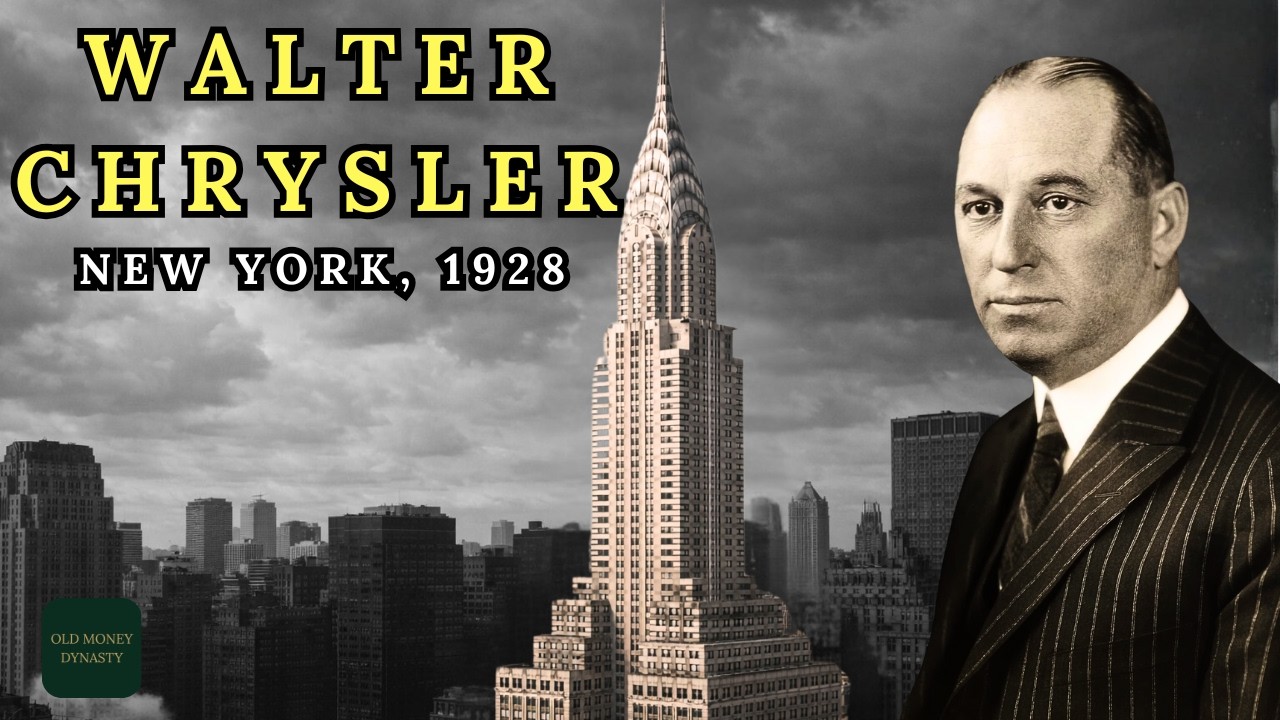
A flagpole, people said. Some kind of ornament. This was no flagpole. The workers began pulling, and the first section rose through an opening in the building’s dome, then descended into the sixty-sixth floor.
Then the second piece, then the third, then the fourth. Within ninety minutes, all four sections had been riveted together, and a one-hundred-eighty-five-foot spire now pierced the sky. The Chrysler Building had just become the tallest structure ever built by human hands: taller than the Great Pyramid, taller than the Eiffel Tower. One thousand forty-six feet of steel, brick, and one man’s obsession.
Twenty-four hours later, the stock market collapsed. This is the story of a railroad mechanic from Kansas who built that tower as a personal monument, not for his company, but for himself and for his children. A man who insisted his bathroom be the highest in Manhattan so he could, as one observer noted, look down on Henry Ford and the rest of the world. Walter Percy Chrysler arrived in the world on April 2, 1875, in Wamego, Kansas.
His father, Henry, drove locomotives for the Kansas Pacific Railroad. His mother, Anna Marie, kept the household together while her husband worked the rails. When Walter was three, the family moved west to Ellis, a frontier town on flat prairie in every direction. The railroad yard dominated local life, and the sound of steam engines filled young Walter’s childhood.
His father, a Civil War veteran, was warm-hearted but firm, and he wanted his son to attend college. Walter had other plans. At fifteen, he dropped out of school, and within a year he was delivering groceries sixteen hours a day for ten dollars a month. He wanted to work with machines, not study them from books.
His father resisted, but Walter was stubborn. At seventeen, he talked his way into an apprenticeship at the Union Pacific Railroad shops. The pay was ten cents an hour, and he took the job anyway. For the next two decades, Chrysler roamed the American West, working for one railroad after another: Colorado, Wyoming, Texas, Iowa.
He built a reputation as a roundhouse mechanic who could solve problems that stumped the supervisors. Valve setting was his specialty. He rose through the ranks—foreman, superintendent, division master mechanic—and by his early thirties he had reached the pinnacle of his railroad career as works manager at the American Locomotive Company in Pittsburgh, at a salary of eight thousand dollars a year. Then came the automobile show.
In 1908, Walter Chrysler attended the Chicago Auto Show. He had never driven a car, never owned one. But when he saw a cream-colored Locomobile on the exhibition floor, something shifted inside him. The vehicle cost five thousand dollars; his annual salary was eight thousand.
The purchase made no financial sense. He bought it anyway—seven hundred dollars down, a forty-three-hundred-dollar loan co-signed by a colleague—and had the car shipped to his home in Oelwein, Iowa. Then he did something peculiar. He did not learn to drive.
Instead, he pushed the Locomobile into his barn and took it apart piece by piece. He studied the engine, the transmission, the brakes, reassembled it, then took it apart again and again. By some accounts, he disassembled that automobile dozens of times before he ever turned the ignition key. Walter Chrysler did not simply want to own a car.
He wanted to understand it—every gear, every valve, every connection. Three years later, in 1911, he received a summons from a banker named James Storrow, who asked if Chrysler had ever considered working in automobile manufacturing. Chrysler admitted he had thought of little else since that day in Chicago. Storrow arranged a meeting with Charles Nash, president of Buick Motor Company.
Nash needed a production chief who understood machines, and Chrysler fit the description perfectly. There was only one problem. The position paid six thousand dollars a year; Chrysler was earning twelve thousand at the locomotive works. Taking the job meant a fifty percent pay cut.
He accepted without hesitation. At thirty-six years old, Walter Chrysler left the railroad industry forever. He arrived in Flint, Michigan, ready to apply everything he had learned about efficiency, production, and mechanical systems to a new kind of machine. Within five years, he would transform Buick into the most profitable division of General Motors.
Within fifteen years, he would build his own automobile company. And within twenty years, he would construct a tower that would change the New York skyline forever. But all of that began with a boy in Kansas who refused to go to college, a man who took apart his first car before he learned to drive it. Billy Durant leaned across his desk and smiled.
He could charm anyone. Walter Chrysler sat opposite, unmoved. Durant had just offered him half a million dollars a year to stay at Buick—an astonishing sum, more money than Chrysler had ever imagined earning. But the offer came with a condition that made it worthless.
Durant wanted control. He always wanted control. The two men had clashed for years. Chrysler believed in lean operations and careful spending; Durant believed in expansion at any cost.
When Chrysler proposed outsourcing frame production to save two million annually, Durant announced plans to build a six-million-dollar plant in Flint instead. When Chrysler streamlined Buick’s operations, Durant sold the profitable Detroit dealership to a friend without even informing him. By autumn of 1919, Chrysler had endured enough. He told Alfred Sloan he was finished.
All he wanted now was to sell his stock and walk away. Durant bought those shares for ten million dollars. A railroad mechanic who had taken a pay cut to join the automobile business eight years earlier now ranked among the wealthiest men in America. He was forty-four years old.
He could have retired to his Long Island estate and never worked another day. Instead, he accepted the most demanding job of his career. Bankers controlling the failing Willys-Overland Company offered Chrysler one million dollars per year to attempt a turnaround. He took the job but demanded to work from New York.
The arrangement lasted two years. When owner John Willys refused to give Chrysler full authority, he moved on. His next project seemed like madness. Maxwell Motor Company had fallen from fourth place in American automobile sales to tenth.
The company carried thirty-two million dollars in debt, and twenty-six thousand unsold cars sat rusting in factory lots across the country. Friends warned Chrysler he was destroying his reputation. He saw something they missed. Maxwell had factories, distribution networks, and a workforce.
What it lacked was a modern automobile. Chrysler hired three brilliant engineers from Studebaker—Fred Zeder, Owen Skelton, and Carl Breer—who had been developing an advanced six-cylinder engine. Chrysler gave them resources and freedom to build something extraordinary. The result debuted at the New York Automobile Show in January 1924.
The Chrysler 6 featured hydraulic brakes on all four wheels, a high-compression engine, and engineering that rivaled cars costing twice as much. The price came in under two thousand dollars. Dealers sold thirty-two thousand units in the first year. Maxwell Motor Company was reorganized into Chrysler Corporation on June 6, 1925.
Walter Chrysler, the Kansas mechanic, now commanded his own automobile empire. Three years later, he purchased Dodge Brothers for one hundred seventy million dollars, launched Plymouth and DeSoto, and watched Time magazine name him Man of the Year. He had built the third-largest automobile company in America. But factories rust, and sales figures fade from memory.
Walter Chrysler wanted something permanent—a structure that would outlast him, outlast his company, outlast the century itself. He turned his attention to Manhattan real estate. The Chrysler Building was never supposed to be called the Chrysler Building. For six years, the plot at Lexington Avenue and Forty-Second Street sat undeveloped.
The land belonged to Cooper Union, a private college that leased it to a Brooklyn real estate developer named William Reynolds. He had grand ambitions but no urgency, and he paid rent on empty dirt while Manhattan grew taller around him. Reynolds knew how to build spectacles. In 1904, he had opened Dreamland at Coney Island, a fifteen-acre amusement park that cost three and a half million dollars.
One million electric lights illuminated white neoclassical structures surrounding a central lagoon, and a three-hundred-seventy-five-foot tower dominated the skyline. Dreamland drew hundreds of thousands of visitors who paid to watch simulated volcanic eruptions, biblical recreations, and trained animal shows. Seven years later, on the morning of May 27, 1911, workers accidentally ignited hot tar inside a ride called Hell Gate. The fire spread faster than anyone could contain it, and by dawn Dreamland had burned to ash.
Dozens of animals died in their cages. The tower collapsed onto Surf Avenue. Reynolds never rebuilt. He turned instead to Manhattan, where fortunes rose from bedrock rather than boardwalks.
The Lexington Avenue plot became his next grand project. He would construct the tallest structure in the world. In 1927, Reynolds hired architect William Van Alen to design a forty-story tower. Van Alen had studied at the École des Beaux-Arts in Paris and understood the emerging Art Deco style transforming European design.
His original concept featured glass-wrapped corners meant to create the illusion that the tower floated above the street. A crystalline dome would crown the structure, glowing at night like a jeweled sphere. Reynolds loved the metallic crown. Van Alen initially resisted, but Reynolds insisted.
This detail would survive into the final structure, though neither man could have predicted how dramatically it would evolve. By April 1928, Reynolds had signed a sixty-seven-year lease and finalized his plans. The Reynolds Building would rise eight hundred eighty-eight feet with sixty-seven floors. Construction permits were approved in June, architectural drawings appeared in trade publications that August, and groundbreaking occurred on September 19, 1928.
Workers began excavating the foundation, steel orders were placed. The Reynolds Building was becoming real. Then Reynolds ran out of money. The scale of his ambition had exceeded his financing, and construction costs mounted faster than he could secure investors.
By early October, he faced a choice between abandoning the project entirely or finding a buyer willing to assume his lease, his plans, and his architect. Walter Chrysler had been watching. On October 15, 1928, Chrysler purchased everything Reynolds had assembled for a price exceeding two and a half million dollars. That same day, demolition crews arrived to tear down what little construction had begun.
Chrysler intended to start over—taller, bolder, a structure that would carry his name and outlast his corporation. The Reynolds Building vanished from history before it ever truly existed. Steel eagles crouch on the corners of the sixty-first floor, beaks pointed toward the horizon, wings folded against the wind. They are enlarged replicas of the 1929 Chrysler hood ornament, bolted to the side of a skyscraper and visible from blocks away.
Walter Chrysler specified every detail: the winged radiator caps jutting from the thirty-first floor, the hubcaps circling the thirtieth, the sunburst patterns radiating from the crown. Every surface would announce what he had built and who had built it. When Chrysler purchased the project from Reynolds in October 1928, he initially treated it as a simple investment. His children—Thelma, Bernice, Walter Jr.
, and Jack—showed no interest in the automobile business and would need income-generating property that required no knowledge of combustion engines or factory logistics. Manhattan real estate seemed ideal. Then Chrysler saw the architectural model. The lobby Van Alen had designed struck him as cramped and ordinary.
A tower of this ambition deserved grandeur at street level, not a narrow corridor. Chrysler told Van Alen to redesign it completely. After that, the industrialist involved himself in every decision. The original Reynolds design called for sixty-seven stories rising eight hundred eighty-eight feet.
Chrysler wanted taller. Van Alen revised the plans to reach nine hundred twenty-five feet, surpassing the Woolworth Building downtown. At one point, Chrysler asked to remove ten stories and reduce costs. Then he reversed himself, realizing that additional height meant additional publicity.
The plans kept growing. No corporate funds would finance this tower. Chrysler wrote personal checks. The final construction cost reached approximately fourteen million dollars—the equivalent of two hundred twenty million today.
Every brick, every rivet, every pane of glass belonged to Walter Chrysler alone. Van Alen transformed the design into a celebration of the machine age. The stainless steel cladding came from Krupp in Germany, an alloy called Nirosta that would never tarnish. Triangular windows punctured the crown in radiating arches.
The setbacks at the seventeenth, twenty-fourth, and twenty-seventh floors created a stepped silhouette unlike anything else on the skyline. Foundation excavation began in mid-November 1928. Workers dug sixty-nine feet through Manhattan schist until they hit bedrock in mid-January, removing one hundred five million pounds of rock and thirty-six million pounds of soil. Steel frame construction started on January 21, 1929, with Carnegie Steel delivering the beams.
The first uprights rose in late March. By June, the skeleton stood several stories high. By August, thirty-five levels of steel pointed at the sky. By September, the frame was complete.
Workers had averaged four stories per week, a pace that seemed reckless. Yet not a single man died during the steel work. The expected casualty rate for a project this size was one death per level above the fifteenth; more than sixty men should have fallen. None did.
Chrysler required safety measures that other developers considered expensive, and he required speed. He required elevators that ran at nine hundred feet per minute despite city regulations limiting them to seven hundred. When inspectors objected, Chrysler found ways to satisfy the letter of the law while ignoring its intent. The tower was becoming exactly what he envisioned: a structure in steel and brick that would outlast his company and generate rental income for generations.
But Chrysler faced a problem. Another tower was rising downtown, designed by his architect’s former partner. That tower intended to be taller. Two architects who once shared an office were now racing to build the tallest structure on Earth.
William Van Alen worked uptown on Lexington Avenue. H. Craig Severance worked downtown on Wall Street. Neither man would speak to the other, and both intended to win.
Their partnership had lasted thirteen years. Van Alen brought imagination; Severance brought clients. Together they designed buildings that made both men wealthy. Then a 1924 article in Architectural Record praised the Albemarle Building and credited Van Alen alone.
Severance saw his name omitted from work he had helped create. Lawsuits followed. The partnership dissolved. A friendship ended.
Five years later, they faced each other across the Manhattan skyline. Severance had been hired by a young financier named George Ohrstrom to design a tower at 40 Wall Street. The project began modestly—forty-seven floors, then sixty. By April 1929, Ohrstrom announced the building would reach eight hundred forty feet with sixty-two stories, surpassing both the Woolworth Building and the Chrysler.
Van Alen responded immediately, revising his plans to reach nine hundred twenty-five feet. Severance countered by adding a pyramidal roof and a sixty-foot steel cap. His building would now stand nine hundred twenty-seven feet—two feet taller than the Chrysler. The newspapers called it the race into the sky.
Reporters tracked each revision, each additional floor, each claim and counterclaim. Metropolitan Life announced plans for a hundred-story tower. A developer named Lefcourt discussed one hundred five floors. Someone proposed a fifteen-hundred-foot building with a rooftop airplane landing field.
The city had gone mad with altitude. Van Alen and Severance ignored the noise. Their focus remained on each other. Construction at 40 Wall Street began in May 1929, with builder Paul Starrett running three shifts seven days a week to meet a May 1930 lease deadline.
Downtown, the steel rose fast. Uptown, Van Alen worked on something Severance could not see. Rumors reached Wall Street that the Chrysler Building had a secret. Van Alen had modified his design.
The announced height of eight hundred eight feet was a lie. But no one knew the truth. Van Alen kept his plans hidden, even from the workers assembling the steel. Inside the fire shaft of the Chrysler Building, a spire was being constructed in sections—one hundred eighty-five feet of steel assembled in secret, waiting for the moment when it would emerge.
On November 13, 1929, 40 Wall Street topped out. Severance and Ohrstrom invited the downtown elite to a ceremony celebrating their victory: nine hundred twenty-seven feet, the tallest building in the world. They were three weeks too late. In late October, workers at the Chrysler Building had hoisted the hidden spire through an opening in the dome, riveting the four sections together before anyone downtown understood what had happened.
Van Alen later compared the moment to watching a butterfly leave its cocoon. The Chrysler Building now stood one thousand forty-six feet tall, one hundred nineteen feet higher than 40 Wall Street—taller than the Woolworth, taller than the Eiffel Tower, the tallest structure ever built by human hands. Severance could not believe it. He considered adding more height to his own building, but the foundations would not support it.
He tried arguing that the Chrysler’s spire should not count because it contained no usable space, and his associate, Yasuo Matsui, wrote articles making this case. No one listened. The final score stood permanent. Chrysler, one thousand forty-six feet.
Wall Street, nine hundred twenty-seven. A partnership that began in 1911 had produced the two tallest buildings in the Western Hemisphere. Neither man ever spoke to the other again. The men arrived before dawn.
They climbed temporary ladders bolted to steel columns, ascending into fog and wind while Manhattan slept below. By the time office workers emerged from Grand Central, the construction crews had already been working for hours. Fox Movietone cameras captured them in 1929. The footage shows riveters straddling beams without ropes, plasterers leaning over edges eight hundred feet above the street, ironworkers wrestling steel into position with bare hands.
One sequence shows a man casually walking across a girder no wider than his boot, pausing to wave at the camera before continuing toward the building’s edge. These images terrified audiences. They still do. Yet the work proceeded inside a system designed to prevent catastrophe.
Walter Chrysler had spent decades in railroad shops and automobile factories. He understood that injuries slowed production and dead workers destroyed morale. So he required precautions that seemed excessive to other developers. Scaffolds with guardrails surrounded every work area.
Tarpaulins stretched overhead to catch falling tools. Wire netting hung between toeboards. A hospital operated on site with a physician on duty every shift, and a bulletin board posted daily safety updates. The job site functioned like one of Chrysler’s assembly plants.
Materials arrived precisely when needed. Cranes positioned beams before the concrete below had fully cured. Bricklayers followed steelworkers up the building like a rising tide, each trade working simultaneously at different elevations. The engineering firm Ralph Squire and Sons coordinated the logistics.
Nothing waited, nothing wasted. The numbers reveal the scale: twenty thousand nine hundred sixty-one tons of structural steel hoisted into position. Three hundred ninety-one thousand eight hundred eighty-one rivets heated red-hot and hammered into place. Nearly four million bricks laid by hand to create walls that bore no structural load.
Three thousand eight hundred sixty-two windows fitted into frames of German stainless steel. Three thousand men performed this work. The expected casualties for a project of this height ran to dozens. At the end, not one of those three thousand had died.
Chrysler celebrated the achievement publicly. Privately, he had always expected it. He had built his fortune by making factories safer and more efficient. The Chrysler Building was simply another factory turned vertical, producing something more permanent than automobiles.
By autumn, the exterior walls were closing in around the completed frame. Bricklayers worked downward from the crown while finishing crews prepared the lower floors for tenants. The building would open in months, but the world did not yet know its true height. Hidden inside the dome, waiting for the right moment, a secret weapon was about to emerge.
No one outside the project knew it existed. While newspapers tracked every floor of the race into the sky, Van Alen worked on something he never announced. Permits were filed quietly. Steel was ordered without fanfare.
The pieces arrived at the construction site in unmarked deliveries and disappeared into the building’s core. The fire shaft at the center of the Chrysler Building rose like a hollow spine through all seventy-seven floors. Normally, such shafts carried stairs and utilities. Van Alen repurposed this one as a hiding place.
Inside the shaft, workers began assembling a steel needle that would transform everything. The vertex, as Van Alen called it, consisted of lattice steel framework with four corner angles and diagonal strut members. The finished structure would stand one hundred eighty-five feet tall and weigh twenty-seven tons. It could not be hoisted from the ground in one piece.
It could not be assembled on the roof in plain view. Van Alen needed secrecy, and the fire shaft provided it. Sections of the spire were delivered to the site, lifted to the sixty-fifth floor, and assembled inside the building where no one could see them. Scaffolding shrouded the dome, ostensibly to allow workers to finish the stainless steel cladding.
In reality, the scaffolding hid what was happening within. Even the riveters did not fully understand. They fastened steel pieces together inside the shaft, following blueprints that showed dimensions but not purpose. Only when the sections came together did the shape become clear.
Only then did the workers realize they were building a weapon in a war for altitude. Van Alen’s cousin, William Edwin Squire, served as the project’s structural engineer. He calculated loads and stresses, determining whether cables could lift twenty-seven tons through the narrow opening at the top of the dome. The math said yes.
The math did not account for wind, for equipment failure, for the thousand ways a plan could collapse eight hundred sixty feet above the street. Rumors reached Wall Street. Severance heard whispers that Van Alen had a secret, that the Chrysler Building would somehow grow taller than announced, but no one knew details. No one had seen proof.
Severance dismissed the rumors and concentrated on his own tower, confident that nine hundred twenty-seven feet would be enough. By mid-October, the hidden spire was complete. It waited inside the fire shaft like a sword in its sheath. Van Alen chose not to alert the press.
He wanted no warning, no chance for Severance to respond, no opportunity for anyone to steal his moment. The newspapers would learn what happened only after it was done. Van Alen felt sick. He stood blocks away, unable to watch directly, unable to look away.
His stomach churned, his head swam. Eight hundred sixty feet above the street, workers balanced on wooden platforms around the dome of his building, preparing to do something no one had attempted before. The fears multiplied in his mind. The cables might snap under the weight and send twenty-seven tons of steel crashing through seventy floors.
The crane might fail to lift the sections high enough. The wind might shift and tip the needle over the edge, dropping it onto Lexington Avenue during morning rush hour. His cousin, William Edwin Squire, had calculated the stresses and declared the operation possible. Possible was not the same as safe.
Rumors had circulated for days. Workers downtown at 40 Wall Street heard whispers that something was happening uptown. Severance’s team noticed a derrick rising above the Chrysler’s dome, visible against the October sky. The official explanation claimed they were hoisting a flagpole.
No one quite believed it. The bottom section rose first. A derrick lifted it up the side of the building, cables straining, and lowered it through the opening in the dome until it settled into the sixty-sixth floor. The workers above guided the steel into position, fastening it to the structure that would support it.
Then the second section, then the third, then the fourth. Each piece ascended the face of the tower, swung over the dome, and descended into the opening where riveters waited to fasten it to the section below. The needle grew taller with each lift. The building grew taller with each rivet.
The work proceeded faster than anyone expected. The coordination that had built four floors per week now assembled a spire in less than two hours. By the time the final section locked into place, the Chrysler Building stood one thousand forty-six feet above the sidewalk. Walter Chrysler watched from across the street.
Van Alen finally allowed himself to breathe. No press had been invited. No photographers captured the moment. No reporters stood ready to announce what had happened.
Van Alen wanted the victory complete before anyone could respond. He wanted Severance to learn the news only after the spire was already bolted into place and unmovable. The New York Herald Tribune had covered the construction almost daily for months. They did not report the spire’s installation until days after it occurred.
By then, the scaffolding still shrouded the crown, and the full effect remained hidden. The gleaming needle would not emerge from its covering until spring, but the numbers were already fixed. Chrysler, one thousand forty-six feet. Eiffel Tower, nine hundred eighty-six.
Woolworth, seven hundred ninety-two. 40 Wall Street, nine hundred twenty-seven. The race was over. The next morning, the stock market began to fall.
The crown emerged from its scaffolding in spring of 1930, and New York had never seen anything like it. Seven radiating arches rose in terraced layers, each stepping back from the one below. Triangular windows pierced every surface, arranged in patterns that radiated outward like the spokes of a wheel or the rays of a rising sun. The effect was deliberate.
Van Alen wanted the building to appear to be reaching upward even while standing still, straining toward the sky with every line and angle. The material covering those arches was equally unprecedented. Nirosta steel, an alloy of eighteen percent chromium and eight percent nickel, had never been used on an American building at this scale. The German-manufactured metal resisted corrosion and cleaned itself whenever it rained.
Unlike bronze, which turned green, or copper, which darkened, Nirosta would gleam as brightly in fifty years as on the day it was installed. Van Alen understood what that permanence meant. As one engineer wrote at the time, the bright metal accentuated the rising lines and diminishing forms of the crown, so that the building literally dissolved into the sky. The Chrysler Building would not fade into the cityscape.
It would shine above it. Below the crown, automobile imagery appeared at every setback. On the sixty-first floor, stainless steel eagles with wide wingspans jutted from the corners, their forms streamlined in the Art Deco manner. These were not the heraldic eagles of older buildings.
They suggested flight, speed, the machine age in motion. Ten floors lower, at the thirty-first, replicas of 1929 Chrysler radiator caps decorated the facade—winged ornaments, hood emblems enlarged to architectural scale. The building announced itself as a product of its era, as sleek and modern as the automobiles rolling off Chrysler assembly lines in Detroit. Every decorative choice reinforced the connection.
This was not a bank dressed in classical columns or a cathedral reaching toward heaven. This was a monument to industry, to commerce, to the belief that machines could be beautiful. Le Corbusier, the most influential architect in Europe, visited New York and offered his verdict on the Chrysler Building. He called it hot jazz in stone and steel.
The description captured something essential. This was not a building designed by committee or constrained by convention. It was exuberant, confident, borderline outrageous. Critics would argue about its merits for decades.
Some called it a masterpiece of modern design. Others dismissed it as flash without substance, a stunt devised to make the man in the street look up. Van Alen did not care about the critics. Walter Chrysler did not care about the critics.
They had built what they wanted to build. The exterior was complete. Now came the interior. Visitors entering through the Lexington Avenue doors encountered a space that matched the exterior’s ambition.
The lobby walls were sheathed in red Moroccan marble, deep crimson with white veining that caught the light from bronze-framed windows. Amber onyx panels flanked the elevator banks. The floor gleamed with polished granite in geometric patterns. Every surface announced that this was not an ordinary office building.
This was a palace of commerce. Above it all stretched what was then the largest mural in the world. Edward Trumbull’s Transport and Human Endeavor covered nearly eight thousand square feet of ceiling, depicting the machinery of modern civilization. Airplanes banked through painted clouds.
Ocean liners crossed stylized seas. The Chrysler assembly line appeared in motion, with workers tending machines that produced the automobiles that had made Walter Chrysler rich. And rising above everything, the Chrysler Building itself painted into its own ceiling—a monument celebrating a monument. The elevator doors became works of art in their own right.
Brass and inlaid African woods formed stylized lotus flower patterns, each door slightly different from the others. Japanese ash met English harewood and Asian walnut. Inside the cabs, American walnut combined with Cuban plum pudding wood and curly maple. Thirty-two elevators served the building.
No two interiors were identical. But the most exclusive space in the Chrysler Building was not the lobby. It was sixty-six floors above the street. The Cloud Club opened in July 1930 with three hundred members, all wealthy men who formed the city’s business elite.
Texaco had demanded the club as a condition of leasing fourteen floors. They wanted a proper restaurant for their executives. Walter Chrysler gave them something far more elaborate. The sixty-sixth floor featured a Tudor-style lounge with oak paneling and an Old English grill room with wooden beams, wrought iron chandeliers, and leaded glass doors.
A Renaissance staircase in marble and bronze connected this floor to the main dining room above. The sixty-seventh floor was pure futurism. Polished granite columns supported a vaulted ceiling painted with clouds. Etched glass sconces lined the walls.
A mural of Manhattan covered the north side. Charles McGrath would later describe it as having a Fritz Lang sort of look, the aesthetic of Metropolis translated into a private dining room. Walter Chrysler maintained his own suite on this floor: black etched paneling, a frieze depicting automobile workers, views of Central Park through triangular windows that slanted with the building’s crown. Texaco executives had their own private room with murals of oil refineries and company trucks.
The club offered amenities that reflected its era: a barber shop, a humidor for cigars, private lockers where members could store their own liquor—a useful feature while Prohibition remained in effect—and a stock ticker room for monitoring markets between courses. Edward F. Hutton lunched at the Cloud Club. Condé Nast came, and Juan Trippe of Pan Am, and Gene Tunney, the boxer who had defeated Jack Dempsey.
They gathered in a room that seated perhaps eighty, far smaller than the Rainbow Room that would open at Rockefeller Center, but more exclusive, more intimate, higher above the city than any dining room had ever been. The club operated only during daylight hours. Members came for lunch, conducted business over meals that cost more than most Americans earned in a week, then descended to street level and returned to their offices. The Cloud Club was not a place for evening entertainment.
It was a place for deals. It would remain open until 1979, closing only when the building itself began to decline and corporations moved their headquarters to newer towers or suburban campuses. By then, the world it represented had vanished entirely. In January 1931, William Van Alen attended the Beaux Arts Ball at the Hotel Astor dressed as his own building.
The costume was extraordinary: patent leather cape and boots, flame-colored silk, flexible inlays of the same exotic woods that decorated the Chrysler elevator doors, and a towering headpiece shaped like the sunburst crown complete with triangular windows. While other architects wore generic tunics beneath their building hats, Van Alen had commissioned something theatrical, something that announced his achievement to everyone in the ballroom. The theme that year was Fête Moderne, a fantasy in flame and silver, a celebration of the new architecture transforming Manhattan. William Lamb came as the Empire State Building.
Leonard Schultze appeared as the Waldorf-Astoria. Ralph Walker dressed as the Irving Trust Building. But Van Alen was the star. Photographers clustered around him.
Newspapers printed his picture the next morning. It was the last public triumph of his career. Van Alen had made a catastrophic mistake when he accepted the Chrysler commission. He never signed a contract.
Walter Chrysler had purchased the project from William Reynolds, and Van Alen had simply continued working, trusting that payment would follow when the building was complete. The standard architectural fee in 1930 was six percent of construction costs. The Chrysler Building had cost fourteen million dollars. Van Alen submitted an invoice for eight hundred forty thousand dollars.
Walter Chrysler refused to pay. The automobile magnate claimed Van Alen had received bribes from building suppliers. He offered no evidence. He simply declined to honor the debt.
The man who had built a monument to his own glory decided the architect who designed it deserved nothing. Van Alen sued. The courts ruled in his favor, and he eventually received his full fee. But the lawsuit destroyed him.
Architecture was a profession built on relationships and reputation. Clients did not hire architects who took their patrons to court. The Great Depression had already frozen most construction in New York. Van Alen found himself famous and unemployable at the same time.
He never received another major commission. The critical reception had been mixed even before the lawsuit. Architect magazine called him the doctor of altitude. Kenneth Murchison compared him to Florenz Ziegfeld, the legendary Broadway producer.
But other critics dismissed the building as flash without substance, a stunt design devised to make the man in the street look up. Lewis Mumford, the most influential architecture writer in America, called it a series of restless mistakes. Van Alen retreated from practice. He taught sculpture at the Beaux Arts Institute of Design.
He watched other architects win commissions for buildings that would never match what he had created at Lexington and Forty-Second Street. He died on May 24, 1954. The obituaries were brief. Four decades later, the Beaux Arts Institute renamed itself the Van Alen Institute in his honor.
By then, the Chrysler Building had been declared a National Historic Landmark. By then, everyone agreed it was a masterpiece. The man who designed it never lived to see that consensus form. The Empire State Building opened on May 1, 1931, and the Chrysler Building was no longer the tallest structure on Earth.
John Jacob Raskob had watched Van Alen’s spire trick with alarm. His own tower had grown from eighty floors to eighty-five, yet would still reach only four feet higher than the Chrysler. That margin was not safe, so Raskob added a two-hundred-foot mooring mast for dirigibles, pushing his building to one thousand two hundred fifty feet. The airships never docked there.
The winds made it impossible. But the mast served its real purpose. It put the Empire State Building two hundred feet beyond anything Chrysler could add. The reign had lasted exactly eleven months.
Some considered this a failure. Others understood it differently. Height records existed to be broken. What mattered was whether a building remained worth looking at after its statistics became obsolete.
Walter Chrysler died in August 1940. His children inherited the tower he had built for them. They sold it in 1953 to William Zeckendorf for eighteen million dollars. The decline began almost immediately.
Successive owners cut maintenance costs. They drilled holes into the lobby ceiling to install cheap lighting, damaging the Trumbull mural. They used the spire to store junk. The observation deck closed.
The Cloud Club lost members as corporations moved to newer buildings or suburban campuses. By the early 1970s, with New York City itself careening toward bankruptcy, the Chrysler Building’s occupancy rate fell to seventeen percent. The gleaming tower that had symbolized American ambition now stood largely empty, its steel eagles watching over a city in crisis. Designation as a National Historic Landmark in 1976 offered legal protection but not salvation.
The building kept slipping into disrepair. Massachusetts Mutual announced a twenty-three-million-dollar renovation in 1978. The Cloud Club closed forever in 1979. Jack Kent Cooke purchased the building later that year.
The entrepreneur and Washington Redskins owner hired architects to restore the lobby closer to Van Alen’s original vision. More importantly, he completed the lighting system that had been part of the original design but never installed. In September 1981, five hundred eighty fluorescent tubes illuminated the triangular windows of the crown for the first time. The Chrysler Building glowed against the night sky as Van Alen had always intended.
Cooke restored the exterior and spire in the mid-1990s. He died in April 1997. His creditors foreclosed almost immediately. Tishman Speyer and the Travelers Insurance Group purchased the building for approximately two hundred twenty million dollars and spent another one hundred million on renovation.
Evergreen Architectural Arts carefully restored the Trumbull mural, removing the polyurethane coating and filling the holes that had been drilled decades earlier. By 2005, the building was ninety-five percent occupied. The ownership continued changing hands: Abu Dhabi Investment Council, RFR Holdings. The land beneath the building still belonged to Cooper Union, which had received it as a donation over a century earlier.
The tower itself became a commodity, bought and sold by investors who rarely set foot inside. Yet something remarkable had happened during those decades of decline and revival. The critical consensus shifted entirely. Lewis Mumford had called the building a series of restless mistakes.
The new generation of architects and historians called it a masterpiece. The American Institute of Architects ranked it among the most admired buildings in America. Tourists who visited the Empire State Observation Deck found themselves drawn to a different silhouette entirely: the sunburst crown, the triangular windows, the needle spire catching light. The taller building won the measurement contest.
The more beautiful building won something else. The Chrysler Building still holds one record that can never be taken. It remains the tallest steel-supported brick building in the world. More importantly, it remains the building that New Yorkers point to when asked which tower they love most.
Walter Chrysler wanted a monument. William Van Alen gave him one. Nearly a century later, it still gleams above Lexington Avenue, dissolving into the sky exactly as its architect intended.






