When the valet Johann Loschek finally broke through the wooden panel of the bedroom door with a hammer and a piece of firewood, the dim light inside revealed a scene that would haunt him for the rest of his life. The heir to the Austro-Hungarian throne, Archduke Rudolf, lay motionless, leaning over the edge of the bed with a thin stream of blood emerging from his mouth. On the other side of the bed lay the lifeless body of seventeen-year-old Baroness Mary Vetsera. At first, Loschek believed they had both taken poison.
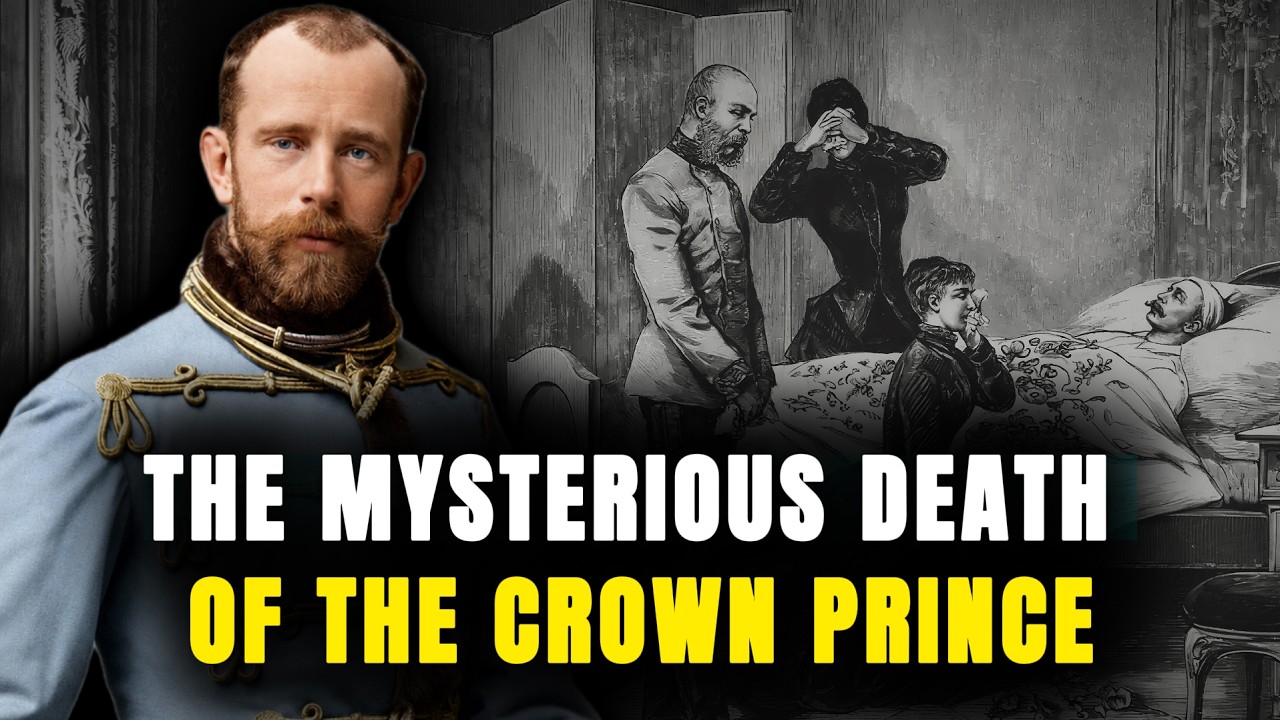
It was the morning of Wednesday, January 30, 1889, and the world was about to learn that the future emperor of Austria was dead. The Austro-Hungarian Empire appeared more powerful than ever in the winter of 1889, yet its Crown Prince had lived trapped between a relentless education, a marriage doomed to failure, and a profound personal crisis. His death alongside his young lover at the Mayerling hunting lodge shocked the whole of Europe, gave rise to one of the greatest mysteries in royal history, and forever changed the fate of the Habsburg dynasty. Archduke Rudolf Franz Karl Joseph was born on August 21, 1858, at Laxenburg Palace.
He was the only son of Emperor Franz Joseph I of Austria and Empress Elizabeth of Bavaria, known as Sisi. Following the birth of two daughters, Sophie and Gisela, and the tragic death of Sophie in 1857, which had plunged the Empress into a deep depression, the arrival of a male heir was greeted with enormous enthusiasm, as it secured the continuation of the House of Habsburg-Lorraine. The court’s joy was expressed with a 101-gun salute, an imperial order to establish the Rudolf Hospital in Vienna, and a donation of 20,000 florins for the capital’s most disadvantaged citizens. Yet that apparent family good fortune concealed an oppressive reality.
From the moment of his birth, Emperor Franz Joseph I decided that the destiny of his only son would be entirely bound to the Imperial Army. The sovereign appointed him a Knight of the Order of the Golden Fleece and honorary colonel of an infantry regiment, convinced that the future emperor should embody the discipline and military tradition of the House of Habsburg-Lorraine. Meanwhile, Empress Elizabeth, still deeply affected by the loss of her daughter Sophie and constantly at odds with her mother-in-law, Archduchess Sophie of Bavaria, gradually withdrew from the direct care of her son, whose upbringing remained largely under the influence of his grandmother. The young Archduke grew up under intense public scrutiny and soon distinguished himself by his great intelligence, extreme sensitivity, and fragile health, characteristics that the conservative court began to regard with growing concern.
In July 1864, shortly before his sixth birthday, Rudolf was removed from the care of his nurse to begin his formal education, in accordance with the strict customs of the Viennese court. Under the supervision of Archduchess Sophie, the emperor entrusted the heir’s education to Major General Count Leopold Gondrecourt. A French-born aristocrat born in Nancy in 1816, Gondrecourt had been educated at the prestigious Saint-Cyr Military Academy and had taken part in the Second Schleswig War. Convinced that a future emperor had to be toughened from childhood, he took on the task of shaping the boy’s character through a method based on extreme military discipline, psychological pressure, and exposure to intense cold.
The methods employed by General Gondrecourt proved profoundly damaging to the young Archduke. He would abruptly wake him by firing a pistol in his bedroom, subject him to prolonged military marches through the snow, and force him to take ice-cold baths. On one occasion, under the pretext of strengthening his nerves, he even left him completely alone in the Lainzer Tiergarten, a hunting reserve near Vienna, while shouting from outside that a wild boar was charging towards him. Over time, these experiences contributed to the heir developing severe episodes of anxiety, recurring nightmares, increasingly fragile health, and an intense fear of the dark, eventually alarming Empress Elizabeth.
The young heir’s situation reached a critical point in August 1865. During a stay at the Imperial residence of the Kaiservilla, Empress Elizabeth realized the extent to which her son’s education was affecting him when she witnessed Gondrecourt’s methods at close quarters. Sisi discovered that the general subjected the boy to demanding physical exercises while at the same time leading a life that contrasted sharply with the discipline he imposed upon the heir. He concealed a cigar case inside a prayer book and frequently visited a chorus girl in Vienna while neglecting his responsibilities.
Outraged by Gondrecourt’s methods, Empress Elizabeth sent a letter to Emperor Franz Joseph I warning him that she would leave Austria unless she was granted control over the education of her children. Faced with the seriousness of the family situation, the emperor eventually gave in to his wife’s demands. Gondrecourt was dismissed and replaced by Colonel Joseph Latour von Thurnburg, a more humane and moderate officer who quickly earned the Archduke’s trust and eventually became a father figure to him. Latour’s arrival marked a turning point in Rudolf’s life.
Under his direction, the heir’s education moved away from rigid military training and adopted a more liberal, science-oriented approach. The Archduke had nearly fifty private tutors who encouraged his interest in the natural sciences, geography, and political economy. In 1873, during the Vienna World’s Fair, he met the celebrated German naturalist Alfred Brehm, with whom he formed a close friendship that aroused suspicion at court because the scientist was a Protestant and a Freemason. In 1878, the two embarked on an ornithological research journey along the River Danube, which culminated in the writing of the book *15 Days on the Danube*, initially published anonymously.
The success of his work and the rigor of his research led the Imperial publishing house to publish the book and contributed to the heir being appointed an honorary member of the Vienna Academy of Sciences. After completing his education in 1877, Rudolf began his military career and was assigned to various regiments as well as traveling through Spain, Portugal, Egypt, and Palestine. However, behind his public image, a profound ideological divide with his father was beginning to emerge. Influenced by the liberal thinking of several of his tutors, the Archduke began to question the conservative policies of Emperor Franz Joseph I and Austria-Hungary’s alliance with the German Empire.
Instead, he advocated closer diplomatic relations with France and a series of reforms aimed at reducing the influence of the church in affairs of state. To express his political ideas without provoking a direct conflict with the crown, Rudolf chose to publish his opinions anonymously. In 1881, the economist Carl Menger introduced him to the journalist and editor Moritz Sepps, director of the liberal newspaper *Neues Wiener Tagblatt*. During the following years, the Archduke contributed to the newspaper by writing anonymous editorials in which he criticized his own father’s policies, denounced the growing anti-Semitism in Vienna, and challenged the most conservative elements of the government.
His close association with bourgeois circles and the liberal press aroused deep suspicion at the Imperial Court, where he became increasingly isolated. In order to secure the continuation of the dynasty, Rudolf married Princess Stephanie of Belgium, daughter of King Leopold II, on May 10, 1881, at the Church of St. Augustine in Vienna. Although the couple initially settled in Prague, it soon became clear that the marriage was experiencing serious difficulties.
They had very different personalities and interests. While Rudolf had a deep interest in politics, science, and liberal ideas, Stephanie had received a far more traditional education. Over time, those differences caused the relationship to become increasingly distant, eventually turning into a union based more on protocol than affection. Despite their emotional estrangement, on September 2, 1883, the couple’s only child, Archduchess Elizabeth Marie of Austria, known within the family as Erzsi, was born in Laxenburg.
However, the possibility of producing a male heir was ruled out only a few years later as a consequence of the Archduke’s private life. Rudolf, who had numerous extramarital relationships and frequented the brothels of Vienna, contracted a sexually transmitted infection, generally identified by historians as gonorrhea, which he subsequently passed on to his wife. The infection caused Stephanie serious health complications that prevented her from having any more children and ultimately destroyed their marriage. The year 1886 marked the beginning of a profound physical and emotional decline for the heir.
Suffering from persistent pain caused by the sexually transmitted infection, recurring episodes of cystitis, and severe bouts of depression, Rudolf began regularly using morphine and alcohol. His growing dependence on both substances rapidly affected his physical appearance and altered his character, making him increasingly suspicious and irritable. In October 1888, after returning from a journey to Greece, Stephanie recorded in her memoirs the impression that seeing him again had made upon her. His deterioration was so evident that it was impossible not to notice it.
He had changed terribly. His skin was flabby, his eyes showed signs of unease, and his expression had completely changed. It seemed as though he were falling apart from within. Knowing that he was incapable of having any more children, increasingly excluded by his father from government decisions, and kept under surveillance by the secret police of the Prime Minister, Count Eduard von Taaffe, Rudolf began to contemplate the possibility of ending his life.
However, he did not want to face that fate alone, and sought a woman willing to share it with him. He first proposed the idea to his wife, Stephanie, who rejected it with indignation and profound horror. He later turned to Mitzi Caspar, a twenty-four-year-old woman who had been his mistress since 1886. The Archduke proposed that they die together in front of the monument to Empress Maria Theresa in Vienna, but Mitzi, deeply alarmed, went to the Prime Minister to warn him of the seriousness of the situation.
However, the Prime Minister dismissed the warning because he did not consider the testimony of a courtesan credible, and ordered her not to interfere in the affairs of the Imperial Household. Despite her refusal, Rudolf remained fond of Mitzi, to whom he left 30,000 florins in his will, and with whom he spent his final night in Vienna between January 27 and 28, 1889. The person who finally accepted the Archduke’s proposal was Baroness Mary Vetsera. Mary was the daughter of Albin Vetsera, a diplomat who had been ennobled in 1870, and Helene Baltazzi.
At only seventeen years old, deeply in love with Rudolf, and influenced by the romantic ideals of the time, she began a relationship with the heir in the autumn of 1888. By January 1889, their relationship had reached a point of no return. On the 13th of January that year, after spending two hours with the Archduke, Mary wrote to her former governess, “We were together last night from 7:00 until 9:00. We have both lost our heads.
Now we belong completely to each other. ” As a symbol of their commitment, Rudolf gave her an iron ring engraved with a German inscription meaning, “United in love until death. ” The following day, Mary visited a photographer’s studio in Vienna and wrote her will, convinced that she would share the Crown Prince’s fate. The tension that had been building for years reached its climax during the final days of January 1889.
On January 20, Rudolf invited Count Joseph Hoyos and Prince Philip of Saxe-Coburg, the husband of Stephanie’s sister, to a hunting party at the Mayerling hunting lodge scheduled for the 29th and 30th. Six days later, he had a heated argument with Emperor Franz Joseph I at the Hofburg Palace. During the confrontation, the emperor reprimanded him for seeking an annulment of his marriage, for his relationship with Mary Vetsera, and for his contacts with the Hungarian opposition, even going so far as to consider him unworthy of the succession. That same evening, Rudolf attended an official reception with Stephanie.
The following day, he took part in his final public engagement and, after returning to Vienna, spent the night with his mistress Mitzi Caspar. On January 28, he departed for the Mayerling hunting lodge, while that same afternoon, Mary Vetsera secretly left her family home to join him. On the morning of Wednesday, January 30, 1889, the unusual silence that prevailed at the Mayerling hunting lodge began to concern those who were there. After knocking several times on the door of the Archduke’s bedroom from half past seven in the morning without receiving any response, the valet Johann Loschek decided to alert Count Josef Hoyos.
Shortly before eight o’clock, as Hoyos was making his way to breakfast, Loschek revealed that he had been unable to wake the prince and that Baroness Mary Vetsera was with him inside the bedroom. Minutes later, Hoyos, Prince Philip of Saxe-Coburg, and Loschek himself made their way to the Archduke’s bedroom, convinced that something was wrong. Given the seriousness of the situation, Hoyos and the prince ordered Loschek to break down one of the wooden panels of the door with the help of a hammer and a piece of firewood. That same day, an examination carried out by the court physicians ruled out the possibility of poison and confirmed that Rudolf had died as a result of a gunshot wound to the head.
Mary Vetsera had met the same fate. Without losing a moment, Count Hoyos left for the railway station to board a special train bound for Vienna and personally inform Emperor Franz Joseph I of what had happened. News of the heir’s death reached the Hofburg Palace at around eleven o’clock in the morning on January 30. Baron Nopcsa, the court’s first chamberlain, first informed Empress Elizabeth, who burst into tears before regaining her composure to break the tragic news to Emperor Franz Joseph I.
Shortly afterwards, the empress sent for Princess Stephanie. Years later, she recalled that distressing moment in her memoirs. The emperor was sitting in the center of the room. The empress, dressed in dark clothes and with a white, rigid face, was with him.
In her confused and shocked state, Stephanie thought they were looking at her as though she were an unfaithful wife. To preserve the prestige of the dynasty, the Imperial Court immediately set in motion a cover-up operation. The treatment of Mary Vetsera’s body was shrouded in absolute secrecy. By order of the Imperial authorities, the young woman’s uncles, members of the Baltazzi family, traveled to Mayerling in the middle of the night.
There they dressed the body in ordinary clothes and, using a wooden stick concealed beneath the garments to keep it upright, discreetly transported it by carriage to the cemetery of the Cistercian Abbey of Heiligenkreuz. Mary was buried in haste, and her mother was unable to visit the grave or learn the exact location of the burial site until more than two months later. At the same time, the Viennese court issued an initial official account attributing the heir’s death to a ruptured cardiac aneurysm. However, the rumors that began to circulate about what had happened at Mayerling and the rapid spread of the news through the European press made that explanation impossible to maintain.
Faced with this situation, the government issued a second statement acknowledging that Rudolf had taken his own life, claiming that he had acted while in a state of mental disturbance. Emperor Franz Joseph I sent an urgent message to Pope Leo XIII explaining that his son had lost his reason before his death, which made it possible to obtain a special dispensation allowing him to receive a Christian burial. Thanks to that authorization, the Archduke was buried with full honors in the Imperial crypt of the Capuchins on Tuesday, February 5, 1889. Although the official forensic report signed by Dr.
Hofmann on February 1, 1889, concluded that the Archduke had died from a self-inflicted gunshot wound to the head, the strange circumstances surrounding the Mayerling tragedy fueled numerous alternative theories. On February 9, 1889, the German ambassador in Vienna sent a confidential report to Chancellor Otto von Bismarck in which he expressed serious doubts about the official account. According to that document, the heir’s injuries did not correspond with the description provided by the court physicians. It also maintained that the bulldog revolver found beside the bed did not belong to the Archduke and noted that all six cartridges in the weapon had been fired.
Over the years, new accounts of what happened at Mayerling began to emerge. Frederick Wolf, the son of the royal carpenter who was urgently summoned to the hunting lodge two days after the tragedy, claimed that his father found Rudolf’s bedroom completely wrecked. According to his account, there was damaged furniture, several bullet marks in the walls, and traces of blood in different parts of the room, making it necessary to replace the wooden flooring completely. He also claimed that the Archduke’s right hand had suffered severe injuries, which, according to him, were concealed by a glove during the lying in state at the Hofburg Palace.
These accounts fueled further speculation about what had happened at Mayerling. In November 1983, the last empress of Austria, Zita of Bourbon-Parma, publicly declared that Rudolf had been the victim of a conspiracy organized by the French secret services. According to this theory, the Archduke refused to take part in a plot to overthrow his father, Emperor Franz Joseph I, and form an alliance with France against Prussia. As a result, foreign agents allegedly entered the hunting lodge and staged the official version of a double suicide in order to conceal the true cause of the Crown Prince’s death.
Regardless of the true circumstances of his death, the Mayerling tragedy profoundly shook the Imperial family and marked a turning point for the Habsburg dynasty. Empress Elizabeth never recovered from the loss of her only son. From then on, she abandoned colored dresses altogether and wore only black, became deeply grief-stricken, and withdrew almost entirely from court, traveling restlessly across Europe until her assassination in 1898. Sisi even confessed that Rudolf’s death had destroyed her Christian faith.
In a private conversation with her niece, Amalie, she admitted that she found it impossible to believe in the doctrines of the church, for to do so would mean accepting that her son’s soul was condemned to hell. Politically, Rudolf’s death triggered a profound succession crisis for the Austro-Hungarian Empire. As Emperor Franz Joseph I had no other sons, the rights to the throne passed to his brother, Archduke Karl Ludwig, who later relinquished them in favor of his eldest son, Archduke Franz Ferdinand. Twenty-five years after the Mayerling tragedy, the assassination of this new heir in the streets of Sarajevo in June 1914 triggered the First World War.
The conflict culminated in the dissolution of the Austro-Hungarian Empire and the end of Habsburg rule, an outcome that many historians consider consistent with the profound concerns Rudolf had expressed years earlier in his political writings.






