In 1899, a young Englishwoman in Hartford wrote a letter to one of the richest men in America. The letter said no. It warned that marrying him would bring them both only misery. Her name was Nora McMullen.
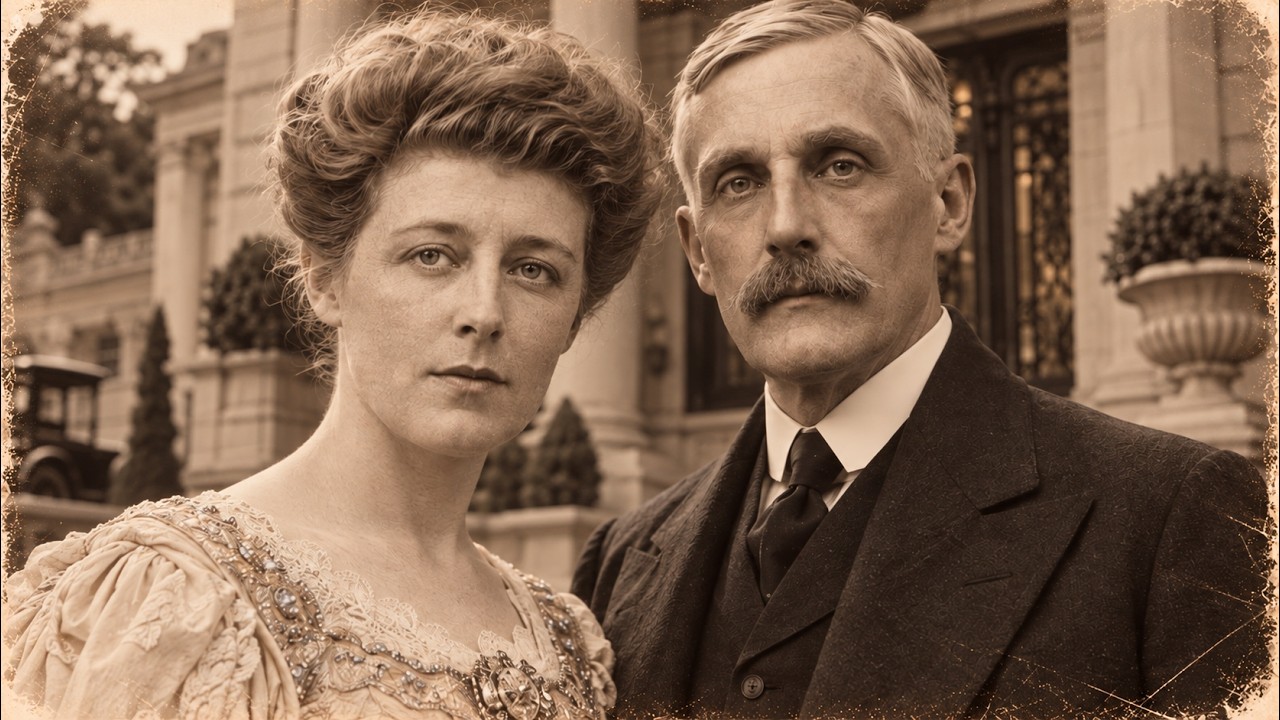
The man was Andrew Mellon. She married him anyway. When her warning came true, his own biographer says he had a state’s law changed so that no jury would ever hear her side. After that, she saw her own children only with a court’s permission.
And yet, the same woman ended up inside the National Gallery he built. Nora McMullen was the youngest of nine children and the only daughter of a brewing family from Hartford, north of London. Andrew Mellon was a Pittsburgh banker, builder of fortunes in aluminum and oil, one of the richest men America ever produced. His father, Judge Thomas Mellon, was a hard man who did not believe in wasted words or wasted feeling.
He built a schoolhouse on his own land so his sons would not be softened by other people’s teachers. His sons, David Cannadine concluded, were in the judge’s eyes essentially extensions of himself. Of all those sons, none absorbed the lesson more completely than Andrew. He left university without a degree, worked full-time at his father’s bank by nineteen, and by his forties was quietly placing money behind aluminum, coal, steel, and oil.
Whenever Andrew faced a hard decision, his instinct was always the same. He would ask himself what his father would do. In the summer of 1898, Andrew boarded a ship for Europe, traveling with Henry Clay Frick, his closest friend and oldest business ally. Frick introduced him to a nineteen-year-old English girl named Nora McMullen.
Something happened to Andrew Mellon on that voyage that may never have happened to him before. He was a man for whom conversation was a kind of labor, yet with this young woman, half his age, lively and entirely outside his world, he found he could open up. He visited her family in Hartford that year, returned the next, and in 1899 asked her to marry him. She said no, and she did not simply say no.
She wrote to him, setting out with painful clarity why a marriage between them could not work. One line of that letter reads, “You must see it is a mistake. It would mean nothing but unhappiness for us both. ”
Andrew Mellon had built his life on reading risk.
He knew when to walk away. Here was a warning written plainly in ink from the only person who could truly know. He read it, and for once in his life, he did not walk away. In the spring of 1900, Nora changed her answer.
Why she did remains her own. What is known is that for much of their engagement, the two were not even on the same side of the ocean. The courtship was carried on largely by post, so the man she agreed to marry was in some sense a man made of paper and distance. On the 12th of September 1900 in Hartford, Nora Mary McMullen married Andrew William Mellon.
She was a young woman from the English countryside. He was a banker of forty-five who had never lived anywhere but his father’s house. In the autumn, they began the long journey west toward the only home he had ever known. As the train slowed into the smoke of East Liberty, Pittsburgh, she looked out at the soot and asked, “We don’t get off here, do we?
You don’t live here. ” He did. Pittsburgh at the turn of the century was the forge of America. Its mills made the steel for the nation’s bridges and railways, and its fortunes were among the largest in the world.
On the worst days, the smoke was so thick that lamps burned at midday. For a young woman raised among the fields and water meadows of Hertfordshire, it was another planet. In David Cannadine’s words, Nora was appalled and bewildered by Pittsburgh. And the city was not the only thing that bewildered her.
Her husband left for the bank in the morning and came home in the evening. In between, he was building an empire. His calendar filled with trains, boardrooms, and telegrams. His wife’s days did not fill at all.
She had no family in America and knew almost no one. When her husband did come home, he brought with him the same silence that had filled his father’s dining room. Even Andrew Mellon’s sharpest critics would later concede that she had a point. She was distressed that he had so little to say to her.
On the 28th of June 1901, Nora gave birth to their first child, a daughter named Alisa. That same year, Andrew began to buy paintings. He spent some $50,000 on art, most of it to decorate their new home. English portraits, quiet landscapes, heavy gilt frames carried in through the front door and hung one by one on its walls.
The walls filled. The silences did not. What she seems to have wanted most, Cannadine suggests, was the one thing he did not know how to give. Into that gap walked a man named Alfred Curry.
Captain George Alfred Curry was an Englishman, charming, well-mannered, and by most accounts in need of money. He was also, according to one account, still married. What is not in doubt is what happened next. Curry befriended the husband before he took the wife.
He persuaded Andrew Mellon, the most cautious lender in Pennsylvania, to advance him $20,000, and by one account he then took up an extended stay under the Mellon roof, escorting Nora around the city while her husband was away on business. By 1903, according to later reconstructions of the affair, she was spending much of her time abroad in Curry’s company. Then, in 1904, four years after the wedding, Nora sat down with her husband and told him the truth. She had been seeing another man for two years.
She wanted a divorce. She wanted to live with Alfred Curry. For Andrew Mellon, it came as a complete shock. Cannadine writes that he tried to talk her out of what he called her madness.
Andrew paid Curry a considerable sum to step aside. Nora came home. The marriage had been repaired the way one repairs a bridge with money. It cracked.
In June 1907, Nora gave birth to a son, Paul. Then came the Panic of 1907. Andrew went home to America in a hurry, leaving his wife behind in Paris. By the summer of 1908, Curry was back in Paris, and so was Nora.
She asked her husband for a regular allowance of her own. Much of it, by one account, found its way to Curry. Then came Easter Sunday, spring of 1909. Nora went to church with a friend.
On her way out, she mentioned that her friend’s husband would be calling on Andrew later that day. Thomas Chadbourne, a New York corporation lawyer, delivered his message. Mrs. Mellon had made an irrevocable decision.
She was leaving her husband. She wanted a divorce. Andrew Mellon’s biographer summarizes that moment briefly: it was a bolt out of a clear sky. This time Nora meant it.
She wanted a settlement large enough to live comfortably in England. She wanted to take the children with her. If he refused, she had a threat ready. In Cannadine’s telling, she promised to make Pittsburgh ring with scandal.
This is when Andrew sent his detective across the ocean. For all the letters of introduction, the investigation came back almost empty. By one account, Nora and Curry had covered their tracks well. Andrew had nothing he could use.
So in the summer of 1909, he negotiated. The terms were generous. A trust of $150,000 for the children, a second of $600,000 to give Nora an income for life, a cash payment of a quarter of a million dollars. The children would live with each parent in turn for several months at a time.
There was one more condition. Nora promised out loud that whenever the children were with her in Europe, she would keep them away from Curry. Andrew never got that promise in writing. The months that followed were among the hardest of Andrew’s life.
According to Cannadine’s account, emboldened by Curry’s letters and telegrams, Nora began to turn the children against their father. When Andrew came to visit them, Alisa had grown cold. Once little Paul struck him with a stick. It is important to say plainly where this account comes from.
It is Andrew’s side, preserved in the biography his own son commissioned decades later. Nora left no memoir. By 1910, Andrew had decided he would no longer negotiate. He moved out, and in October of that year, he filed for divorce, not on grounds of desertion, but of adultery.
He placed every first-class lawyer in the region on retainer, not because he needed them all, but so that his wife could not hire a single one. And yet one obstacle remained. Under Pennsylvania law, a divorce on grounds of adultery required a jury. Twelve men from the city would sit in a courtroom and hear everything.
Andrew Mellon, the most private man in Pittsburgh, would have his marriage read aloud to strangers. He did something else entirely. According to David Cannadine, the historian later chosen by the Mellon family itself to write his life, Andrew used his influence with the political machine that ran Pennsylvania. In 1911, the state legislature changed the law.
For cases of adultery, the requirement of a jury trial was removed. The rules of an entire state had been rewritten. His biographer leaves little doubt whose case it was changed for. To stop Nora from taking the children to England, Andrew went to the orphans’ court of Allegheny County.
He asked that Alisa and Paul be made wards of the court and placed under a guardian. Cannadine does not soften what followed. He writes, “These were terrible times for the Mellon children. By turns lonely and fearful and bored, they were uprooted, hauled off to unfamiliar and impermanent surroundings, and looked after by a strange German lady.
” Alisa was nine. Paul was three. Norah, meanwhile, went to the newspapers. She gave interviews attacking her husband.
By one account, her own family, including her mother back in Hartford, sided with Andrew. Andrew had listening devices installed in the house where Nora was living. The trial opened on the 20th of May, 1912. Nora was thirty-three.
Andrew was fifty-seven. It lasted just two days. A single judge heard the evidence. The decision came on the 3rd of July 1912.
Nora was found guilty of adultery. The divorce was granted to Andrew Mellon. Andrew was given custody for eight months of every year. Nora was given four.
The decree forbade Nora from taking the children out of Allegheny County without Andrew’s written consent. Her family was in Hartford. Her friends were in England. The children she was allowed to see for a third of the year could not even cross a county line without his signature.
Paul, in particular, never put it down. Eight years later, as an old man, he would write about his parents’ divorce at length in his own memoir. Reviewers noticed how much of his life’s unease he traced back to it. In his thirties he went to Zurich for analysis with Carl Jung himself.
In the years after the decree, Andrew Mellon’s diary began to record something new. Different entries keep recurring: rides with the children, sledding in the winter, hide-and-seek in the evenings, trips to the zoo and the circus. One typical entry reads, “Glorious day with children. ”
Norah did not go home to England.
With the children tied to Allegheny County, she could not. She stayed within reach of Pittsburgh, later settling on a farm in the Hudson Valley in New York. In 1921, Andrew moved to Washington to serve as Secretary of the Treasury. Once they were all away from Pittsburgh, relations between Andrew and Norah became much easier.
Then in 1923, word reached Andrew that Nora was going to marry again. The man was Harvey Arthur Lee, English-born, a dealer in art and antiques in New York, some fourteen years younger than Nora. Andrew Mellon, now sixty-eight, one of the most powerful men in America, did something no one could have imagined. By one account, he asked her not to.
He asked her to come back to him instead. One reviewer of the biography admitted that in those pages he emerges as a sympathetic figure, or simply a pathetic one. Nora said no. She married Harvey Lee.
It did not last. Five years later, in 1928, that marriage too ended in divorce. In 1930, two years after her second divorce, Norah stopped calling herself Mrs. Lee.
She took back the name Mellon. According to the family’s account, she did it because her son asked her to. The boy who had been made a ward of the court went to his mother and asked her to carry his father’s name again. By the mid-1930s, Andrew Mellon’s public life lay in ruins.
The market crash had destroyed his reputation. A new administration in Washington was pursuing him through the tax courts. He was old and ill. What he had left was his collection.
At the height of the depression, in the deepest secrecy, he had bought twenty-one masterpieces from the Hermitage in Leningrad, paintings sold off by the Soviet state for hard currency. Now he meant to give them away. He would build a national gallery for the people of the United States. He insisted it must not carry his name.
On the 24th of March 1937, his eighty-second birthday, the Congress of the United States accepted his gift. David Cannadine spent twelve years on Andrew Mellon’s life. When he reached the question of why this silent, unsentimental man had ever begun to buy pictures, this is the answer he gave. What began as a way to decorate his drab marital home evolved into a personal interest.
The house on Forbes Street, the house whose walls he began to fill in 1901 with landscapes and English portraits, while the silences between husband and wife grew longer. He could not give her conversation. He could not give her Hartford. So he gave her pictures.
Andrew Mellon did not live to see the building rise. He died on the 26th of August 1937, five months after his gift was accepted. His funeral was held at the East Liberty Presbyterian Church. There was no eulogy.
Paul was there, Alisa was there, and sitting among the mourners, according to his biographer, was Norah. She said nothing that anyone recorded. In March 1941, Paul Mellon stood on the Mall in Washington and gave the nation a building made of pink Tennessee marble. It held his father’s collection.
Andrew Mellon’s name was nowhere on its front. It was simply the National Gallery of Art. Norah was sixty-two that year. She would outlive the man she married by thirty-six years.
Her son and daughter grew rich, famous, and generous. Paul Mellon never forgot the summers of his boyhood, the weeks that belonged to his mother. The Yale Center for British Art, which he founded, puts it simply: his childhood summers were spent visiting his mother’s family in the English countryside, where his lifelong love of British culture began. Norah died on the 29th of May 1973, at the age of ninety-four.
She was buried in the churchyard of Trinity Episcopal Church in the small Virginia village of Upperville, where Paul had made his home. Today, the cemetery records list them both. Andrew William Mellon, 1855 to 1937, and Norah McMullen Mellon, 1878 to 1973. Two names in one churchyard.
And the portrait, the one painted in 1910, the very year her husband went to court to be rid of her, survived. It belonged to the woman in it. When she died, it passed to her son. When Paul Mellon died in February 1999, his will sent it on to the National Gallery of Art in Washington.
It entered the collection among the gifts of the Paul Mellon bequest. It is cataloged there today in the gallery her husband founded, the gallery that began, if his biographer is right, with pictures bought to cover the walls of her unhappy home. Ninety-nine years after her wedding in Hartford, Norah McMullen had taken her own place among them.






